
The x402 protocol is an open payment standard that lets a website, an API, or an AI agent charge for a request directly over HTTP, using stablecoins that settle on a blockchain in seconds. It takes a forgotten piece of the web — the HTTP status code 402, “Payment Required” — and finally gives it a job. Coinbase released x402 on May 6, 2025, and within a year it had turned into a cross-industry standard backed by Google, Visa, Mastercard, Stripe, and Circle. Here’s the short version: x402 is an attempt to give the internet the native payment layer it never had, built for a web where software does more and more of the buying.
What Is the x402 Protocol?
x402 is an open standard for internet-native payments — a shared set of rules that lets any server ask for money before it answers a request, and lets any client pay without a login, a card number, or a subscription. It was built by the Coinbase Developer Platform team and is now governed by an independent x402 Foundation. The name comes straight from the web’s plumbing.
x402 is an open protocol that uses the HTTP “402 Payment Required” response to attach a price to a web resource. A client requests something, the server replies “402” with payment details, the client pays in stablecoins, and the server delivers the content.
The protocol is deliberately thin. It doesn’t launch a new coin or a new blockchain — x402 itself is a standard, not a cryptocurrency. It defines how a payment request and a payment proof travel inside ordinary HTTP traffic, then leaves the actual settling of funds to whatever chain and stablecoin the two sides agree on.
Where the “402” Comes From
The 402 in x402 is a real HTTP status code that sat unused for almost thirty years. When the HTTP/1.1 spec was written in the late 1990s, its authors reserved code 402 “Payment Required” for a digital-cash system that never got standardized — and MDN still lists it that way.
Every web developer has met its neighbors — 404 Not Found, 403 Forbidden — but 402 stayed a placeholder, because the early web had no built-in way to move money. x402 is the first widely adopted attempt to give that code a concrete meaning.
Why Is x402 Needed?
x402 exists because the web never shipped with a payment method, and that gap is becoming a real problem now that AI agents are starting to buy things on their own. Paying online today means cards, gateways, accounts, and fees of roughly 2–3% plus a fixed charge per transaction — which makes anything under a dollar pointless.
For a person buying a $40 product, those costs disappear into the price. For a program that wants to pay half a cent for a single API call, they’re a wall: the fee dwarfs the payment, and there’s no card-free way for software to check out on its own. This is the problem x402 targets — small, automatic, account-free payments between machines.
Erik Reppel, the Coinbase engineer who created x402, puts the shift bluntly. “If a human visits a website, show them an ad. If an agent visits a website, charge them five cents,” he told CoinDesk. His point is that the web’s ad-supported model breaks when the visitor is a bot that ignores ads, so sites need a way to charge agents directly for what they consume.
Reppel compares x402 to HTTPS — the layer that made the web safe to transact on — and estimates the “agentic economy” could reach $3–5 trillion within a few years. That figure is speculative, but the direction is the point: more web traffic will come from software that needs to pay as it goes, and x402 payments are built for that.
Who Uses x402?
Right now, x402’s main users are developers wiring up AI agents, API providers, and payment companies testing machine-to-machine commerce — not everyday consumers yet. The protocol is aimed at four broad groups:
- AI agents that pay per action — buying API access, data feeds, or compute without a human approving each charge.
- API and data providers that want to meter access by the request instead of managing keys, plans, and invoices.
- Content and model providers charging small amounts for an article, an image, or a single model inference.
- Agent marketplaces, where autonomous buyers and sellers transact around the clock.
The common thread is automation. Every one of these cases involves a payment too small or too frequent for a human to sit and approve, which is precisely where a card checkout falls apart and x402 crypto payments start to make sense.
How Does x402 Work?
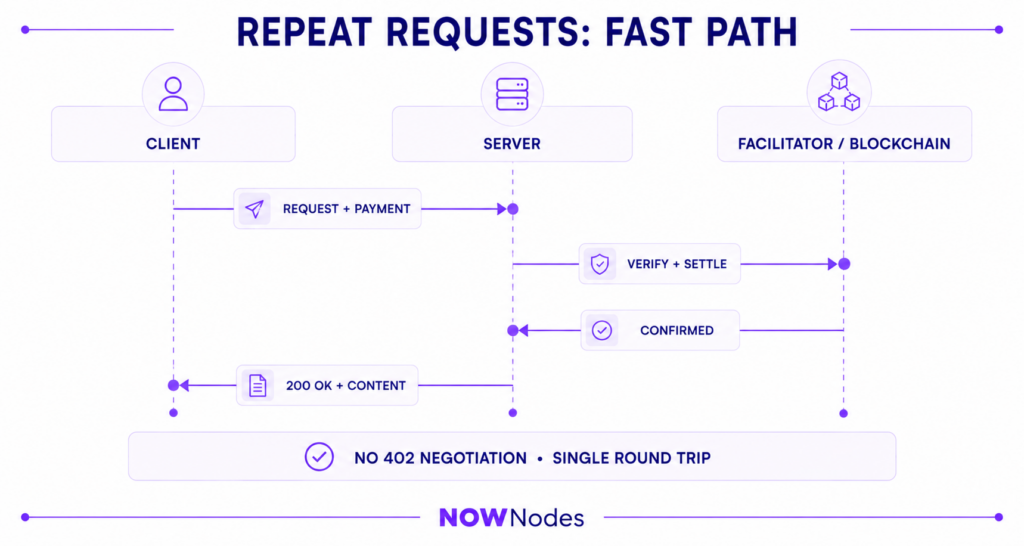
An x402 payment is a short back-and-forth: the client asks, the server says “pay first,” the client signs a payment, and a helper called a facilitator settles it on-chain — usually in under a couple of seconds. The x402 specification lays out the full exchange, which follows this sequence:
- Request — the client makes a normal HTTP request to a resource server for an API, a file, or a page.
- 402 response — instead of the content, the server replies
402 Payment Requiredwith a header describing what it accepts: the network, token, amount, and destination address. - Sign — the client picks one of the offered options and signs a payment authorization for that amount. No account or password is involved.
- Retry — the client resends the same request, this time attaching the signed payment in a header.
- Verify — the server, often by calling a facilitator’s
/verifyendpoint, checks that the payment is valid before doing any work. - Settle — the facilitator submits the payment to the blockchain and waits for confirmation.
- Deliver — the server returns
200 OKwith the content and a receipt header proving the payment settled.
Steps 2 and 3 can be skipped entirely if the client already knows the price, which lets repeat calls happen in a single round trip. That speed is the whole point — a payment shouldn’t feel slower than loading the page.
Who Does What
x402 splits the job across four roles:
| Role | What it is |
|---|---|
| Resource | The thing being paid for — an API, file, webpage, or any HTTP resource. |
| Client | The buyer — a browser, script, or AI agent that wants the resource. |
| Resource server | The seller’s HTTP server that returns the 402 and, once paid, the content. |
| Facilitator | A service that verifies payments and settles them on-chain, so the buyer and seller never touch gas or blockchain details. |
Why You Don’t Need Gas
One reason x402 feels simple is that the buyer never handles “gas” or native crypto — they just sign a message. On Ethereum-style chains, x402’s default “exact” scheme relies on ERC-3009, a stablecoin standard whose transferWithAuthorization function lets someone approve a transfer with an off-chain signature.
The facilitator takes that signed message, submits it to the token contract, and pays the gas fee itself. The contract checks the signature and a one-time nonce, then moves the funds. ERC-3009 uses random nonces rather than sequential ones, so an agent can sign many payments in parallel — handy when one bot pays dozens of services at once.
A facilitator only works while it’s connected to every chain it settles on. Verifying and submitting payments across networks like Base and Solana means constant reads and writes to each chain, which is why teams running a facilitator lean on multi-chain access from a provider such as NOWNodes rather than wiring up every network by hand.
x402 Schemes and Networks
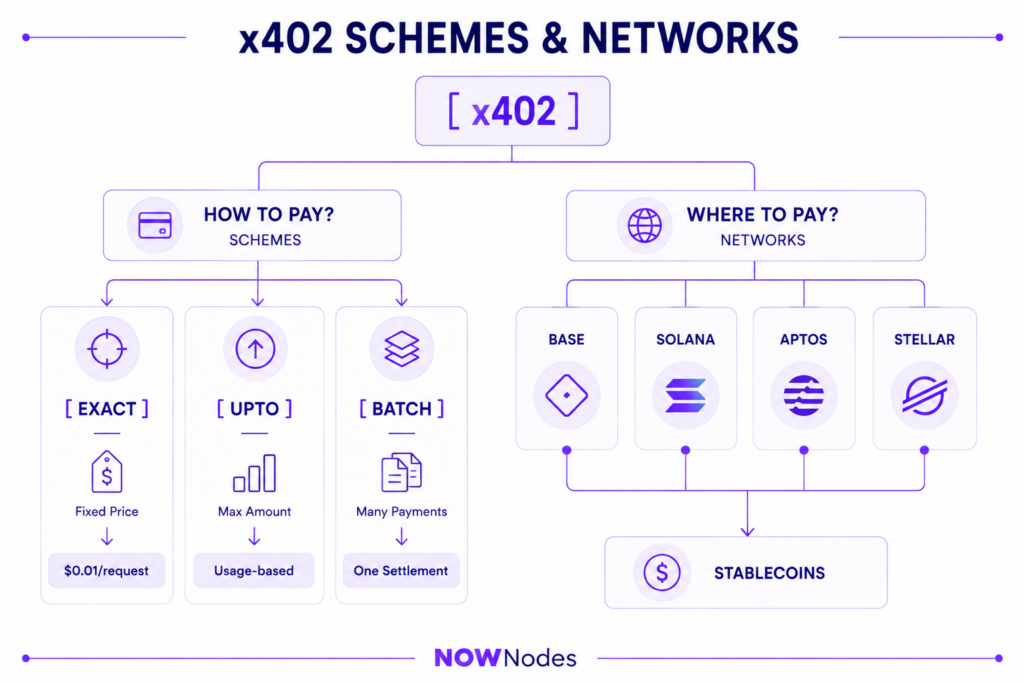
x402 isn’t tied to one blockchain or one way of paying. It defines schemes — logical ways to move money — and lets each network implement them. Three schemes are in use today:
| Scheme | What it does | Good for |
|---|---|---|
| exact | Pays a fixed amount per request. | A set price, like $0.01 to read an article. |
| upto | Authorizes a maximum; the seller charges the actual usage. | Metered work where the final cost isn’t known upfront. |
| batch-settlement | Uses escrow and off-chain vouchers to settle many small charges in one on-chain transaction. | High volumes of tiny payments that shouldn’t each hit the chain. |
On the network side, it’s stablecoin- and chain-agnostic by design. Base carries most activity so far, but the official SDKs also cover Solana, Aptos, Stellar, and others, and Stripe settles USDC on Base, Solana, and Tempo. USDC is the dominant settlement token, which keeps prices predictable across all of them.
x402 vs Traditional Online Payments
The clearest way to see what x402 changes is to put it next to a standard card checkout.
| Traditional card / gateway | x402 | |
|---|---|---|
| Minimum viable payment | ~$0.50+ before fees eat it | Fractions of a cent |
| Account required | Yes — cards, logins, KYC | No — a signed payment is enough |
| Who can pay | Mostly humans at a checkout | Humans and software agents |
| Settlement | Days, via banks | Seconds, on-chain |
| Fees | ~2–3% plus a fixed fee | Network fee only, often a fraction of a cent |
| Reversals | Chargebacks possible | Payments are final |
That last row cuts both ways. Instant, final settlement is what makes agent payments practical, but it also means there’s no chargeback safety net, so buyer protection has to be built on top rather than assumed.
How Big Is x402 in 2026?
The number of x402 transactions is large and growing fast — but the real money moving through it is still small, because most activity is testing, not commerce.
On the growth side, Chainalysis reported that x402 crossed 100 million transactions on Base in about three quarters, and independent trackers counted well over 150 million across seven chains by mid-2026. Coinbase reported roughly 69,000 active agents, 165 million transactions, and around $50 million in cumulative volume by late April 2026.
Now the reality check. CoinDesk found that genuine daily commercial volume was only about $28,000 in early 2026, with the vast majority of transactions being machines “testing the plumbing.” One mid-2026 tally clocked 75 million payments moving just $24 million — an average payment far below a dollar.
There’s a twist, too: sub-dollar micropayments shrank as a share of volume while payments above $1 grew — a hint that the first real demand is API and data purchases, not the penny-scale tips people first imagined. The rails work and adoption is real; genuine buying and selling is only starting to catch up.
The x402 Foundation and What Comes Next
To keep the standard neutral, Coinbase handed x402 to an independent body. Coinbase and Cloudflare announced the x402 Foundation in September 2025, and the Linux Foundation formalized it in April 2026. The goal is a shared, open standard no single company controls — x402 is released under the permissive Apache-2.0 license and stays agnostic about networks and tokens.
The backer list has grown well beyond crypto. Members and launch supporters include Google, Visa, Mastercard, AWS, Circle, Anthropic, Stripe, Shopify, and the Solana Foundation, among more than twenty organizations. A version 2 of the standard shipped to refine the schemes and broaden network support, Stripe added x402 to its Machine Payments product in February 2026, and payment networks kept joining through the year. For anyone building, the practical takeaway is that x402 is now stable enough to develop against, with real tooling in TypeScript, Python, and Go.
The Bottom Line
x402 gives the web a payment primitive it never had: a way to charge for a single request, over plain HTTP, with money that settles in seconds. It’s aimed squarely at agentic payments — an internet where AI agents transact on their own — and it’s backed by an unusually broad mix of crypto firms, card networks, and cloud platforms.
It’s also early: the transaction counts are enormous and the real dollar volume is tiny — what a new standard looks like before its use cases arrive. If you’re building, the interesting work is in facilitators, agent tooling, and APIs that meter access by the request. If you’re watching, track whether real spending catches up with the plumbing.
FAQ
Is There an x402 Token or Coin?
No. x402 is a protocol — a set of rules for sending payments over HTTP — not a cryptocurrency, and it has no official token. Payments settle in existing stablecoins like USDC. Be cautious with any coin marketed as “the x402 token,” since it isn’t connected to the standard itself.
Is x402 Free to Use?
The protocol is free and open-source under the Apache-2.0 license, so there’s no license fee to build with it. You still pay the underlying blockchain’s network fee on each settlement, and some facilitators may charge for their service, but those costs are typically a fraction of a cent.
Do I Need a Crypto Wallet to Use x402?
To pay, you need a wallet that can sign transactions and hold a supported stablecoin — though for AI agents this is usually an automated wallet, not something a person opens by hand. On the receiving side, a seller needs an address to be paid to, plus a facilitator or their own setup to settle payments.
How Is x402 Different From Stripe’s Machine Payments Protocol?
They overlap and increasingly work together. x402 is the open, HTTP-native standard for requesting and proving a payment, while Stripe’s Machine Payments Protocol (MPP) adds card rails and Stripe’s own settlement and reporting around it. Stripe supports x402 directly, so a server can accept x402 stablecoin payments and record them through Stripe.
Is x402 Secure?
The design is “trust-minimizing”: a facilitator can verify and submit a payment but can’t move funds in any way the client didn’t authorize with its signature. The main risks are the usual ones for on-chain payments — final settlement means no chargebacks, and buyers should confirm they’re paying the address a legitimate server returned, not one injected by a bad actor.