
If you want to buy, sell, or mint a Sui NFT, the platform you pick matters more than most guides admit. The Sui blockchain now hosts tens of millions of tokens across tens of thousands of collections, but the Sui NFT marketplaces serving them range from thriving to abandoned — and one former leader just imploded. This guide covers the ones worth using in 2026, how they differ, and what to check before you connect a wallet.
Here’s the short version. TradePort is the default for active traders, Clutchy and KeepSake own the gaming and collectibles niche, Sui Gallery is the friendly on-ramp for creators, and BlueMove — the old go-to — is now a cautionary tale. Below, we go from the basics of what a Sui NFT actually is up to the details that separate a safe platform from a risky one.
What You’re Actually Buying on Sui
Let’s start with the asset before the marketplace. On most blockchains, a token is really just an entry in a smart contract’s ledger, with the artwork living somewhere off-chain. Sui does it differently, and that difference shapes every platform in this guide.
Sui NFT: a non-fungible token represented as a first-class on-chain object on the Sui network. Each one carries its own attributes — name, description, media link, and custom fields — directly on the blockchain, with ownership assigned to a specific address rather than tracked inside a shared contract.
That object model is the whole story. Because every token is its own object, it can hold data that changes over time, which is why every Sui NFT is dynamic by default. A game character can level up, an event ticket can mark itself “used,” and a piece of art can permanently change color — all recorded on-chain.
Adeniyi Abiodun, co-founder and Chief Product Officer of Mysten Labs, the team that built the network, framed the goal early: Sui was designed for tokens that offer “a lot more user engagement than just a flat file.” That single design choice is why the venues below are built the way they are.
The appetite is real, and the numbers back it up. By early 2025, more than 52 million NFTs had been minted on Sui across over 76,000 collections, according to analytics from SuiVision — with one record day in January 2024 seeing roughly 6 million minted in 24 hours.
Why the Object Model Helps Collectors
Direct ownership has a practical payoff. Because your token sits in your wallet as its own object rather than as a line in a contract, you get cleaner control over it and, often, cheaper storage for richer media. Prime Machin, one of the network’s flagship art collections, stores hand-drawn 4K images fully on-chain — something its creators say costs a fraction of what the same storage would run on older networks.
Composability is the other advantage. These tokens can be merged, nested, or plugged into other apps, so a collectible isn’t stuck in one place. That flexibility is exactly what gaming and utility projects need, and it’s a big reason the ecosystem grew as fast as it did.
How Sui Trading Platforms Work Under the Hood
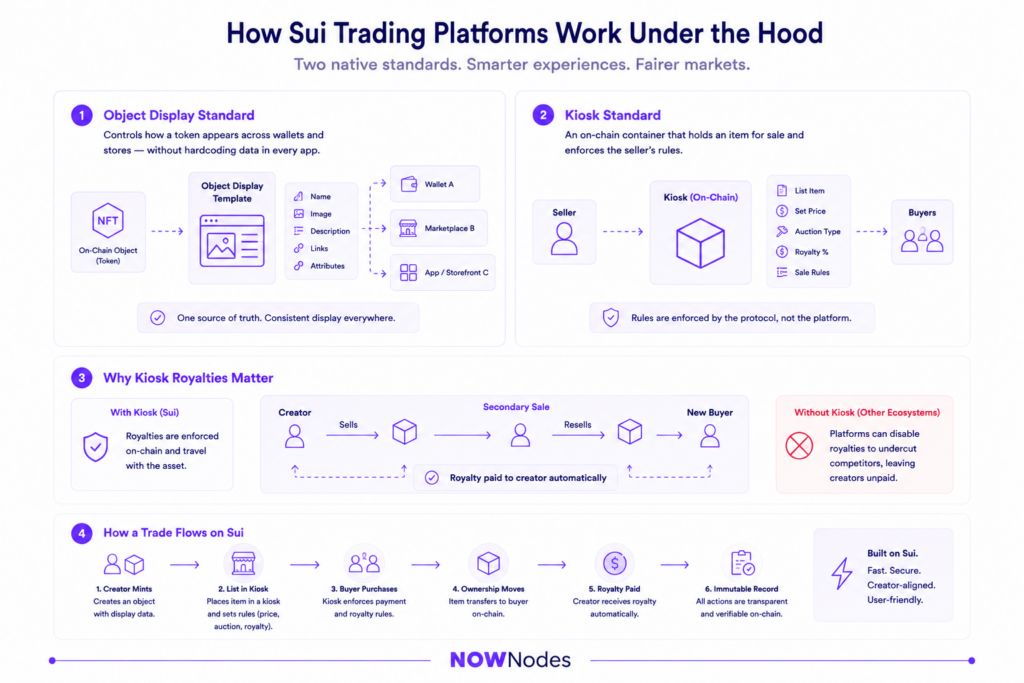
Here’s the part that separates Sui from a generic digital-goods market. Two native standards do most of the heavy lifting, and understanding them tells you why some platforms feel smoother and fairer than others.
The first is the Object Display standard, a template system that controls how a token appears in wallets and storefronts — its name, image, and links — without hardcoding that data into every app. The second is the Kiosk standard, an on-chain container that holds an item for sale and enforces the seller’s rules: pricing, auction style, and, crucially, royalties.
Why does the Kiosk matter to you? Because royalties set through it can’t be quietly stripped out by a platform trying to undercut rivals. When a creator attaches a royalty, it travels with the asset. That’s a sharp contrast with ecosystems where marketplaces switched royalties off to win volume, leaving artists unpaid on secondary sales.
What Makes a Sui Platform Worth Trusting
Not every venue that ever launched on the network is still standing. As trading dashboards like DefiLlama and SuiScan make clear, a handful of platforms carry nearly all the real activity, while dozens of others sit with stale listings and dead Discord servers. Choosing well is mostly about filtering for signs of life.
A few things reliably separate a safe venue from a risky one:
- Active development and community — recent updates, a responsive team, and live social channels.
- Audited smart contracts — third-party reviews or a bug bounty you can actually find.
- Real liquidity — genuine listings and completed sales, not a wall of unsold tokens.
- Wallet support — clean integration with Sui-native wallets like Slush.
This is not paranoia. A 2025 CertiK report tied more than $30 million in NFT-related scams to lesser-known chains and platforms in a single year. On a young network, the Sui NFT marketplace you pick is itself part of your risk — a point the BlueMove story below drives home.
The Leading Sui Trading Platforms in 2026
The table is the quick version; the write-ups explain the fit. Details like fees change often, so confirm them on each site before committing funds.
| Platform | Best For | Standout Feature | Chains |
|---|---|---|---|
| TradePort | Active traders & flippers | Deep analytics + gasless listing | Sui, Aptos, NEAR, Stacks |
| Clutchy | Gaming assets & launches | GameFi launchpad | Sui |
| KeepSake | Creators & collectors | On-chain royalty enforcement | Sui |
| Sui Gallery | First-time minters | Zero listing fees | Sui |
TradePort
TradePort is the closest thing the network has to a default Sui NFT marketplace in 2026. It’s a cross-chain aggregator — pulling listings from Sui, Aptos, NEAR, and Stacks into one interface — but the chain stays a core focus, and the platform leans hard into data. You get floor-price history, volume charts, and per-collection analytics that make it the obvious pick for anyone who trades actively or flips.
Two features stand out. Gasless listing lets you put items up for sale without paying upfront, and a developer API exposes the same NFT data the site runs on. If your idea of collecting involves spreadsheets and entry timing, this is where you’ll spend your time.
Clutchy
Clutchy earned its place in the network’s history by hosting Fuddies, the first collection to launch on Sui back in May 2023. Today it’s the go-to venue for Web3 gaming assets, pairing a marketplace with an NFT launchpad built for GameFi projects. If a new Sui game is dropping collectibles, there’s a good chance it’s happening here.
That focus is the whole appeal. Clutchy surfaces in-game items, avatars, and gaming collections in a way general storefronts don’t, and it has partnered with a stack of Sui GameFi projects — activity that helped push Sui gaming-NFT trading volume up roughly 200% in the fourth quarter of 2024. For players who want assets they’ll actually use, it’s the natural home.
KeepSake
KeepSake specializes in the collectibles side of the ecosystem — gaming items, avatars, and even NFT-linked physical goods. Its standout feature is strict on-chain royalty enforcement, which makes it one of the more creator-friendly options on the network. Artists who care about getting paid on secondary sales pay attention to that.
It also runs a membership rewards program and supports collections tied to real-world items, which stretches what “collectible” even means here. If you’re a creator weighing where to launch, KeepSake’s royalty guarantees are a concrete reason to look closely.
Sui Gallery
Sui Gallery was one of the first Sui NFT marketplaces on the network and has grown past 30,000 users. Its pitch is simplicity: zero listing fees, a clean interface, and a built-in minting tool that lets creators launch a collection without touching code. A number of early blue-chip Sui projects made their debut here.
For a first-timer, that low-friction setup is the draw. You can mint, list, and sell without a fee wall or a steep learning curve, which makes it a sensible base before you graduate to a data-heavy platform like TradePort.
What Happened to BlueMove
If you read an older guide — including the previous version of this one — BlueMove was the headline pick. That is no longer safe advice. In July 2026, roughly 700,000 SUI (about $500,000) was drained from BlueMove’s locked liquidity pools through what the company blamed on a long-standing arithmetic bug in a legacy contract, affecting 389 pools.
Some observers alleged an inside job; BlueMove disputed that but confirmed it would suspend operations and wind the project down, as reported by Protos. The lesson generalizes. A platform that tops the charts one year can be gone the next, which is exactly why the “check for signs of life” advice above isn’t optional. Treat any list — including this one — as a snapshot, and verify a venue is live and funded before you trust it with assets.
Gaming on Sui: Assets You Can Actually Play With
Gaming is where the dynamic-object design pays off most, and it’s a big part of why people call this the best Sui gaming NFT ecosystem in the current cycle. Because a token can change state on-chain, an in-game item can evolve as you play instead of sitting frozen the way a static collectible does.
The catalog has filled out fast. Titles like Abyss World, Bushi, ONE Fight Arena, and Samurai Shodown R have brought recognizable studios onto the network, while experimental projects like Sui Monstar show off pet NFTs that gain attributes through play. On the infrastructure side, SEED partnered with the Sui Foundation on a Web3 gaming push aiming to reach 100 million players.
For trading these assets, Clutchy and KeepSake are the venues built for the job, with launchpads and item-level listings that general marketplaces lack. Buy a character on one of them and it can carry live stats — not just a picture.
How to Start Safely on Sui
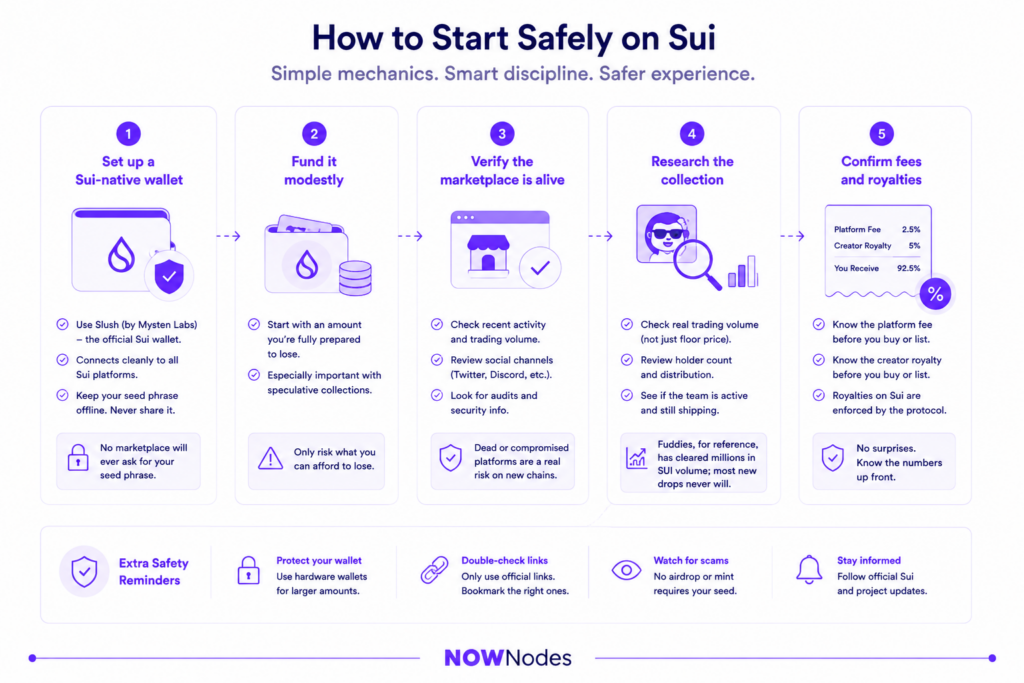
New to this? The mechanics are simple; the discipline is what protects you. A sensible path looks like this:
- Set up a Sui-native wallet. Slush — the official wallet from Mysten Labs, formerly Sui Wallet — connects cleanly to every platform above. Keep your seed phrase offline; no marketplace will ever ask for it.
- Fund it modestly. Start with an amount you’re fully prepared to lose, especially with speculative collections.
- Verify the marketplace is alive. Check recent activity, social channels, and audits before connecting. Dead or compromised platforms are a genuine risk on a young chain.
- Research the collection. Look at real trading volume, holder count, and whether the team still ships. Fuddies, for reference, has cleared millions in SUI volume; most new drops never will.
- Confirm fees and royalties. Know the platform cut and the creator royalty before you buy or list.
The single rule above all the others: a legitimate platform will never ask for your private key or seed phrase. Anything that does is trying to empty your wallet, so walk away.
For developers rather than collectors, the same ecosystem is open to build on. Minting dApps and custom storefronts need steady access to the Sui network, which is where managed infrastructure takes the maintenance off your plate and lets you focus on the app.
The Bottom Line
The Sui NFT marketplace landscape in 2026 is smaller and sharper than the old guides suggest. TradePort is the all-purpose choice for traders, Clutchy and KeepSake cover gaming and creator royalties, and Sui Gallery is the gentle on-ramp for anyone minting a first collection. BlueMove’s collapse is the reminder underneath all of it: on a fast-moving chain, the “best” list shifts, and the safest move is to confirm a platform is healthy before trusting it.
So pick the venue that matches what you’re doing — trading, gaming, or creating — keep your keys to yourself, and treat every too-good drop with suspicion. Do that, and Sui’s low fees and dynamic tokens make it one of the more rewarding places to collect right now.
FAQ
Which Sui NFT marketplace is best for beginners?
Sui Gallery is the easiest starting point, with zero listing fees, a simple interface, and a built-in minting tool. Once you want deeper analytics and cross-chain listings, TradePort is the natural next step.
Is BlueMove still safe to use?
No. After a July 2026 exploit drained roughly $500,000 from its pools, BlueMove said it would suspend operations and shut down. Use an active platform such as TradePort or Clutchy instead, and double-check its status before connecting a wallet.
Does OpenSea support Sui NFTs?
No. As of 2026, OpenSea does not list Sui among its supported networks, so you’ll need a Sui-native marketplace to trade these assets.
What wallet do I need for a Sui marketplace?
A Sui-native wallet such as Slush, the official option from Mysten Labs. It connects directly to the platforms covered here and holds your tokens as on-chain objects, with hardware-wallet support for extra security.
Why are Sui NFTs called “dynamic”?
Because each one is an on-chain object that can change over time — leveling up, updating metadata, or altering artwork — rather than a fixed file. It’s a core reason the chain suits gaming and utility use cases.