

A stablecoin is a crypto token built to hold a fixed value — almost always one US dollar — and most of them live on Ethereum. Out of roughly $315 billion in total stablecoin supply, Ethereum carries about $157 billion, just over half of the entire market, according to DefiLlama. When people talk about the stablecoin economy, they are mostly talking about Ethereum.
This guide starts simple and builds up. You’ll get a plain definition, a clear answer to the “is Ethereum a stablecoin” question, the problem stablecoins solve, who actually uses them, the three ways a token defends its peg, and a ranked stablecoin list of the seven biggest names on Ethereum — with current figures and an honest look at the risks.
Why Do Stablecoins Matter?
Stablecoins matter because they give crypto a unit of account that doesn’t move. Without a steady dollar on-chain, every trade, loan, and payment would carry currency risk on top of everything else.
Their most visible job is in DeFi. Stablecoins are the preferred collateral in lending markets like Aave and the default quote asset on exchanges like Uniswap and Curve. They are the cash leg of nearly every on-chain transaction.
Off-chain, the case is just as strong. A dollar-pegged token settles faster and cheaper than a bank wire, which matters for remittances, payroll, and merchant payments. The pull is strongest in countries with weak local currencies, where a stablecoin preserves purchasing power that a domestic savings account can’t.
Who Uses Stablecoins?
Plenty of people, for very different reasons. The audiences break down cleanly:
- Traders park funds in stablecoins between positions to sit out volatility without cashing back to a bank.
- DeFi users supply them as collateral to borrow, or lend them to earn yield on protocols like Aave and Sky.
- Businesses and freelancers invoice and settle cross-border in seconds instead of waiting days for a wire.
- People in high-inflation economies hold dollars through a stablecoin when local banking is unstable or hard to access.
- Institutions use regulated tokens for on-chain settlement and treasury operations, now that clearer rules exist.
The common thread: everyone here wants dollars that move at internet speed.
The Three Types of Stablecoins
Not every stablecoin holds its dollar the same way, and the design is where the real risk lives. Three models dominate, and knowing which group a token belongs to tells you more about its safety than any marketing page.
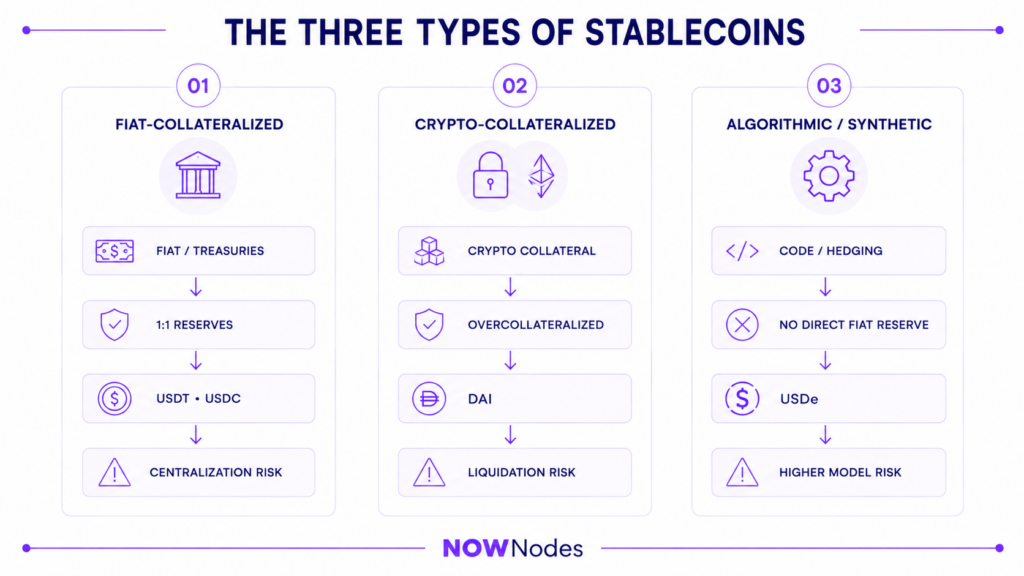
Fiat-collateralized is the most common type. For each token in circulation, the issuer holds a dollar — or an equivalent liquid asset like a US Treasury bill — in reserve. USDT and USDC lead here. The trade-off is centralization: you trust a company to actually hold what it claims.
Crypto-collateralized tokens are backed by other cryptocurrencies locked in a smart contract. Because crypto prices move, the system holds more collateral than the stablecoins it issues — DAI has historically kept 150% or more. You get decentralization, but you accept liquidation risk if the collateral drops sharply.
Algorithmic and synthetic designs skip direct fiat reserves and lean on code or hedging. This is the riskiest category historically — pure algorithmic coins have collapsed outright. The survivors, like Ethena’s USDe, use a sturdier synthetic model that hedges crypto holdings with offsetting derivatives.
| Type | Backed by | Example | Main risk |
|---|---|---|---|
| Fiat-collateralized | Cash + Treasuries | USDT, USDC | Issuer trust, transparency |
| Crypto-collateralized | Over-collateralized crypto | DAI, USDS | Volatility, liquidation |
| Algorithmic / synthetic | Code, hedging, derivatives | USDe, crvUSD | Mechanism failure, depeg |
The Best Stablecoins on Ethereum
Here’s the ranked stablecoin list, ordered by Ethereum footprint and overall relevance. Figures come from DefiLlama and on-chain trackers in mid-2026 and shift week to week, so check a live source before relying on any number. The concentration is stark — the top two tokens hold the vast majority of supply on the network.
| Rank | Stablecoin | Issuer | Type | Approx. supply (all chains) |
|---|---|---|---|---|
| 1 | USDT | Tether | Fiat-backed | ~$186B |
| 2 | USDC | Circle | Fiat-backed | ~$75B |
| 3 | USDS | Sky | Crypto-collateralized | ~$8B |
| 4 | DAI | Sky | Crypto-collateralized | ~$4.4B |
| 5 | USDe | Ethena | Synthetic | ~$5B |
| 6 | PYUSD | Paxos / PayPal | Fiat-backed | ~$2.7B |
| 7 | FDUSD | First Digital | Fiat-backed | ~$1.5B |
1. USDT (Tether)
USDT is the largest stablecoin in the world, at roughly $186 billion across all chains — about 59% of the entire market. Tron carries its biggest single-chain float (near $88 billion), with Ethereum second at roughly $79 billion and the deepest venue for DeFi and exchange liquidity.
One myth worth correcting: Tether wasn’t the first stablecoin. That was BitUSD, launched on BitShares in July 2014. Tether was the first fiat-backed token to reach real scale, and that model won. Its reserves are now dominated by short-dated US Treasuries, with the long-standing knock being transparency — something regulation is slowly forcing to improve.
2. USDC (Circle)
USDC is the pick for anyone answering to an auditor, at about $75 billion across all chains, with its largest single deployment on Ethereum. Circle holds reserves in a BlackRock-managed fund with daily disclosed composition, and runs CCTP for native transfers across 30-plus networks.
Both the US GENIUS Act and the EU’s MiCA reward exactly this kind of transparency-first approach. That regulatory tailwind is a big reason USDC keeps gaining ground with institutions.
3. USDS (Sky)
USDS is Sky’s flagship dollar, introduced in 2024 and convertible 1:1 with DAI on the same collateral. It climbed fast — around $8 billion in mid-2026, and briefly above $11 billion earlier in the year — making Sky the third-largest issuer behind Tether and Circle.
Its rise pushed back on the early-2025 idea that synthetic, yield-bearing coins would take over. Instead, capital rotated toward established collateral-backed models.
4. DAI (Sky)
DAI is the longest-running crypto-collateralized stablecoin, launched in December 2017 and backed by over-collateralized crypto plus tokenized real-world assets. It sits near $4.4 billion and has the deepest DeFi integration of any stablecoin.
A point that confuses many: MakerDAO, the protocol behind DAI, rebranded to Sky in 2024. DAI still exists alongside USDS and converts freely between the two. Sky’s docs cover the mechanics.
5. USDe (Ethena)
USDe is the largest non-fiat-backed stablecoin, holding no bank reserves at all. For each dollar of USDe, Ethena holds a spot crypto position hedged with a short futures position, turning the funding rate into yield.
It surged past $14 billion at its late-2025 peak before contracting to around $5 billion after a deleveraging event. Its yield token, sUSDe, carries real exchange counterparty and funding-rate risk — powerful for sophisticated users, cautionary for everyone else.
6. PYUSD (Paxos / PayPal)
PYUSD is the one stablecoin with a mainstream distribution channel: PayPal. Paxos issues it under New York DFS oversight, backed by cash, repos, and Treasuries, and redeemable inside PayPal and Venmo.
Supply peaked near $4.2 billion in 2026 before easing to roughly $2.7 billion, split between Ethereum and Solana. Its position in consumer payments matters more than its raw size.
7. FDUSD (First Digital)
FDUSD is a Hong Kong-based dollar stablecoin backed by Treasuries, repos, and segregated deposits, sitting near $1.5 billion. Its moment came in 2024, replacing BUSD on Binance’s zero-fee pairs.
Most of its supply lives on BNB Chain, with Ethereum second. For teams working outside the US regulatory orbit, it’s a real way to diversify away from US-issued tokens.
Also worth knowing: crvUSD (Curve) uses soft-liquidation to reduce cascading liquidations; USD1 (World Liberty Financial) has grown quickly since 2025; and older names like GUSD and TUSD still circulate. BUSD, once top-three, has been wound down — proof that even giants fade when conditions shift.
How New Rules Reshaped the Leaderboard
The 2026 rankings look the way they do partly because of regulation. On July 18, 2025, the US signed its first federal stablecoin law, the GENIUS Act. It requires payment stablecoins to hold 100% reserves in liquid assets like cash and short-term Treasuries, plus monthly public disclosure of what’s backing them.
For years, issuers ran on “trust us, the reserves are there.” The Act ended that with mandatory attestations and real oversight. It also bars issuers from paying interest directly to holders, pushing yield into separate, opt-in products.
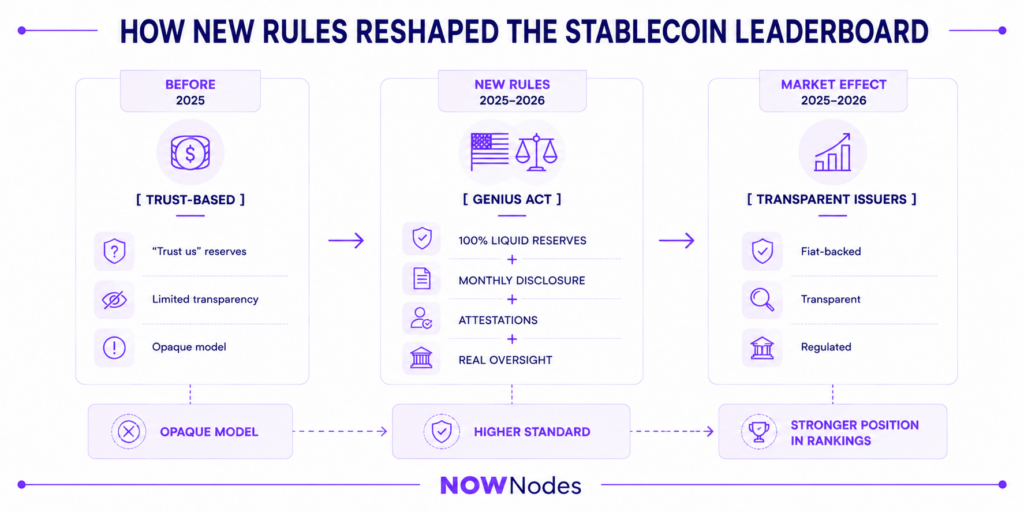
Not everyone thinks the design is risk-free. Economist Barry Eichengreen of UC Berkeley has warned that if a loss of confidence triggered mass redemptions, issuers could be forced to dump Treasuries fast enough to drive down bond prices and push up interest rates — safer for the individual holder, potentially systemic in aggregate. The EU’s MiCA framework, with stablecoin rules live since mid-2024, pushes the same way. The upshot: regulation now rewards transparent, fiat-backed issuers and squeezes opaque ones.
How to Choose a Trustworthy Stablecoin
The best stablecoins all share a few traits, and knowing how to judge them matters more than memorizing any ranking. Run any token through these five checks:
- Reserves — fiat-backed coins should publish independent attestations; under the GENIUS Act, US-regulated issuers now must.
- Collateral — fully-backed coins are safer than algorithmic ones, but crypto-backed carry liquidation risk and fiat-backed carry custody risk.
- Regulatory standing — clarity in a major jurisdiction like the US, EU, or Hong Kong is now a genuine quality signal.
- Liquidity — can you actually move size without moving the price?
- Track record — how long has it held its peg, and through how many real stress events?
The deepest risk to watch is a depeg — when a token’s market price drifts from $1, usually under extreme stress or a mechanism failure. It’s rare for the top names but devastating when it hits: the 2022 collapse of TerraUSD erased tens of billions in days. Before committing capital, it’s worth watching how a token behaves on-chain — reading contract data and transfers is a low-stakes way to check reality against the marketing.
Conclusion
A stablecoin is the quiet workhorse of crypto: a token built to hold its value so the rest of the ecosystem has something steady to stand on. Ethereum hosts just over half of all global supply through the ERC-20 standard, from the fiat-backed giants USDT and USDC to the crypto-collateralized DAI and synthetic USDe.
The category is consolidating around transparency. The 2026 rules rewarded issuers who could prove their reserves and pressured those who couldn’t. Whether you’re building on stablecoins, holding them in treasury, or just getting your bearings, the same advice applies: look past the branding and check what backs the token, who regulates it, and how long it has held its peg.
FAQ
Is Ethereum a Stablecoin?
No. Ethereum is not a stablecoin. Ether (ETH), Ethereum’s native coin, is a volatile asset whose price moves constantly — the opposite of stable. The confusion is understandable, because Ethereum is where most stablecoins are issued, but the network and the tokens on it are different things.
What is the most stable cryptocurrency?
The most stable cryptocurrencies are fiat-backed stablecoins like USDC and USDT, which are designed to stay at $1 and are backed by cash and short-term Treasuries. Coins like Bitcoin and Ether are not stable — their prices move freely. “Most stable” and “most profitable” are opposite goals, so a stablecoin trades upside for predictability.
What’s the difference between USDT and USDC?
Both are fiat-backed dollar stablecoins, but they differ on transparency. USDC (Circle) discloses its reserve composition daily and leans into regulation, which appeals to institutions and auditors. USDT (Tether) is far larger and more liquid across global exchanges, but has historically faced more scrutiny over reserve disclosure.
How many stablecoins are there?
DefiLlama tracks more than 380 stablecoins across all chains, though the market is heavily concentrated. USDT and USDC alone account for over 80% of total supply, and only a handful of tokens have meaningful liquidity on Ethereum.
Can you earn yield on stablecoins under the new rules?
Yes, but not from the issuer directly. The GENIUS Act bars US payment-stablecoin issuers from paying interest to holders, so yield now comes from separate, opt-in products — lending on protocols like Aave, staking into tokens like sUSDe, or using Sky’s savings features. Each adds risk beyond simply holding the coin.
Do you need ETH to use stablecoins on Ethereum?
Yes. Sending an ERC-20 stablecoin like USDC requires a small amount of ETH to pay the network (gas) fee, even though the transfer itself is denominated in dollars. This catches new users who fund a wallet with only stablecoins and then can’t move them.