
Ethereum vs BNB Smart Chain is one of crypto’s headline rivalries. Strip away the tribalism and it’s really one trade-off. Ethereum spreads its security across hundreds of thousands of validators. BSC hands block production to a few dozen and gets speed and low fees for it. Both run the same smart-contract engine, so a contract that works on one usually works on the other with almost no changes.
So what actually separates them? Three things: who secures the network, how fast blocks land, what you pay per transaction. Get those straight and the rest of the ethereum bsc comparison falls into place.
Why Does BSC Exist If Ethereum Already Did Smart Contracts?
Short answer: Ethereum got expensive. By 2020, a busy day on a popular Ethereum app could cost tens of dollars in gas per transaction, which priced out anyone moving small amounts. Binance built BSC to offer the same programmability for a fraction of the cost.
How it pulled that off is the crux of the whole debate. BSC uses a smaller validator set, which lets it agree on blocks faster and cheaper. That was a deliberate design call, not an accident.
Proof of Staked Authority (PoSA) is a BSC’s consensus model, a blend of Proof of Authority and staking. A limited group of validators, picked by how much BNB is staked to them, takes turns making blocks. Fast and cheap, but far more concentrated than Ethereum’s open set. The BNB Chain docs have the full spec.
One thing to settle before we go deeper: neither approach is just “better.” Ethereum optimizes for decentralization and staying censorship-resistant. BSC optimizes for throughput and cost. Which one wins depends entirely on what you’re building or trading in crypto.
Ethereum and BSC Compared: The Key Differences
The table sums up where the two chains stand in 2026. Every number under it gets unpacked below.
| Metric | Ethereum | BNB Smart Chain (BSC) |
|---|---|---|
| Launched | July 2015 | September 2020 |
| Native token | ETH | BNB |
| Consensus | Proof of Stake | Proof of Staked Authority |
| Block time | ~12.6 seconds | ~0.75 seconds |
| Layer-1 TPS | ~26 | ~285 |
| Average fee | ~$1.17 per transaction | under $0.04 per transaction |
| Validators | 560,000+ | ~45 (21 producing at a time) |
| Layer-1 TVL | ~$102 billion | ~$58 billion |
| Token standard | ERC-20 / ERC-721 | BEP-20 / BEP-721 |
Figures compiled from CoinLaw’s 2026 BSC vs. Ethereum statistics and official chain documentation.
Consensus and Security
The two chains reach agreement in very different ways. Ethereum’s Proof of Stake lets anyone with 32 ETH, or a slice of a staking pool, run a validator, which keeps the set huge and hard to collude against. BSC’s PoSA hands block production to a small, permissioned group. That’s exactly what makes BSC quick.
Security is the flip side. More validators, spread more widely, mean it’s harder for any group to censor a transaction or rewrite history. A smaller set moves faster but bends more easily under pressure. It’s the real price of BSC’s speed.
How Fast Are Ethereum and BSC?
At the block level, BSC is about sixteen times quicker. Blocks land every 0.75 seconds on BSC, a pace reached only after the Maxwell hardfork hit mainnet on June 30, 2025 and halved the old 1.5-second interval, per the official BNB Chain announcement. Ethereum takes twelve seconds a block, a fixed slot time it’s held since The Merge.
Raw throughput looks lopsided too: roughly 285 transactions per second on BSC, about 26 on Ethereum. But that stat is misleading. Ethereum deliberately moved its scaling onto Layer-2 rollups, which now handle around 95% of all Ethereum transactions and batch back to the main chain. Judging the two base layers alone misses most of what Ethereum really does.
Which Chain Has Lower Fees?
For everyday use, BSC is cheaper. Not close. An average BSC transaction runs under $0.04. Ethereum’s network-wide average sits near $1.17 once swaps and contract calls are folded in.
The gap has been shrinking, and it’s worth knowing why. A run of upgrades in 2024 and 2025 (Dencun, then Pectra, then Fusaka) widened Ethereum’s data capacity and dragged base fees down hard. A plain ETH transfer in 2026 often costs a couple of cents. So BSC still wins for high-frequency or micro-payment activity. For big, occasional settlements, the Ethereum fee barely registers either way.
Decentralization
Here’s where the ethereum bsc split is widest. Ethereum’s stake sits with more than 560,000 validators, holding about 39 million ETH between them, roughly a third of everything in circulation. BSC does the same job with around 45 validators, and only about 21 make blocks at any given moment.
BSC took the trade. It gave up decentralization to buy speed and low cost. Ethereum spent years trying to beat the trilemma instead of accepting it, and in January 2026 Buterin claimed the work had paid off. “The trilemma has been solved — not on paper, but with live running code, of which one half (data availability sampling) is on mainnet today, and the other half (ZK-EVMs) is production-quality on performance today,” he wrote on January 3, 2026. Agree with him or not, it frames the whole divide. For Ethereum, decentralization is the one thing that never gets traded away. For BSC, it’s a dial like any other.
Token Standards: ERC-20 vs BEP-20
To most builders, the two standards feel identical. BEP-20, BSC’s token standard, was written to mirror ERC-20, so a token contract from one chain compiles on the other with barely a change. NFTs work the same way, BEP-721 shadowing ERC-721.
The payoff is portability. A team can launch on BSC to keep fees low, then redeploy the very same contracts to Ethereum when it wants deeper liquidity, no core rewrite needed. Same wallets, same Solidity code. That shared toolkit is the biggest reason the two ecosystems feel like siblings, not rivals.
Who Uses Ethereum and Who Uses BSC?
Different priorities pull people to different chains. The split is rough, but it holds:
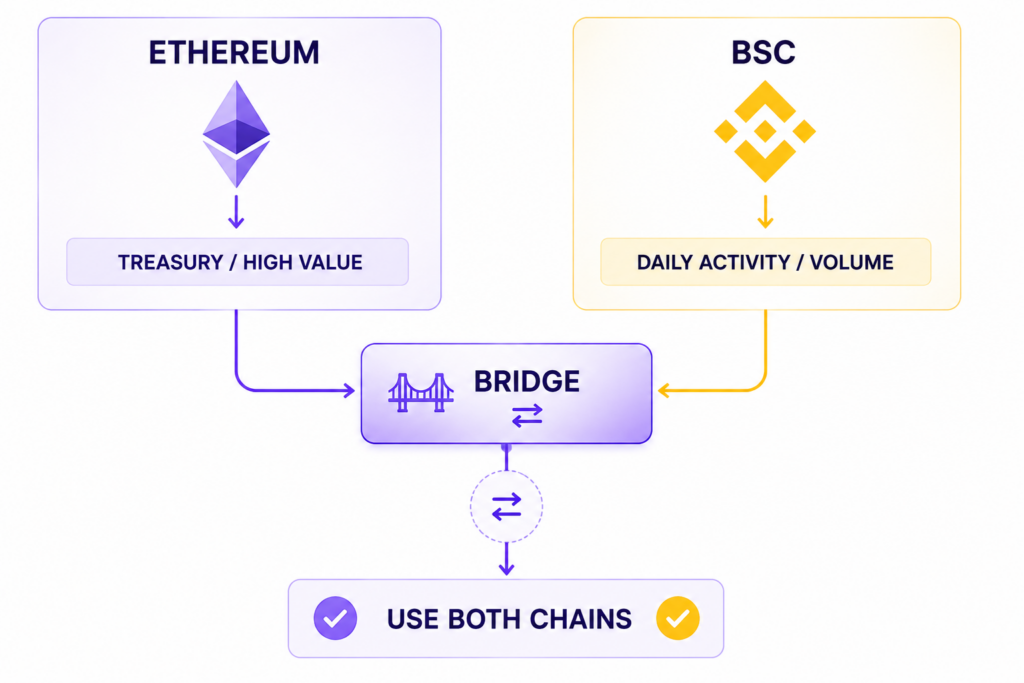
- Ethereum draws high-value DeFi, institutional money, blue-chip NFT projects. When millions sit in a contract, that deep validator set is exactly what people are paying for.
- BSC draws cost-sensitive retail traders, on-chain gamers, high-frequency bots that feel every $1 fee. Cheap, near-instant transactions make small and frequent moves worth doing.
Plenty of crypto projects just use both. A protocol might keep its treasury on Ethereum and run day-to-day activity on BSC, bridging value between them as needed. Less “which chain is best,” more “which chain fits this job.”
Connecting to Ethereum and BSC
Build on either chain and you’ll hit the same requirement: your app has to read the blockchain and push transactions to it. That means talking to a node. A node is just a computer running the chain’s software with a copy of its state. Your app reaches it over an RPC (Remote Procedure Call) endpoint. Through it, the app checks balances, calls contracts, sends transactions.
Running your own node is doable, but it’s a grind. You’re on the hook for client software, storage that just keeps growing, security patches, and constant uptime. An archive node that holds full history is heavier again. So most teams reach for a node provider instead of self-hosting.
This is the gap a provider like NOWNodes fills in the ethereum bsc crypto picture. It serves RPC and WebSocket access to both Ethereum and BSC, along with 120-plus other networks, through shared or dedicated nodes, with Ethereum archive access reaching all the way back to the genesis block. For a product that spans both Ethereum and BSC, one access layer beats standing up a separate node stack for each. None of that means you have to outsource your nodes. It just means the infrastructure is a real line item, worth planning for early.
Which Chain Is Right for You?
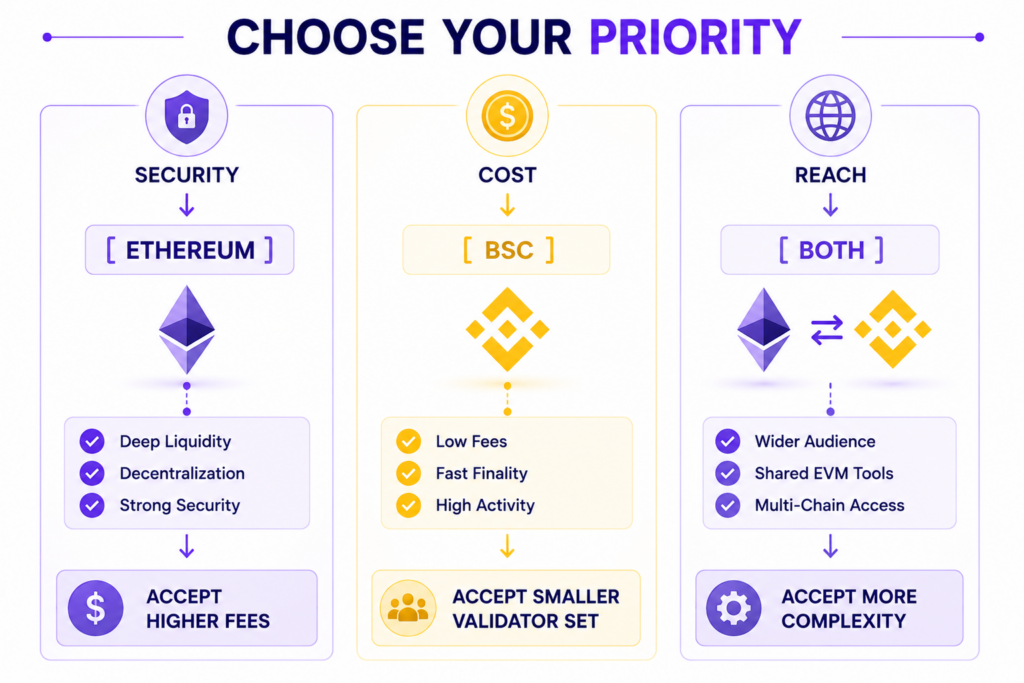
There’s no universal winner here, and anyone who says otherwise is selling something. It comes down to what you weight most:
- Go with Ethereum when security, decentralization, and deep liquidity outweigh fee size. Mostly that means high-value DeFi and long-horizon institutional settlement.
- Go with BSC when low fees and fast confirmations come first and a smaller validator set is a trade you’ll take. Think active retail trading, gaming, and cost-sensitive apps.
- Run both when your audience is split across Ethereum and BSC. Shared EVM tooling makes supporting two chains far less painful than it sounds.
None of this is investment advice. Prices, staking yields, and fees all move, so check the live numbers before you commit real money or ship to production.
Conclusion
In the end, the ethereum bsc question is a question about priorities. Ethereum invented the smart-contract model and then bet everything on decentralization, spreading security across a massive validator set and shoving scale onto Layer-2 rollups. BSC took that same code and made the opposite bet, trading away some decentralization for blocks that settle in under a second and fees under four cents.
They’re both EVM chains, so the real distance between them is smaller than the branding implies. The same contracts and wallets run on either side. What actually differs is the bet each one made. Match that bet to your use case, stay honest about what each design costs you, and the “which chain” question mostly answers itself.
FAQ
Is BSC the Same as Ethereum?
No, but they’re close relatives. BSC runs a fork of Ethereum’s software and copies its token standards, so the same smart contracts run on both. Where they part ways is consensus, decentralization, speed, and cost. Ethereum uses an open Proof-of-Stake validator set. BSC uses a small Proof-of-Staked-Authority group tuned for speed.
Is BNB Smart Chain Cheaper Than Ethereum?
On average, yes. A typical BSC transaction costs under $0.04, against roughly $1.17 network-wide on Ethereum. The gap narrowed after Ethereum’s 2024–2025 upgrades cut base fees, and a simple ETH transfer now often runs just a few cents. For high-frequency, low-value activity, though, BSC still comes out ahead.
Can I Use the Same Wallet for Ethereum and BSC?
Usually, yes. BSC is EVM-compatible, so wallets like MetaMask handle both Ethereum and BSC. You just switch networks and pick the matching token standard. Your address stays the same across EVM chains. The assets on each network are separate, though, and moving them takes a bridge.
Is BSC More Centralized Than Ethereum?
Yes, and on purpose. BSC leans on roughly 45 validators to stay fast and cheap. Ethereum spreads security across more than 560,000. That makes Ethereum the harder network to censor or attack, and BSC the quicker, cheaper one to use. Classic decentralization-versus-performance trade-off.
Should I Build My dApp on Ethereum or BSC?
Depends on your users. For maximum security and decentralization, build on Ethereum. For low fees and fast confirmations, build on BSC. Both share the EVM and Solidity toolchain, so plenty of teams just ship to both and let users choose. A multi-chain node provider makes running that setup a lot easier.