
To stake Polygon, you bridge POL — Polygon’s native token — from the Polygon PoS chain to Ethereum Mainnet, then delegate it to a validator through the official Polygon Staking Hub. There’s no fixed minimum for a polygon stake: you can start with 1 POL, though rewards only become claimable once your share crosses a small threshold. Staking polygon currently pays out somewhere in the 2.5–3% APY range before validator commission, and unstaking takes roughly 80 checkpoints — about 2 to 4 days — before your POL is liquid again.
Can you stake Polygon without running a validator yourself? Yes — delegating POL to one of the network’s 100-plus active validators is how nearly everyone does polygon staking today. Running your own validator is the other route, but it takes technical infrastructure and enough delegated stake to make the cut into Polygon’s capped validator set.
That’s the short version. The rest of this guide covers what polygon staking actually means, why the network needs it, who’s doing it, and how validator staking, delegation, and Polygon’s new liquid staking token compare once you look past the headline reward rate.
What Is Polygon Staking?
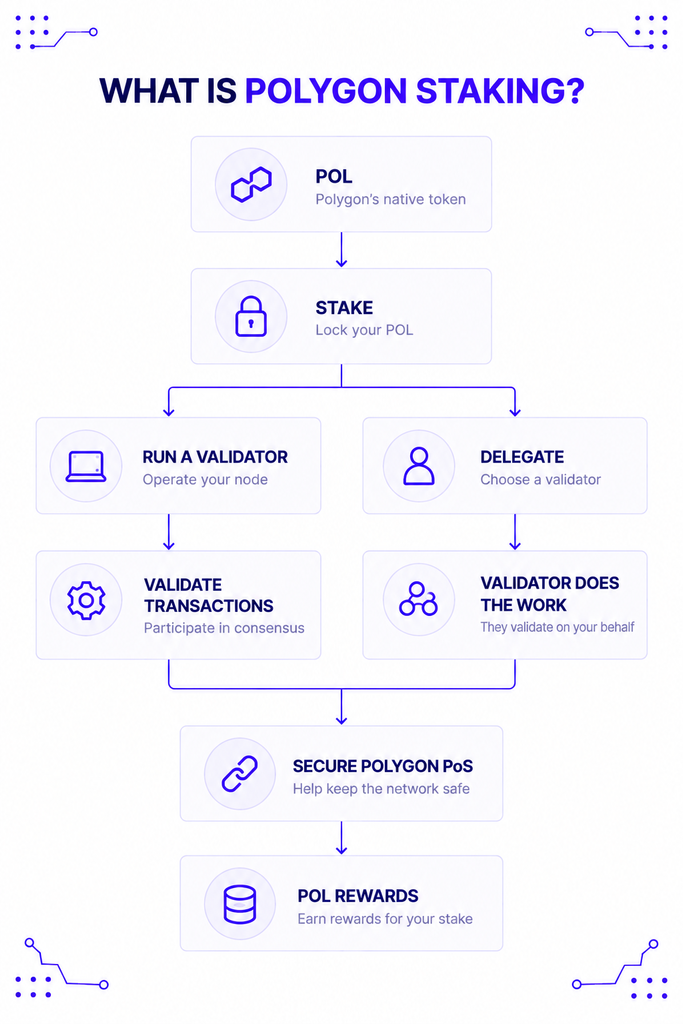
Polygon staking is the process of locking POL to help secure the Polygon PoS chain, in exchange for a share of the network’s staking rewards. Polygon runs on proof of stake, so instead of miners burning electricity to add blocks, validators put up POL as collateral and get paid for confirming transactions honestly.
POL is Polygon’s native gas and staking token, having replaced MATIC through a 1:1 migration completed on September 4, 2024, according to Polygon’s own documentation. Every transaction on Polygon PoS runs on POL, and it’s the same token validators stake to participate in consensus.
You can take part in two ways. You either run a validator node yourself, or you delegate your POL to someone else’s validator and share the reward with them, minus whatever commission that validator charges. Both routes lock your POL for however long it takes the unbonding process to clear once you decide to exit.
Why Does Polygon Need Staking?
A blockchain with no cost to participate is a blockchain anyone can attack for free. Staking POL gives validators something to lose: miss too many checkpoints or misbehave, and the rewards you’d otherwise earn quietly leak away instead.
The mechanism also controls how new POL enters circulation. Polygon’s tokenomics run on a 2% annual emissions schedule split evenly between staking rewards and a community treasury over a ten-year window, per Polygon’s staking documentation. That’s a fixed, predictable issuance rate rather than open-ended inflation, which is part of why locking POL into staking is also a way to offset dilution for long-term holders.
Staking is what makes Polygon’s checkpoint system trustworthy, too. Validators periodically submit checkpoints — batches of Polygon blocks — back to Ethereum, anchoring Polygon’s state to Ethereum’s own security. That checkpointing only means something if the validators doing it have real capital at stake behind their signatures.
Who Actually Stakes Polygon?
Staking polygon attracts a wider mix of participants than the technical process suggests, and each group wants something slightly different out of it.
- Retail holders who want yield on POL they’d otherwise leave sitting in a wallet, usually delegating through the Staking Hub or an exchange rather than running hardware.
- Validators and node operators who run infrastructure as a business, collecting commission from every delegator who stakes to them — Polygon currently caps its active validator set at just over 100 slots.
- DeFi users chasing Polygon’s new liquid staking option, which frees up capital that used to sit locked for the full unbonding period.
- Developers and dApp teams building on Polygon or AggLayer, who often need to understand staking mechanics before reasoning about validator incentives or checkpoint timing that affects their own product.
That range is why there’s no single “best” way to approach a polygon stake — a retail holder optimizing for simplicity has different needs than a DeFi user layering a liquid staking token into a lending position.
How Does Polygon Staking Actually Work?
Staking on Polygon happens on Ethereum, not on the Polygon PoS chain itself. You bridge POL to Ethereum Mainnet, connect a wallet to the Staking Hub, and delegate to a validator from there — the staking contract lives on Ethereum, which is also where checkpoints get verified.
Rewards accrue continuously and get distributed at each checkpoint, which currently lands roughly every 30 to 40 minutes. Sandeep Nailwal, Polygon’s co-founder, has framed staking as the mechanism tying the whole ecosystem together, not just a yield product:
“POL staking is the electricity that gives Agglayer its internet-like aura: easy, safe transfers across different ecosystems and chains.” — Sandeep Nailwal, Polygon co-founder, Bitfinex AMA
That framing matters practically: chains connected through AggLayer, Polygon’s interoperability layer, have started sending airdrops back to POL stakers, which makes staking relevant beyond the base reward rate.
How to Stake Polygon: Validator vs. Delegator
Before picking a method, it helps to see the two core roles side by side.
| Factor | Running a validator | Delegating to a validator |
|---|---|---|
| Minimum stake | No fixed minimum, but enough to rank in the top ~100 by total stake | 1 POL to start; rewards claimable at a small threshold |
| Where it happens | Ethereum Mainnet | Ethereum Mainnet |
| Hardware required | Yes — a node that stays online continuously | No |
| Commission | You keep the full reward pool from delegators | Median commission around 7%, though some validators run 0% |
| Active validator cap | Just over 100 slots | Not applicable |
| Best fit | Teams with technical capacity and enough delegated stake | Most individual holders |
With Polygon’s validator set capped at roughly 100 slots and dominated by established operators, delegation is the realistic path for almost everyone. Delegators still inherit their chosen validator’s uptime record, though — a validator that repeatedly misses checkpoints earns less, and so does everyone delegated to it.
How to Stake Polygon Step by Step
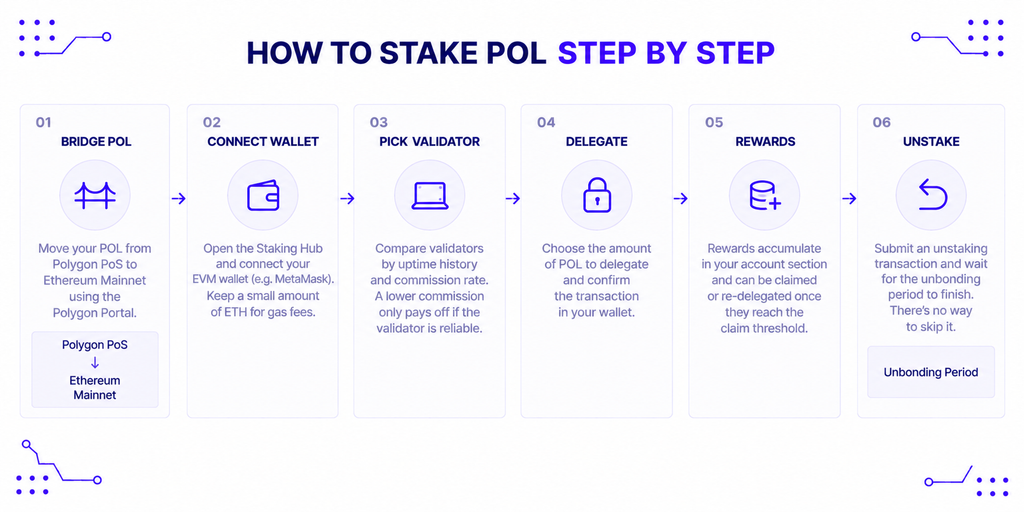
Delegating through the official Staking Hub is the most direct non-custodial route:
- Bridge your POL to Ethereum. If your POL sits on the Polygon PoS chain, move it to Ethereum Mainnet using the Polygon Portal first — staking happens on Ethereum, not on Polygon itself.
- Connect your wallet to the Staking Hub. An EVM-compatible wallet like MetaMask works, and you’ll need a small amount of ETH on hand for gas.
- Review the active validator set. Compare uptime history and commission rate; a lower commission only pays off if the validator’s uptime is solid enough to actually earn rewards consistently.
- Delegate your POL. Pick a validator, enter the amount, and confirm the transaction.
- Track and claim rewards. Rewards accumulate in your account section and can be claimed or re-delegated once they cross the claim threshold.
- Unstake when ready. Submit an unstaking transaction and wait out the unbonding period — there’s no way to skip it once it starts.
This is critical: once you submit a delegation, your POL is locked until you manually initiate unstaking and the unbonding period clears. There’s no automatic expiry like Avalanche’s fixed-term model — Polygon staking runs indefinitely until you choose to exit.
How Much Can You Earn Staking Polygon?
Polygon’s reward rate isn’t fixed by a simple formula tied to total stake the way some other networks work; it’s driven by the protocol’s 2% annual emissions schedule split between stakers and the treasury. In practice, that currently puts the gross reward rate somewhere around 2.5–3% APY before any validator commission comes out, per data tracked across major staking platforms.
That’s before fees. A validator charging the roughly 7% median commission takes that cut from your share before it lands in your wallet, so the number a validator advertises isn’t quite what you’ll net — the same trade-off that applies to staking on any proof-of-stake network. A handful of validators run 0% commission, which Polygon’s checkpoint-based reward model can sustain in a way some other networks can’t.
What Is sPOL, and Should You Use It?
Polygon launched sPOL, its own native liquid staking token, on April 14, 2026 — a direct answer to how much staked capital was sitting idle. At launch, roughly 3.6 billion POL sat locked in validator contracts, but only about 4–5% of it was liquid through third-party staking tokens, compared to nearly a third of all staked ETH on Ethereum, according to Polygon’s official announcement.
Depositing POL through the sPOL program mints a transferable token in return, starting at a 1:1 exchange rate that appreciates as staking rewards accumulate underneath it. You can hold it, trade it, or use it as collateral elsewhere in DeFi while the underlying POL keeps earning — the same capital-efficiency pattern covered in more depth in our guide to liquid staking. Third-party liquid staking tokens on Polygon have historically charged 5–16% in fees, well above what sPOL charges as Polygon’s own native option.
The trade-off is the one liquid staking always carries: you’re adding a smart contract and a token-peg layer on top of ordinary staking risk, in exchange for getting your capital back before the unbonding period would otherwise release it. That’s a reasonable swap for an active DeFi user, but it adds complexity a buy-and-hold staker doesn’t need.
Where to Stake Polygon: Comparing Your Options
“Where to stake polygon” usually comes down to keeping custody yourself or handing that job to an exchange.
| Option | Custody | Typical minimum | Notes |
|---|---|---|---|
| Polygon Staking Hub (direct) | You | 1 POL | No platform fee beyond the validator’s own commission |
| sPOL (native liquid staking) | You (non-custodial) | No fixed minimum | Adds liquidity but introduces token-peg and contract risk |
| Coinbase | Exchange | Often no practical minimum | Simple UI, exchange keeps a commission |
| Binance | Exchange | Varies by product | Broad access, flexible staking terms |
| Institutional providers (e.g., AMINA Bank) | Provider | Higher, compliance-oriented | Aimed at institutions needing regulated custody |
There isn’t one best place for a polygon stake. Staking directly through the Staking Hub keeps you in control of your keys, which matters for a meaningful position; an exchange is faster to set up but adds that platform’s solvency risk on top of Polygon’s own protocol risk.
What Are the Risks of Staking Polygon?
Your POL isn’t instantly liquid
Direct delegation through the Staking Hub locks your POL until you submit an unstaking transaction and the unbonding period — roughly 80 checkpoints, or about 2 to 4 days — clears. If POL drops sharply during that window, you can’t sell to cut losses until the unbonding process finishes.
Validator performance passes through to you
Delegating doesn’t remove your exposure to the validator’s uptime. A validator that repeatedly misses checkpoints earns less for that period, and so does everyone delegated to it, even though delegators did nothing wrong themselves.
Slashing enforcement is still being phased in
Polygon’s protocol includes penalties for double-signing and prolonged downtime, but enforcement across every violation type isn’t fully live yet, according to reporting from staking providers tracking the network. Treat that as a reason to check a validator’s track record directly rather than assuming penalties alone will filter out bad operators.
Liquid staking adds a new layer of risk
sPOL and third-party liquid staking tokens remove the unbonding wait, but they add smart contract risk and the possibility the token trades below its underlying POL value during a liquidity crunch — the same dynamic that has hit liquid staking tokens on other chains during past market stress.
Infrastructure dependency for anyone building on top
Wallets, staking dashboards, and validator-monitoring tools all need reliable, always-on access to Polygon to show accurate balances and validator status. Building that in-house means running full Polygon nodes — Bor and Heimdall together, as covered in our comparison of Polygon RPC providers — and a provider such as NOWNodes offers API access to Polygon nodes instead, which is why several staking-adjacent products connect through a provider rather than maintaining their own node infrastructure for every chain they support.
Conclusion
Staking Polygon comes down to one practical decision: delegate through the Staking Hub for the full reward and direct control, or trade some of that reward for the convenience of an exchange or the liquidity of sPOL. For most holders, delegating a modest amount of POL to a validator with a strong uptime record and a reasonable commission is the straightforward path.
The number that should drive your choice isn’t the headline APY — it’s how confident you are that you won’t need that POL liquid before the unbonding period clears. Check the current reward rate and your validator’s uptime record before committing, since both shift over time.
FAQ
How much POL do I need to start staking?
There’s no fixed minimum to delegate — you can start with as little as 1 POL, though rewards typically become claimable only once they cross a small threshold. Running your own validator instead requires enough total delegated stake to place among Polygon’s roughly 100 active validator slots.
Can I unstake POL before the unbonding period ends?
No. Once you submit an unstaking transaction, the unbonding process — about 80 checkpoints, roughly 2 to 4 days — has to run its course before your POL becomes liquid again, aside from using a liquid staking token like sPOL to exit early on the open market.
Is staking Polygon through an exchange different from staking directly?
Yes. Staking through Coinbase or Binance hands custody of your POL to the exchange, which stakes on your behalf and keeps a commission. Staking through the Polygon Staking Hub keeps the keys with you the entire time.
What is sPOL, and is it the same as staking POL?
sPOL is Polygon’s native liquid staking token, launched in April 2026. Depositing POL into the sPOL program still stakes it in the background, but you receive a tradable token in return instead of waiting through the unbonding period to access your capital.
Does staked POL still count toward my holdings for tax purposes?
Staking rewards are generally treated as taxable income when received in most jurisdictions, with capital gains rules applying again if you later sell. Confirm the current rule in your own country rather than assuming one standard applies everywhere.