

To stake XRP today, you deposit it into an exchange’s rewards program, lend it through a CeFi platform, or bridge it to Flare Network as FXRP to stake in a DeFi vault like Firelight. Current rates run from roughly 1.5% on simple exchange programs up to 7–10% on Flare’s newer DeFi vaults, depending on which route you pick and how much risk you’re willing to carry. None of these lock XRP into a validator the way staking works on Ethereum or Avalanche — the XRP Ledger itself doesn’t run proof of stake — but each one lets XRP holders earn a return instead of leaving tokens idle.
That distinction is worth fifteen seconds before you commit any funds, and it’s what the rest of this guide walks through: how each staking XRP option actually works, how they compare on yield and custody, and why the XRP Ledger was built without a native staking reward in the first place.
What Does “Staking XRP” Actually Mean?
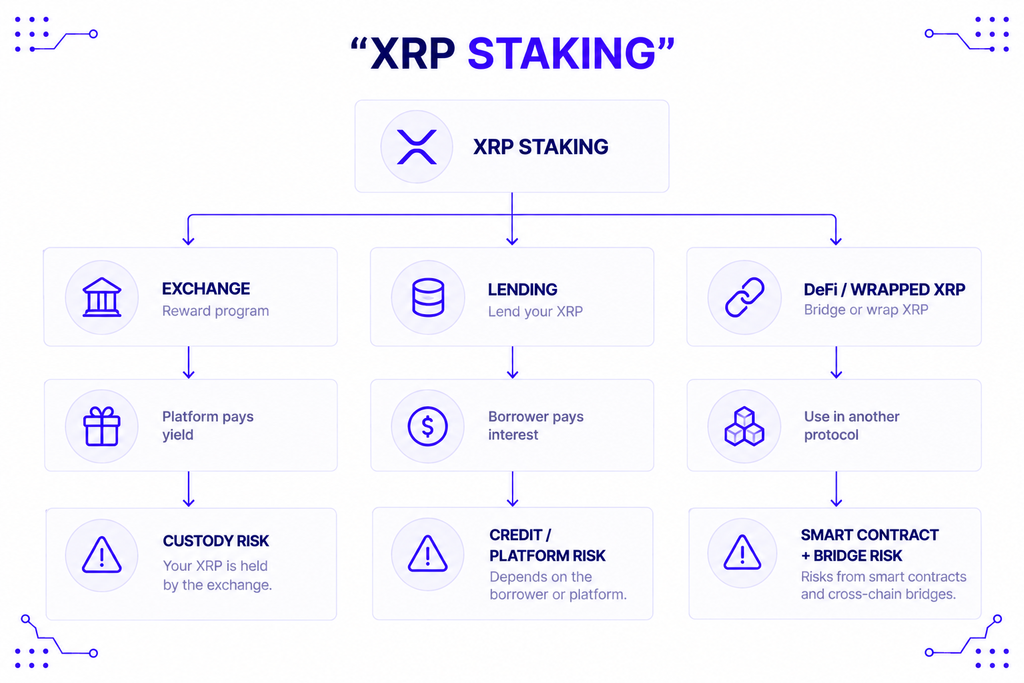
On networks like Ethereum, staking means locking tokens to run a validator that earns newly issued coins for confirming blocks honestly. XRP staking works differently, because the XRP Ledger doesn’t have that mechanism — there’s no validator reward and no protocol-level lock-up to opt into.
What gets marketed as XRP staking today is really one of three things: a centralized exchange’s reward program, a lending arrangement, or a DeFi protocol on a different chain that accepts a wrapped version of XRP as collateral. Each one still pays a real return on real XRP holdings — the difference from Ethereum-style staking is who’s paying it and what backs the payment.
How to Stake XRP: Step by Step
The fastest way to start earning on XRP is through an exchange; the highest-yield route currently runs through Flare Network. Both are covered below.
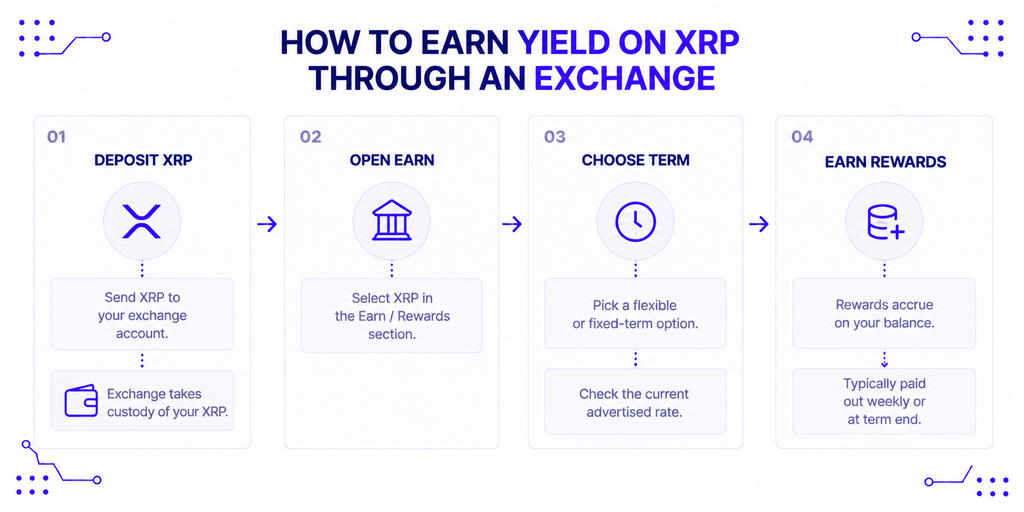
Through a centralized exchange:
- Deposit XRP to an exchange offering a rewards or earn program, such as OKX or Binance.
- Open the earn or rewards section and select XRP.
- Choose a flexible or fixed-term option, checking the current advertised rate first — these change often.
- Confirm the deposit. Rewards typically accrue daily and pay out weekly or at the end of the term.
Through Flare’s FXRP ecosystem:
- Bridge XRP to Flare using an FAssets-compatible wallet to mint FXRP, a wrapped, over-collateralized representation of XRP.
- Choose a destination for the FXRP — a Firelight staking position or a yield vault such as earnXRP.
- Deposit the FXRP and review the vault’s current target yield and strategy mix before confirming.
- Redeem your position later to withdraw the underlying FXRP, then bridge back to XRP if you want the original asset.
Through a CeFi lending platform:
- Deposit XRP with a lending platform that re-lends it to borrowers.
- Select a flexible or locked term — locked terms usually pay a higher published rate.
- Confirm the deposit and track accrual through the platform’s dashboard.
- Withdraw at the end of the term, or immediately on a flexible plan.
None of these three is instant, and none is staking in the strict protocol sense — each hands your XRP, in some form, to a third party or smart contract in exchange for a return.
Comparing Your Options: Exchange, Lending, and Flare
| Method | How it works | Typical yield | Who holds custody |
|---|---|---|---|
| Exchange rewards | Deposit XRP into an exchange’s earn/rewards product | Roughly 1.5–4%, platform-dependent | The exchange |
| CeFi lending | Lend XRP to a platform that re-lends it to borrowers | Roughly 2–5% | The lending platform |
| Flare FXRP / DeFi staking | Bridge XRP to Flare as FXRP, then stake or deploy it in vaults | Roughly 4–10%, vault-dependent | You (non-custodial bridge) or the vault protocol |
The differences that matter most aren’t in the headline yield — they’re in who’s holding your XRP while it earns, and what happens if that counterparty has a bad day. A reputable exchange’s flexible program is the simplest and lowest-risk entry point; Flare’s vaults pay more but add bridge and smart contract risk on top of ordinary market risk.
Exchange Reward Programs
Exchanges including OKX, Binance, and Kraken have offered flexible or fixed-term XRP earn products, though availability and rates shift constantly — Kraken’s own XRP rewards page currently shows the product unavailable in several regions. Where it’s live, published rates have run in the 1.5%–4% range depending on term length and market demand.
The mechanics are simple: you deposit XRP, the exchange pays a rate it sets unilaterally, and you can typically withdraw after a notice period or immediately on a flexible plan. That simplicity is also the catch — the platform, not a protocol, decides the rate and can change or pull it without much warning.
CeFi Lending Platforms
Lending platforms accept XRP deposits and re-lend them to borrowers, paying depositors a share of the interest. Rates have generally clustered around 2%–5% for straightforward lending, with some platforms advertising higher figures for locked terms or promotional periods.
This is critical: a lending platform’s advertised APR is a promise backed by that company’s solvency, not by code or a blockchain protocol. If the platform can’t cover withdrawals during a stress event, depositors are exposed exactly the way they would be with any unsecured loan.
Flare Network’s FXRP and Firelight Staking
Flare Network lets XRP holders bridge their tokens into FXRP, then deploy it across Flare’s DeFi ecosystem — including Firelight, a staking-style product built with an institutional partner. Flare’s co-founder, Hugo Philion, has described the goal as giving XRP holders low-risk ways to earn by putting FXRP to work securing other services, in exchange for tokens from whatever the stake secures.
A related product, earnXRP, deploys deposited FXRP across strategies like Firelight staking, liquidity provision, and DeFi insurance underwriting, targeting yields of roughly 7%–10% in smaller vaults and closer to 3%–4% once a vault scales past $50 million, according to The Block’s coverage of the product’s launch. This is the closest thing to staking XRP that currently exists, though it’s staking a wrapped derivative on a different chain rather than XRP itself on the XRP Ledger.
Why Doesn’t the XRP Ledger Have Native Staking?
The XRP Ledger runs on the XRP Ledger Consensus Protocol, a form of federated Byzantine agreement where a network of independent validators — currently 36 on the default Unique Node List published jointly by Ripple and the XRP Ledger Foundation — agree on transaction order roughly every 3 to 5 seconds, according to XRPL.org’s consensus documentation. No validator locks up XRP as collateral, and no validator earns newly minted XRP for participating.
This is a deliberate design choice, not a missing feature. David Schwartz, Ripple’s CTO Emeritus and one of XRPL’s original architects, has pushed back publicly on the idea that XRP holders should expect yield from the network the way ETH holders do: “Do you want to be your own bank or do you want someone else to pay you to be their bank?”
A proof-of-stake network pays validators to compensate them for locking capital and taking on slashing risk; XRPL validators take on neither, so there’s nothing for the protocol to pay them for. The practical result is that transaction fees on XRPL are simply burned rather than redistributed, and the ledger has run this way since launch with no roadmap to add native staking.
Who Actually Stakes XRP, and Why?
Demand for XRP yield is real even without a native mechanism behind it, and it comes from a few distinct groups who each want something slightly different.
- Long-term holders who don’t want to sell XRP but would rather it generate some return than sit idle in a wallet.
- Exchange users who already hold XRP on a centralized platform and want a simple toggle for extra return, even a modest one.
- DeFi participants willing to bridge XRP into an ecosystem like Flare to access lending, liquidity, and newer staking-style products built around a wrapped version of the token.
- Traders and bots that need XRP Ledger data to track balances, rewards, and DeFi positions in real time, whichever route they pick.
That last group runs into an infrastructure question that has nothing to do with which yield product they choose. Reading XRPL balances and transaction history reliably means either running a rippled server or connecting through a provider such as NOWNodes, which offers API access to the XRP Ledger without a team maintaining that infrastructure itself.
XRP vs. True Proof-of-Stake Coins
It helps to see why staking XRP and staking a coin like ETH aren’t really the same process, even though people search for them the same way.
| Factor | XRP Ledger | Ethereum (proof of stake) |
|---|---|---|
| Consensus | Federated Byzantine agreement among trusted validators | Proof of stake among staked validators |
| Native staking reward | None | Roughly 2.5% APR from protocol issuance |
| Capital at risk to validate | None required | 32 ETH per solo validator |
| Slashing | Not applicable | Real, for provable misbehavior |
| Where yield comes from | Third-party platforms or bridged DeFi | The protocol itself |
Our guide to what liquid staking actually is covers how that protocol-level reward works on chains that do support it, and the best staking platforms comparison breaks down the same custodial-versus-non-custodial trade-off that applies to every option in this guide, XRP included.
What Are the Risks of Staking XRP?
You’re always trusting a third party
Every current option — exchange, lender, or DeFi vault — puts your XRP under someone else’s control at some point, whether that’s a company’s balance sheet or a smart contract’s code. There’s no version of XRP yield today that avoids counterparty or contract risk entirely.
Advertised rates aren’t guaranteed
Exchange and lending rates are set unilaterally and can change or disappear with little notice, unlike a protocol-level reward set by fixed issuance rules. A rate that looks attractive today may not exist in three months.
Bridging XRP adds a new failure point
Minting FXRP requires trusting the FAssets bridge mechanism in addition to whatever vault or staking product you deposit into afterward. A bridge exploit or a mispriced collateral event affects your position even if the yield vault itself performs exactly as advertised.
Scams specifically target this confusion
Because staking XRP isn’t well understood, it’s a common target for fake staking apps and phishing sites promising fixed, unrealistic returns. Verify any staking or bridging interface against the official project’s own documentation before connecting a wallet or sending funds.
Conclusion
Staking XRP isn’t a single action the way staking ETH is — it’s a choice between three yield products with different custody and risk profiles. An exchange’s flexible rewards program is the fastest and simplest way to start; CeFi lending pays slightly more for a bit more counterparty exposure; Flare’s FXRP ecosystem pays the most for holders willing to bridge and accept smart contract risk.
Pick based on how much of that risk you’re comfortable carrying, not on which platform uses the word “staking” most confidently. Whatever route you choose, check the current rate and terms directly on the platform first, and treat any XRP stake you commit as fully exposed to that platform’s own risk, since none of these numbers are fixed by protocol the way they are on a genuine proof-of-stake chain.
So can you stake XRP the way you can stake ETH or AVAX? No — but you can put XRP to work through any of the three methods above, and for most holders that’s the question that actually matters.
FAQ
Can you actually stake XRP, or is it just a marketing term?
You can earn a real return on XRP through exchange rewards, lending, or Flare’s FXRP vaults, but none of it is protocol-level staking the way it works on Ethereum. The yield is real; the mechanism behind it is different from what “staking” means on a proof-of-stake chain.
Does Ripple itself pay XRP holders for staking?
No. Ripple doesn’t operate a staking program for XRP holders, and the XRP Ledger doesn’t distribute newly issued XRP to validators or token holders for participating in consensus.
Can I stake XRP directly from a hardware wallet like Ledger?
Not in the protocol sense — there’s no native staking transaction type on the XRP Ledger for a hardware wallet to sign. Some wallets integrate with third-party earn or DeFi products, but that’s the wallet connecting to an external service, not the ledger itself paying a reward.
Is Flare’s FXRP staking safe?
It carries bridge risk and smart contract risk on top of ordinary market risk, since FXRP is a wrapped, over-collateralized asset rather than XRP itself. It’s generally considered lower-risk than unaudited yield farms, but it isn’t risk-free, and yields compress as vaults grow larger.
Do I owe taxes on XRP staking or lending rewards?
In most jurisdictions, yes — rewards from exchange programs, lending, or DeFi vaults are typically treated as taxable income when received, with capital gains rules applying again if you later sell. Confirm the current rule in your own country rather than assuming one standard applies everywhere.