You’ve probably seen the word nonce sitting in a block explorer next to a long string of numbers, or buried in an error message that broke your deploy script — and wondered what it actually does. In plain terms, a nonce is a “number used once”: a value that appears exactly one time in a specific cryptographic operation so the result is unique and can’t be quietly replayed. That single idea shows up in three very different places — Bitcoin mining, the transaction counter on your Ethereum wallet, and the security headers protecting websites you visit every day. Get the core concept down once, and all three click into place.
Here’s the thing most guides miss: there isn’t one nonce. The word covers a family of related tools that solve different problems, and mixing them up is exactly why people get confused — or, worse, ship code that fails in production. This guide walks from the simplest definition up to the technical edge: what a nonce is, the types you’ll meet, how each one works, the code to read and create them, and where they quietly hold the whole system together.
What Is a Nonce? The One-Sentence Version
A nonce is a number used once. That’s the whole etymology — “number used once” — and it’s the rare piece of crypto jargon that means precisely what it says. The point of using a value a single time is to guarantee that a given operation is original, fresh, and can’t be copied and re-run by someone who intercepted it.
The term didn’t start with blockchain. It traces back to a 1978 paper by Roger Needham and Michael Schroeder, Using Encryption for Authentication in Large Networks of Computers, published in Communications of the ACM, Vol. 21, No. 12. They introduced the nonce as a way to prove a message was current rather than a recording of an old one — the original defense against what we now call replay attacks. Nearly fifty years later, the same idea secures billion-dollar blockchains.
Nonce: an arbitrary number used exactly once in a cryptographic communication, typically random or sequential, included to ensure a message or operation is unique and cannot be reused maliciously. See MDN’s Content Security Policy documentation for the web-security definition, or the Ethereum developer docs for the account-based one.
This matters because the rest of the article splits along that definition. Whether a nonce is keeping a Bitcoin block honest, ordering your wallet’s transactions, or blocking a malicious script, it’s always doing the same job — enforcing “this exact thing, exactly once.”
What Is a Nonce in Crypto? The Two Blockchain Flavors
Inside crypto specifically, the word nonce points to two distinct mechanisms, and telling them apart is the single most useful thing in this whole guide. They share a name and nothing else.
The mining nonce lives inside a block header and exists to make Proof-of-Work expensive. The transaction nonce (also called an account nonce) is a counter on your wallet that orders your transactions and stops them being replayed. One secures block production; the other secures your individual account. Here’s the quick contrast before we go deep on each.
| Mining nonce | Transaction nonce | |
| Where it lives | Block header | Per-account counter |
| Who sets it | Miners (trial and error) | Your wallet (sequential) |
| Its job | Make valid blocks costly to find | Order transactions, block replays |
| Used on | Proof-of-Work chains (Bitcoin) | Account-based chains (Ethereum, L2s) |
| Value pattern | Random search, 0 to ~4.29 billion | Increments by 1: 0, 1, 2, 3… |
The confusion is understandable — both genuinely are “numbers used once.” But a developer interacts with the transaction nonce daily, while the mining nonce is something a Bitcoin ASIC chews through billions of times a second and you never touch directly. We’ll take the mining nonce first, because it’s where the concept is most visible.
How the Mining Nonce Works in Proof-of-Work
This is the nonce most people picture when they hear the word, and it’s the heart of how Bitcoin secures itself. To add a new block, a miner has to find a hash of the block header that lands below a target number set by the network’s difficulty. The catch: they can’t pick the hash directly.
The Brute-Force Search
A hash function is deterministic — feed it the same input, you always get the same output. So if the block data never changed, the hash would never change, and no miner could ever hit the target. The nonce is the one field miners are free to alter. They start at zero, hash the header, check the result, and if it’s too high they bump the nonce by one and hash again. This repeats millions or billions of times per second until a valid hash appears.
That successful value is sometimes called the golden nonce. Because hashing is unpredictable, nobody can calculate it in advance — the only way through is raw computation. As Chainlink’s explainer on the topic puts it, miners “must rely on raw computational power to cycle through possible nonces until one produces a hash that aligns with the network rules.” That asymmetry — hard to find, instant to verify — is the entire “proof” in Proof-of-Work.
Why Bitcoin Needs an “Extra Nonce”
Here’s a constraint that trips people up. The Bitcoin nonce is a 32-bit (4-byte) field, which caps it at just over 4.29 billion possible values (2³² − 1). Modern mining hardware burns through that entire range in a fraction of a second. So what happens when none of the 4.29 billion values produces a winning hash?
The miner changes something else. A second value called the extra nonce sits in the coinbase transaction; nudging it alters the Merkle root, which changes the block header, which resets the 32-bit nonce search from zero with a fresh starting point. If that still fails, miners adjust the timestamp. These three levers — nonce, extra nonce, timestamp — work together to keep Bitcoin producing one block roughly every 10 minutes, a pace the network defends by recalculating difficulty every 2,016 blocks.
A Real Example You Can Verify
This isn’t abstract. Pull up an old block in any explorer and you’ll see the final nonce that won it. Per Investopedia’s reference on the topic, the nonce for block 841,948 was 1,614,498,317, while the very next block, 841,949, landed on 4,218,083,700 — wildly different numbers, because each block is a fresh independent search. A nonce of 3.98 billion doesn’t mean the miner made 3.98 billion attempts; it likely rolled over the 32-bit limit several thousand times, leaning on the extra nonce and timestamp to keep going.
A note on Ethereum: before its Merge to Proof-of-Stake in September 2022, Ethereum also used a mining nonce — a larger 64-bit field hashed with the memory-hard Ethash algorithm. Since the Merge, that field is set to zero and validators produce blocks through staking, not hashing. The mining nonce now matters only for Bitcoin and other Proof-of-Work chains.
How the Transaction Nonce Works on Account-Based Chains
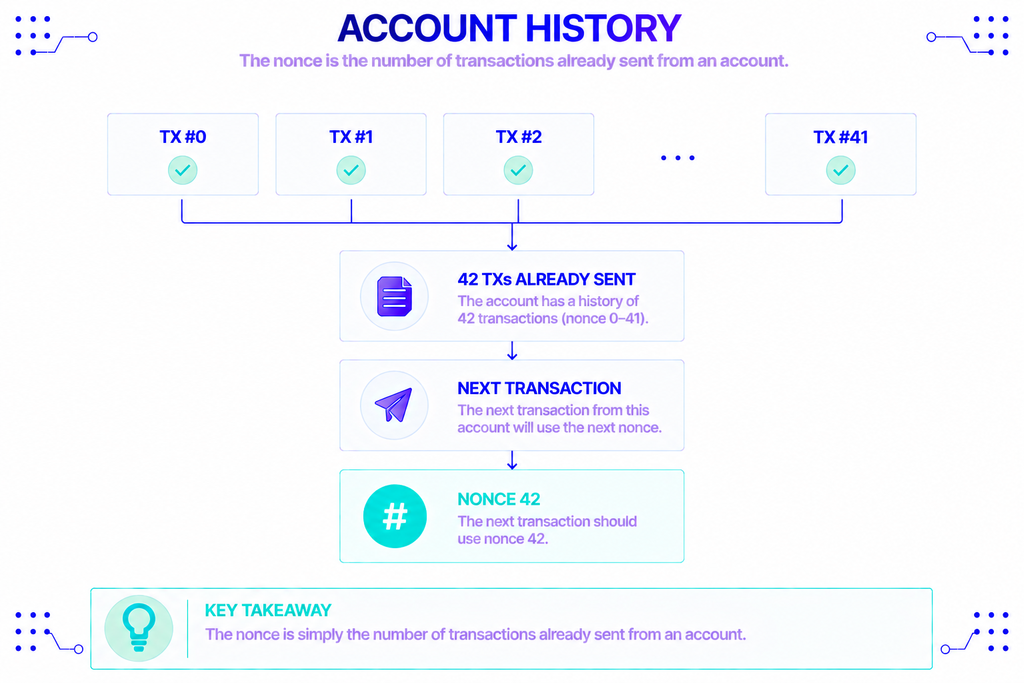
Now the nonce you’ll actually wrestle with as a builder. Every account-based blockchain — Ethereum, Polygon, Arbitrum, Base, Optimism — attaches a sequential nonce to each account to track how many transactions it has sent. Your first transaction uses nonce 0, your second nonce 1, and so on. It’s bookkeeping with teeth.
The Three Rules That Govern It
Three strict rules make the transaction nonce work, and breaking any of them is where production outages come from:
- Sequential ordering — the network won’t confirm nonce N until the one numbered N−1 has already landed in a block, so the count climbs in strict order with no jumping ahead.
- No reuse — once nonce 5 is confirmed, no other transaction with nonce 5 from that account will ever be accepted again.
- No gaps — if nonce 5 is stuck or fails, then nonces 6, 7, 8 and everything after sit waiting in the mempool until nonce 5 clears.
That third rule is brutal in practice. As Ben Chatwin writes in Dwellir’s deep-dive on the subject, “a failed transaction at nonce 5 blocks nonces 6, 7, 8, and all subsequent transactions.” One stuck transaction can freeze an entire wallet’s queue — a single failure at nonce 47 can pile up hundreds of transactions behind it.
What the Transaction Nonce Actually Protects
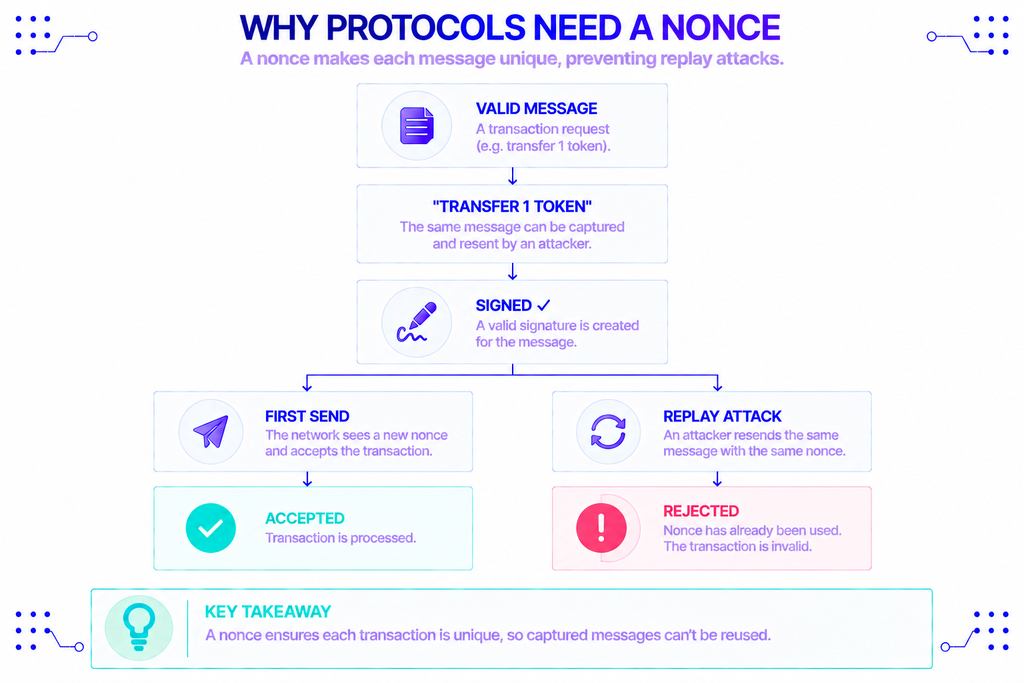
This counter does more than count. It delivers three guarantees that make account-based chains usable at all. First, replay protection: without a nonce, anyone could grab your signed “send 1 ETH” transaction and rebroadcast it over and over, draining your account — the nonce ensures each signed transaction is valid exactly once. Second, strict ordering: if your app needs to approve a token, then swap it, then transfer the result, the nonce sequence forces those steps to execute in order. Third, and less obviously, it shapes deterministic contract addresses — when you deploy with the CREATE opcode, the new contract’s address is derived partly from your account’s nonce, so deploying the same code at nonce 10 yields a different address than at nonce 11.
One historical wrinkle worth knowing: the nonce alone didn’t originally protect you across chains. During the Ethereum / Ethereum Classic split, the same signed transaction could be replayed on both networks. EIP-155 fixed this by including the chain ID in the data being signed, which affects the v parameter of the signature.
What Is a Nonce in Security? Beyond the Blockchain
Step outside crypto and the nonce is everywhere in security — which makes sense, given it was a security tool eighteen years before Bitcoin existed. The unifying job is identical: prove freshness, block replays, guarantee single use.
The Cryptographic Nonce
In authentication and encryption, a cryptographic nonce is a random or pseudo-random value generated for one session or message. It’s what stops an attacker from capturing a valid login handshake and replaying it later to impersonate you. The same principle underpins digital signatures and encryption schemes — and getting it wrong has real consequences, which we’ll get to.
Nonces in Web Security: The CSP Nonce
Here’s the one running quietly on countless websites right now. A Content Security Policy (CSP) nonce is a cryptographically random value the server generates fresh on every single page load. The server drops it into the CSP header and into the <script> tags it trusts. When the browser sees an inline script, it only runs it if the script’s nonce matches the one in the header.
Why does this matter? Cross-site scripting (XSS) attacks work by injecting malicious inline scripts into a page. An attacker who finds an injection flaw still can’t run their script, because they can’t guess the correct nonce for that specific response. Google’s own web.dev guidance on strict CSP documents that nonce-based policies have prevented numerous XSS attacks across Google products. The one non-negotiable rule, per the CSP specification community: the nonce must be unpredictable and regenerated on every load. Reuse it, and the whole protection collapses.
The Account Nonce as a Security Primitive
Worth circling back: the Ethereum transaction nonce belongs in this security section too, not just the crypto one. Its anti-replay function is a textbook cryptographic-nonce use case applied to a public ledger. The same 1978 idea — a number used once to prevent an old message being reused — is what stops your signed transaction from being weaponized against you.
The Different Types of Nonce, Side by Side
Pulling the whole family into one view. The concept is singular; the implementations are not.
| Type | Where it’s used | What it does |
| Mining nonce | Proof-of-Work blocks (Bitcoin) | Variable miners adjust to find a valid block hash |
| Account / transaction nonce | Ethereum, L2s, account-based chains | Sequential counter ordering an account’s transactions |
| Cryptographic nonce | Authentication, encryption, messaging | Random value preventing replay attacks per session |
| CSP nonce | Web security (HTTP headers) | Per-load token authorizing trusted inline scripts |
| Hash-function nonce | General cryptography | Alters input to force a different, unpredictable output |
| Programmatic nonce | Software, web forms, databases | Prevents duplicate submissions or ID collisions |
The pattern across every row is the same: introduce a unique value so that identical-looking operations produce distinct, non-replayable results. Once you see that thread, “nonce” stops being six different confusing things and becomes one idea wearing different hats.
How to Read and Create a Nonce: Code You Can Use
Enough theory — here’s how you actually touch a nonce in code. For developers, this almost always means the transaction nonce, since the mining nonce is handled by mining software you’ll never write by hand.
Reading the Current Nonce
To get the next nonce for any address, you query the chain. The eth_getTransactionCount RPC method returns how many transactions an account has sent — which is exactly the next nonce to use. The critical detail is the ‘pending’ parameter:
javascript
// Get the next nonce to use for a new transaction
const response = await fetch('https://eth.nownodes.io/YOUR-API-KEY', {
method: 'POST',
headers: { 'Content-Type': 'application/json' },
body: JSON.stringify({
jsonrpc: '2.0',
method: 'eth_getTransactionCount',
params: ['0xYourAddress', 'pending'], // 'pending' includes mempool txs
id: 1
})
});
const { result } = await response.json();
const nonce = parseInt(result, 16); // hex → integer
Use'pending', not 'latest'. The 'latest' parameter counts only confirmed transactions and ignores anything sitting in the mempool — which guarantees a stale, colliding nonce the moment you have a transaction in flight. This one-word choice is behind a huge share of nonce bugs.
Setting a Nonce When Sending
Most libraries fill the nonce in automatically, but for batching, retries, or high-throughput systems you’ll set it explicitly:
javascript
// Always fetch the freshest nonce immediately before submitting
const nonce = await provider.getTransactionCount(address, 'pending');
const tx = {
to: '0xRecipient',
value: ethers.parseEther('0.01'),
nonce: nonce, // explicit control
gasLimit: 21000
};
await wallet.sendTransaction(tx);
Generating a Security Nonce
For the security side — a CSP or authentication nonce — you want cryptographic randomness, never a predictable counter:
javascript
// Node.js: a 16-byte cryptographically secure nonce
const crypto = require('crypto');
const nonce = crypto.randomBytes(16).toString('base64');
// Drop into a CSP header, fresh on every response:
// Content-Security-Policy: script-src 'nonce-<value>'
The distinction is the whole point: a transaction nonce is sequential and predictable by design (it has to be, to enforce order), while a security nonce must be random and unguessable (it has to be, to resist attackers). Same word, opposite requirements.
Common Nonce Errors and How to Fix Them
Transaction nonces are one of the most common sources of failed and stuck transactions in Ethereum development — MetaMask and most major wallets build dedicated tooling specifically to resolve them.
“Nonce too low” means you submitted a nonce already used by a confirmed transaction — usually your local counter drifted out of sync with the chain. The fix is to re-query eth_getTransactionCount with ‘pending’ and use the returned value rather than trusting your own count.
“Nonce gap” (stuck queue) is the dreaded pileup: a transaction at nonce N failed or got stuck on too low a gas price, and everything behind it is frozen. The fix is to send a replacement transaction with the same stuck nonce and a higher gas price — at least 10% higher on most networks — often a zero-value transaction to yourself to unstick the queue.
“Replacement transaction underpriced” appears when your replacement’s gas bump isn’t big enough; push it 10–12% above the pending transaction, more during congestion. A recurring theme connects all three: query the chain, don’t assume your local state is right. Inconsistent results from different RPC nodes are a leading cause of these failures, so using a single reliable endpoint for both your nonce queries and your submissions removes a whole class of bugs. A stable Ethereum node gives you that consistent view of pending state without running your own infrastructure.
Nonces Aren’t Universal: How Chains Differ
A dangerous assumption when building a multi-chain: that every network handles nonces like Ethereum. They don’t, and porting that assumption across chains breaks things.
| Chain | Nonce model | Transaction expiration |
| Ethereum / L2s | Sequential per-account (0, 1, 2…) | None — pending forever |
| Polkadot | Sequential, with “mortality” era | Expires after a set block range |
| Solana | No account nonces; uses recent blockhash | ~60 seconds, then invalid |
| Bitcoin | No account nonces (UTXO model) | None |
Solana is the sharpest contrast: instead of a sequential counter, every transaction carries a recent blockhash that expires in about 60 seconds. That design eliminates stuck-transaction queues entirely — expired transactions simply vanish rather than blocking the ones behind them. Bitcoin, on the UTXO model, has no account nonce at all; replay protection is inherent, because once an output is spent it can’t be spent again. The lesson is simple: confirm how nonces (or their absence) work on each chain before you assume Ethereum’s rules apply.
When Nonces Go Wrong: The Reuse Attack
A nonce only protects you if it’s used once — the entire guarantee lives in that word. Break it, and the security collapses, sometimes catastrophically.
The classic failure is the nonce reuse attack. In systems that depend on a nonce being unique — digital signatures, encryption schemes — reusing one can let an attacker recover private keys or forge signatures. It’s not a theoretical footnote; real systems have leaked signing keys precisely because a nonce repeated when it never should have. Two related failures round out the picture: the predictable nonce attack, where patterns in how nonces are generated let an attacker guess the next one, and the stale nonce attack, where an old but technically valid nonce is replayed to slip a duplicate operation through.
The defenses are unglamorous and effective. Cryptographic nonces must come from a secure random source and never repeat. Transaction nonces must be tracked carefully so they never collide or skip. CSP nonces must regenerate on every page load. Across every type, the same discipline applies: enforce uniqueness ruthlessly, because the moment a “number used once” gets used twice, it stops being a nonce and starts being a vulnerability.
Conclusion
A nonce is a number used once — and that plain definition holds across every place it appears. In Bitcoin mining, it’s the 32-bit value miners attempt billions of times per second to make blocks costly to produce and trivial to verify. On Ethereum and its L2s, it’s the sequential counter that orders your transactions and shields them from replay. In web and network security, it’s the random token — direct heir to Needham and Schroeder’s 1978 idea — that keeps stale messages and injected scripts from doing damage.
The practical takeaways are few but they prevent most of the pain. Use the ‘pending’ parameter when reading a transaction nonce. Note that different nodes may return different values for ‘pending’ due to mempool differences. For critical systems, consider using a single consistent endpoint for nonce queries.
Keep sequential nonces in sync with the chain and build replacement logic for stuck ones. Make security nonces random, single-use, and freshly generated. And never assume one chain’s nonce rules apply to another. Whether you’re debugging a frozen transaction queue or hardening a site against XSS, it all comes back to the same quiet primitive doing the same quiet job: this exact thing, exactly once. If you’re building on top of it, reliable node infrastructure from NOWNodes is what gives your nonce queries a consistent, trustworthy view of the chain.
FAQ
What is a nonce in blockchain?
A nonce is a “number used once” — a value included in a cryptographic operation exactly one time so the result is unique and can’t be replayed. In blockchain it appears in two main forms: the mining nonce in Proof-of-Work block headers, and the transaction nonce that orders an account’s transactions and prevents replay attacks.
What is a nonce in crypto, specifically?
Two things. The mining nonce is a 32-bit field in a Bitcoin block header that miners adjust by trial and error to find a hash below the network’s difficulty target. The transaction nonce is a sequential counter on each account (used by Ethereum and similar chains) that increments by one with every transaction sent.
What is a nonce in security?
A security nonce is a random, single-use value that proves a message or session is fresh and blocks replay attacks. It predates blockchain — introduced in a 1978 cryptography paper — and shows up in authentication handshakes, encryption, and web security as the CSP nonce that authorizes trusted inline scripts to stop cross-site scripting.
How big is the Bitcoin mining nonce?
It’s a 32-bit (4-byte) field, giving just over 4.29 billion possible values (2³² − 1). Because mining hardware exhausts that range almost instantly, miners also vary an “extra nonce” in the coinbase transaction and adjust the timestamp to keep searching for a valid block hash.
What’s the difference between a mining nonce and a transaction nonce?
The mining nonce makes Proof-of-Work blocks expensive to produce — miners search for it randomly. The transaction nonce orders the transactions from a single account and prevents them being replayed — it’s strictly sequential (0, 1, 2…). They share a name but solve completely different problems.
Why is my transaction stuck with a nonce error?
Most likely a “nonce gap”: a transaction at some nonce failed or stalled, and every later nonce is queued behind it. Fix it by resubmitting a transaction with that same stuck nonce and a gas price at least 10% higher. Always query the current nonce with the ‘pending’ parameter before sending to avoid collisions.
What is a nonce reuse attack?
It’s when a nonce that should appear only once is used more than once, breaking the uniqueness guarantee. In digital signatures and encryption, reuse can expose private keys or allow forged signatures. The defense is strict: generate nonces from a secure random source and never repeat them.
Can I create my own nonce?
Yes. For transactions, read the next value with eth_getTransactionCount using the ‘pending’ parameter and set it explicitly when sending. For security purposes, generate a cryptographically random value (for example, with crypto.randomBytes in Node.js) and use it once. The key difference: transaction nonces are sequential and predictable by design, while security nonces must be random and unguessable.