
NOWNodes and dRPC both solve the same basic problem — connecting an application to a blockchain without anyone on your team running a node — but they get there through very different architectures. NOWNodes operates shared and dedicated nodes directly across 120+ networks under a flat monthly request quota, including Bitcoin, Litecoin, and privacy coins most providers skip entirely. dRPC instead routes requests across a network of independent node operators and bills by a method-weighted compute unit, covering 130+ chains that lean heavily toward EVM networks.
For a team that wants predictable, forecastable pricing and broad non-EVM coverage under one account, NOWNodes is the more straightforward starting point. dRPC’s routing model earns real credit for redundancy, but that architecture brings a billing model that’s harder to plan around and a chain list that’s thinner outside the EVM-and-Solana world.
What Are NOWNodes and dRPC, Exactly?
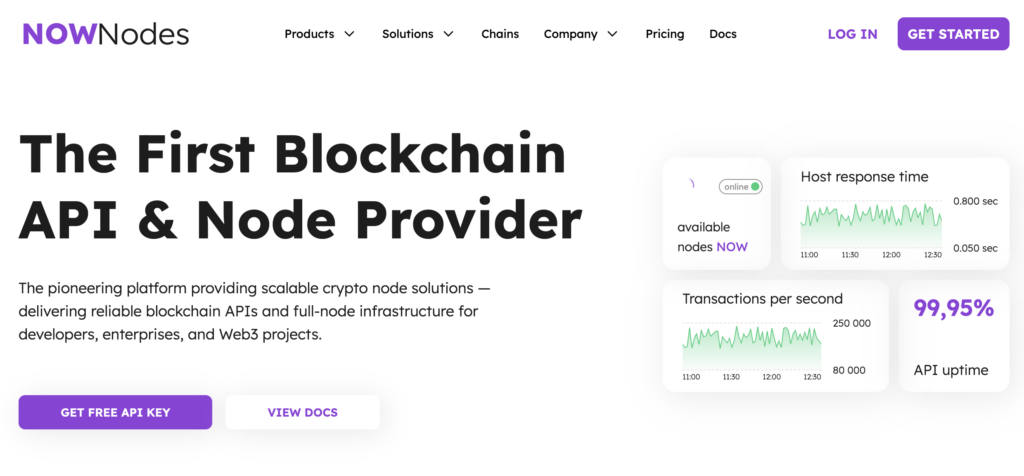
NOWNodes is a blockchain infrastructure provider that gives developers API-based access to shared and dedicated nodes across 120+ networks, from Bitcoin and Ethereum to Solana, Polygon, and Monero. You get an endpoint and an API key, and NOWNodes keeps the underlying node synced, patched, and running.
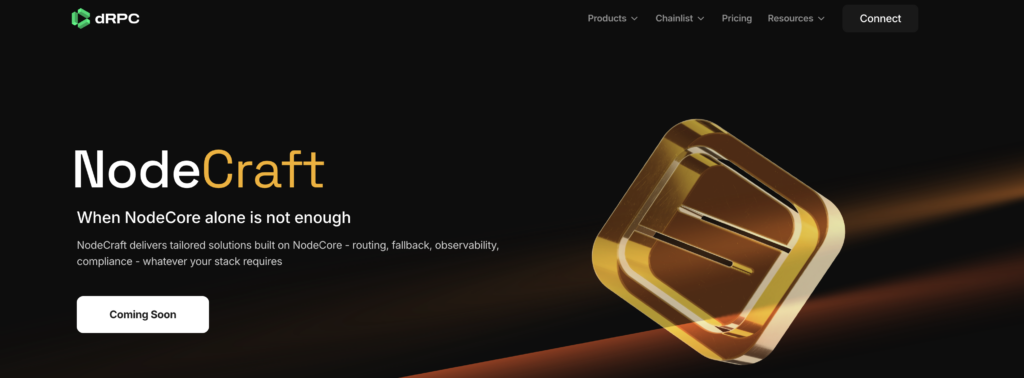
dRPC takes a different approach: it doesn’t operate every node itself. It aggregates infrastructure from independent providers and exposes it through a single API key per chain, using a gateway called Dproxy to route each request to whichever node in the pool answers fastest. A companion agent, Dshackle, runs alongside each provider’s infrastructure and reports its health back to the router.
RPC (remote procedure call) is the mechanism underneath both services — a way of asking a remote server to run a function, such as “return this address’s balance,” and get the result back over the network. Every blockchain client, from Geth to Solana’s Agave, exposes its data this way, which is why standard JSON-RPC calls can move between providers without an application rewrite.
Why Do You Need a Provider Like NOWNodes or dRPC?
Running your own node is a real operational commitment, not a background task. A synced Ethereum full node currently needs roughly 650–700 GB of disk space, and it has to be patched and resynced through every protocol upgrade the network ships.
A provider takes that maintenance off your plate. Your team gets an authenticated endpoint, the provider keeps the client software current, and engineers spend their time on application logic instead of server operations. That trade-off holds whether you’re on NOWNodes’ flat-rate shared nodes or dRPC’s compute-unit-billed endpoints — only the pricing mechanics differ.
dRPC’s own pitch is built specifically around not being a single company’s server farm. Constantine Zaitcev, dRPC’s CEO, framed it this way at launch: “The launch of DRPC will enable end-to-end decentralization for Ethereum. In addition to the blockchain and application layer, the infrastructure layer will be decentralized as well,” according to The Block’s coverage of the launch. That’s a coherent thesis, but it’s also a design choice with trade-offs, which is where this comparison gets useful.
Who Actually Uses NOWNodes vs. dRPC?
NOWNodes tends to attract teams whose product spans several blockchains at once — wallets, exchanges, and payment platforms that need Bitcoin, Ethereum, and a dozen other chains under one account instead of a separate vendor per network. Trading tools and monitoring systems built on WebSocket or gRPC streaming fit the same profile.
dRPC’s positioning — chain breadth on the EVM side, a generous free public tier, usage-based billing — points at multichain dApp teams comfortable modeling compute-unit costs against their real traffic, plus developers who specifically want routing redundancy built into the base architecture rather than added on top.
| Use case | Better fit with NOWNodes | Better fit with dRPC |
|---|---|---|
| Multi-chain wallet or exchange (BTC + ETH + others) | Yes — one account, broad non-EVM coverage included | Requires checking non-EVM chain support first |
| EVM-heavy dApp prototyping across many chains for free | Works on the Start plan’s request limits | Yes — 210M CU/month free tier on public nodes |
| Backend needing predictable monthly cost regardless of method mix | Yes — flat request quota | Depends heavily on which methods dominate traffic |
| Payment platform needing Bitcoin, Litecoin, or privacy-coin support | Yes — built in from day one | Limited; dRPC’s list leans EVM and Solana |
| Team that wants provider-level routing failover as a default | Possible via NOWNodes + a second provider | Yes — dRPC’s core architecture |
A backend that mainly needs Bitcoin-adjacent chains alongside Ethereum won’t find much of what it needs in dRPC’s current lineup, which is the first real crack in dRPC’s case for a multi-asset product.
How Does dRPC’s Routing Architecture Actually Work?
dRPC’s Dproxy gateway picks a node for each incoming request by weighing region, node health, chain-head height, and the specific method called — what the company calls AI-driven load balancing. If one provider in the network lags or goes unhealthy, Dshackle reports that back and the router skips it.
The trade-off is structural: performance on any given dRPC request depends partly on infrastructure dRPC doesn’t fully own end to end. NOWNodes’ shared and dedicated nodes are operated directly, so a request’s path is simpler and doesn’t depend on a third-party operator’s uptime that day.
Neither model is wrong. Routing across independent operators buys resilience against any single node failing, but it also means consistency varies with a network dRPC only partially controls — a meaningfully different risk profile than a provider running its own fleet top to bottom.
Pricing: Flat Quotas vs. Compute-Unit Billing
This is where the two providers diverge the most, and it’s the detail most likely to decide your monthly bill. NOWNodes’ shared plans use a flat request-quota model: pick a tier, get a fixed number of requests, and every call — light or heavy — counts the same against that number.
dRPC bills through compute units (CUs), a per-method weighting system. A simple balance check costs far fewer CUs than a heavier call like a log scan or a trace request, per dRPC’s compute-unit documentation.
| Plan tier | NOWNodes (flat quota) | dRPC (compute units) |
|---|---|---|
| Free | 100,000 requests/month, 1 API key | 210M CU/month, public nodes only, 100 RPS |
| Entry paid | ~€20/month, 1M requests, 3 API keys | From $6 per 1M requests, 20M CU included, 5,000 RPS |
| Mid tier | ~€200/month, 30M requests, 25 API keys | No published flat mid tier — scales with CU volume |
| Enterprise | ~€500/month, 100M requests, 100 API keys | Custom, from 300M+ requests/month, unlimited RPS |
Both companies adjust pricing regularly — verify current numbers on NOWNodes’ pricing page and dRPC’s own pricing page before budgeting. The practical gap is predictability: 1 million balance checks and 1 million log scans cost the same on NOWNodes, while a CU bill on dRPC shifts with whatever methods your app calls most that month. A workload heavy on eth_getLogs or trace calls can burn through an advertised CU allowance faster than the headline number suggests, which is a real planning risk for any team that can’t fully predict its method mix in advance.
Network and Feature Coverage
NOWNodes advertises 120+ blockchain networks, including non-EVM chains such as Bitcoin, Dogecoin, Litecoin, and Monero alongside Ethereum, Solana, and other EVM chains. dRPC’s paid plans currently list 130+ chains, a number that looks larger on paper but leans heavily toward EVM networks with growing, not yet comprehensive, non-EVM support.
That gap matters most for multi-asset products. An EVM-only dApp won’t notice much difference in raw chain count between the two providers. A wallet or exchange that also needs Bitcoin, Litecoin, or a privacy coin will find several of those simply aren’t part of dRPC’s current lineup — a gap NOWNodes’ network directory covers under one account instead.
Past raw chain count, the two platforms emphasize different things:
- Dedicated infrastructure — NOWNodes’ dedicated nodes are available from mid-tier plans with no predefined RPS limit; dRPC reserves comparable control for its custom Enterprise tier or its self-hosted NodeCore product.
- Market data — NOWNodes bundles a market data API covering 9,000+ cryptocurrencies and 90+ fiat assets; dRPC’s core product is RPC access, not price data.
- gRPC streaming — NOWNodes offers multichain gRPC across 25+ blockchains with sub-200ms latency; dRPC’s routing layer focuses on request-response RPC rather than a dedicated streaming product.
- Deployment flexibility — dRPC splits its offering into NodeCloud (managed endpoints), NodeCore (a self-hosted version of its routing stack), and NodeHaus (enterprise-managed clusters), which gives larger teams more infrastructure choices than NOWNodes’ shared-versus-dedicated split.
Is dRPC Faster or More Reliable Than NOWNodes?
Neither company’s uptime figures are independently audited, so treat both as marketing claims worth testing against your own traffic rather than guarantees. dRPC advertises 99.99% uptime on its Growth plan; NOWNodes states 99.95% API uptime on shared infrastructure and a separate 99.99% figure specific to its dedicated-node product.
The more meaningful difference is architectural, not a single percentage. dRPC’s latency on any request depends on which underlying provider its router picked that moment, while NOWNodes’ response time reflects a node it operates and monitors directly. Test both against your target regions before committing budget to either.
Switching Costs: How Locked In Are You?
Because JSON-RPC is a standardized protocol, moving core traffic between providers is usually a configuration change, not a rewrite. An application built purely against standard methods like eth_getBalance and eth_sendRawTransaction can point at a new endpoint with a URL and key swap.
The friction shows up with provider-specific tooling. dRPC’s NodeCore deployment and its routing-specific configuration don’t have direct equivalents elsewhere, so a team that builds around them has real migration work if it ever needs to leave. A team on NOWNodes’ standard shared or dedicated nodes keeps that exit path simpler, since there’s no proprietary routing layer to unwind.
dRPC vs. NOWNodes: Which One Should You Choose?
Is NOWNodes better than dRPC for a multi-chain product? In most cases, yes. Broader non-EVM coverage, flat and forecastable pricing, and a node NOWNodes operates and monitors directly make it the simpler, more predictable choice for wallets, exchanges, and payment platforms juggling several chains at once.
Is dRPC better than NOWNodes for a team that specifically wants routing redundancy as a design principle? For that narrow case, yes — dRPC’s architecture bakes failover across independent providers into the base product rather than treating it as an add-on.
Weighed against each other on the criteria most teams actually care about — predictable billing, non-EVM reach, and a straightforward exit path — NOWNodes comes out ahead for the majority of production use cases. dRPC’s free tier and routing model are genuinely useful for prototyping across many EVM chains cheaply, but that advantage narrows once a project needs Bitcoin-adjacent chains or a bill it can forecast before the month starts.
Limitations Worth Knowing Before You Commit
dRPC’s compute-unit billing is its biggest planning risk. The advertised CU allowance on any plan is a starting estimate, not a guaranteed runway, once a workload leans on heavier methods like log scans or trace calls.
NOWNodes’ flat quota removes that guesswork but has its own ceiling: once a plan’s allowance is used up, the account either upgrades or pays overage rates, regardless of whether the extra requests were cheap or expensive to serve. Its non-EVM strength is also NOWNodes’ clearest advantage over dRPC, not a universal one — a team that only ever touches Ethereum and a handful of EVM chains won’t feel that gap the same way a multi-asset wallet would.
Conclusion
NOWNodes and dRPC both give applications API access to blockchain data, but they’re built on different bets. NOWNodes bets that operating nodes directly, covering non-EVM chains broadly, and billing at a flat rate matters more than routing across independent providers — a bet that holds up well for wallets, exchanges, and payment platforms that need to know their monthly bill in advance. dRPC bets that decentralized routing and compute-unit pricing reward flexible, EVM-heavy workloads willing to model their own method mix.
For most production teams outside a narrow EVM-routing use case, NOWNodes is the more forecastable and broadly capable starting point. Since both speak standard JSON-RPC, testing NOWNodes against a slice of real traffic costs little more than an endpoint and API-key swap.
FAQ
Is dRPC free to use?
dRPC’s Free plan includes 210 million compute units a month on public nodes, capped at 100 requests per second. Production traffic on private, higher-performance nodes requires a paid plan.
How many blockchains does dRPC support in 2026?
dRPC’s paid plans currently list support for 130+ chains, leaning heavily toward EVM networks with growing but still limited non-EVM coverage. Check the current chain list before committing to a specific non-EVM network.
What is a compute unit on dRPC?
A compute unit is dRPC’s billing measure, weighted by how much CPU, memory, and network resource a given RPC method consumes. A simple balance check costs fewer CUs than a heavier call such as a log scan or trace request.
Does NOWNodes support Bitcoin and other non-EVM chains?
Yes. NOWNodes covers 120+ networks including Bitcoin, Litecoin, Dogecoin, and privacy coins like Monero and Zcash, alongside Ethereum, Solana, and other EVM chains — coverage that sits outside dRPC’s current EVM-heavy focus.
Can I use dRPC and NOWNodes together as failover?
Yes. Running two RPC providers side by side — one primary, one as failover, or split by chain — is a common production pattern that limits how much a single provider’s outage or rate-limit spike can affect an application.