
The Solana virtual machine (SVM) is the runtime that executes smart contracts on Solana — the software layer that takes a program’s compiled code and a transaction’s instructions, then actually runs them and updates the blockchain’s state. Every balance change, token swap, and NFT mint on Solana passes through it. What makes the Solana VM worth a separate name, rather than just “Solana’s backend,” is that it can run many unrelated transactions on multiple processor cores at the same time instead of one after another.
That single design choice is the throughline of this guide: what a virtual machine does, why Solana built its own instead of reusing the Ethereum Virtual Machine (EVM), who builds on it today, and how it compares to the alternative most developers already know.
What Does a Virtual Machine Do on a Blockchain?
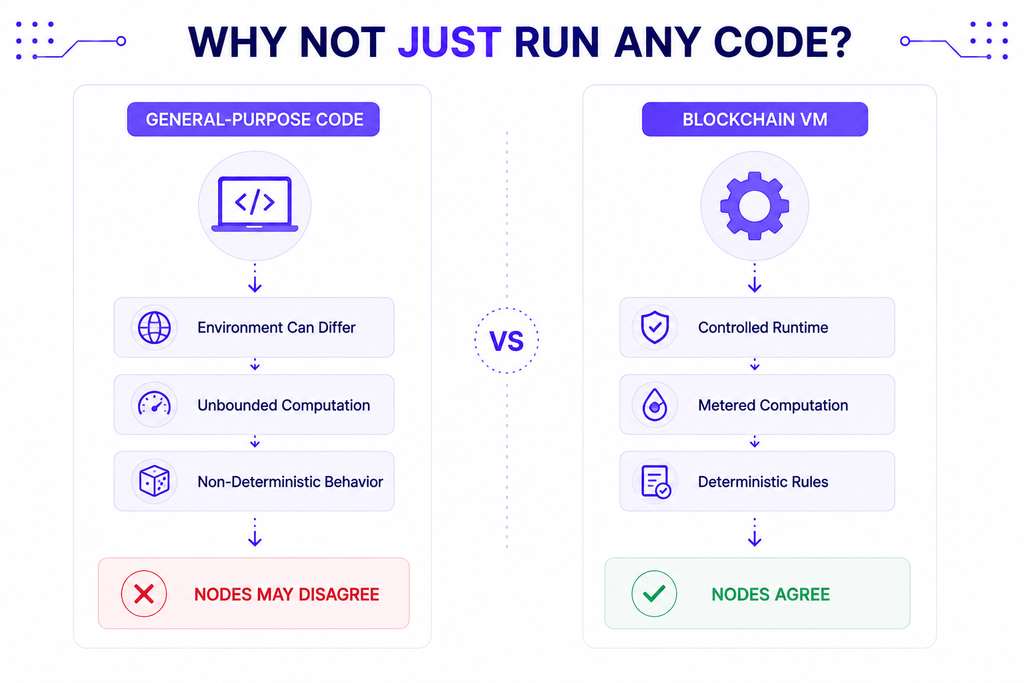
A blockchain virtual machine is the component that executes smart contract code identically on every validator, so the whole network agrees on the result without trusting any single machine. Think of it as a shared calculator: every node runs the same program on the same inputs and must land on the exact same output, or the network can’t reach consensus.
Virtual machine (blockchain context): an isolated runtime environment that executes program bytecode deterministically — the same code and inputs always produce the same output, regardless of which physical computer runs it. This is what lets thousands of independent validators agree on a shared state. See Ethereum’s own definition of the EVM for the concept in its original context.
This is why blockchains don’t just let developers run arbitrary Python or JavaScript on-chain. A general-purpose language has no built-in way to guarantee identical behavior across every machine or to price computation before it runs — exactly what a purpose-built VM solves.
What Is the Solana Virtual Machine, Specifically?
The SVM is Solana’s execution environment: it takes compiled programs, checks their instructions, and applies state changes to accounts. What sets it apart from most other blockchain VMs is that it processes non-overlapping transactions in parallel rather than strictly in sequence.
Solana requires every transaction to declare, upfront, exactly which accounts it will read from and which it will write to. Because the SVM knows this in advance, it can look at a batch of pending transactions and figure out which ones touch completely different accounts — and run those simultaneously across as many CPU cores as the validator has available.
Solana co-founder Anatoly Yakovenko described the goal behind this design plainly in the original write-up introducing it: “What we’ve built in Solana is a runtime that can process tens of thousands of contracts in parallel, using as many cores as are available to the validator,” he wrote in Sealevel — Parallel Processing Thousands of Smart Contracts. That subsystem, called Sealevel, is the part of the SVM responsible for scheduling and running transactions concurrently.
This is critical to understand before anything else about Solana makes sense: nearly every other performance characteristic people associate with the network — low fees, fast confirmations, high throughput — traces back to this one architectural bet on parallel execution.
Why Does Solana Need Its Own Virtual Machine?
Ethereum already had a working virtual machine when Solana launched in 2020, so building a separate one wasn’t a given — it was a deliberate response to a specific bottleneck.
The Problem: Sequential Execution Caps Throughput
The EVM processes transactions one at a time, in the order they appear in a block, even when two transactions have nothing to do with each other. That sequencing is simple to reason about, but it puts a hard ceiling on throughput no matter how fast the underlying hardware gets.
Ethereum mainnet currently processes on the order of tens of transactions per second, a limit rooted in this single-threaded design rather than in bandwidth or storage. Layer-2 rollups work around the limit by moving execution off the base layer, but the EVM itself still executes sequentially wherever it runs.
The Fix: Make Parallelism Possible by Design
Solana’s answer wasn’t to make the EVM faster — it was to design a runtime where parallel execution is the default, not an optimization bolted on afterward. Requiring transactions to declare their account access upfront is what makes that possible: the runtime can prove two transactions won’t conflict before running either one.
The result, according to Solana’s own documentation, is throughput that has reached over 50,000 transactions per second in sustained testnet conditions, and mainnet benchmarks that hit 100,000 TPS in tests reported in August 2025. Real-world mainnet activity typically runs at 3,000–5,000 TPS under normal conditions — still an order of magnitude above what a single-threaded EVM chain can sustain on its base layer.
Who Actually Builds on the Solana VM?
Three groups reach for the SVM because parallel execution and sub-second blocks solve a real problem, not because it’s trendy infrastructure.
DeFi and Trading Applications
On-chain order books, perpetuals exchanges, and automated market makers benefit directly from a runtime that processes many independent trades in the same slot rather than serializing them. Thousands of users swapping different token pairs at once is close to the ideal case for Sealevel’s parallelism, since most of those trades never touch the same accounts.
High-Frequency Consumer and Gaming Apps
Solana’s roughly 400-millisecond block time — confirmed in the official Solana documentation, which notes it can stretch to 600ms under load — makes the SVM viable for applications where users expect near-instant feedback, from in-game economies to consumer apps with frequent microtransactions.
Traders Using Automated Tools
Automated trading tools, including Solana sniper bots, exist because Solana’s block window is too short for a human to react to manually. These tools submit pre-built transactions the instant a trigger fires on-chain, which only works because the SVM confirms transactions in well under a second.
How Does the SVM Actually Execute a Program?
The mechanics explain why the SVM behaves so differently from a sequential VM in practice, not just in theory.
Programs Are Stateless; Accounts Hold the Data
On Solana, a program — the SVM’s term for what other chains call a smart contract — holds only executable code. All the data it operates on lives in separate accounts, passed into the program as part of each instruction.
That separation is deliberate. Because the runtime can see exactly which accounts a transaction will touch before executing anything, it can schedule non-conflicting transactions in parallel — a program bundled together with its own data would make that upfront analysis far harder.
Code Compiles to sBPF Bytecode
Solana programs are typically written in Rust, then compiled through LLVM into Solana Bytecode Format (sBPF), an adaptation of the Berkeley Packet Filter format originally built for network packet filtering in the Linux kernel. The SVM’s execution engine runs this compiled sBPF bytecode directly, rather than interpreting a higher-level language at runtime.
A few concrete limits shape what a program can actually do inside this environment, according to Solana’s developer documentation:
| Resource | Limit |
|---|---|
| Default heap size | 32 KiB (adjustable up to 256 KiB) |
| Stack frame size | 4,096 bytes per frame |
| Max sBPF call depth | 64 levels |
| Max compute units per transaction | 1,400,000 |
| Base fee per signature | 5,000 lamports |
These aren’t arbitrary — each limit exists to keep execution predictable and to make sure one heavy transaction can’t stall the runtime for everyone else sharing the same slot.
Compute Units Price Execution, Not Gas
Rather than Ethereum’s gas model, the SVM meters work in compute units (CU): a default budget of 200,000 CU per instruction, up to the 1,400,000 CU ceiling per transaction. Users can also attach a priority fee — compute unit price multiplied by the compute unit limit — to push a time-sensitive transaction ahead of others in the same block, a mechanism Solana’s fee documentation covers in full.
SVM vs. EVM: What Actually Changes for Developers
The comparison below focuses on the differences that change how you’d actually build something, not just terminology.
| Aspect | Solana VM (SVM) | Ethereum VM (EVM) |
|---|---|---|
| Execution model | Parallel, for non-conflicting transactions | Sequential, one transaction at a time |
| Primary language | Rust (compiled to sBPF) | Solidity (compiled to EVM bytecode) |
| Code/data separation | Programs are stateless; data lives in accounts | Contracts hold both code and storage together |
| Fee unit | Compute units, priced per transaction | Gas, priced per opcode |
| Block time | ~400ms | ~12 seconds |
| Typical mainnet throughput | 3,000–5,000 TPS | Roughly tens of TPS on base layer |
Neither model is a strictly better version of the other — they’re different trade-offs. The EVM’s simpler sequential model has a decade of tooling, auditors, and battle-tested contracts behind it, while the SVM trades some of that maturity for throughput headroom that doesn’t depend on moving activity to a separate layer-2 network.
Developers coming from Ethereum also have to unlearn a few assumptions. A Solidity contract stores its own state directly; an SVM program has to be explicitly handed the accounts it needs for every single instruction, which changes how you design data access from the ground up. Solana’s own migration guide for EVM developers walks through this account model shift in more detail.
Beyond Solana Mainnet: The Wider SVM Ecosystem
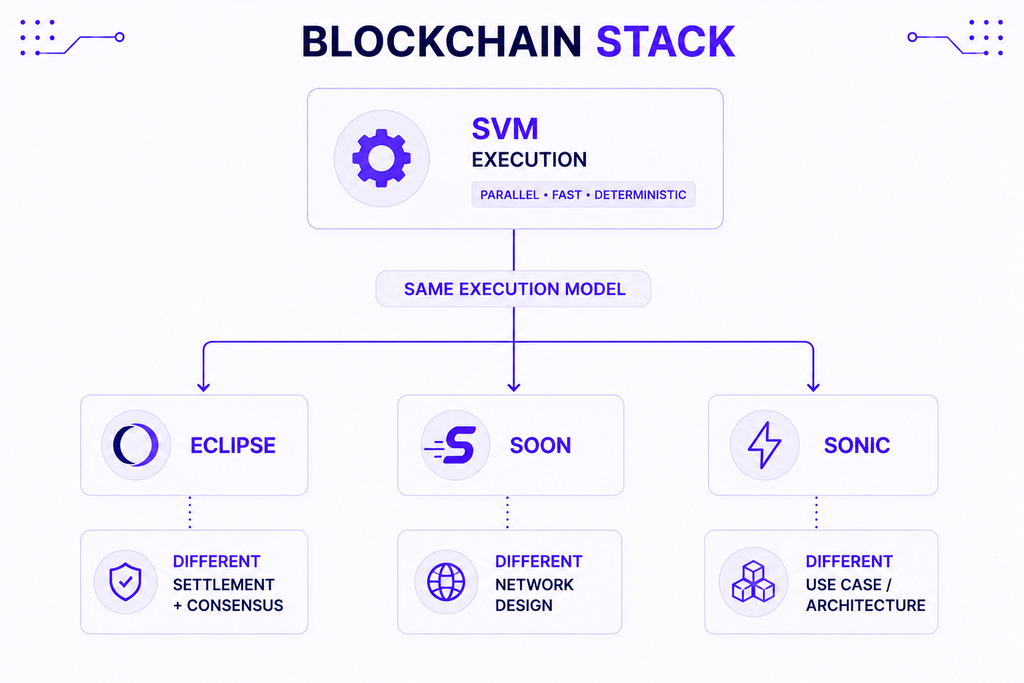
The SVM isn’t locked to Solana’s own base layer. Because it’s an execution engine rather than a full blockchain, other projects have adopted it as the runtime for their own networks, decoupling parallel execution from Solana’s specific consensus and settlement layer.
Eclipse runs the SVM on top of Ethereum, combining Solana-style execution with Ethereum’s existing liquidity and security guarantees. SOON separates the SVM from Solana’s runtime entirely and reports block times as low as 50 milliseconds during high-activity periods. Sonic applies SVM execution specifically to gaming, where high-frequency, low-value transactions are the norm.
This pattern mirrors how the EVM itself became a standard that dozens of chains implement independently of Ethereum. The SVM is increasingly judged on its own technical merits, separate from Solana’s specific token or validator set.
What Client Software Actually Runs the SVM?
The SVM is a specification for how programs execute; validator client software is what actually runs it in production, and Solana now has more than one implementation.
Agave, maintained by Anza (a team that spun out of the original Solana Labs), is written in Rust and is the direct descendant of Solana’s original validator software. Firedancer, built independently by Jump Crypto’s engineering team in C++, went live on mainnet in December 2025 after roughly three years of development and has demonstrated 1.1 million transactions per second in synthetic benchmarks — though real mainnet throughput remains far lower, since benchmarks measure raw execution capacity under ideal conditions rather than live network load.
It’s worth keeping the SVM separate in your head from Solana’s consensus layer, which is a different subsystem entirely and is getting its own overhaul through the Alpenglow upgrade. The SVM decides how a transaction executes once it’s included in a block; consensus decides when that block becomes final. Both matter for overall speed, but they solve different problems.
Two independently built clients running the same SVM specification matters for a reason unrelated to speed: if a bug exists in one client’s code, a network running only that client can agree on an incorrect result by mistake. Multiple implementations make that kind of systemic bug far less likely, which is why client diversity is tracked as its own health metric, not just a performance story.
How Do Developers Reach the SVM Without Running a Validator?
Building on the SVM doesn’t require running Solana’s full validator software, which demands substantial hardware and continuous synchronization with the network. Most developers instead connect to a node run by an infrastructure provider through a standard interface.
NOWNodes provides API-based access to Solana nodes as part of its coverage across 120+ blockchain networks, letting an application read account state, simulate transactions, or broadcast signed instructions to the SVM without the team deploying and maintaining Solana infrastructure itself. That’s a different problem from the SVM’s execution model — it’s about how an application reaches the network, not how the network processes what it receives — but the two are connected: an application built for Solana’s speed still needs a connection fast enough not to become the bottleneck itself.
Conclusion
The Solana virtual machine earns its separate identity from one structural choice: transactions declare their account access in advance, letting the runtime execute unrelated transactions in parallel instead of one at a time. That decision produces Solana’s sub-second blocks, its compute-unit fee model, and its throughput headroom over sequential virtual machines like the EVM.
Whether that trade-off is right for a given project depends on what it needs. An application processing many independent, high-frequency transactions — trading, gaming, consumer apps — tends to fit the SVM’s strengths, while one that values a decade of tooling maturity and auditor familiarity may still lean toward the EVM. The SVM’s growing use outside Solana’s own base layer, from Eclipse to SOON, suggests it’s being evaluated as infrastructure in its own right, not just as one blockchain’s internal engine.
FAQ
Is the Solana VM the same thing as Solana?
No. Solana is the full blockchain network, including its consensus mechanism, validators, and token economics. The SVM is specifically the execution engine inside that network — and, as chains like Eclipse show, it can run on infrastructure outside Solana entirely.
Can Solidity contracts run on the SVM?
Not directly. Solidity compiles to EVM bytecode, which the SVM doesn’t execute. Projects that want EVM compatibility on Solana-adjacent infrastructure typically use a separate compatibility layer, such as Neon EVM, rather than running Solidity natively on the SVM.
What language do SVM programs use?
Rust is the primary language for Solana programs, compiled through LLVM into sBPF bytecode. C and C++ are also supported through the same LLVM toolchain, though Rust dominates the ecosystem’s tooling and documentation.
Does parallel execution mean every transaction runs at the same time?
No — only transactions that don’t share the same accounts can run concurrently. Two transactions that both write to the same account still have to execute in order, since letting them run simultaneously would create an unpredictable result.
Is the SVM open source?
Yes. Both major validator client implementations — Agave and Firedancer — are open source, and their code is publicly available for review, which is part of how independent audits and client-diversity tracking are possible in the first place.