
A Firo explorer is a website that lets you look up blocks, transactions, and transparent addresses on the Firo network without running a node yourself. Firo is a privacy coin, so an explorer here shows less than it does on Bitcoin, and that is by design. The official Insight explorer and CryptoID cover FIRO, while developers who need the same data inside an application can pull it from an indexed API.
This guide explains what a Firo explorer can and cannot show, who relies on one, how a supply flaw found in August 2026 made public lookups newly relevant, and how the available tools compare.
What Is a Block Explorer for FIRO?
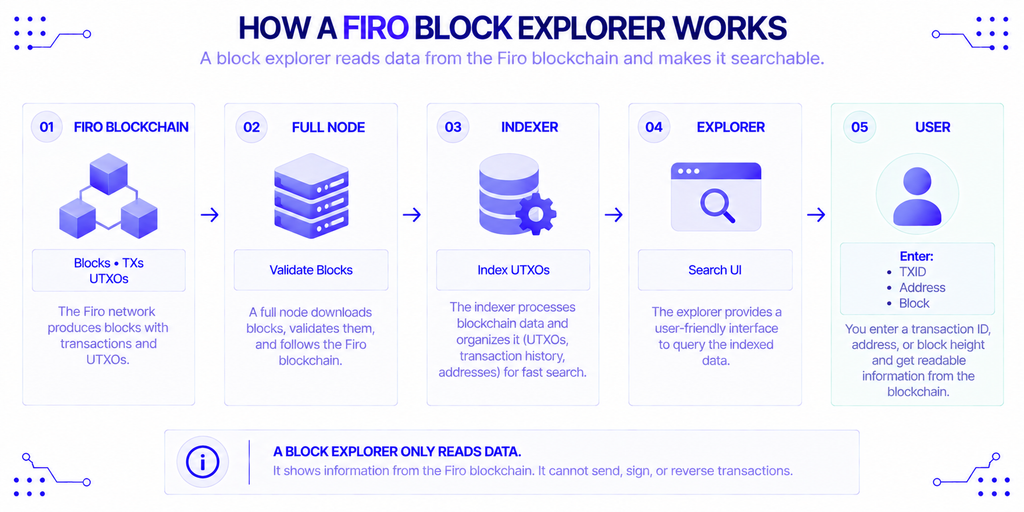
A block explorer for FIRO is a search interface over an indexed copy of the Firo blockchain. You enter a block height, transaction ID, or address, and it returns the matching record in a readable page. It is read-only: it cannot send, sign, or reverse anything.
Firo launched on September 28, 2016 as Zcoin and took its current name in October 2020, according to Wikipedia. The network targets one block every 2.5 minutes, and Firo’s FAQ notes that roughly 1 in 400 blocks can take longer than 15 minutes. That variance matters when you are staring at an unconfirmed payment.
Firo inherits Bitcoin’s transaction model, where a balance is the sum of unspent outputs rather than one stored number (UTXO vs account model). Behind every explorer sits a full node that validates blocks and an indexer that reorganizes the data so lookups return instantly.
Why Do You Need a Block Explorer for FIRO?
You need one to check what the network recorded, as opposed to what your wallet believes happened. When a deposit goes missing, the transaction ID settles the question in seconds.
Common situations include:
- A missing deposit. The transaction ID shows whether coins were broadcast, confirmed, or never sent.
- A pending payment. Zero confirmations means the transaction is waiting in the mempool, the network’s queue of unconfirmed transfers.
- Network checks. Difficulty, hashrate, and masternode counts show whether the chain is healthy.
Firo adds a second reason. Masternodes form quorums that provide ChainLocks, which the Firo FAQ describes as single-block finality against 51% attacks, and InstantSend, which finalizes transfers in a few seconds. An explorer is where you see whether a transaction has actually picked those up.
Who Relies on FIRO On-Chain Lookups?
The audience runs from someone checking a single payment to teams reconciling thousands of them.
- Holders and traders confirm that an exchange withdrawal arrived.
- Merchants watch an address for an incoming payment before releasing goods.
- Masternode operators and miners track block production, rewards, and difficulty.
- Developers test wallet and payment code against real chain data.
- Analysts and auditors verify circulating supply and follow the movement of transparent funds.
A trader needs a fast page and a confirmation count. An exchange integration needs an API it can query on a schedule, which changes which tool fits, as the comparison below shows.
What Can You See on a Privacy Coin’s Public Ledger?
Less than you would on Bitcoin. Firo’s privacy protocol, Lelantus Spark, went live on mainnet on January 18, 2024. According to the Firo announcement, it “hides sender, receiver and amounts while everyone can still verify the blockchain state through the use of zero-knowledge proofs.”
Reuben Yap, Firo’s Project Steward, framed the trade-off this way: “There are only a handful of cryptocurrency privacy protocols in meaningful use today, each with different trade-offs. We believe Lelantus Spark represents a holistic balance of high anonymity, simplicity and flexibility while remaining true to the spirit of trustlessness in cryptocurrencies.” (Bitcoin.com News)
Which Address Types Show Up in an Explorer?
Firo has three address types that behave differently in a lookup, and mixing them up is the most common source of confusion.
| Address type | Format | What to know |
|---|---|---|
| Transparent | Standard public address | Yes: balance, history, and amounts |
| Spark | Prefix sm, 144 characters | No: not searchable on the blockchain or an explorer |
| Exchange | Prefix EX, 36 characters | Built for services; cannot directly receive Spark or Lelantus funds, mining rewards, or masternode rewards |
The format details come from the Spark launch post. Mining and masternode rewards, as well as Spark and Lelantus funds, cannot go straight to an exchange address; they must move through transparent addresses first.
Practically, that means you can follow transparent transfers, but you cannot look up a Spark wallet’s balance. A user who pastes a Spark address into a Firo explorer and gets no result has not made a mistake.
How Can Anyone Trust Hidden Amounts?
The proofs are checked by every node, not by people reading a page. Spark has a peer-reviewed design paper (Lelantus Spark, IACR ePrint 2021/1173), and the launch went through two cryptographic audits plus a code audit. Still, the fact that amounts are hidden makes total-supply auditing harder, and 2026 showed why.
Why Did the August 2026 Spark Flaw Matter for Explorers?
A cryptographic flaw disclosed on August 1, 2026 allowed forged coins in multi-input Spark transactions. Single-input spends were unaffected. Firo’s incident report says researchers generated roughly 200 FIRO to validate the finding, with no other inflation detected, and that wallets and private keys were never at risk.
The response had two steps. Version 0.14.17.2 temporarily limited Spark to single-input spends, and v0.14.18.0 delivered the permanent fix through a hard fork. Per the release notes, activation was set for block 1,371,000, around September 4, 2026, with no migration required for existing Spark coins.
For anyone using a Firo explorer, the lesson is practical. Node operators and services that did not upgrade would fall off the network at the activation block, so an explorer that stops advancing is a red flag worth checking against a second source. It also shows why supply monitoring matters on a chain where individual amounts are hidden: the visible totals are one of the few checks an outsider can run.
Which Block Explorers Cover FIRO?
The choice is narrower than for Bitcoin. Two public tools dedicated to FIRO are worth knowing, and the third option is building your own data layer.
| Tool | Best for | Standout feature |
|---|---|---|
| Firo Insight explorer | Everyday lookups and testing | Official; separate testnet instance; Insight API |
| CryptoID | Network and holder analytics | Rich list, hashrate distribution, orphan tracking |
| Indexed API (self-built) | Applications and reconciliation | Programmatic access to balances, blocks, transactions |
Features change, so confirm details on each site.
Official Firo Insight Explorer
The official Insight explorer shows blocks, transactions, mining difficulty, and hash data, and it includes message verification and a transaction broadcast tool. It references the Insight API for programmatic queries. A separate testnet explorer is available, which helps developers avoid mixing test coins with mainnet activity.
CryptoID
CryptoID’s Firo page covers price, market cap, masternode count, difficulty, and outstanding supply. Its stronger side is analytics: a “Richest FIRO Addresses” list, holdings-percentage charts, hashrate distribution across pools, and orphaned-block tracking. CryptoID also offers experimental wallet grouping through taint analysis, which it says is inaccurate and not updated in real time, so treat it as a hint rather than evidence.
Building Your Own Layer
Some teams outgrow manual lookups. A wallet showing balances, a merchant tool matching payments, or a dashboard tracking masternode payouts all need data delivered to code, not to a browser tab.
How to Look Up a FIRO Transaction
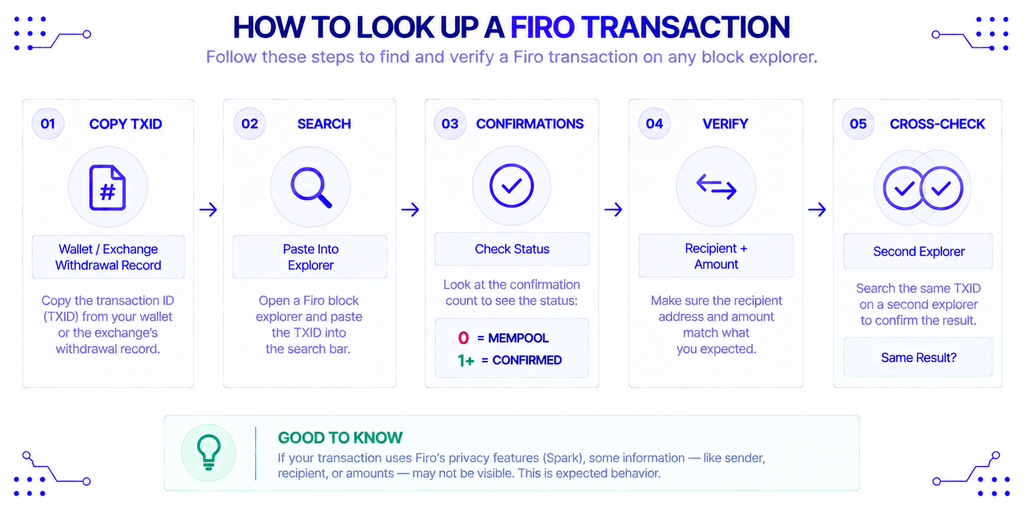
The steps are the same on any Firo explorer:
- Copy the transaction ID from your wallet or the exchange’s withdrawal record.
- Paste it into the search bar.
- Check the confirmation count. Zero means the transaction is still in the mempool.
- Compare the recipient address and amount with what you expected.
- If the result looks wrong, search the same ID on a second explorer.
Remember the limits from earlier. A Spark transaction will not reveal its parties or amounts, and a Spark address will not return a wallet page. If your payment involves only private funds, the absence of detail is normal.
Where Does Explorer Data Come From?
Every explorer runs a synced Firo node and an indexer on top of it. Operating both yourself takes disk space, upgrades, and attention, and the August 2026 hard fork showed what missing an upgrade costs.
NOWNodes provides that layer as a service. Its Firo node page lists shared and dedicated access, archive mode, Debug and Trace API, WebSocket, and the Blockbook API. Blockbook is the indexed interface for balances, transactions, blocks, and address history, currently offered on 30+ networks including Firo.
The free Start plan includes 100,000 API requests, enough to prototype a lookup feature. NOWNodes does not operate a public Firo explorer, so the value is on the application side: the same kind of indexed data an explorer displays, returned as JSON. For a deeper look at the protocol itself, see NOWNodes’ guide to Firo privacy and Lelantus Spark.
What Risks and Limits Should You Know?
No single explorer is final. Indexers can trail the chain tip, so a confirmed transaction may look pending on one site and settled on another. Cross-check anything surprising.
Never enter a seed phrase or private key into an explorer or a “wallet checker.” A legitimate lookup needs only a public address, transaction ID, or block reference.
Privacy has a timing dimension too. Firo’s own advice during the flaw response was to wait until the hard fork before spending via Spark, “to avoid amount-correlation analysis.” Transparent addresses, by contrast, are fully readable: anyone who links an identity to one can follow its history in any Firo explorer.
Conclusion
A Firo explorer gives you a verified view of the parts of the chain that are meant to be public: blocks, difficulty, masternodes, supply, and transparent transfers. The official Insight explorer is the default for lookups, CryptoID adds analytics, and the shielded side of Spark stays out of reach by design.
For a single payment, check two explorers and move on. For a product, decide early whether a browser lookup is enough or whether the data belongs in your own backend.
FAQ
Can I see my Spark balance on a block explorer?
No. Spark addresses are not searchable on the blockchain or an explorer, so balances and history are visible only in your own wallet.
Does Firo have a testnet?
Yes. The Firo project runs a separate testnet explorer, and testnet coins carry no market value. Developers use it to test wallet and payment flows safely.
Why does my Firo deposit show zero confirmations?
The transaction is in the mempool waiting for a block, and Firo’s target is 2.5 minutes per block. InstantSend can finalize eligible transfers within seconds, but exchanges set their own confirmation rules.
What is the maximum supply of FIRO?
21.4 million FIRO, with emission fixed at 6.25 FIRO per block until the cap, then a tail emission of 1 FIRO per block. Since block 958,655, rewards split 70% to masternodes, 5% to miners, 15% to development, and 10% to the community fund, per Firo’s tokenomics post.
How much collateral does a Firo masternode need?
1,000 FIRO, which is refundable, according to the Firo FAQ.