

A crypto loan lets you borrow cash or stablecoins by pledging Bitcoin, Ethereum, or another cryptocurrency as collateral, without selling the asset itself. You keep your position, the lender holds your crypto as security, and you walk away with liquidity to spend, invest, or cover a bill.
This isn’t a fringe corner of crypto anymore. Crypto-collateralized borrowing hit a record $73.6 billion in the third quarter of 2025, then cooled to $56.16 billion by Q2 2026 as institutions deliberately trimmed leverage, according to Galaxy Research. Even after that pullback, the market is roughly six times bigger than it was at the start of 2024.
This guide covers what a crypto loan is, why people borrow this way instead of just selling, and how the leading platforms compare on rate and risk. It also answers a question a lot of searches get wrong: what’s actually possible if you want to borrow crypto without collateral.
What Is a Crypto-Backed Loan?
A crypto-backed loan is a lending agreement where cryptocurrency secures the debt instead of a credit check or a paycheck. You deposit crypto with a lender, receive cash or stablecoins in return, and get your original collateral back once you repay what you borrowed plus interest.
Crypto-backed loan is a loan in which a borrower pledges cryptocurrency as collateral to receive fiat currency or stablecoins, typically without a credit check, with the collateral held until the debt is repaid. See Coinbase’s overview of how crypto-backed loans work.
Say you hold 1 BTC and need $20,000 for a home repair. At a 50% loan-to-value ratio, a lender advances that amount against roughly $40,000 worth of BTC — you keep your Bitcoin exposure and repay on your own schedule.
The appeal comes down to one trade-off: selling crypto to raise cash usually triggers a taxable event and permanently closes out your position, while borrowing against it does neither — Coinbase, for one, doesn’t treat an on-platform loan as a taxable sale. That convenience isn’t free: you still pay interest, and if the collateral’s price falls far enough, the platform can liquidate it without asking, a mechanic covered in detail below.
Why Do People Borrow Against Their Crypto?
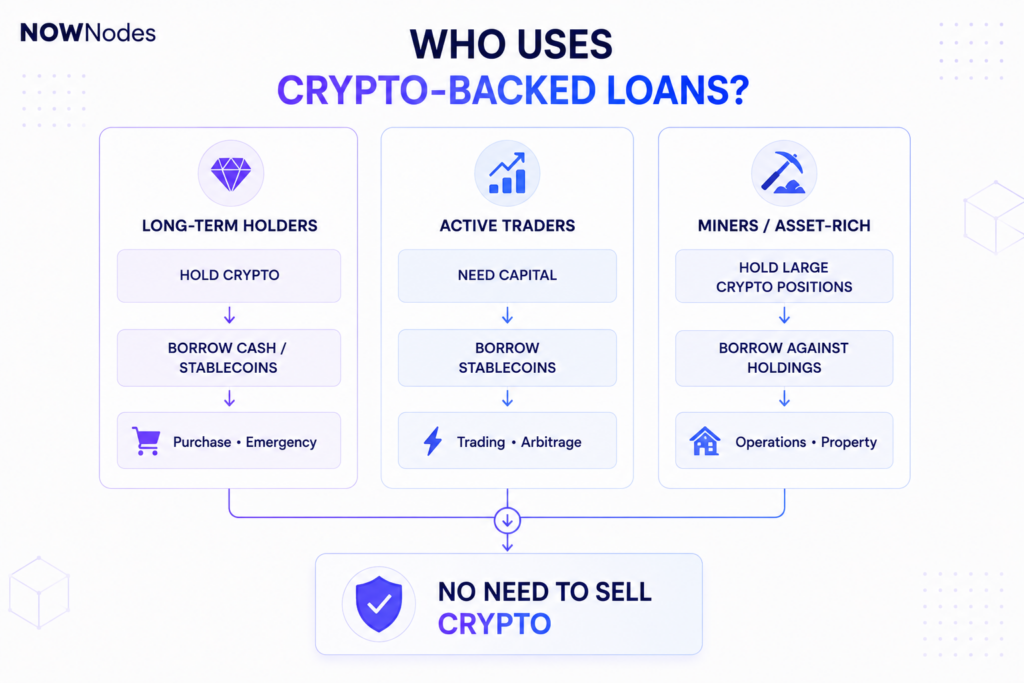
Plenty of people are asset-rich and cash-poor, holding crypto wealth that a traditional bank won’t recognize as collateral. The Crypto Loan Platforms that do accept it move in hours rather than weeks, since the collateral sits on a transparent, instantly verifiable ledger instead of behind an income check.
A few groups account for most of Crypto Loan Platforms activity:
- Long-term holders who want cash for a purchase or emergency without selling a position they expect to appreciate.
- Active traders who borrow stablecoins to fund positions or arbitrage opportunities, often through DeFi protocols directly.
- Bitcoin miners and asset-rich individuals, who borrow against holdings rather than sell at that week’s price — Coinbase has become one of the largest lenders to mining companies for this reason, per Bloomberg, and now powers crypto-backed conforming mortgages with lender Better for homebuyers who’d rather not liquidate first.
Retail borrowers dominate by number of loans, but institutions dominate by dollar volume. That imbalance is a big reason the market swings hard when large players adjust risk, as the 2026 pullback showed.
How Does Borrowing Against Crypto Actually Work?
Loan-to-Value and Liquidation, Explained
Every crypto loan is built around one number: the loan-to-value ratio, or LTV. It determines both how much you can borrow and how close you are to losing your collateral.
Loan-to-value (LTV) is the size of a loan expressed as a percentage of the collateral’s value. A $5,000 loan against $10,000 of Bitcoin is a 50% LTV. See Aave’s explanation of health factor and liquidations.
A lower LTV means a bigger cushion against price swings; a higher LTV means more borrowing power and less room for error. Cross a platform’s liquidation threshold — commonly 70%–86% LTV, depending on the platform — and it sells enough collateral automatically to bring the loan back into range, whether or not that’s convenient for you. On Coinbase, crossing its 86% maximum triggers automatic liquidation plus a penalty fee.
Custodial (CeFi) vs. On-Chain (DeFi) Lending
Crypto loans come from two structurally different types of platforms, and the difference matters more than any single rate. Centralized lenders like Nexo, Ledn, and Figure work like a company you open an account with: they run KYC checks, custody your collateral directly, and handle everything through a dashboard. The trade-off is counterparty risk — you’re trusting the company’s solvency, not just the market.
Decentralized protocols like Aave, Compound, and Spark replace the company with code: smart contracts hold your collateral, set the rate algorithmically based on supply and demand, and liquidate automatically if you breach the threshold, with no one approving the loan in the first place. You trade counterparty risk for smart contract risk instead — worth weighing against a smart contract auditing firm’s track record before committing serious funds.
Both models depend on the same thing underneath: an accurate, real-time read of collateral prices and on-chain balances, since a liquidation bot can only act as fast as the data feeding it. Most platforms reach that through a provider like NOWNodes rather than running nodes for every chain themselves.
How the Leading Platforms Compare in 2026
The table below covers five Crypto Loan Platforms with real usage and published terms, spanning both CeFi and DeFi. Rates and limits shift constantly, so treat this as a snapshot, not a live quote.
| Platform | Type | Collateral | Max LTV | Rate (2026) | Notable trait |
|---|---|---|---|---|---|
| CoinRabbit | CeFi | 345+ assets, incl. BTC, ETH, XRP | 90% | From 11.95%, fixed | No approval stage; funds in 10 minutes |
| Nexo | CeFi | 100+ assets, incl. BTC, ETH, stablecoins | 90% (stablecoins); 50% (BTC/ETH) | From 1.9%/year | Instant approval; $50–$2M range |
| Ledn | CeFi | Bitcoin only | 50% | 9.25%–11.49% | No collateral rehypothecation |
| Coinbase | CeFi, Morpho-powered | BTC, ETH, SOL, ADA, XRP, LTC, DOGE | 86% | From ~5.1% | Not a taxable event; US only, excl. NY |
| Aave | DeFi | 100+ assets | ~90%+ for correlated stablecoin pairs; lower for volatile assets | Variable, market-set | No minimum loan; DAO-governed |
| Figure | CeFi | BTC, ETH, SOL | 75% | ~8.9%–11.5% base | US-regulated; MPC custody; own blockchain |
CoinRabbit runs on 100% reserves and never re-lends client collateral, which sits in segregated cold storage with multisig access. On terms it is the most flexible CeFi name here: 345+ assets accepted, LTV up to 90%, and an APR from 11.95% that stays fixed for the life of the loan. There is no approval stage and no credit check, since the collateral underwrites the loan. Funding takes 10 minutes, and loans start from $25 depending on the asset.
Nexo’s draw is flexibility: 100+ collateral assets and rates from 1.9% a year, with funds typically arriving within hours. That headline rate depends on loyalty tier and which asset you post, so it isn’t guaranteed to every borrower.
Ledn keeps things narrow on purpose, accepting Bitcoin only and contractually refusing to rehypothecate (re-lend) customer collateral. For a bitcoin-only borrower who values custody integrity over asset variety, that focus is the entire pitch.
Coinbase’s loans run on Morpho, a DeFi protocol, rather than a proprietary ledger — an unusual hybrid where a centralized brand sits on transparent on-chain infrastructure. It’s currently limited to US residents outside New York, but supports the widest collateral range among major CeFi names.
Aave is the largest DeFi lending protocol by scale, with roughly $12.7 billion in total value locked and about $10 billion in active borrows across 22 chains, per CoinLaw. There’s no minimum loan and no company to apply to — you manage your own liquidation risk without a support line to call.
Figure operates as a fully US-regulated lender on its own Provenance blockchain, using multi-party computation custody instead of a simple hot wallet. That suits borrowers who specifically want a domestically compliant lender, though a $5,000 minimum prices out smaller borrowers Nexo or Aave would accept.
Is a Loan Without Collateral Actually Possible?
Searches for a crypto loan without collateral or free crypto loans without collateral are common, but no legitimate platform hands a stranger cash based on nothing. Three very different things sit under that label, and only one is remotely relevant to an everyday borrower.
Flash Loans: Real, but Not for Retail Cash
A flash loan lets you borrow any amount with zero collateral, on the condition that you repay it inside the very same blockchain transaction — if repayment doesn’t happen before that transaction finishes, the entire loan reverses as though it never occurred, per Chainlink’s technical explainer. Aave pioneered the mechanism and remains one of the primary crypto flash loan providers, alongside protocols traders use to route trades across a decentralized exchange mid-transaction.
This isn’t a loan you can spend on rent. It exists purely for split-second, code-driven operations — arbitrage, liquidations, collateral swaps — executed by developers, not as a source of walking-around cash for an individual.
Undercollateralized Lending, for Institutions Only
A second category extends real, spendable credit with little or no crypto collateral, but only to KYC-verified institutional borrowers whose creditworthiness is underwritten off-chain, much like a corporate loan. Maple Finance is the largest name running this model, carrying roughly $2.1 billion in total value locked with $1.8 billion actively borrowed — the highest utilization of any major lending protocol tracked in 2026, per CoinLaw.
The “Free Loan, No Collateral” Scam Pattern
This is critical: any ad promising an instant, no-collateral crypto loan to an individual borrower — no KYC, no credit check, no catch — is a scam pattern, not a product. The usual hook asks for a small “activation” or “insurance” deposit upfront, which simply disappears. Treat that phrase as something scammers optimize for in search results, not a real offer sitting behind it.
What Are the Risks of Pledging Your Crypto?
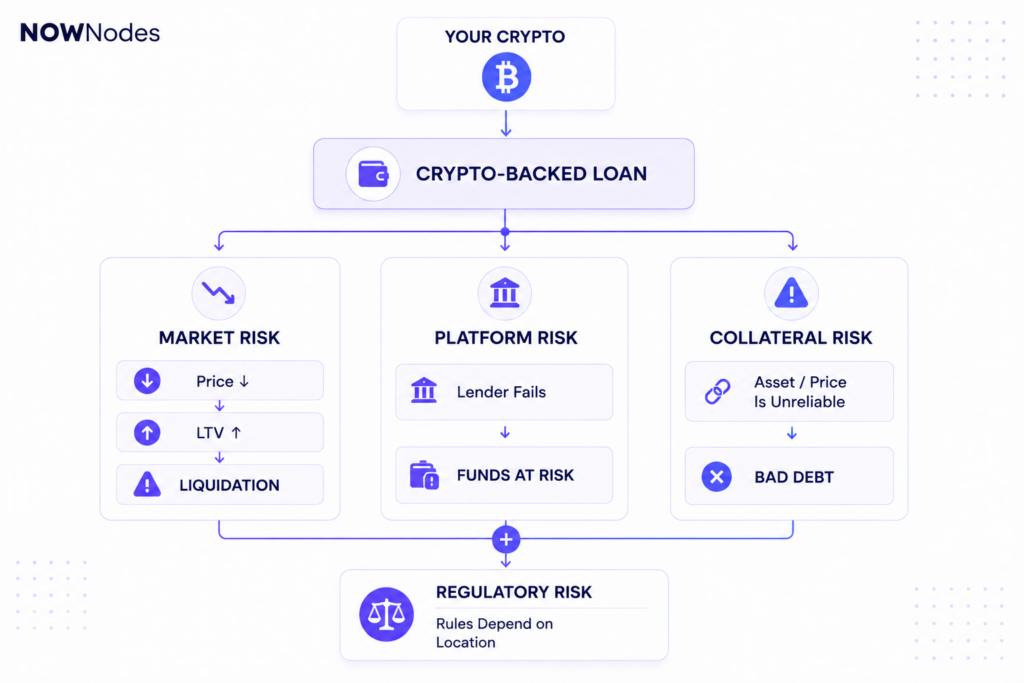
Volatility is the risk that catches people off guard first. Crypto can move 20% in a day, and a loan sized comfortably at 50% LTV during a calm week can be one bad weekend away from a liquidation notice.
Counterparty risk is the other side, and it isn’t theoretical. Celsius, Voyager, BlockFi, and Genesis collectively owed customers tens of billions at their peaks before filing for bankruptcy between July 2022 and January 2023; Celsius alone left users in a recovery process that reached only about 65% of claims by August 2025, three years later, per Cryptonomist. None of those four were DeFi protocols — all were CeFi lenders that gambled with customer collateral instead of holding it as promised.
Even a well-collateralized loan can turn bad if the collateral itself isn’t what it appears to be. Peter Chung, Head of Research at Presto Research, described this exact failure mode after a 2026 exploit exposed the weakness in on-chain lending markets: “It’s similar to conning a traditional bank by depositing fake fiat and taking out loans against it, ultimately leaving the lender with bad debt,” he told CoinDesk. Reputable platforms manage this by restricting collateral to well-established, liquid assets rather than accepting anything with a price feed attached.
Location changes what’s available, too. In the EU, every lending platform serving retail customers needed a MiCA license by December 30, 2024, with the transition window for unlicensed providers closing entirely on July 1, 2026, per ESMA. The US still has no single federal framework — Crypto Loan Platforms register piecemeal as money service businesses under state law — and the UK’s FCA finalized its core cryptoasset rules in July 2026, signaling that stablecoin-based yield structures will face extra scrutiny rather than being treated as simple payment tools, per Skadden.
How Do You Pick the Right Platform?
Matching Crypto Loan Platforms to your risk tolerance matters more than chasing the lowest advertised rate. Before funding a loan, work through these steps:
- Check the liquidation threshold, not just the max LTV. A platform advertising 90% LTV is only safe once you know where forced liquidation actually kicks in.
- Confirm whether your collateral gets rehypothecated. Platforms that re-lend customer collateral carry more risk than ones, like Ledn, that contractually don’t.
- Verify licensing in your region. A platform operating without a MiCA license in the EU, or proper state registration in the US, is a legal risk regardless of its rates.
- Start with a low LTV on your first loan. Borrowing well below the maximum leaves room to survive a downturn without scrambling to add collateral.
- Read the liquidation process before you need it. Know whether the platform partially liquidates as you approach the threshold or closes the full position at once — that matters during a fast market move.
Conclusion
A crypto loan is a useful tool for one specific situation: you hold crypto you don’t want to sell, and you need cash now. Used at a conservative LTV, on a platform with clear licensing and no history of rehypothecating collateral without consent, it does exactly that.
The version of this search that doesn’t exist is a truly free, no-collateral loan handed to a retail borrower — that’s either an institutional credit product you don’t qualify for, or a scam wearing a search-friendly headline. Compare Crypto Loan Platforms on liquidation mechanics and regulatory footing first, and let the interest rate be the tiebreaker, not the headline.
FAQ
Is a crypto loan taxable?
In most jurisdictions, taking out a loan against crypto collateral isn’t itself a taxable event, since you haven’t sold the asset. If your collateral gets liquidated to cover the loan, that liquidation is typically treated as a sale and can trigger capital gains tax, so check current guidance with a tax professional.
Can you get a crypto loan with bad credit or no credit check?
Yes — most platforms skip credit checks entirely because the loan is secured by collateral worth more than the amount borrowed, not by your credit history. That’s one of the main draws for borrowers who’d struggle to qualify for a traditional bank loan.
What happens if you can’t repay a crypto loan?
Your credit score is unaffected, since most platforms don’t report to credit bureaus, but you do lose your collateral. If you stop making progress toward repayment, the platform liquidates enough of your pledged crypto to cover the balance and fees, returning whatever is left over.
What’s the difference between a crypto loan and margin trading?
A crypto loan gives you cash or stablecoins to spend anywhere, backed by a separate collateral asset, while margin trading borrows funds specifically to buy more of an asset within a trading platform and can’t be withdrawn as cash. Both rely on similar liquidation mechanics, but they serve different purposes.