
A dedicated node provider runs a blockchain node that only your application uses, so nobody else’s traffic competes with yours for CPU, disk or bandwidth. You pay a flat monthly fee for that isolation instead of paying per request. It costs more than a shared plan, and for the right workload it’s worth it. A good dedicated node provider also handles syncing, updates and monitoring for you.
This guide starts with the basics of crypto node hosting: what the service is, why teams leave shared endpoints, and who runs on private infrastructure. From there it gets into the technical layers, such as clusters, archive access and hardware, and then compares seven providers side by side.
What Is Managed Private Node Hosting?
Crypto node hosting means a service where a company deploys, syncs and maintains a blockchain client on rented hardware, and you connect to it over an API. A node, as ethereum.org defines it, is a computer running client software that is connected to other computers running the same software.
On a shared plan, thousands of customers send requests to the same pool of machines. In a private setup, the machines serve one customer only. That second model is what a dedicated node provider sells.
The difference shows up in three places: who competes for resources, how much you can configure, and how the bill is calculated. Shared plans meter requests. Private crypto node hosting usually bills for the server, its storage and its region.
Why Do Teams Outgrow Shared Endpoints?
Teams outgrow shared endpoints when limits, missing methods or reliability start costing more than the server would. A dedicated node provider removes all three problems, and here’s how they usually show up.
Rate limits come first. NOWNodes’ free public endpoints, for instance, are capped at 5 requests per second, and its free Start plan at 15. A trading bot or an exchange back end can burn through that in a second.
Missing methods come next. Trace and debug calls, which expose internal contract calls and let you replay transactions, are heavy on the node, so shared plans often limit them. A private machine can expose them.
The third reason is concentration risk. On 11 November 2020, an unannounced fix for a bug in Ethereum’s Geth client split the chain for services still running old versions, and Infura’s Ethereum API went down. Binance temporarily closed withdrawals, according to The Block.
Paolo Ardoino, CTO of Bitfinex, drew the lesson at the time:
“While Infura is offering an important service to the crypto industry, exchanges should not fall into the trap of depending upon centralized parties while being in a decentralized industry like crypto.” — Paolo Ardoino, Bitfinex CTO, quoted by The Block
That was a shared provider failing all its customers at once. Private infrastructure doesn’t remove the dependency, but it does shrink the group that goes down with you.
Why Not Just Run the Node Yourself?
Because the hardware bill is real, and crypto node hosting spreads it across many customers. Ethereum’s own guidance lists 16 GB of RAM and a 2 TB NVMe SSD as the minimum, and 32 GB with 4 TB as the recommended setup, per ethereum.org. A consensus client adds roughly 200 GB on top.
Archive mode is heavier still. Geth, Nethermind and Besu need 12 TB or more for a full archive, while Erigon and Reth get by with about 2.2 to 2.5 TB. Then someone has to patch, resync and monitor the machine at 3 a.m.
Ethereum’s docs also note the trade-off of renting: cloud providers offer high uptime and static IPs, but you’re trusting a third party. Hosting is a business decision, not a way around that.
Who Uses Single-Tenant Infrastructure?
Anyone whose product breaks when the endpoint slows down. These are the groups that most often hire a dedicated node provider, and the reasons differ:
- Exchanges and payment processors, which need steady deposit detection and withdrawal broadcasting with no throttling during volatility.
- Trading and MEV bots, where a few milliseconds of latency, and a stable region close to the network’s validators, decide whether a transaction lands.
- Explorers and analytics platforms, which query years of chain history and hit archive data constantly.
- Wallets with large user bases, where one shared quota would be split across millions of balance checks.
- Rollups, bridges and indexers, which need consistent block data and custom client configuration.
A small dApp with a few hundred users almost never needs a dedicated cluster or its own server. A shared plan covers it for a fraction of the cost.
Single Instance vs Multi-Node Cluster: Which Setup Do You Need?
A single instance is one node on one server. It’s the cheapest private option, and it’s a single point of failure. If the machine dies or needs a resync, your endpoint goes with it.
A dedicated cluster groups two or more nodes for the same chain behind a load balancer, so traffic fails over when one node drops out. Alchemy, for example, describes its Dedicated Clusters as two or more nodes per chain per region, with automatic failover to its shared fleet during spikes. NOWNodes lists multi-instance clusters as an option too.
Here’s the practical rule. If an hour of downtime costs you money, or you need to upgrade clients without going dark, a dedicated cluster pays for itself. If you’re running an internal analytics job that can wait, a single instance is fine.
Shared vs Private: How the Two Models Compare
| Area | Shared plan | Private (single-tenant) |
|---|---|---|
| Infrastructure | Pooled across customers | Reserved for one customer |
| Billing | Requests or compute units | Server, storage and region |
| Rate limits | Plan-dependent | Set by hardware, not by quota |
| Method access | Standard set | Broader; trace, debug, archive on request |
| Setup effort | Minutes | Minutes to days, depending on the provider |
| Typical fit | Development, moderate load | High load, private or specialized workloads |
Neither model is universally better. Shared is the right start for most teams, and private is the right move once limits or isolation matter.
Which Providers Offer Private Node Infrastructure?
Seven providers cover most use cases, and each dedicated node provider below sells a slightly different flavor of isolation. The table gives the headline numbers, and the notes below explain what separates them. Pricing for private setups is often quote-based, so treat every figure as a starting signal.
| Provider | Chains | Pricing signal | Standout detail |
|---|---|---|---|
| NOWNodes | 120+ | Quote-based | One node per network, no predefined RPS limit, 99.99% uptime on the product page |
| Chainstack | 70+ | Pro plan from $199/month plus compute and storage | Published pricing; Geth and Erigon; US, Europe, APAC |
| QuickNode | 80+ | Enterprise from $999/month ($849 billed annually) | Dedicated Clusters; SOC and ISO reports on request |
| Alchemy | 100+ | Fixed monthly, quote-based | SOC 2 Type II; custom tracers and binaries |
| Blockdaemon | 30+ on product page | Quote-based | 70+ points of presence, cloud and bare metal |
| GetBlock | 130+ | $1,000+/month full, $1,500+/month archive | Frankfurt, New York, Singapore |
| Allnodes | 95 | Varies by service | Bare metal hosting, masternodes and validators |
The GetBlock figures come from Alchemy’s provider comparison, which is a competitor’s page, so confirm them with GetBlock directly.
NOWNodes
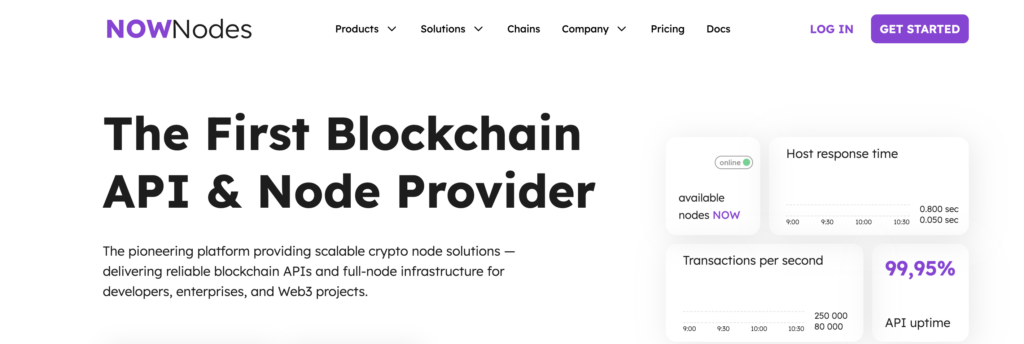
NOWNodes deploys an isolated node for one customer on one blockchain network, with a choice of region and client, including Geth, Erigon, Blockbook or custom indexing. It supports private IP whitelisting and full method access, including Trace and Debug.
The product page quotes setup from 15 minutes and 99.99% uptime. These are current page claims, not guarantees for every configuration. Capacity depends on the allocated hardware, so “no predefined RPS limit” doesn’t mean unlimited. Details are in the custom node documentation, and shared plans are on the pricing page.
Chainstack
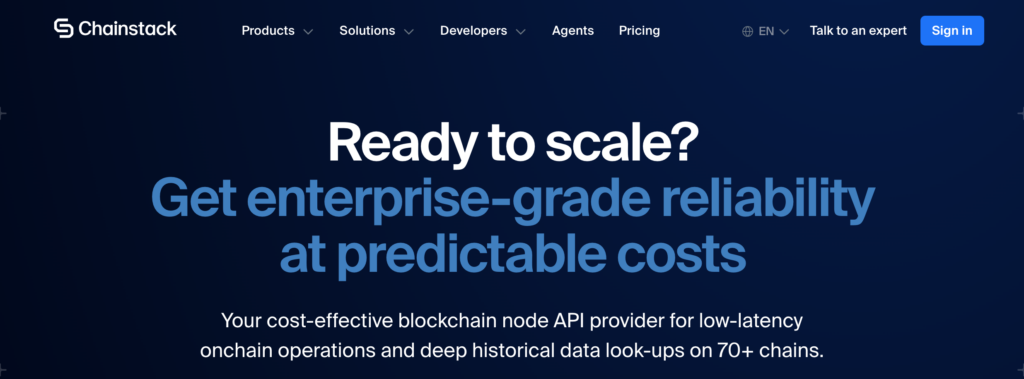
Chainstack is the one large provider that publishes numbers. Its own pricing breakdown puts an Ethereum full node at roughly $1,279 a month on the Pro plan, with storage as the main cost driver (Chainstack). That’s a vendor’s figure for its own product, but it’s a useful anchor when other quotes arrive.
QuickNode and Alchemy
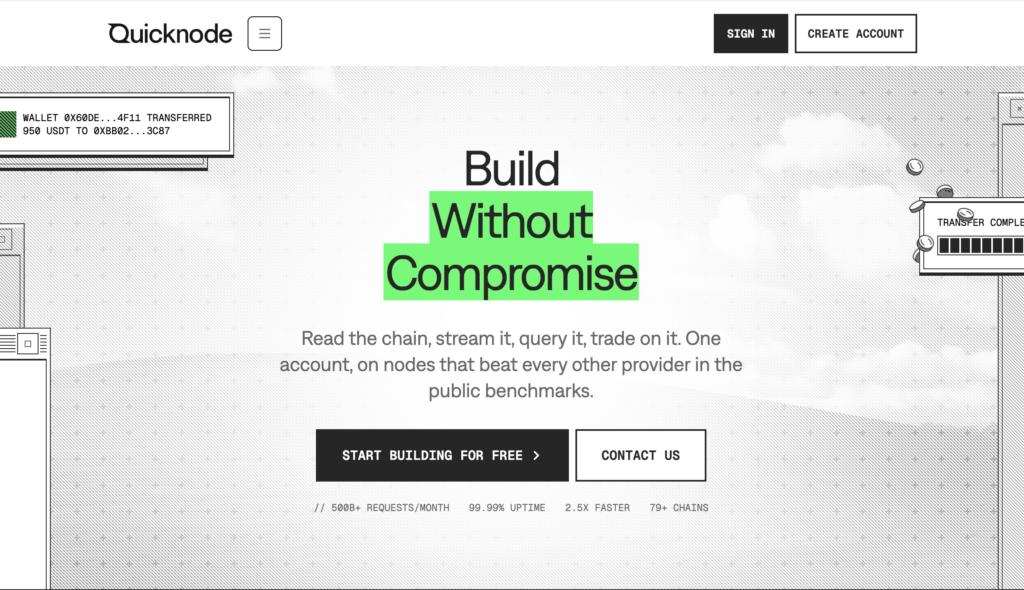
Both sell their private tier as a dedicated cluster rather than a single server, which suits teams that want redundancy built in. QuickNode’s Enterprise plan starts at $999 a month and adds custom RPS and contractual SLAs. Alchemy’s version is single-tenant and SOC 2 Type II compliant, with fixed monthly pricing instead of per-request billing, according to its March 2026 announcement.
Blockdaemon
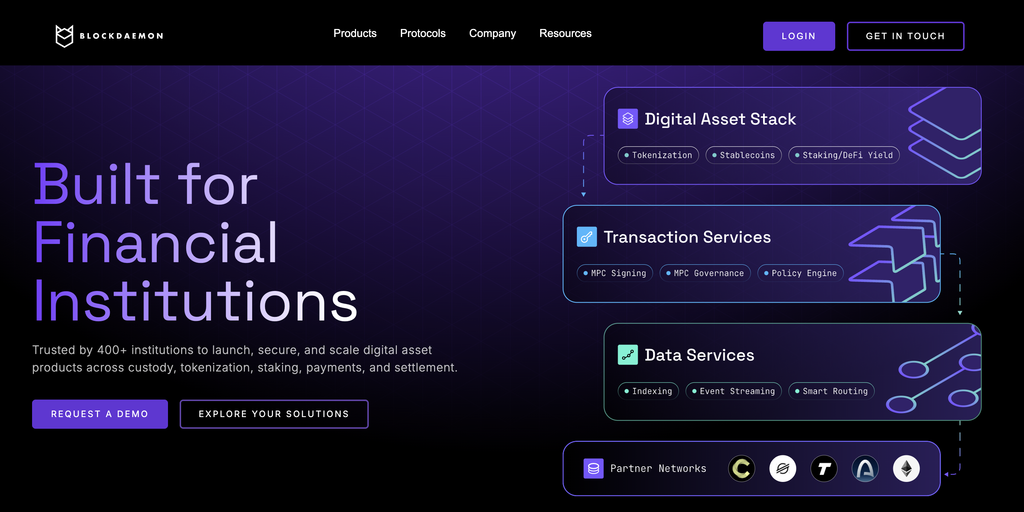
Blockdaemon targets institutions. It reports 200,000 nodes launched, SOC 2 Type II and ISO 27001 certifications, and deployment across cloud and bare metal in 70+ points of presence. If your compliance team asks for audit reports before anything else, start here.
GetBlock and Allnodes

GetBlock covers 130+ chains and publishes the lowest entry price in the group. Allnodes sits closer to crypto node hosting for validators and masternodes. It’s non-custodial, offers bare metal servers and supports 95 protocols. For staking-focused setups, see what a validator node actually does first.
Solana teams have a narrower field. Helius, a Solana-only provider, lists private setups from $2,900 a month, again per Alchemy’s comparison.
How to Choose a Provider for Private Infrastructure
Work through these steps in order, because each answer narrows the next. Comparing any dedicated node provider this way keeps the quotes honest, and a dedicated cluster changes steps 2 and 5 the most.
- List your chains and methods. Confirm the provider runs your exact network and exposes what you call, whether that’s archive state, trace or debug. Coverage differs by chain, and a headline of “120+ networks” doesn’t guarantee every feature on every one.
- Size the hardware. Match storage to full or archive mode, using the client figures above. Storage is the biggest line on the bill.
- Pick regions by users and validators. Put nodes near your traffic or, for bots, near the network’s validators. Ask whether multi-region clusters are offered.
- Check SLA and compliance. Look for a written uptime commitment with compensation, and ask for SOC 2 or ISO reports if your industry requires them. A 99.99% page claim and a contractual SLA are not the same thing.
- Compare the pricing model. Server-based billing is predictable; request-based billing scales with traffic. Ask what happens when you need a second node.
- Test before committing. Run your real workload against a trial or shared tier of the same provider first, then compare latency and error rates.
Conclusion
A dedicated node provider is worth paying for when rate limits, missing trace methods or downtime risk cost you more than a fixed monthly server bill. Below that point, shared crypto node hosting is cheaper and simpler.
Once you cross it, the decision comes down to chain coverage, single instance versus dedicated cluster, and what the SLA actually promises in writing. Get quotes from two or three providers and test the endpoint under your own load before signing.
FAQ
Is a private node faster than a shared endpoint?
Not automatically. It removes competition for resources, so response times stay steady under load, but latency still depends on hardware, region and how close your servers are to the node.
Can one deployment cover several blockchains?
Usually not. Most providers deploy one node per blockchain network, so a multi-chain product needs one deployment for each chain, or a shared plan for the lighter ones.
Do I need archive mode?
Only if you query old state, such as historical balances or past contract calls. Explorers and analytics tools need it; wallets and most dApps work fine on a full node.
How long does deployment take?
It ranges from minutes to days. NOWNodes lists setup from 15 minutes, while the initial chain sync on a large network can take longer, so confirm both figures with your provider.
Can I start on a shared plan and move later?
Yes, and that’s the safest path. Your application talks to a URL, so moving to private infrastructure usually means swapping the endpoint, not rewriting code. Confirm that your provider’s private setup exposes the same methods as its shared tier.