
Building a dapp on Ethereum means writing a smart contract, testing it, deploying it to a live chain, and connecting a frontend that lets people use the dapp — without a company server in the middle. A dapp, short for decentralized application, is exactly that pairing: on-chain logic plus an interface built around it.
That structure is the whole point. The contract’s logic and state live on Ethereum itself, not on infrastructure one team can quietly shut off or change the rules on later.
This Ethereum dapp tutorial covers that path in order: why Ethereum remains a common choice, who actually uses what gets shipped, and then the concrete steps — writing, testing, deploying, and connecting a frontend. By the end, you’ll have a working route from an empty file to a live dapp, plus the trade-offs worth knowing first.
Why Do Developers Keep Choosing Ethereum?
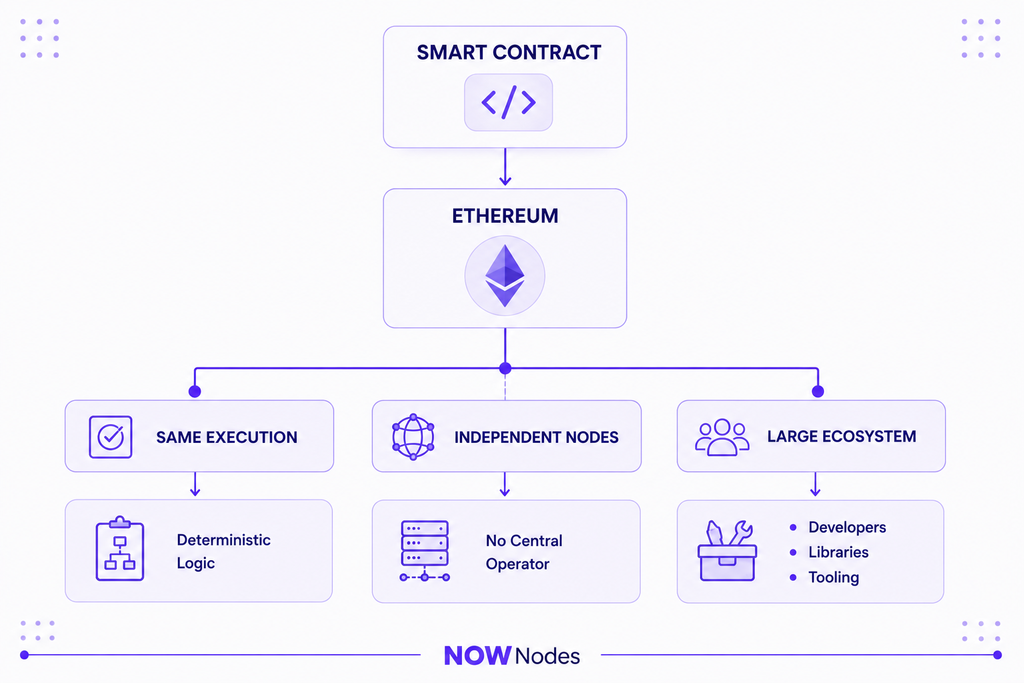
Ethereum remains a common choice because a contract deployed on it runs exactly as written, on infrastructure no single company controls or can quietly shut down. That pitch hasn’t changed much since Vitalik Buterin wrote the original whitepaper in 2014 — describing the platform he was proposing, he put it plainly:
“What Ethereum intends to provide is a blockchain with a built-in fully fledged Turing-complete programming language that can be used to create ‘contracts’ that can be used to encode arbitrary state transition functions, allowing users to create any of the systems described above, as well as many others that we have not yet imagined, simply by writing up the logic in a few lines of code.” — Vitalik Buterin, Ethereum Whitepaper (2014)
Write the logic once, and it runs the same way on thousands of independent machines, with no single party able to alter it after deployment. A dapp built this way doesn’t depend on one company staying in business, keeping its servers online, or deciding to change the rules later.
The practical case has gotten stronger recently, too. Ethereum’s developer base crossed 1,012,824 lifetime contributors by mid-2026, with roughly 232,000 developers active in the past twelve months, according to Electric Capital data reported by thirdweb. That’s a large pool of documentation, audited libraries, and working examples to draw on when something breaks.
Network costs have dropped, too. The Fusaka upgrade, live on mainnet since December 3, 2025, introduced PeerDAS, which lets nodes store only a fraction of blob data instead of all of it — raising theoretical layer-2 data capacity by up to 8x. Combined with a block gas limit that doubled from 30 million to 60 million in 2025, the first increase since 2021, mainnet gas now sits under 1 gwei, according to Etherscan’s live gas tracker — a fraction of past congestion-era prices.
Who Actually Uses Ethereum Dapps?
Four groups make up most of who actually builds and uses dapps on Ethereum, and they rarely need the same things from a chain. The list below runs roughly from consumer-facing dapps to the infrastructure everything else depends on.
- DeFi users and protocols — lending markets, decentralized exchanges, and yield platforms where funds move by code instead of a bank’s back office.
- NFT and gaming projects — ownership records and in-game assets that live outside any single game studio’s database.
- DAOs and treasuries — organizations that vote and spend through smart contracts instead of a traditional company structure.
- Wallets and infrastructure tools — the software layer everything else depends on, from MetaMask to block explorers to portfolio trackers.
That’s a category breakdown, not a ranking — which category sees the most daily activity shifts with market conditions and can be tracked in real time through aggregators like DappRadar, which lists thousands of active dapps across chains. What stays constant is the shape of a dapp: on-chain logic, paired with a way for people to reach it.
What Do You Need Before You Start?
Four things make the rest of this guide easier to follow: a wallet, test funds, and a framework to write and test in. A crypto wallet like MetaMask handles signing and account management, and you’ll use it constantly for both testing and real deployments later. Free test ETH from a Sepolia faucet covers gas costs on Ethereum’s main public testnet, so nothing here costs real money yet. A code editor plus a framework rounds out the basic dapp development toolkit, and which one you pick depends on how you like to work.
| Tool | Runs Where | Best For | Trade-off |
|---|---|---|---|
| Remix IDE | Browser, no install | A first contract, quick experiments | Not built for larger, multi-file projects |
| Hardhat | Local, JavaScript/TypeScript | Most small-to-mid projects, wide plugin support | Slower test runs than Foundry |
| Foundry | Local, Solidity-native tests | Fast testing, larger production codebases | Steeper learning curve, thinner beginner docs |
Remix is the easiest on-ramp because it needs no setup: write a contract in the browser and deploy it in a few clicks. Hardhat and Foundry both assume a local environment and more command-line comfort, but they scale to dapps Remix isn’t really designed for. Ethereum’s own framework overview covers a few more options if none of these three fit.
The Development Process, Step by Step
Now the actual build. Whether the goal is to create a dapp from scratch or extend an existing protocol, each step below assumes the tools from the previous section and builds directly on the one before it.
Step 1 — Write and Compile Your Smart Contract
Start with the contract, since everything else in a dapp exists to read from it or write to it. Most Ethereum contracts are written in Solidity, currently at version 0.8.36 as of July 2026 according to the official Solidity blog, though Vyper is a common alternative for teams wanting a smaller, more auditable language.
For a standard token, NFT, or access-control contract, there’s rarely a reason to write the logic from scratch. OpenZeppelin’s Contracts Wizard generates audited, standard-compliant Solidity for exactly these cases, which you then customize instead of re-testing boilerplate that thousands of other contracts already got right.
Step 2 — Test Before Anything Touches Real Funds
A contract that compiles isn’t the same as a contract that works. Run unit tests locally first — both Hardhat and Foundry support this — then check specific calls against live network state using eth_call or a full execution trace before anything gets deployed anywhere permanent.
Once local tests pass, deploy to Sepolia and repeat the same flow there. This is critical: a testnet deployment behaves exactly like mainnet, just with worthless test ETH, so it’s the closest rehearsal you get before real money is on the line.
Step 3 — Deploy to a Live Network
Deployment is a transaction like any other, just one that creates a contract instead of moving value. Even a minimal contract needs roughly 66,862 gas units to deploy, according to a gas breakdown from RareSkills — at current mainnet conditions (sub-1 gwei gas, ETH near $1,880 in mid-August 2026), that’s roughly $0.11 in gas for the dapp’s contract alone. A more complex contract costs more, but the gap between today’s gas prices and past congestion spikes is real.
To broadcast that transaction, your deployment script needs an RPC endpoint: a node that accepts the signed transaction and relays it to the network. Running one yourself means syncing and maintaining Ethereum client software indefinitely, so most teams connect through a provider instead. NOWNodes, for example, offers Ethereum mainnet and Sepolia testnet access over RPC, so the same API key that tested a contract on the testnet can point at mainnet once it’s ready.
Step 4 — Connect a Frontend to Your Contract
The contract is only half the dapp. A frontend built with standard web tools — React is common, though not required — needs a library like ethers.js or viem to read contract state and submit signed transactions, plus something like wagmi or a wallet’s own connector to handle sign-in.
Reading data is usually the easy part: call a public function and get a value back. Real-time updates are trickier, since polling a node every few seconds for new transactions or balance changes wastes requests and adds lag. WebSocket connections solve that by keeping a connection open so updates arrive as they happen instead of on a delay, and NOWNodes and most other RPC providers support this over the same account used for standard requests.
What Security Mistakes Sink New Projects?
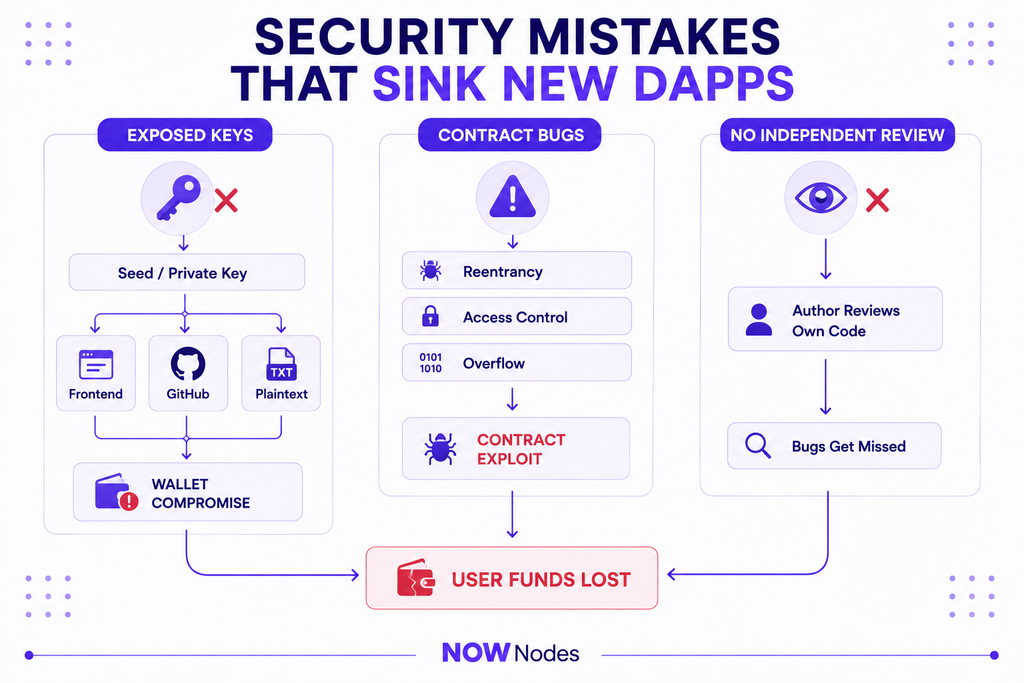
Most dapp failures aren’t exotic hacks — they’re avoidable mistakes made early. A private key or seed phrase typed into frontend code, committed to a public repository, or stored in plain text has ended more dapp projects than any clever exploit.
Contract-level bugs matter too, and they’re exactly why testing on a fork or testnet before mainnet isn’t optional. Reentrancy, integer overflows, and access-control mistakes are well-understood failure patterns at this point, which is precisely why independent audits exist as a separate step from your own testing — a second set of eyes trained to catch what the person who wrote the code tends to miss. The rule holds regardless of budget: don’t let a contract touch real user funds until it’s been tested on a testnet, reviewed by someone other than its author, and — for anything holding meaningful value — audited by a firm that does this professionally.
Can a Dapp Scale Beyond Ethereum Mainnet?
Yes — layer-2 networks like Arbitrum, Optimism, and Base run the same EVM and accept the same Solidity contracts as Ethereum mainnet, just settling transactions back to it in batches instead of processing everything directly. That’s exactly what Fusaka’s blob-data improvements were built to support more cheaply, and for many dapps, an L2 is the first deployment target rather than mainnet itself.
That compatibility means a contract tested on Ethereum mainnet or Sepolia usually deploys to an L2 with little more than a change of RPC endpoint — a big part of what makes multi-chain dapp development practical instead of a rebuild for every new network. Providers that support Ethereum alongside 120-plus other networks, NOWNodes among them, let a team point the same API structure at a new chain instead of onboarding a separate provider each time a project expands.
For teams using AI coding assistants, that same infrastructure question shows up differently. NOWNodes’ MCP Server, for instance, connects tools like Claude Code, Cursor, and VS Code to documented API methods and request examples directly, instead of an assistant guessing at endpoint syntax. It doesn’t write the dapp for you, but it does cut one specific kind of busywork: finding the right method for the right chain.
Conclusion
A dapp is really just two things working together: a smart contract that holds the logic and state on-chain, and a frontend that gives people a way to reach it. Everything in this guide — the language you pick, the framework you test in, the network you deploy to — serves one or the other of those two pieces.
The fastest path to building dapps on Ethereum is also the safest one: prototype in Remix, move to Hardhat or Foundry as the project grows, test everything on Sepolia before it touches mainnet, and treat an audit as part of the budget rather than an afterthought. None of that changes whether you’re building a simple token-based dapp or a full DeFi protocol — only the stakes do.
FAQ
Do I Need to Know Solidity to Build a Dapp on Ethereum?
Only for the contract side. A frontend developer can build the interface for an existing contract using JavaScript or TypeScript alone, though shipping your own contract logic does require Solidity, Vyper, or a similar language made for the EVM.
How Long Does It Take to Ship a Working Dapp?
A simple prototype — a single contract with a basic frontend — is realistic in a few days for someone comfortable with Solidity and JavaScript. A production dapp with an audit, thorough testing, and a polished interface typically takes weeks to a few months, depending on the contract’s complexity.
Can I Build and Test a Dapp Without Spending Real Money?
Yes. Remix is free, Sepolia test ETH comes from public faucets at no cost, and providers including NOWNodes offer free public RPC endpoints for prototyping — NOWNodes’ current limit on that free tier is 5 requests per second, enough for development and testing but not production traffic.
What Actually Separates a Dapp From a Regular App?
A regular app stores its data and logic on a server one company controls. A dapp’s core logic and state live on a public blockchain that no single party can unilaterally change or shut down, even though the two can look identical from the interface alone.