
A privacy coin is a cryptocurrency built to hide the sender, receiver, and amount of every transaction, using cryptography instead of a company’s privacy policy. Bitcoin and Ethereum publish that same data forever on a ledger anyone can read; Monero, Zcash, and Dash are engineered specifically so they can’t. Type “what is a privacy coin,” “crypto privacy coins,” or “privacy coins cryptocurrency” into a search bar and the question is the same either way: which cryptocurrencies actually keep transactions private?
The privacy crypto space had its best year on record in 2025: Zcash gained 861%, Monero climbed 123%, and the two now carry a combined market cap north of $17 billion, according to KuCoin’s year-end report, cited by CoinDesk. That rally collided head-on with tightening regulation — the EU has already set a July 2027 deadline to strip privacy coins off every licensed exchange in the bloc.
This guide starts with the basic mechanics, then works through why financial anonymity became a selling point, who’s actually buying privacy coins right now, and how the three major projects hide your data differently. It closes with the regulatory squeeze shaping where you can still buy and hold one in 2026.
What Is an Anonymous Cryptocurrency?
Every Bitcoin transaction ever sent sits in a public database right now — anyone can look up an address and see its full balance and history back to the first coin it received. That’s called being pseudonymous: your name isn’t attached, but your wallet’s entire financial life is visible to whoever bothers to look.
Privacy coin: a cryptocurrency whose protocol cryptographically hides the sender, receiver, and/or amount of a transaction, rather than relying on a third party to keep that data confidential. See Chainalysis’s overview of anonymity-enhanced cryptocurrencies for how investigators classify them.
Search for the best privacy coins, or any privacy coins crypto ranking, and three names dominate: Monero, Zcash, and Dash. Each takes a different technical route to the same goal: making it mathematically hard to link a transaction back to a person.
That matters for a second reason: fungibility. If an analytics firm flags certain bitcoins as “tainted” after passing through a hack or a darknet market, those coins become worth less than “clean” ones — a problem physical cash never has, since one dollar spends like any other. Privacy coins stay fungible by making that kind of coin-tracing impossible.
Why Does Financial Anonymity Matter in Crypto?
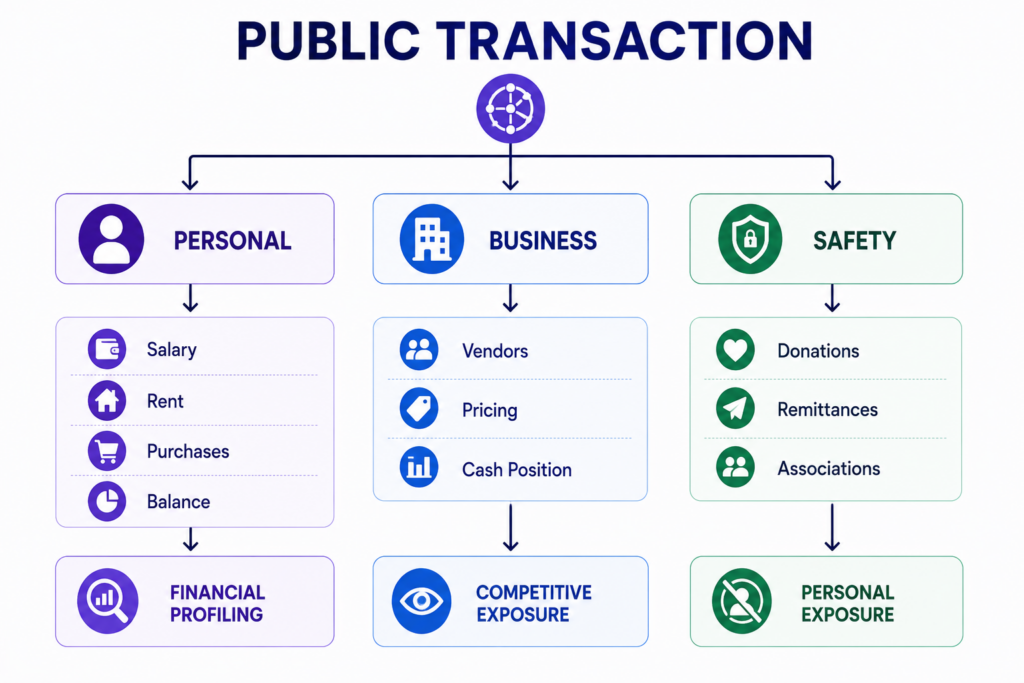
A fully transparent ledger sounds fine in theory until it’s your paycheck, your rent, or your medical bills sitting in a permanent public record. Pay a contractor in Bitcoin and they can see your entire wallet balance; get paid in ETH and your employer, coworkers, or a nosy stranger can watch every purchase you make afterward.
That trade-off is exactly what’s pulling more users toward cryptocurrency privacy, according to Mati Greenspan, founder of the crypto research firm Quantum Economics: “Privacy coins are outperforming because transparency became overused as a control layer. When everything is traceable, privacy shifts from philosophy to utility,” he told CoinDesk in January 2026.
The business case is just as concrete. A company paying suppliers in a transparent cryptocurrency exposes its entire vendor list, pricing, and cash position to any competitor willing to look up its wallet address — information no business would post on its own website.
There’s a harder-edged version of the same problem: people living under capital controls, sanctions, or authoritarian surveillance, for whom a traceable wallet isn’t an inconvenience but a genuine safety risk. A public blockchain can turn a routine donation or remittance into evidence — exactly the kind of record cash never left behind.
Who Relies on Anonymous Crypto Transactions?
Four groups make up most real-world demand for privacy coins:
- Everyday holders who don’t want a public ledger of their rent, salary, or medical bills.
- Businesses protecting payroll, supplier contracts, and cash reserves from competitors who can read a transparent chain like a bank statement.
- Journalists, activists, and people under sanctions or authoritarian regimes, for whom a traceable wallet can mean real physical risk.
- Traders chasing 2025’s rally, drawn by the price action as much as the underlying technology.
Regulators tend to focus on a fifth group: criminals. It’s a real use case, and it’s the reason exchanges keep delisting these assets — but it’s a smaller share of the picture than the headlines suggest. A 2020 legal analysis from Perkins Coie, cited by Chainalysis, found privacy coins carry no more inherent money-laundering risk than other cryptocurrencies, and most criminals still move stolen funds through Bitcoin instead, simply because it’s far more liquid and easier to cash out across exchanges.
How Do Anonymous Cryptocurrencies Hide Your Data?
The three major privacy coins solve the same problem with three different toolkits. None is “more encrypted” than the others — they hide different pieces of a transaction, by default or by choice, at different costs to speed and usability.
Monero’s Ring Signatures and Stealth Addresses
Monero hides everyone, every time — there’s no transparent option, which is the single biggest thing separating it from Zcash and Dash. Every transaction runs through ring signatures, stealth addresses, and RingCT by default, all at once.
A ring signature mixes your real transaction in with decoys pulled from the blockchain, so an outside observer sees several possible senders and can’t isolate which one actually spent the coins — like fifteen people signing a group cheque where only one holds real funds, and the bank can’t tell which. A stealth address then generates a brand-new, one-time address for every incoming payment, so the same wallet never visibly receives two transactions at the same address. RingCT, active since 2017, hides the amount on top of that.
Zcash’s Zero-Knowledge Proofs
Zcash takes a more mathematically exotic route: zk-SNARKs, a type of zero-knowledge proof that lets the network confirm a transaction follows the rules — no double-spending, no coins created from nothing — without revealing the sender, receiver, or amount to anyone, including the validators processing it. That’s a different strategy from Monero’s decoy-based mixing: instead of hiding a real transaction in a crowd, Zcash mathematically proves it’s valid without showing any of it.
zk-SNARK: a cryptographic proof letting one party demonstrate a statement is true without revealing the underlying data behind it. See the Electric Coin Company’s technical explainer for the underlying math.
Here’s the catch: that privacy is optional. Zcash has transparent t-addresses that work like Bitcoin and shielded z-addresses that get the full zk-SNARK treatment, and most transactions historically ran through the transparent side because it’s simpler and works with more wallets. That’s shifting fast — the share of ZEC sitting in Zcash’s shielded pool climbed from 18% to 23% of total supply in a single month in late 2025, according to The Block, a trend it tied to genuine shielded activity rather than speculation.
Dash’s Optional CoinJoin Mixing
Dash takes the lightest-touch approach of the three. Its PrivateSend feature, built on the CoinJoin model, mixes your coins with other users’ funds across Dash’s network of masternodes — but it’s opt-in, transaction by transaction, while the base network stays as transparent as Bitcoin.
That optionality is also Dash’s ceiling. Because most Dash transactions never touch PrivateSend, the anonymity set it draws from is thinner than Monero’s always-on approach, one reason Dash’s market cap has fallen to roughly $395 million — a fraction of Monero’s or Zcash’s — despite launching as a privacy coin back in 2014 under its original name, Darkcoin.
| Coin | Privacy method | On by default? | Market cap (Aug 2026)* |
|---|---|---|---|
| Monero (XMR) | Ring signatures + stealth addresses + RingCT | Yes, always | ~$8.1B |
| Zcash (ZEC) | zk-SNARKs (shielded z-addresses) | No — optional | ~$9.4B |
| Dash (DASH) | CoinJoin-based PrivateSend | No — optional | ~$0.4B |
*Figures from CoinGecko; prices move constantly, so treat this as a snapshot, not a fixed ranking.
Anonymous Coins vs. Crypto Mixers: What’s the Difference?
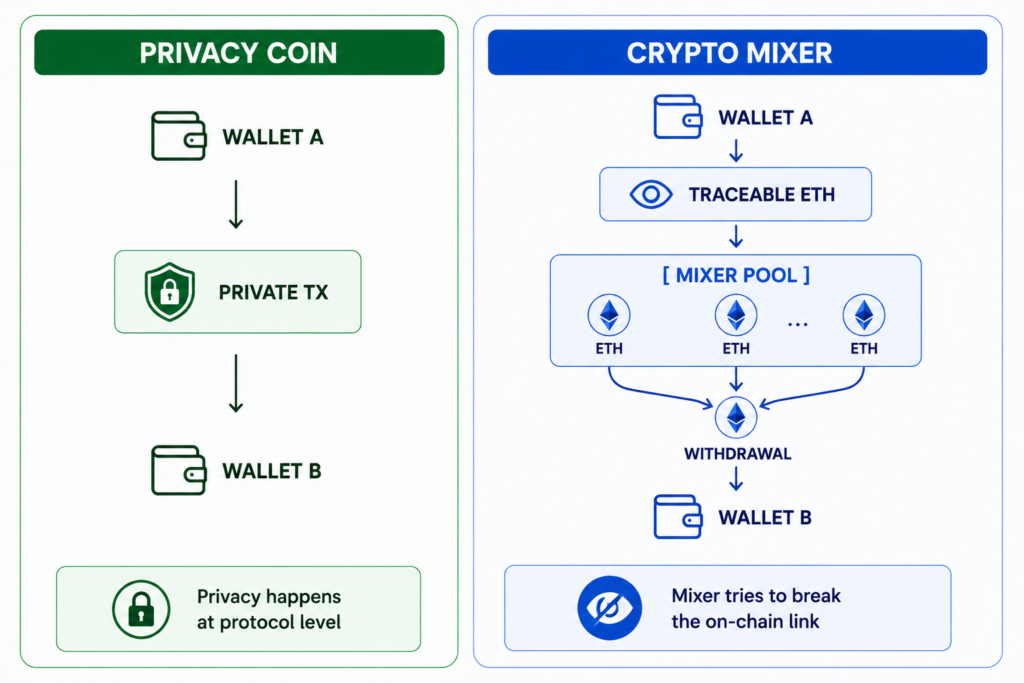
A privacy coin bakes anonymity into its own blockchain protocol. A mixer is a separate service that anonymizes transactions on an otherwise transparent chain, most commonly Ethereum — you send in traceable ETH, it pools with everyone else’s, and you withdraw different coins with no on-chain link back.
Tornado Cash is the clearest example, and its history shows how unsettled the rules still are. OFAC sanctioned the protocol in August 2022, then reversed course and delisted it in March 2025 after a federal appeals court ruled the agency had overstepped, according to Forbes.
The distinction matters if you’re weighing risk. Holding Monero or Zcash means holding a specific asset with privacy built into its own chain; using a mixer means running a transparent asset like ETH through a third-party contract — a step regulators have historically scrutinized even harder than the coins themselves.
Is Financial Anonymity Legal in Crypto Right Now?
Owning a privacy coin is legal in nearly every country, including the US and EU — nobody is coming to seize your Monero for holding it. What’s disappearing fast is the ability to buy or sell one on a regulated exchange.
The clearest deadline is European. The EU’s Anti-Money Laundering Regulation (2024/1624) bars regulated crypto platforms from supporting “anonymity-enhancing coins,” naming Monero, Zcash, and Dash directly, with enforcement starting July 10, 2027, according to CCN’s reporting on the rule. Self-custody wallets are untouched — the rule targets licensed intermediaries, not private ownership.
Exchanges got ahead of that deadline. Binance and Kraken both moved to delist or restrict Monero in 2024 over compliance concerns, and Dubai’s DIFC regulator barred Monero and Zcash from licensed platforms in 2026, according to FinanceFeeds. The Financial Action Task Force’s June 2025 update on virtual assets still flags “anonymity-enhancing technologies” as a persistent obstacle to tracking illicit finance.
The practical result is a slow migration off centralized platforms. As regulated exchanges drop these assets, more trading volume shifts to decentralized exchanges, where a smart contract, not a compliance department, decides whether a trade goes through.
How to Choose and Hold an Anonymous Coin Safely
There’s no single best privacy coin for everyone — the right pick depends on your threat model. Four steps cover most of what actually matters:
- Match the coin to what you need to hide. Monero hides everything by default, Zcash lets you choose per transaction, and Dash suits users who mainly want a faster, cheaper payment coin.
- Use the coin’s official wallet, not a random app-store result. For Monero specifically, stick to audited, open-source options — NOWNodes’ comparison of the safest Monero wallets breaks down desktop, mobile, and hardware choices.
- Buy through a source that still lists it — a shrinking pool of centralized exchanges, or a decentralized one — and verify the network details against an official source before sending funds.
- Keep the seed phrase offline and never share it. No legitimate wallet, exchange, or support agent will ever ask for it.
Monero, Zcash, and Dash aren’t the only projects chasing this problem — newer designs like Firo’s Lelantus Spark protocol rework the same burn-and-redeem idea with smaller proof sizes, aimed at making default privacy cheaper to run at scale. PIVX and Beam pursue similar goals with their own trade-offs, though neither has matched Monero or Zcash for liquidity or exchange support.
Whichever coin you hold, the wallet or explorer behind it needs a live connection to that blockchain. Monero’s node software is notoriously heavy to sync from scratch, which is one reason wallets and explorers often connect through a hosted provider instead. Monero, Zcash, and Dash are among the 120-plus networks a provider such as NOWNodes lists node access for, letting an app read balances and broadcast transactions without maintaining that infrastructure alone.
Conclusion
Privacy coins solve a problem that’s easy to underestimate until it’s your own transaction history sitting in a permanent public record: Bitcoin and Ethereum were never built to keep that data private, and Monero, Zcash, and Dash exist because someone decided that gap mattered. 2025’s rally proved plenty of people agree, even as regulators move the other way.
The trade-off comes down to a straightforward question: what a regulated exchange will list is shrinking, while what stays legal to hold and use privately is not. Anyone weighing whether to hold one should treat that gap, between ownership and access, as the real decision rather than the marketing around any single coin. Match the coin to what you actually need to hide, use an audited wallet, and keep the regulatory deadline in mind if a centralized exchange is where you plan to hold or trade it.
FAQ
How Private Is Monero, Really?
Monero is generally considered the most private cryptocurrency available today, since ring signatures, stealth addresses, and hidden amounts run on every transaction with no transparent option to opt out of. It isn’t absolute — researchers have previously found edge cases that narrowed its anonymity set in specific scenarios, which is why its development team keeps revising the protocol rather than treating the job as finished.
Can Law Enforcement Trace an Anonymous Transaction?
Sometimes. Chainalysis notes that while these coins resist tracking far better than a transparent chain, “nothing is completely anonymous,” and investigators with advanced tools have traced specific cases, particularly on Zcash’s transparent side or at the point a coin enters or exits an exchange.
Are DeFi Privacy Tools the Same Thing as Monero or Zcash?
No. A shielded pool or confidential-transfer feature inside a DeFi protocol — sometimes marketed under the broader label of privacy tokens — usually protects one specific action on a transparent chain like Ethereum. Monero and Zcash build anonymity into the base blockchain itself, covering every transaction the network processes.
Will the United States Ban Anonymous Cryptocurrencies?
Not currently, and there’s no federal proposal matching the EU’s 2027 deadline as of mid-2026. US pressure so far has targeted specific tools, like the Tornado Cash sanctions saga, rather than an outright ban on holding or trading Monero, Zcash, or Dash.
Do You Owe Taxes on Anonymous Crypto Transactions?
Yes. Privacy at the protocol level doesn’t change tax law — the IRS and most other tax authorities still expect gains and income from any cryptocurrency, including Monero or Zcash, to be reported the same as any other asset.