
An Ethereum block reward — what people also call an Ethereum mining reward, from the years when miners were the ones earning it — is the ETH paid to whoever adds a valid block to the chain: newly issued coins plus a cut of the transaction fees inside that block. For nearly seven years, that “whoever” was a miner solving Proof-of-Work puzzles. Since September 15, 2022, it’s a validator staking ETH instead, and the math behind the payout changed along with the job title.
If you searched “ethereum mining reward” hoping for a current number, here’s the short version: there isn’t one anymore, because Ethereum mining itself stopped in 2022. This guide covers both the old mining formula and what replaced it, because plenty of people still need the pre-2022 numbers — reconciling mining income for taxes, building a tool that reads historical blocks, or simply understanding why “miner rewards” and “staking rewards” aren’t the same thing.
What Does an Ethereum Miner Actually Get Paid?
A block reward has always had two parts: a fixed subsidy of brand-new ETH, and a share of whatever transaction fees users paid to get into that block. The subsidy is set by the protocol and changes only through a hard fork; the fee share moves with network demand and, since 2021, with a rule that burns part of it outright.
Block reward: the ETH a block producer earns for adding a valid block to Ethereum, made up of a protocol-set issuance amount plus applicable transaction fees. See ethereum.org’s issuance documentation for how issuance is calculated today.
Under Proof of Work, this block reward went to a miner for solving Ethereum’s hash puzzle first. Under Proof of Stake, it goes to a validator instead, for proposing and attesting to blocks with staked ETH rather than spent electricity. Same basic idea — get paid for keeping the chain honest — different mechanism entirely.
Why Does Ethereum Pay This Out At All?
A blockchain with no bank in the middle still needs someone to bundle transactions into blocks and everyone else to agree those blocks are valid. Nobody does that reliably for free, especially when doing it dishonestly could be more profitable. The block reward is what makes honest participation the rational choice.
This is the core of what people mean by a network’s “security budget”: pay out enough in block rewards that attacking the chain costs more than it could possibly earn. Miners had to buy hardware and electricity upfront, so the reward reimbursed a real cost. Validators lock up ETH they can lose to slashing, so the reward compensates capital at risk instead. Ethereum also spreads that budget across hundreds of thousands of validators rather than concentrating it in a few dozen hands, the same trade-off that separates it from faster, more centralized chains like BNB Smart Chain.
Who Actually Needs to Calculate This?
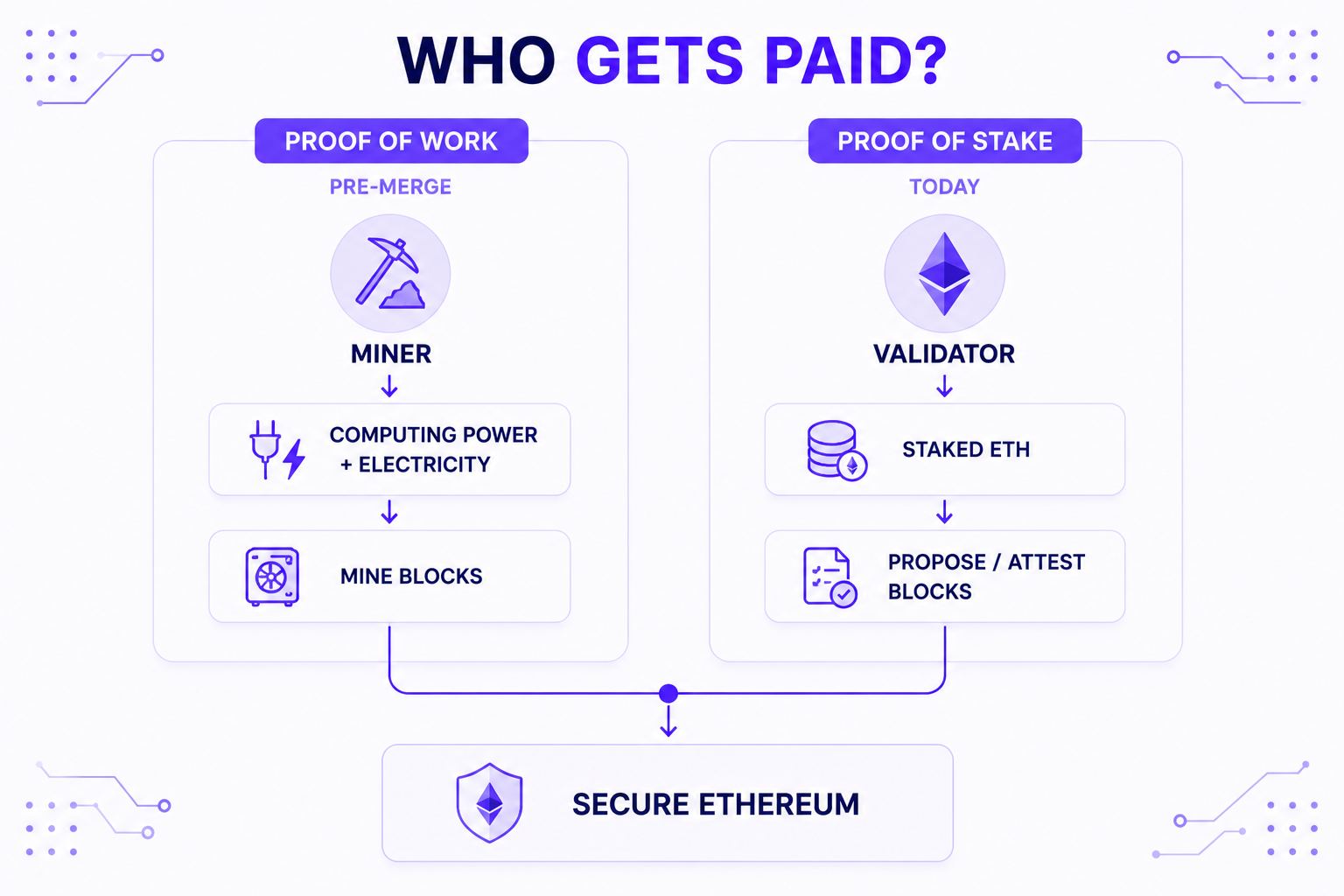
Not just miners, and not just historically. A handful of groups still run these numbers regularly, for different reasons.
- Crypto tax preparers and former miners reconstructing exact block reward income for years before September 2022, since block-by-block records matter more than a rough annual estimate to most tax authorities.
- Block explorers and analytics platforms that display a block reward figure on every historical block page, computed the same way for millions of blocks in a row.
- Researchers and economists tracking Ethereum’s block reward and issuance schedule, comparing it against EIP-1559 burn to see whether supply grew or shrank over a given period.
- Validators and staking pool operators today, who need the modern version of the block reward calculation to estimate expected yield before committing capital.
Here’s the catch: current data isn’t enough. A live, non-archive node prunes old state, so pulling a reward from a 2018 or 2021 block needs a node that still holds that history. That’s the kind of gap providers such as NOWNodes fill with Ethereum archive access reaching back to the genesis block, alongside standard RPC across 120-plus other networks — useful infrastructure for a tax tool or explorer doing this at scale, not something every team needs to run itself.
The Original Mining Reward Formula (2015–2022)
Ethereum’s Proof-of-Work block reward wasn’t one static number. It stepped down twice by hard fork, and it included a bonus most explanations skip entirely.
How the Base Subsidy Dropped From 5 ETH to 2 ETH
Ethereum launched on July 30, 2015, paying miners a flat 5 ETH per block. That figure changed twice over the next four years, per Etherscan’s issuance history:
| Fork | Date | New base reward | Change |
|---|---|---|---|
| Frontier (genesis) | July 30, 2015 | 5 ETH | — |
| Byzantium (EIP-649) | October 16, 2017 | 3 ETH | −40% |
| Constantinople (EIP-1234) | February 28, 2019 | 2 ETH | −33% |
Both cuts were bundled with a delay to Ethereum’s “difficulty bomb,” a mechanism designed to push miners toward the eventual switch to staking. The 2 ETH figure from Constantinople stayed the base subsidy for every block mined until the Merge, more than three years later.
Uncle and Nephew Bonuses
Ethereum’s fast block time meant two miners occasionally solved a valid block at almost the same moment, and only one could become part of the canonical chain. The runner-up was called an uncle, or ommer, and rather than let that work go to waste entirely, Ethereum paid it a reduced reward anyway.
Uncle reward: a partial block reward paid to a valid block that lost the race to be included in the main chain. The uncle reward formula is base reward × (8 − (current block − uncle block)) / 8. An uncle more than six blocks old earns nothing at all.
The miner who included that uncle in their own block also got a “nephew” bonus worth 1/32 of the base reward — 0.0625 ETH during the Constantinople era. Say a Constantinople-era block referenced one uncle produced two blocks earlier: the uncle’s own miner collected 2 × (8−2)/8 = 1.5 ETH, and the block’s miner added 0.0625 ETH on top of their own subsidy just for the reference.
How EIP-1559 Split the Fee Side of the Reward
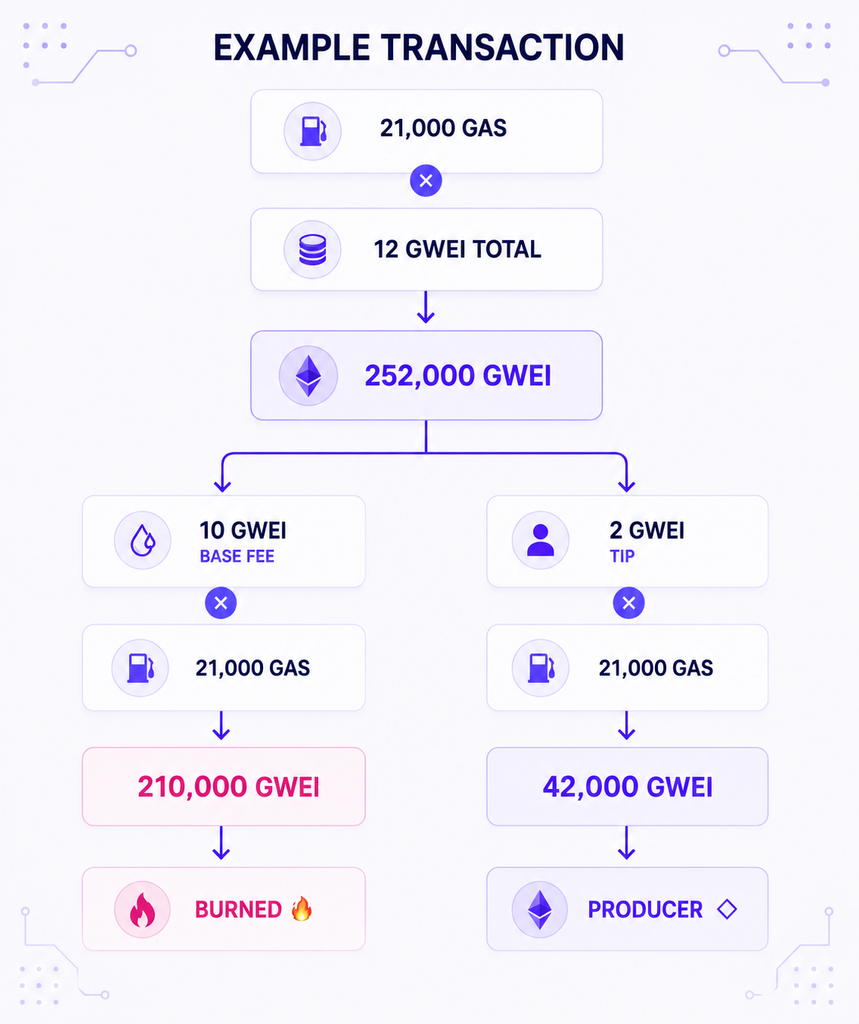
Before August 5, 2021, a miner kept every gwei of every transaction fee in their block, and users bid against each other in a blind first-price auction to get included. EIP-1559, part of the London upgrade, replaced that with a protocol-set base fee plus an optional tip — and only the tip still goes to the block producer.
Here’s the part that actually changes the math: the base fee is burned outright, straight out of circulation, adjusting up or down depending on how full the previous block was. The tip, or priority fee, is what a user adds to jump the queue, and it’s the only fee revenue a miner or validator actually keeps. For a standard 21,000-gas transfer at a 10 gwei base fee and a 2 gwei tip, the total cost is 252,000 gwei, but only 42,000 of that — the tip times gas used — reaches the block producer.
Scale that up to a full block and the gap widens. A block using 15 million gas at a 30 gwei base fee with a 2 gwei average tip burns 0.45 ETH (15,000,000 × 30 gwei) while the miner keeps just 0.03 ETH in tips, on top of the 2 ETH subsidy. Vitalik Buterin flagged this dynamic a year before EIP-1559 shipped, arguing fee burn alone could offset new issuance: “transaction fees the past 2 months have been high enough to more than fully cancel out PoS rewards post-EIP 1559,” he wrote in August 2020. That’s roughly what happened through parts of 2021 and 2022, when burn outpaced issuance often enough to push ETH supply briefly negative.
What Happened to Mining Payouts After the Merge?
Short answer: they stopped completely. The Merge, on September 15, 2022, swapped Ethereum’s entire consensus mechanism from Proof of Work to Proof of Stake in a single coordinated upgrade, ending the miner’s block reward for good — there’s no partial transition here, no leftover mining income running alongside staking.
The scale of that change is worth putting a number on. Pre-Merge, the block reward accounted for about 4.61% annual issuance, split between miners (roughly 4.09%) and the smaller Beacon Chain staking rewards already running in parallel (about 0.52%). Post-Merge, only the consensus-layer side remains, which cut total new ETH issuance by close to 89% overnight, according to ethereum.org’s own issuance breakdown.
What replaced the miner’s block reward is a validator reward, and it’s structured differently enough that the old formula doesn’t carry over directly. Instead of one lump sum per block, a validator earns smaller amounts continuously for attesting to blocks, proposing them, and taking part in sync committees, with the total scaling down as more ETH gets staked network-wide. That yield runs around 2.7% annually in 2026 before pool or operator fees. A staking reward calculator can estimate that yield for a given ETH amount, but the real figure keeps shifting as the total staked changes — covered in more depth in our validator-node guide.
How to Pull the Numbers Yourself, Step by Step
There’s no single “Ethereum mining reward calculator” that covers every block, because the formula itself changed three times. Reconstructing the block reward for one specific block means reading it straight from chain data, and the process differs slightly depending on whether the block predates EIP-1559.
- Get RPC access to Ethereum, including archive support if the block is more than a few thousand blocks old.
- Fetch the block with
eth_getBlockByNumber, which returns the miner address, gas used, base fee (post-1559 blocks only), and a list of included uncles. - Identify the base subsidy — the fixed, newly issued portion of the block reward — for that block’s era: 5, 3, or 2 ETH depending on the date.
- Pull each uncle referenced in the block with
eth_getUncleByBlockNumberAndIndex, and add a 0.0625 ETH nephew bonus per uncle included. - Sum the fee revenue. For blocks before August 5, 2021, that’s gas used × gas price for every transaction. For blocks after, it’s gas used × priority fee per transaction, not the full fee, since the base-fee portion was burned rather than paid out.
- Add the three components together to get the final block reward: base subsidy, uncle and nephew bonuses, and fee revenue.
For a live block, simulating the call with eth_call first sanity-checks gas figures before pulling final numbers from the receipts. None of these RPC methods are unique to one provider — any Ethereum endpoint with archive support can answer them.
Mining Reward vs. Validator Reward at a Glance
| Mining reward (pre-Merge) | Validator reward (today) | |
|---|---|---|
| Consensus | Proof of Work | Proof of Stake |
| Base payout | Fixed 2 ETH per block (2019–2022) | Variable, scales with total ETH staked |
| Fee share | 100% before 2021; tips only after EIP-1559 | Priority fees, plus occasional MEV |
| Extra bonuses | Uncle and nephew rewards | None — PoS has no uncle equivalent |
| Typical yield | Varied with difficulty and hash price | ~2.7% annually before fees, in 2026 |
| Who earns it | Anyone with mining hardware | Anyone staking 32 ETH, or via a pool |
Whether you call it an eth block reward or a validator payout, neither is “better” in the abstract — they answered different questions at different points in Ethereum’s history. What matters practically: only one of them still runs.
Common Mistakes When Estimating a Miner’s Earnings
A few errors show up constantly in block reward calculations built from scratch. The big one is confusing total transaction fees with what the miner actually received: post-2021, that gap is the burned base fee, and it can easily be larger than the tip itself.
Forgetting uncles is another. A block with two referenced uncles pays out a meaningfully bigger block reward than the base subsidy alone, and skipping that step undercounts real historical mining income. MEV is a subtler problem: extra profit from reordering transactions inside a block doesn’t show up as a clean “reward” field, and spotting it usually requires trace-level data, not a basic block query.
Conclusion
The eth block reward isn’t a single formula anymore — it’s two different systems separated by a hard date. Before September 15, 2022, it was a fixed ETH subsidy plus gas fees and the occasional uncle bonus, all going to whoever won the mining race. After that date, it’s a smaller, continuous validator payout scaled by how much ETH is staked network-wide.
Getting an exact block reward, for either era, comes down to reading the right fields off the right block: the subsidy for that period, any uncles included, and the fee split that applied at the time. Get those three right and the math is simple arithmetic, not guesswork.
FAQ
Is a miner’s payout the same thing as the gas fee?
No. The gas fee is what a user pays to get a transaction included; the block reward is what the block producer actually earns, which includes only part of that fee — the tip — since EIP-1559 started burning the base-fee portion in August 2021.
Can you still mine Ethereum today?
Not on Ethereum itself. Proof-of-Work mining stopped entirely at the Merge on September 15, 2022; GPU miners either switched to a different Proof-of-Work coin or shut down, since Ethereum’s mainnet no longer accepts mined blocks under any circumstances.
Why does “Ethereum mining reward” still get searched if mining ended in 2022?
Mostly because a lot of older calculators, forum threads, and articles about Ethereum mining are still online and never got updated after the Merge. Anyone researching Ethereum mining profitability today is very likely landing on pre-2022 information, whether or not the page says so.
How do I check one block’s payout without writing code?
Block explorers like Etherscan display the block reward directly on each block’s page, already broken into subsidy, uncle bonuses, and fees where relevant. That’s the faster option for a single lookup; the RPC method described above is for pulling this across many blocks at once.
Is MEV counted in a validator’s payout?
Not in the traditional sense. MEV, or maximal extractable value, is extra profit from transaction ordering, and it can dwarf the standard block reward in some blocks, but it doesn’t appear as a labeled field in basic block data — it has to be reconstructed from internal transaction traces.
Does new ETH issuance affect price?
Indirectly, through supply. A higher block reward means faster issuance and more new ETH entering circulation, while EIP-1559 burn works the other way; the net of the two affects supply growth, but price depends on far more than issuance alone. None of this is financial advice.