
The most reliable WebSocket provider for a production blockchain app is the one whose uptime, reconnection behavior, connection limits, and network coverage match how your app actually consumes data. The biggest number on a provider’s homepage rarely answers that question.
Reliability for a streaming connection is less about a single uptime figure and more about what happens when a socket drops at 3 a.m. and your app has to catch up without missing a block. This guide covers on-chain data WebSockets — streams of new blocks, transactions, and contract logs — rather than price-feed APIs, and it walks through the criteria that separate one WebSocket provider from another, with a side-by-side look at the main options.
What is a blockchain WebSocket API?
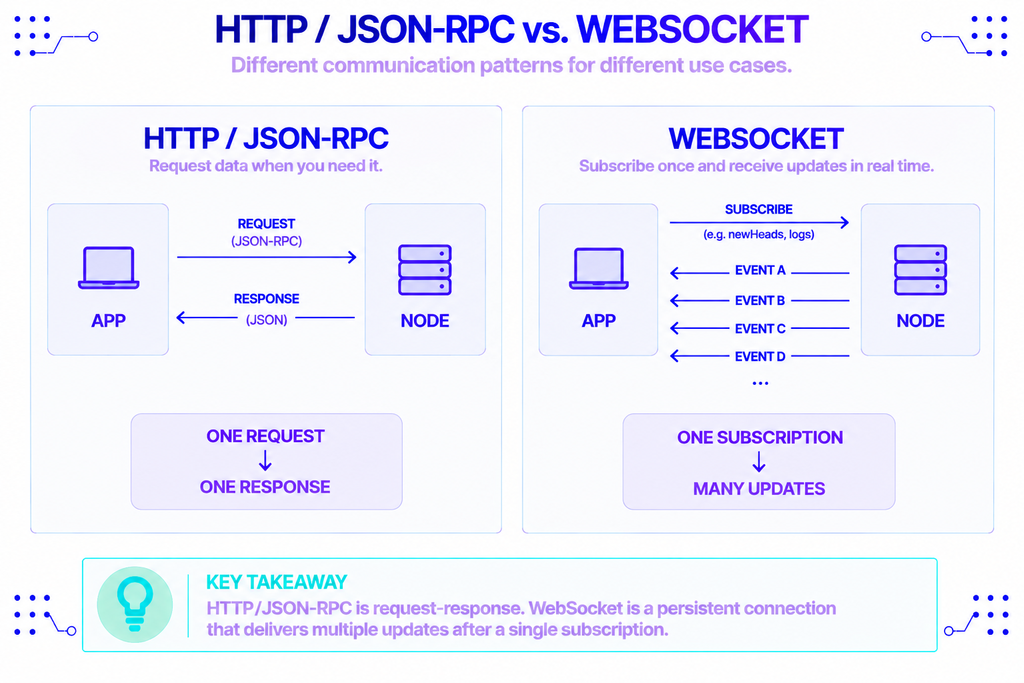
A blockchain WebSocket API is a persistent, two-way connection to a node that pushes on-chain updates to your app as they happen, instead of making your app ask for them over and over. One request opens the socket. After that, the server streams events to you until the connection closes.
On EVM-compatible chains, you subscribe to a specific feed by name. The three standard ones are newHeads (every new block), logs (contract events matching a topic filter), and newPendingTransactions (pending transaction hashes). The official ethereum.org WebSocket tutorial documents how these subscriptions work in practice.
Opening a newHeads subscription looks like this:
json
{"jsonrpc":"2.0","id":1,"method":"eth_subscribe","params":["newHeads"]}From that point on, every new block arrives on the socket without another request.
Why polling over HTTP breaks down at scale
Polling means your app repeatedly calls an HTTP endpoint to check whether anything changed. It works for a prototype and falls apart under real load. You either poll often and burn through your request quota while still lagging behind the chain, or poll rarely and miss events.
A bot that checks for a new block once a second is up to a second behind the network and spends a request on every check, most of which return nothing new. A WebSocket subscription pushes the block the moment it is produced, with no wasted calls in between. That difference matters most for anything time-sensitive, where a one-second lag is the gap between catching an event and missing it.
Which applications actually need streaming data
Any app that has to react to on-chain activity in real time benefits from a streaming connection rather than a polling loop. The common ones:
- Wallets — reflect incoming payments and balance changes the moment they land, instead of on a refresh.
- dApp front ends — update the interface when a transaction confirms or a contract emits an event.
- Trading and liquidation bots — watch for pending transactions, price-moving events, or new blocks where milliseconds decide the outcome.
- Monitoring and indexing backends — track addresses, ingest every block into a database, or trigger alerts on specific contract activity.
If your app only reads data occasionally — a balance check here, a transaction lookup there — plain HTTP requests are simpler and perfectly fine. Streaming earns its place when the volume of events is continuous.
What does “reliable” actually mean for a WebSocket connection?
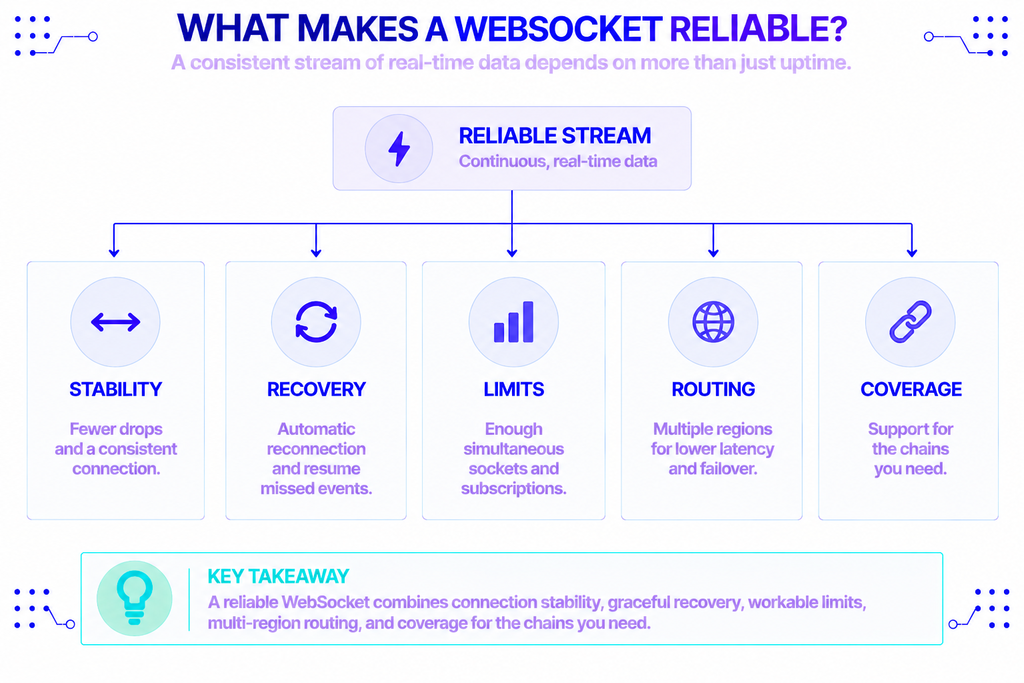
Reliability is the combination of connection stability, graceful reconnection, workable connection and subscription limits, multi-region routing, and the network coverage your app needs. An uptime badge on its own tells you none of this. A provider can report 99.9% availability and still drop your socket during a chain reorganization or leave you with no way to recover the events you missed.
Break it into the parts that actually fail in production.
Uptime and where the servers sit
Uptime is the headline figure, and it is worth comparing, but read it alongside geography. A provider running infrastructure in several regions can route around a single-region problem, which a single-location setup cannot. NOWNodes, for example, advertises 99.95% API uptime on shared infrastructure and describes response times under 200 milliseconds for key regions in the US and Europe through GEO-balanced routing. Treat figures like these as current product-page claims rather than universal guarantees, since real performance shifts with network, region, and workload.
Reconnection and missed events
Sockets drop. A deploy on the provider’s side, a network blip, or an idle timeout will close your connection eventually, so the real question is what your app does next. Most providers do not replay the events you missed while disconnected. The catch is that this leaves a gap your app has to notice and fill itself — usually by detecting the last block it saw and backfilling over HTTP before resuming the stream.
Design for reconnection from the start. An app that assumes the socket stays open forever will silently fall behind the chain the first time it drops.
Connection and subscription limits
Every provider caps how many connections you can hold open and how many subscriptions each one carries. These ceilings are invisible in testing and painful at scale. Alchemy, for instance, documents a limit of 100 concurrent WebSocket connections on its free tier and 2,000 on paid tiers, with up to 1,000 unique subscriptions per connection, according to its subscription API reference. If your architecture opens a connection per user or per watched address, those numbers decide how far a single account scales before you need to pool connections or upgrade.
Cost predictability
Streaming can drain a request quota faster than you expect, because a busy feed generates events constantly. Infura’s documentation shows how this adds up: a newHeads subscription consumes 50 credits per block event, a logs subscription up to 300 credits per block, and newPendingTransactions around 200 credits, with new events roughly every 700–800 milliseconds, per its WebSocket concepts page. On a metered plan, a single high-traffic subscription can quietly eat a daily allowance. Flat request quotas, like the per-plan limits on NOWNodes pricing, are easier to forecast because the number does not swing with on-chain activity.
Network coverage
Many WebSocket products are EVM-centric, which is fine until your app needs Bitcoin, Litecoin, Dogecoin, or a privacy coin. Coverage for a streaming interface is often narrower than a provider’s full chain list, so check the specific network before committing. NOWNodes supports WebSocket on 30+ networks and also offers a Blockbook WebSocket interface for indexed, wallet-style data on supported chains, with Bitcoin-family and non-EVM networks sitting alongside the EVM ones in its node directory.
How the main WebSocket providers compare
The table lines up the concrete differences. Limits and metering come from each provider’s own documentation and change over time, so verify the current state before you build against it.
| Provider | WebSocket subscriptions | Connection ceiling | Extra streaming options | Network breadth |
|---|---|---|---|---|
| NOWNodes | New blocks, transactions, address activity; Blockbook WebSocket on supported chains | Flat per-plan request quotas | gRPC streaming across 25+ chains | WebSocket on 30+ networks; non-EVM included |
| Alchemy | newHeads, logs, plus full pending and mined-transaction feeds | 2,000 connections, 1,000 subs each (paid) | Webhooks (separate product) | EVM chains plus Solana |
| Infura | newHeads, logs, newPendingTransactions | Not published; credit-metered | — | ~13 networks |
| QuickNode | eth_subscribe over WSS | Not published | Streams, Webhooks | 80+ chains |
A few trade-offs behind the rows:
Alchemy adds enhanced subscription types that return full pending and mined transaction objects, not just hashes, which saves a follow-up request. It leans toward EVM chains and Solana, and the connection and subscription ceilings above are firm.
Infura is simple and well-documented, with a strong tie to the MetaMask ecosystem. The trade-off is a short menu — three subscription types — and newPendingTransactions is not available on every network, so a non-EVM or newer chain may not expose the feed you want.
QuickNode offers standard WebSocket subscriptions plus Streams, a managed pipeline that filters and transforms blockchain data before it reaches you. Streams is capable, but it is also proprietary, which brings us to a cost that does not show up on a pricing page.
NOWNodes covers WebSocket on 30+ networks and layers on gRPC streaming across 25+ chains, with the gRPC product advertising sub-200 millisecond stream latency and unlimited requests per second on paid plans. Its reach into non-EVM chains is wider than most, and quotas are flat. The honest limit is that WebSocket coverage spans 30+ networks rather than the full 120+ reachable over standard API access, so confirm your exact chain is on the streaming list.
The hidden cost of proprietary streams
Standard WebSocket subscriptions and JSON-RPC are portable. A proprietary streaming product is not, and that gap becomes a migration bill if you ever want to switch providers. Auston Bunsen, co-founder of QuickNode, put the dynamic plainly in an interview with Sacra: “I can go from Alchemy to Infura to QuickNode relatively quickly, unless I’m using one of their sort of custom APIs.”
That caveat is the whole story. An app built on standard subscriptions can point at a new endpoint with a URL and key change. An app wired into one provider’s custom pipeline has real work ahead if it needs to leave, because that exact feature does not exist the same way elsewhere. The convenience is real; so is the lock-in. Weigh both before you build your core data flow on a feature only one vendor offers.
Picking the right provider for your workload
There is no single most reliable WebSocket provider, only the one that fits what your app does. Start from your workload. Map which chains you need, how many connections and subscriptions your architecture will open, and how predictable the monthly cost has to be. Those three answers rule out most of the field before uptime ever enters the conversation.
If you are EVM-only and want rich pending-transaction data, Alchemy’s enhanced feeds are a strong fit. If you live in the MetaMask ecosystem, Infura is the path of least resistance. If you need custom server-side filtering and accept the lock-in, QuickNode’s Streams delivers it. If your app spans many chains — especially Bitcoin-family and other non-EVM networks — and you want flat, forecastable quotas, a broad multi-chain provider such as NOWNodes covers more of that ground under one account, with gRPC streaming available when you outgrow standard WebSocket subscriptions. Whatever you choose, build reconnection and backfill in from day one. That single habit does more for reliability than any provider’s uptime number.
FAQ
Do I still need HTTP endpoints if I use WebSockets?
Yes. WebSockets handle the live stream of new events, but you still need HTTP requests for historical queries and, importantly, to backfill the blocks you missed after a socket drops. Most production apps run both side by side.
Do WebSocket connections stay open forever?
No. A connection will eventually close from a timeout, a deploy on the provider’s side, or a network interruption. The reliable pattern is to detect the drop, reconnect, and fill the gap by querying the blocks you missed over HTTP before resuming the subscription.
Can I stream data from non-EVM chains like Bitcoin over WebSocket?
On some providers, yes. Support for Bitcoin and other non-EVM chains varies by provider, and the interface often differs from EVM subscriptions — NOWNodes, for example, exposes a Blockbook WebSocket for indexed, wallet-style data on supported chains. Check the specific network before you build.
What is the difference between a WebSocket subscription and a streaming product like gRPC or Streams?
A WebSocket subscription is the standard way to receive pushed events over an open socket. A dedicated streaming product, such as gRPC streaming or a managed pipeline, typically adds server-side filtering, transformation, and higher throughput, at the cost of using a provider-specific interface rather than a portable one.