
To stake AVAX, you lock tokens with a validator on Avalanche’s Primary Network through a wallet like Core, an exchange such as Coinbase or Binance, or by running a validator node yourself. Delegators need at least 25 AVAX; running your own validator takes 2,000 AVAX. Rewards currently sit around 6.4–6.7% APY, and the tokens stay locked for whatever period you choose, from two weeks up to a year.
That’s the short version. The rest of this guide covers what staking AVAX actually means, why the network needs it, who’s doing it, and the trade-offs between validating, delegating, and staking through an exchange — plus the numbers you need before committing real funds.
What Is AVAX Staking?
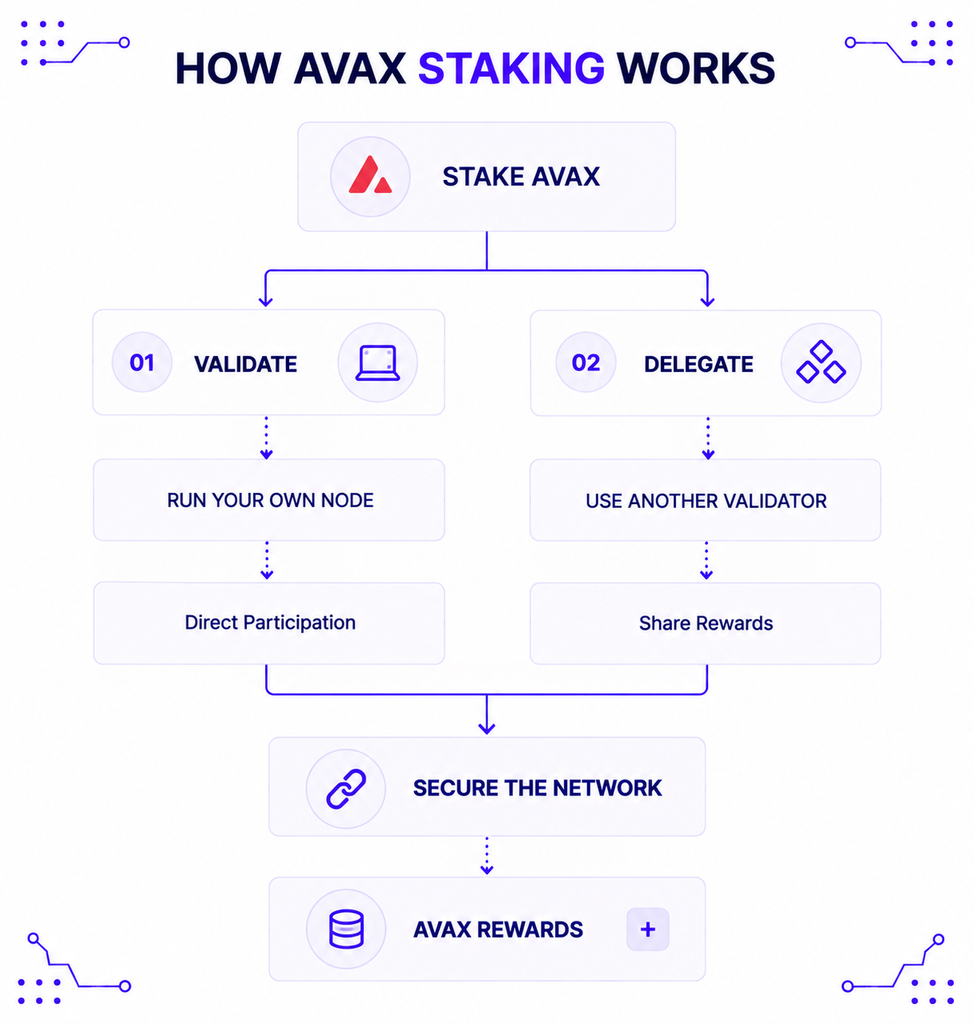
AVAX staking is the process of locking Avalanche’s native token to help secure the network, in exchange for a share of newly issued AVAX as a reward. Avalanche runs on Proof of Stake, so instead of miners burning electricity to add blocks, validators put up AVAX as collateral and get paid for confirming transactions honestly.
You can take part in two ways. You either run a validator node yourself, or you delegate your AVAX to someone else’s validator and split the reward with them. Both routes lock your tokens for a fixed period — there’s no early exit once the transaction is submitted.
Why Does Avalanche Need Staking?
A blockchain with no cost to participate is a blockchain anyone can attack for free. Staking avax gives validators something to lose: misbehave or go offline too often, and you forfeit part or all of the reward you’d otherwise earn on your locked stake.
The mechanism also controls AVAX’s supply. New tokens enter circulation as staking rewards rather than through open-ended issuance, so locking AVAX in the network doubles as a way to offset dilution for anyone holding the token long term. As of late 2026, roughly 46% of all AVAX in circulation — about 218.6 million tokens — sits staked across 597 active validators, which gives a sense of how central staking is to how the network actually runs.
Who Actually Stakes AVAX?
Staking avalanche attracts a wider range of people than you’d expect from a technical process, and each group wants something slightly different out of it.
- Retail holders who want yield on AVAX they’d otherwise leave sitting in a wallet, usually delegating through Core or an exchange rather than running hardware.
- Node operators and infrastructure teams who run validators as a business, collecting delegation fees from everyone who stakes to them.
- DAOs and treasuries holding AVAX as a reserve asset, staking a portion to generate yield without giving up custody.
- Developers building on Avalanche subnets, who often need to understand Primary Network staking before they can reason about how their own subnet’s validators get paid.
That range is why there’s no single “best” way to stake avax — a retail holder optimizing for simplicity has different needs than a team weighing whether to run its own validator infrastructure.
How Does Avalanche Staking Actually Work?
Staking transactions on Avalanche happen on the P-Chain, the platform chain that coordinates validators, tracks staked balances, and manages Avalanche’s built-in subnets. This is separate from the C-Chain, where most smart contracts and DeFi activity live — a distinction worth knowing if you’ve only interacted with AVAX through a dApp.
When you stake, you’re not just locking tokens — you’re voting, indirectly, on which validators get to help run consensus. Avalanche’s founder has described the underlying design as a deliberate break from older consensus models:
“The big breakthrough behind Avalanche is a consensus protocol where a group of entities can make a decision even with bad participants inside the Senate, even with evil actors inside the Senate, without having to talk to every other member of that Senate.” — Emin Gün Sirer, Ava Labs founder and CEO
Practically, that means validators don’t need to poll every other validator to agree on a block. They sample a random subset repeatedly until confidence in the outcome is high enough — which is what lets Avalanche finalize transactions in under two seconds even with hundreds of independent validators staked on the network.
How to Stake AVAX: Validator vs. Delegator
Before picking a method, it helps to see the two core roles side by side. The numbers below come directly from Avalanche’s own staking parameters.
| Factor | Running a validator | Delegating to a validator |
|---|---|---|
| Minimum stake | 2,000 AVAX | 25 AVAX |
| Staking duration | 2 weeks – 1 year | 2 weeks – 1 year |
| Hardware required | Yes — a node that stays online | No |
| Fee paid to others | None (you keep the full reward) | Minimum 2% to the validator |
| Uptime requirement | 80%+ or the reward is forfeited | Tied to your chosen validator’s uptime |
| Best fit | Teams with technical capacity and 2,000+ AVAX | Most individual holders |
With 2,000 AVAX worth well into six figures at most price levels, delegation is the realistic path for almost everyone. Delegators still share the validator’s uptime risk, though — if the node you delegated to falls below the 80% threshold, neither of you gets paid for that period, according to Avalanche’s own staking FAQ.
How to Stake AVAX Step by Step
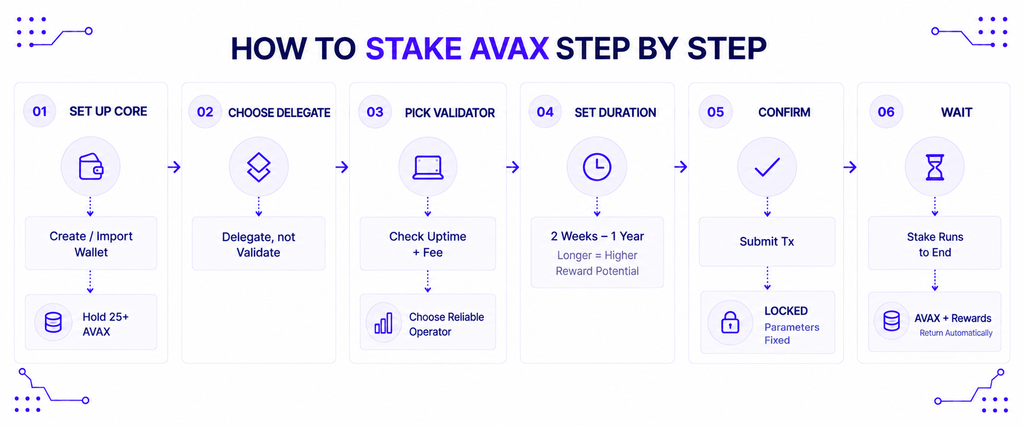
Delegating through Core, Avalanche’s official non-custodial wallet, is the most direct route for most people:
- Install Core and create or import a wallet holding at least 25 AVAX.
- Open the staking section and choose “Delegate” rather than “Validate,” unless you’re running your own node.
- Pick a validator. Compare uptime history and delegation fee — a lower fee only matters if the validator’s uptime is solid enough to actually pay out.
- Set your staking duration, from two weeks to a year. Longer commitments earn a reward rate closer to the maximum the formula allows.
- Confirm the transaction. Once submitted, the parameters are locked — you can’t shorten the duration or switch validators until it ends.
- Wait out the staking period. Your AVAX and the reward return to your wallet automatically when the term completes.
There’s no manual “claim” step and no way to withdraw early. This is critical: treat the AVAX you stake as unavailable for the full duration you selected, not just “probably fine to access.”
Where to Stake AVAX: Comparing Your Options
“Where to stake avax” usually comes down to a choice between keeping custody yourself or handing that job to an exchange. Each path trades convenience for control differently.
| Option | Custody | Typical minimum | Notes |
|---|---|---|---|
| Core wallet (direct) | You | 25 AVAX (delegate) | No platform fee beyond the validator’s own cut |
| Coinbase | Exchange | Often no practical minimum | Simple UI, exchange keeps a commission |
| Binance | Exchange | Varies by product | Broad access, flexible and locked options |
| Kraken | Exchange | Varies by product | Published rates, tiered by asset |
| Ledger (hardware wallet) | You | 25 AVAX (delegate) | Adds hardware-level key security to Core’s staking flow |
There isn’t a single best place to stake avax that fits everyone. Staking directly through Core or a hardware wallet keeps you in control of your keys, which matters if you’re staking a meaningful position; an exchange is faster to set up but means trusting that platform’s solvency on top of Avalanche’s own protocol risk.
How Much Can You Earn Staking AVAX?
Avalanche calculates rewards using a formula tied to total AVAX supply, your stake size, and how long you commit: longer durations move you closer to the maximum consumption rate the protocol allows, while short two-week stakes land near the minimum. In practice, that currently works out to roughly 6.4–6.7% APY across the network, per Staking Rewards’ live tracker.
That figure moves as more or less AVAX gets staked overall — the reward pool doesn’t grow with demand, so if the staking ratio climbs above the current 46% of supply, the average payout per staker tends to compress. A delegation fee of at least 2% comes out of your share before it lands in your wallet, so the number a validator advertises isn’t quite what you’ll net.
What Are the Risks of Staking AVAX?
Your tokens are illiquid for the full term
Unlike liquid staking on some other networks, staked AVAX through the Primary Network has no tradable receipt token and no early exit. If AVAX drops sharply mid-term, you can’t unstake to cut losses — you wait out the lockup regardless of price.
Validator uptime risk passes through to you
Delegating doesn’t remove your exposure to the validator’s performance. Pick a node with a weak uptime history and you risk earning nothing for the period, even though you did nothing wrong yourself.
Custodial risk on exchanges
Staking AVAX through an exchange adds that platform’s solvency to the list of things that can go wrong, on top of the protocol’s own risk — the same trade-off covered in more depth in our guide to how liquid staking removes this lockup problem on other chains.
Infrastructure dependency for anyone building on top
Wallets, staking dashboards, and delegation tools all need reliable, always-on access to Avalanche’s P-Chain and C-Chain to show accurate balances and validator data. Building that in-house means running full Avalanche nodes; a provider such as NOWNodes offers API access to Avalanche nodes instead, which is why several staking-adjacent tools connect through a provider rather than maintaining their own node fleet for every chain they support.
Conclusion
Staking AVAX is straightforward in mechanics but unforgiving in commitment: pick a duration, pick a validator or run your own, and your tokens are locked until the term ends. Delegating 25 AVAX or more through Core is the realistic path for most holders, while running a validator only makes sense once you’re staking well above the 2,000 AVAX minimum and can guarantee the uptime the network demands.
The number that should drive your decision isn’t the headline APY — it’s how confident you are that you won’t need that AVAX liquid before the staking period ends. Check the current reward rate and your validator’s uptime record before locking anything up, since both shift over time.
FAQ
How much AVAX do you need to start staking?
You need at least 25 AVAX to delegate to an existing validator, or 2,000 AVAX to run your own validator node on Avalanche’s Primary Network.
Can I unstake AVAX before the term ends?
No. Once a staking transaction is submitted, the duration and validator choice are locked, and there’s no mechanism to exit early — your AVAX and any reward return automatically when the period completes.
Is staking AVAX through an exchange different from staking directly?
Yes. Staking through Coinbase, Binance, or Kraken hands custody of your AVAX to the exchange, which stakes on your behalf and keeps a commission. Staking through Core or a hardware wallet keeps the keys with you the entire time.
What happens if my validator goes offline?
If a validator’s uptime falls below 80% during the staking period, neither the validator nor its delegators receive a reward for that term, though the staked principal itself isn’t slashed.
Does staked AVAX still count toward my holdings for tax purposes?
Staking rewards are generally treated as taxable income when received in most jurisdictions, with capital gains rules applying again if you later sell. Confirm the current rule in your own country rather than assuming one standard applies everywhere.