
Starting a DAO comes down to a handful of concrete moves: define what the group is for, pick a blockchain, lock the money in a shared wallet, wire up voting, and bring in members. Deploying the contracts is the easy part. Keeping people voting and the treasury safe afterward is where most of the real work lives.
A DAO — a decentralized autonomous organization — is an internet-native group that coordinates money and decisions through smart contracts and member votes instead of a CEO or a board. Rules live in code, funds live in a wallet the group controls together, and changes happen when a proposal passes a vote.
This guide walks through how to start a DAO that can actually function, from the first design choices to the legal and operational details people usually discover too late.
What Is a DAO, Exactly?
A DAO is a group that runs on shared rules enforced by smart contracts rather than by a company and its managers. Members propose actions, vote on them, and the code executes whatever passes.
The word “autonomous” oversells it a little. A DAO doesn’t run itself; it runs on the decisions its members keep making. What the smart contracts guarantee is that no single person can quietly move the funds or rewrite the rules without a vote going through first.
That distinction matters for the rest of this article. “Starting a DAO” splits into two jobs: standing up the tooling (a treasury, a voting system, maybe a token), and building an organization that people will keep showing up for. The first takes an afternoon. The second takes months.
When Does Launching a DAO Make Sense?
A DAO makes sense when a group needs to control money or decisions together, transparently, without trusting one person to hold the keys. If a spreadsheet and a group chat already work, you don’t need one.
Three patterns show up again and again:
- Handing a protocol to its users. A project launches, gains traction, and the founding team wants token holders to steer upgrades and treasury spending instead of a central company.
- Pooling and distributing funds. A collective raises capital and lets members vote on where it goes. Grant-funding communities like Gitcoin run this way.
- Single-purpose collectives. A group forms around one goal — buying an asset, funding a cause, backing a project. Nouns DAO (which funds projects from daily NFT auctions) and PleasrDAO (formed to buy culturally significant pieces) are well-known examples.
Here’s the honest counterweight: a DAO adds friction. Every meaningful decision becomes a proposal and a vote, which is slower than a founder making a call. If speed matters more than shared control right now, launching a DAO too early will just slow you down.
What Are the Steps to Launch a DAO?
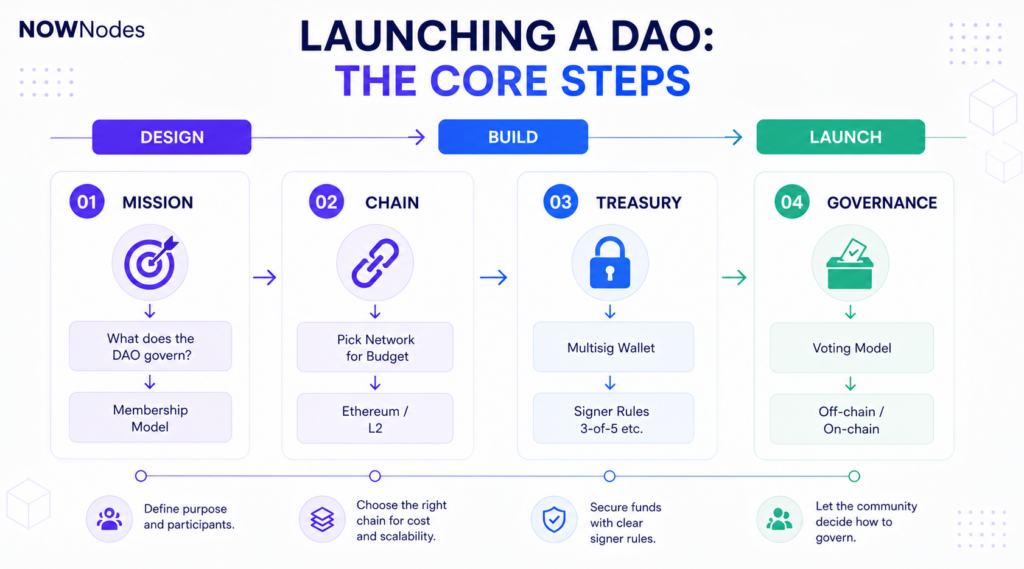
The best way to start a DAO is to get the structure and the money right before you touch governance tooling. Here’s the order that avoids the most rework.
- Define the mission and who can be a member. Write down what the DAO decides on and what it stays out of. Decide whether membership comes from holding a token, earning contribution points, or being invited. This one choice shapes everything downstream.
- Pick a blockchain. Most DAO tooling targets Ethereum and EVM-compatible chains. Governance activity means a lot of small transactions, so deployment and voting costs matter — an Ethereum Layer 2 or a low-fee chain keeps running costs down versus Ethereum mainnet.
- Set up the treasury first. Deploy a multisig wallet — a shared wallet that needs several approvals to move funds — before anything else. Funds should never sit under one person’s control, even temporarily.
- Choose your voting system. Decide between off-chain signaling for cheap, frequent polls and on-chain voting for binding decisions that execute automatically. Many DAOs use both.
- Deploy and audit the governance contract. If votes trigger on-chain actions, that contract controls real money. Have it audited before it goes live.
- Write the operating rules down before the first hard vote. Set quorum, voting periods, and proposal thresholds while the group is still calm. Deciding these during a contentious vote goes badly.
- Launch publicly and onboard members. Open participation, explain how to propose and vote, and distribute voting power in a way that reflects the community rather than concentrating it in a few early wallets.
Which Governance Model Should You Choose?
The governance model decides who gets a say and how much. There are three common approaches, and each trades something away.
| Model | How power is assigned | Strength | Weakness |
|---|---|---|---|
| Token-weighted | One token ≈ one vote | Easy to bootstrap; power is liquid and tradable | Whales can dominate; wealth buys influence |
| Reputation-based | Non-transferable points earned by contributing | Rewards work, resists vote-buying | Slow to get off the ground |
| Council / multisig | A small elected group decides | Fast, decisive | Reintroduces the centralization a DAO was meant to avoid |
Ethereum co-founder Vitalik Buterin has argued that DAOs shouldn’t simply copy corporate structures. In his 2022 essay “DAOs are not corporations,” he makes the case that decentralization earns its keep on contentious, adversarial decisions — the kind a rigid hierarchy handles badly — and matters far less for routine ones.
Read practically, that’s an argument for matching the model to the decision instead of defaulting to one-token-one-vote for everything. Plenty of DAOs run token voting for big calls and a small multisig for day-to-day execution.
What Tools and Infrastructure Does a DAO Need?
A new DAO needs four things: a treasury, a way to vote, a place to talk, and a connection to the chain. You can assemble these from separate tools or use an all-in-one platform.
| Need | What it does | Common choices |
|---|---|---|
| Off-chain voting | Gasless polls and signaling | Snapshot |
| On-chain voting | Binding votes that execute automatically | Tally, OpenZeppelin Governor |
| Treasury | Holds and controls funds | Safe (multisig) |
| All-in-one setup | Deploy and manage a DAO with less code | Aragon OSx, DAOhaus |
| Community | Coordination and discussion | Discord, Discourse |
| Chain access | Read on-chain data, broadcast transactions | NOWNodes |
Snapshot is the default for off-chain voting because members sign votes with their wallets without paying gas. For votes that must move funds on their own, an on-chain framework like OpenZeppelin’s Governor (the open-source standard most Ethereum DAOs build on) handles execution. Safe is the most widely used treasury wallet — the Safe Foundation reported its smart accounts held $35.25 billion across more than 61 million accounts in Q1 2026, more than a third of all EVM DeFi value. If you’d rather not stitch these together, Aragon OSx lets teams deploy and run a DAO with far less custom code.
Every piece of that stack — the voting interface, the treasury dashboard, a bot that executes a passed proposal — has to read the chain’s current state and push transactions to it. Teams either run that infrastructure themselves or use a provider. NOWNodes offers API access to 120+ networks, so a DAO’s tooling can check balances, track proposals, and submit transactions without the group maintaining its own servers.
How Much Does It Cost to Launch a DAO?
Launching a basic DAO can cost almost nothing, or it can run into five figures — the gap is mostly the security audit. Here’s a realistic breakdown.
| Item | Typical cost | Notes |
|---|---|---|
| Governance contract deployment | ~$1–$100+ | Depends on the chain and congestion; cents on an L2, more on Ethereum mainnet |
| Off-chain voting (Snapshot) | Free | Signatures only, no gas |
| Treasury wallet (Safe) | Gas only | No platform fee to create |
| Legal wrapper (Wyoming DAO LLC) | $100 state filing fee | Plus annual report and registered-agent costs |
| Security audit | $5,000–$20,000+ | For a simple token or governance contract |
That audit range is the one to plan around. According to a 2026 market reference from auditing firm Sherlock, simple token contracts land in the $5,000–$20,000 band, while more complex systems with remediation passes can climb well past that. Price scales mainly with lines of code and complexity. Skipping the audit saves money up front and is the single most expensive mistake a DAO can make if the contract holds real funds.
Do You Need a Legal Wrapper?
Not to launch — but you probably want one if the DAO holds significant money or signs contracts. A DAO with no legal entity can be treated by courts as a general partnership, which can expose members to personal liability for the group’s actions. U.S. regulators have already treated an unwrapped DAO’s members this way, which is why serious projects wrap their DAO in a legal shell.
A few established options:
- Wyoming DAO LLC. The most common U.S. route. A $100 state filing plus ongoing agent fees gives the DAO limited-liability protection.
- Wyoming DUNA. Wyoming’s Decentralized Unincorporated Nonprofit Association Act, effective July 1, 2024, created a nonprofit framework built specifically for DAOs. A DUNA needs at least 100 members, gives the organization legal personhood, and lets it hold property, sign contracts, and pay taxes while staying member-governed. In 2026, the Uniswap Foundation proposed wrapping its DAO in a Wyoming DUNA as it moved toward turning on protocol fees.
- Marshall Islands DAO LLC. A non-U.S. alternative for groups that want to incorporate the DAO itself as a recognized entity.
Which one fits depends on where your members are and what the DAO does, so this is the step where talking to a crypto-literate lawyer actually pays off.
What Does It Take to Keep a DAO Going?
Launching is the milestone people celebrate; running a DAO is the part that quietly decides whether it survives. The most common failure after launch isn’t a hack — it’s silence.
Turnout drops, quorum becomes impossible to reach, and the DAO stalls with proposals nobody votes on. A few habits keep a DAO alive:
- Set a realistic quorum. Require enough votes to be legitimate, but not so many that routine proposals can never pass.
- Use delegation. Delegate systems in tools like Tally and Snapshot let passive members assign their voting power to informed delegates, so decisions still happen when most holders aren’t paying attention.
- Treat the treasury like an operating budget. Diversify holdings, fund work through clear spending proposals, and plan a runway — not a trophy balance that sits untouched until a crisis.
- Keep proposals legible. If a vote is too technical to understand, people won’t vote on it. Summaries and discussion before a formal vote keep participation up.
To run a DAO well is mostly to fight apathy. The contracts will do their job indefinitely; the members are the part that needs maintenance.
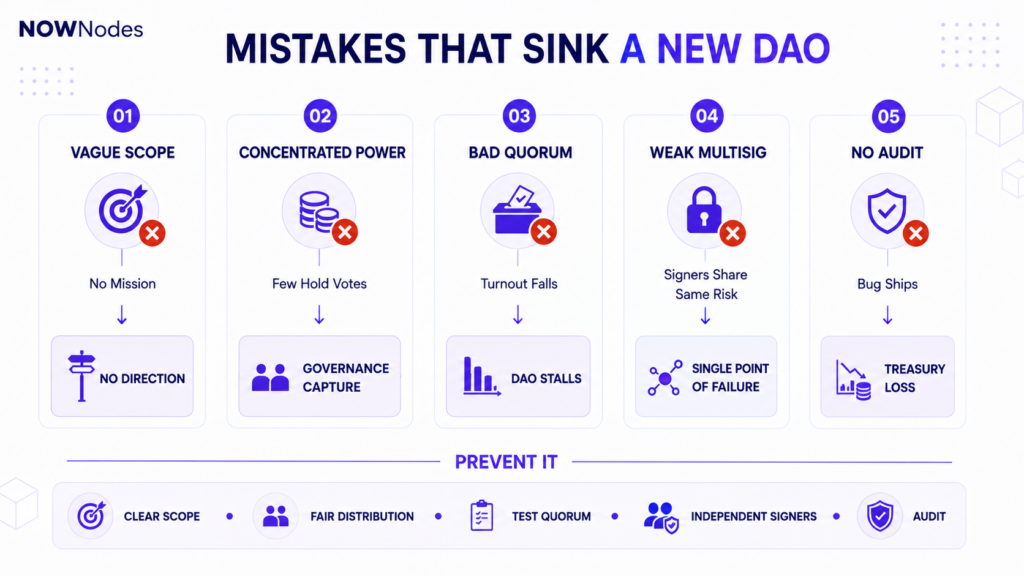
Mistakes That Sink a New DAO
Most DAOs that fail do so for reasons that were visible at launch. The usual suspects:
- Undefined scope. A DAO that tries to decide everything decides nothing.
- Concentrated token distribution. If a few wallets hold most of the voting power on day one, it’s a DAO in name only.
- Badly calibrated quorum. Set it too high and the DAO freezes; too low and a tiny faction can push proposals through.
- Non-independent multisig signers. If the treasury’s approvers are all the same person’s friends, the multisig protects nothing.
- Skipped audits. Deploying an unaudited contract that controls funds is how DAOs lose everything in one transaction.
Conclusion
Starting a DAO is a short checklist: define the mission, pick a chain, set up a shared treasury, choose a voting system, audit the contracts, and open the doors. The tooling is mature enough that the technical launch rarely fails.
What determines whether a DAO lasts is everything the tooling can’t do for you — a scope people understand, voting power that’s actually distributed, a treasury managed like a budget, and members who keep participating. Get the structure right first, add a legal wrapper once real money is involved, and treat the launch as the start of the work rather than the finish.
When your tooling needs reliable access to the chains your DAO runs on, infrastructure providers like NOWNodes handle that layer so your team can focus on governance instead of servers.
FAQ
How long does it take to launch a DAO?
The technical setup — treasury, voting, token — can be done in a day or two using existing platforms. Getting a real community and well-distributed voting power in place usually takes weeks or months, and that’s the part that actually determines whether the DAO works.
Can you start a DAO without writing any code?
Yes. All-in-one platforms let you deploy a treasury, a token, and on-chain voting through a web interface without writing smart contracts yourself. You still need custom code (and an audit) if the DAO requires logic those templates don’t cover.
What happens to a DAO if its founders leave?
A well-designed DAO keeps running, because the rules live in smart contracts and control sits with the members, not the founders. A poorly designed one often stalls — if founders held most of the voting power or ran the only active communication channels, their exit can leave the DAO unable to reach quorum.
Can you convert an existing company or project into a DAO?
Yes, and many protocols do exactly that, gradually handing decisions and treasury control to token holders. It’s more involved than starting fresh: you have to distribute voting power, migrate treasury funds into a multisig, and usually pair the DAO with a legal wrapper to handle the existing company’s obligations.
Do DAO members have to pay taxes on the treasury?
Possibly — tax treatment depends on the jurisdiction and the legal structure. A legal wrapper such as a Wyoming DAO LLC or DUNA clarifies who is responsible for filings and taxes, which is one of the main reasons DAOs adopt one. Treat this as a question for a qualified tax professional, not a settled rule.