
A reliable Optimism RPC service is one that publishes evidence of its own reliability and returns correct OP Stack data. Uptime alone does not cover it. Those two conditions can be checked, unlike a claim of offering the most reliable Optimism endpoints.
This guide gives you a way to check them for any Optimism RPC provider, then applies it to seven providers using only their own documentation, dated 28 September 2026. It does not rank them, because reliability cannot be measured from documentation alone.
NOWNodes is one of the seven. It is a blockchain infrastructure provider listed in the OP Stack RPC directory maintained by OP Labs, with Optimism access over JSON-RPC, WebSocket and indexed APIs on Mainnet. Its Optimism page states 99.95% uptime. This article treats that as a page claim, the same way it treats every other provider’s figures.
What Is Different About Optimism for RPC Access?
OP Mainnet runs on the OP Stack, and its chain ID is 10. Per the OP Labs documentation, a new L2 block appears every 2 seconds. Base and other Superchain networks run the same stack, so much of what follows carries over to them.
The public endpoint is not built for production. The Optimism docs say it is rate limited and does not support WebSocket connections. The OP Stack RPC directory adds that public endpoints are “not suitable for production use.”
What Does the OP Stack Change for Developers?
Three behaviors matter for endpoint quality. Each one is a place where a provider can return something subtly wrong.
Why does the L1 data fee show up in receipts?
Every OP Mainnet transaction pays an execution fee and an L1 data fee. The fee documentation defines the total as execution gas cost plus l1Fee, and after the Isthmus upgrade an operator fee is added.
Receipts carry OP-specific fields for this. According to the op-core types package, l1Fee is present from before Bedrock, l1GasUsed is deprecated as of Fjord, and l1FeeScalar is empty after Ecotone. An Optimism endpoint that drops or mislabels these fields breaks fee accounting without any error.
What do the unsafe, safe and finalized tags mean?
Nodes expose three states. The finality documentation maps the unsafe head to the latest tag, and the safe and finalized heads to the safe and finalized tags.
The same page gives typical timings: about 2 seconds to soft finality, a few minutes to safe, and about 15 to 30 minutes to finalized. A provider that serves a stale finalized tag will misreport when a deposit is truly settled.
What happens after an L1 reorg?
The docs state that if Ethereum reorgs, OP Stack nodes will downgrade “safe” transactions to “unsafe” if needed, while “finalized” transactions are protected from reorgs. An application that stored a block as safe should therefore be ready to see it change.
Here is the catch. The unsafe head depends on a single sequencer, and the docs say the sequencer can reorganize unsafe blocks until their data lands on Ethereum. That is a property of the network, not of any provider, but a good endpoint lets you read the safe tag so you can avoid the risk.
“A common misconception is that the Sequencer can trigger reorganizations of the OP Stack chain at any time.”
— Optimism documentation, Transaction finality
How Do You Assess OP Mainnet Access Reliability?
Frame every criterion as a question about published evidence. You are not measuring the provider. You are checking what it is willing to put in writing.
| Criterion | What to check | Why it matters on OP Stack |
|---|---|---|
| Published uptime or SLA | A dated source page, and whether it is a target or a commitment | Marketing pages and SLA documents can disagree |
| Public status page | Incident history for the OP Mainnet component specifically | Shows how outages are disclosed |
| Correct OP Stack data | L1 receipt fields and block tags returned as documented | Wrong fields break fee accounting silently |
| WebSocket stability | Which plans include it, and what happens at plan limits | Real-time apps depend on subscriptions |
| Archive and debug/trace | Availability on OP Mainnet, and on which plan | Indexers and forensics need historical state |
| Rate-limit behavior | Model (requests, credits, compute units) and 429 handling at peaks | Peaks are where free tiers fail |
| Multi-region and failover | Whether regions are named and failover is described | One region is one point of failure |
| Client diversity | Only if the provider publishes it | Reduces shared-bug risk |
| Support level per plan | Response time and who answers | Incidents need a human quickly |
Two cautions apply to every row. Aggregator sites such as StatusGator and IsDown report incident counts, but they are not provider documentation and they disagree with one another, so this guide does not use them for any verdict. And a figure without a date and a source page is a slogan.
How Do the OP Stack Providers Compare?
The table uses only each provider’s own pages, checked on 28 September 2026. “Not specified” means the provider’s OP Mainnet page did not state it, which is different from “not supported.” Read the linked source before relying on any cell, because a provider can add a feature the day after this was checked.
| Provider | Published uptime / SLA | Status page | WSS | Archive | Debug/trace | Rate-limit model |
|---|---|---|---|---|---|---|
| NOWNodes | 99.95% (page claim) | Yes | Yes, Pro plan and up | Listed as API tool | Debug namespace documented | Monthly requests; no predefined RPS limits on paid plans (page claim) |
| Alchemy | Not specified on OP page | Listed | Yes | Not specified | Debug and Trace API listed | Not specified |
| QuickNode | Not specified on OP page | Not specified | Yes | Yes | Yes | “Predictable rate limits” (no figure) |
| Infura | Not specified | Not specified | Yes, public beta | Requests older than 128 blocks priced as normal | Not specified | Credits per second by plan |
| Chainstack | 99.9% target, SLA dated 8 March 2024 | Not specified | Yes (HTTP and WebSocket) | Priced at 2 Request Units | Listed for Dedicated nodes | Request Units |
| dRPC | Not specified | Yes | Yes | Yes | Not specified | Not specified on OP page |
| GetBlock | Not specified | Not specified | Not specified | Not specified | Not specified | Not specified |
Checked on: 28 September 2026. Coverage of OP Mainnet is confirmed for all seven in the OP Stack RPC directory. Ankr also appears in that directory, but its documentation repository was archived on 10 September 2026, so it is left out until its current status is confirmed.
The most useful row is Chainstack. Its enterprise SLA document states a 99.9% target with service credits of 10% of paid amounts, while marketing pages elsewhere cite 99.99%. Neither is wrong, but only one is a contract. That gap is why the first criterion asks for a dated source.
Provider Profiles
Each profile covers who the provider fits, its strengths, its limits, and when to pick something else. Facts come from the provider’s own pages.
NOWNodes
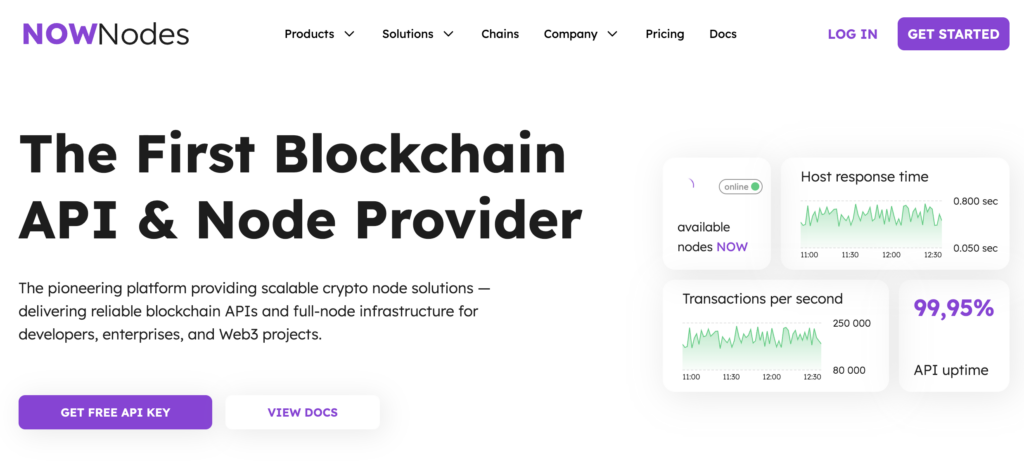
NOWNodes fits teams that want one provider across many networks with a single key. Its Optimism page lists Optimism RPC, indexed APIs, WebSocket and indexed WebSocket on Mainnet. The documentation also lists a debug namespace and an eth_getBlockReceipts method.
The limits are specific. WebSocket is not available on the Start plan, which is 100,000 requests per month, and starts on Pro. The OP directory lists no testnet for NOWNodes on Optimism. Uptime is stated as 99.95% on the product page, and the status page tracks incidents, though its history is not readable without JavaScript.
Support response time is 3 minutes on all plans per the pricing page. Choose an alternative if you need a published, contract-level SLA figure before signing, or Optimism testnet access from the same provider.
Alchemy
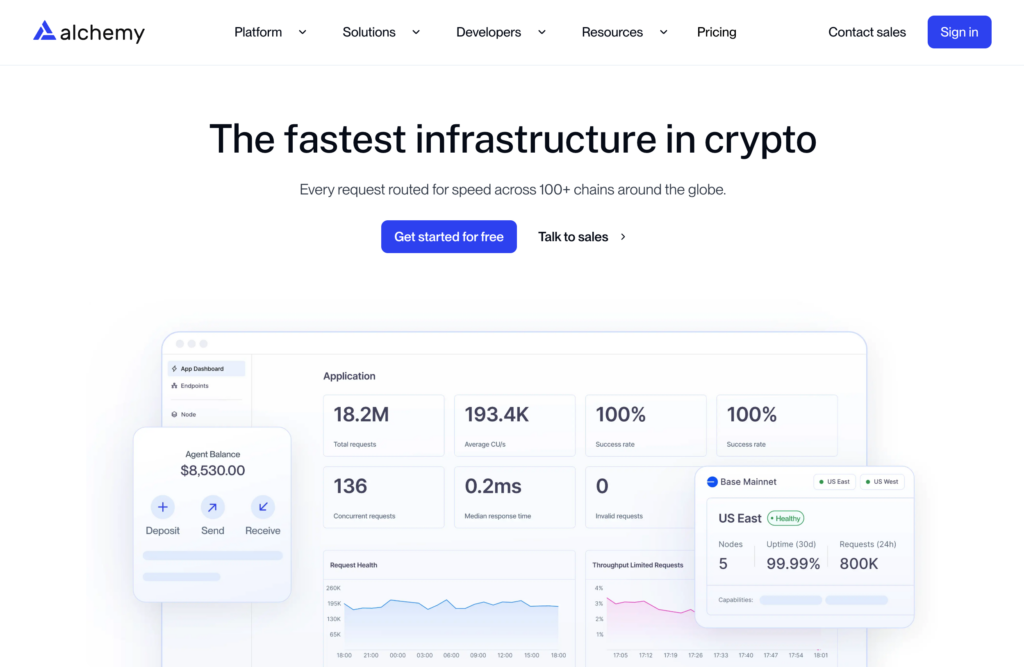
Alchemy suits teams that want enhanced APIs on top of standard RPC. Its OP Mainnet page lists WebSockets, Debug API, Trace API and Webhooks as supported, and lists gRPC as unsupported.
Its own page gives no uptime figure. A 99.99% claim appears on an AWS Marketplace listing, which is not Alchemy documentation, so it is not used here. Pick another provider if you need a stated SLA on the OP page itself.
QuickNode
QuickNode fits data-heavy workloads. Its OP Mainnet page describes full archive data, debug and trace namespaces, and a qn_getBlockWithReceipts call that returns a block with all receipts in one request.
It publishes a latency benchmark but no uptime figure on that page. Choose something else if you need the status page and SLA terms visible on the same page as the OP offering.
Infura
Infura suits teams already in the MetaMask developer ecosystem. Its pricing documentation sets the Free tier at 3,000,000 daily credits and 500 credits per second, Developer at 15,000,000 and 4,000, and Team at 75,000,000 and 40,000.
One detail matters for reliability. Per that page, WebSocket connections are severed when you reach your daily credit limit. Optimism WebSocket support is marked public beta. Look elsewhere if you need WebSocket that does not depend on a daily quota.
Chainstack
Chainstack fits teams that want dedicated infrastructure and clear SLA paperwork. Its enterprise SLA is a real document with defined downtime and credits, though the 99.9% target and the March 2024 date are worth reading closely.
Its Optimism page prices full-node requests at 1 Request Unit and archive requests at 2, and lists debug and trace APIs under dedicated nodes. Other Chainstack pages describe debug and trace more broadly, so confirm which node type includes them before you plan around it.
dRPC
dRPC suits teams that want a low entry price and a public status page. Its Optimism page lists HTTPS and WSS endpoints, an Archive label, and a Growth plan with 5,000 RPS.
It states no uptime SLA and no debug/trace coverage on that page. Choose another provider if either is a requirement.
GetBlock
GetBlock appears in the OP directory with OP Mainnet as a supported mainnet, and it offers free and paid plans. This guide found no first-party OP-specific feature documentation, so its cells are marked not specified. Verify directly before adopting it.
Shared or Dedicated Infrastructure on OP Mainnet?
Neither is universally better. Shared access is cheaper and deploys immediately, but your traffic shares capacity with other customers. Dedicated infrastructure isolates your load and is chosen for heavy tracing or strict performance needs, at higher cost.
For a first production launch, start on a shared plan and measure. Move to dedicated only when your own tests show contention. NOWNodes lists shared and dedicated options, but its Optimism page does not confirm dedicated availability for this network, so ask before assuming.
How Can You Verify Reliability Yourself?
You can test the claims above without trusting anyone. Run these steps against each candidate, and do it before launch rather than during an incident.
- Test from your own region, since latency and routing vary by location.
- Send your heaviest methods, such as
eth_getLogsover wide ranges and trace calls. - Generate a traffic spike and watch for 429 responses and how quickly they clear.
- Compare receipts and the
safeandfinalizedtags around known L1 activity. - Keep a second provider configured as failover and confirm your client switches.
Conclusion
Choose an Optimism provider by the evidence it publishes, not the adjective it uses. Ask for a dated SLA, read the status page, and confirm receipts and block tags behave as the OP docs describe.
For most teams the practical Optimism RPC setup is two providers: one primary, one failover, with the safe tag used for anything that moves money. See NOWNodes’ Base page for the Superchain neighbor on the same key.
FAQ
Is the public OP Mainnet URL enough for production?
No. The OP Labs docs describe public endpoints as rate limited and not suitable for production use, and the main public URL does not support WebSocket.
Can Optimism and Base share one provider account?
Often yes. Several providers in the OP directory list both OP Mainnet and Base. Check the plan’s network access, since NOWNodes’ Start plan does not include access to all nodes.
Do receipt L1 fields differ between providers?
They should not, because they come from the same OP Stack client software. Some fields do change by hardfork, so test a recent transaction against the OP documentation.
How does a provider outage show up in an app?
Usually as stale block numbers, timeouts, or 429 errors, rather than a clear failure. Monitoring eth_blockNumber freshness catches it earlier than error rates.
Can the unsafe head be trusted for payments?
Only if you trust the sequencer. The docs say it can reorganize unsafe blocks until data lands on Ethereum, so use the safe or finalized tag for irreversible actions.