
A permissioned blockchain restricts who can join the network, validate transactions, or see certain data — an administrator decides who gets in. A permissionless blockchain does the opposite: anyone can download the software, run a node, and start validating, with no application or approval required. That single design choice — gatekeeper or no gatekeeper — shapes almost everything else about how a network behaves.
Bitcoin and Ethereum are permissionless. Anyone with an internet connection can join either network today. Hyperledger Fabric, R3 Corda, and most bank-run blockchain consortiums are permissioned — a handful of vetted institutions control who reads and writes to the ledger.
Neither model is a downgrade of the other; they’re built for different jobs. This guide starts with plain-language definitions, works through why each model exists, who actually uses them, and ends with the deeper trade-offs — consensus mechanics, performance, and the hybrid setups that borrow from both.
What Is a Permissioned Blockchain?
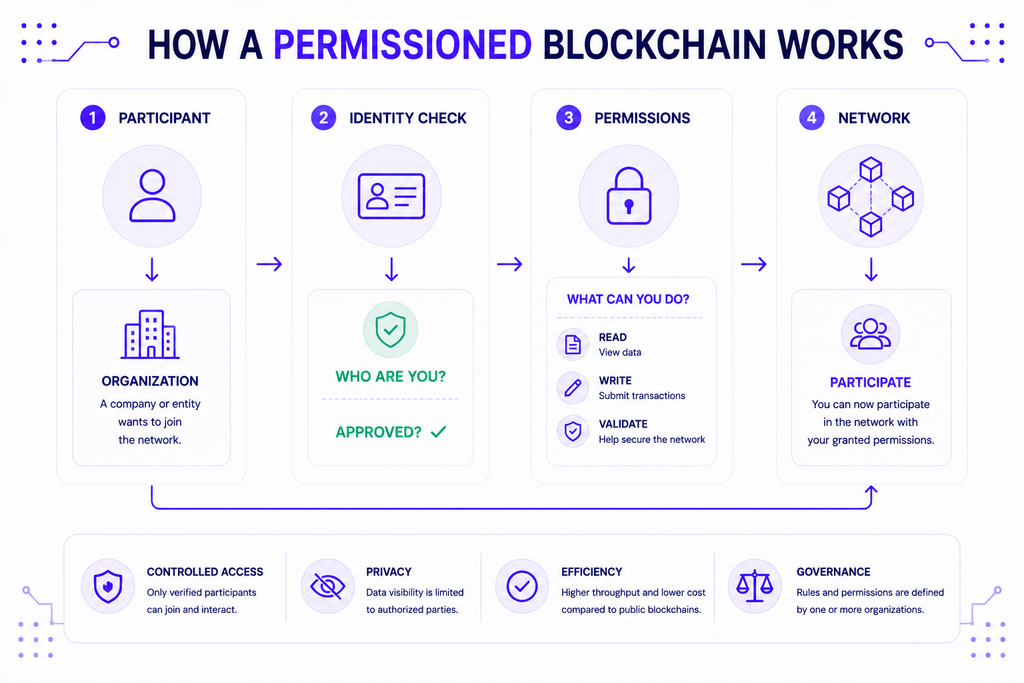
A permissioned blockchain is a network where an operator or consortium controls who can join, submit transactions, or validate blocks. Every participant needs an identity the network recognizes before they can do anything beyond, at most, viewing public data.
Permissioned blockchain: a distributed ledger where read, write, or validation rights are restricted to approved, identified participants, with access managed by a central operator or a consortium of organizations rather than open to the public.
Hyperledger Fabric, one of the most widely deployed permissioned frameworks, puts it directly in its own documentation: participants “join the network under some form of governance model,” and transactions are only visible to the organizations authorized to see them, according to Hyperledger Fabric’s official docs. That governance layer is the whole point — a bank consortium doesn’t want a stranger validating its settlement data.
What Is a Permissionless Blockchain?
A permissionless blockchain lets anyone participate in its core functions — running a node, validating transactions, or submitting one — without asking anyone for permission first. There’s no sign-up form, no KYC check, no operator who can reject an application.
Permissionless blockchain: a distributed ledger where anyone can read the chain, broadcast transactions, and take part in consensus by meeting the protocol’s technical requirements, with no central party able to approve or deny access.
Bitcoin remains the clearest example. Over 26,000 public nodes currently enforce its rules, according to coin.dance’s live node count, and none of them asked Bitcoin’s original developers for a permission slip. Ethereum works the same way structurally, even though it moved from mining to staking in 2022.
Why Does This Distinction Exist?
Here’s the problem both models are trying to solve, just from opposite directions: how do you get people who don’t trust each other to agree on a shared, tamper-resistant record? A permissionless chain solves it by making trust unnecessary — the code and the open validator set do the enforcing, so no participant has to vouch for another.
A permissioned chain solves a related but different problem. It assumes the parties already have some baseline trust — they’re banks in a settlement consortium, or departments in the same supply chain — and what they actually need is a shared, auditable ledger without exposing that data to the public internet or ceding control to strangers running nodes.
This is critical: permissionless doesn’t mean lawless, and permissioned doesn’t mean untrustworthy. It means the two models locate trust in different places — one in open code and economic incentives, the other in vetted institutional relationships.
Who Actually Uses Each Model?
The split maps fairly cleanly onto two different kinds of users, though the line has started to blur in 2026.
Permissioned Networks in Practice
Financial institutions and enterprise consortiums are the primary users of permissioned blockchains, largely because regulation and internal compliance require them to know exactly who touches their systems. A few concrete deployments show the range:
- R3 Corda underpins interbank settlement systems used by dozens of financial institutions that need shared ledgers without broadcasting trade data publicly.
- JPMorgan’s Kinexys (formerly Onyx) runs permissioned infrastructure for intraday repo and cross-border payment settlement between its institutional clients.
- Swift, the global bank-messaging network, went live in July 2026 with a permissioned blockchain ledger connecting 17 banks across six continents to pilot tokenized, 24/7 cross-border settlement without opening the network to the public, according to Swift’s own announcement.
The enterprise blockchain market built on this model isn’t small. It’s projected to grow from roughly $9.6 billion in 2023 to about $287.8 billion by 2032 — a 47.5% compound annual growth rate — according to market.us’s enterprise blockchain forecast. That pace reflects how many institutions are choosing controlled ledgers over public ones for internal and consortium use.
Permissionless Networks in Practice
Cryptocurrency holders, DeFi users, and developers building open financial infrastructure gravitate toward permissionless chains precisely because nobody can lock them out. Ethereum alone runs on more than 1.2 million active validators as of mid-2026, securing roughly a third of all circulating ETH, according to CoinLaw’s 2026 staking data — a scale of open participation no permissioned network attempts to match.
Newer permissionless networks are pulling real capital, too. Base, a permissionless Ethereum layer-2, holds roughly $4.45 billion in DeFi protocol deposits, according to CoinLedger’s network-growth research — money moving through smart contracts nobody had to apply to use.
Anyone building a wallet, an exchange, or a DAO on top of one of these networks still needs a way to read blockchain state and broadcast transactions. That’s usually where a node-access provider enters the picture: NOWNodes, for instance, offers API access to both shared and dedicated nodes across 120-plus permissionless networks, so a developer doesn’t have to run and sync the underlying full nodes and validator nodes themselves.
Permissioned vs. Permissionless Blockchain: Side-by-Side Comparison
The table below lays out where the two models genuinely diverge.
| Factor | Permissioned Blockchain | Permissionless Blockchain |
|---|---|---|
| Who can join | Approved participants only | Anyone meeting technical requirements |
| Identity requirement | Known, verified identities | Pseudonymous by default |
| Governance | Operator or consortium | Open protocol rules, community governance |
| Transaction speed | Higher — fewer validators to coordinate | Lower — thousands of nodes must agree |
| Data visibility | Often private to authorized parties | Public and auditable by anyone |
| Censorship resistance | Low — operator can exclude participants | High — no single party can block access |
| Typical fit | Consortiums, regulated finance, supply chains | Public cryptocurrencies, DeFi, open dApps |
None of these rows makes one model objectively superior. A hospital consortium sharing patient-consent records wants exactly the restricted visibility a public chain refuses to offer, while a payments network aiming for global censorship resistance needs exactly the openness a permissioned chain restricts.
How Consensus Works Differently
The consensus mechanism — how the network agrees on the next valid block — is where the two models diverge mechanically, not just philosophically. Permissionless networks typically run Proof of Work or Proof of Stake, both designed to let anonymous strangers reach agreement without knowing or trusting each other. A validator node on Ethereum, for example, stakes real ETH as collateral and loses part of it if it cheats — the economic penalty substitutes for the vetting a permissioned network does upfront.
Permissioned networks skip that economic bootstrapping because the participants are already known. Hyperledger Fabric can use a pluggable ordering service, and Corda relies on notary clusters, both closer to classical Byzantine fault-tolerant consensus than to mining or staking. Because the validator set is small and identified, these systems can finalize transactions in a couple of seconds rather than the minutes a public chain sometimes needs.
That speed comes at a cost worth stating plainly: a permissioned network’s transaction finality depends on trusting the handful of parties running it. If a majority of them collude, they can rewrite history in a way that a permissionless chain’s thousands of independent nodes make practically impossible.
What Are the Real Trade-Offs?
Every advantage on one side maps to a limitation on the other, and it’s worth being direct about where each model actually struggles.
Permissioned blockchains trade decentralization for control. Fewer validators means faster, cheaper transactions, but it also means the network’s integrity rests on the good behavior — and continued cooperation — of a small group. If the operator shuts down or a majority of consortium members disagree, the network can stall or fork in ways users can’t override.
Permissionless blockchains trade control for resilience. Nobody can be excluded, censored, or have their transaction quietly reversed, but that same openness means the network can’t easily enforce compliance rules, reverse a mistaken transaction, or restrict who sees the data. Ethereum co-founder Vitalik Buterin framed the choice this way back in 2015, and it still holds:
“The solution that is optimal for a particular industry depends very heavily on what your exact industry is. In some cases, public is clearly better; in others, some degree of private control is simply necessary.” — Vitalik Buterin, CoinDesk
That’s really the whole debate in one sentence. Public networks protect users from the people running the software; private networks let the people running the software fix mistakes and enforce rules that regulators demand.
Can You Combine Both? Hybrid and Consortium Models
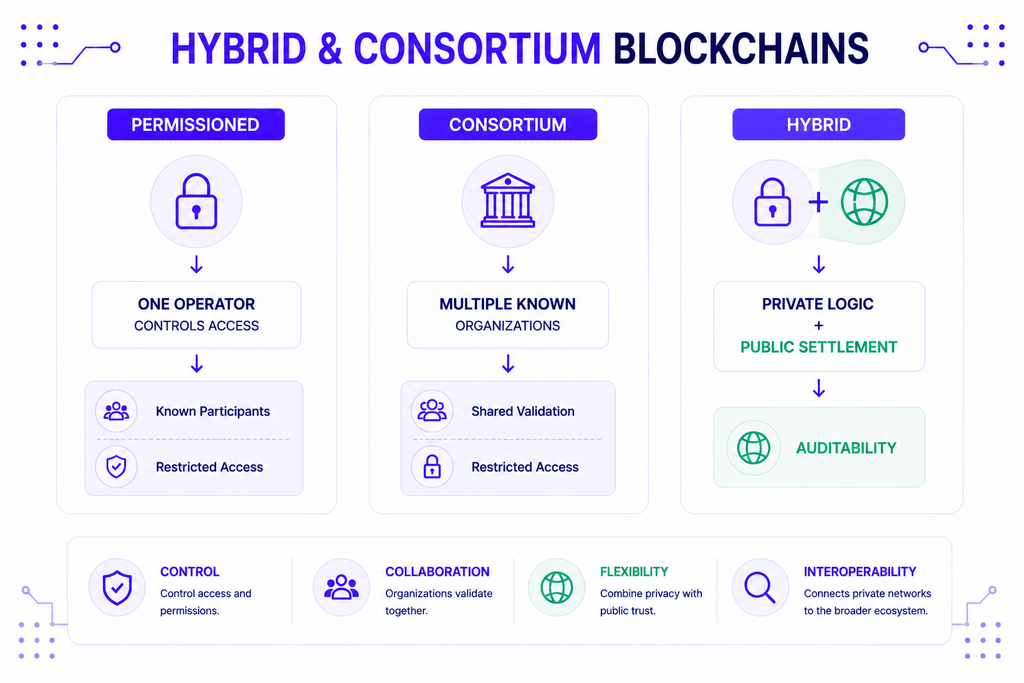
Plenty of real deployments don’t pick a side cleanly. A hybrid blockchain runs permissioned logic for parts of the system — who can submit certain transaction types, for instance — while settling final state on a public, permissionless chain for auditability.
The Canton Network is one current example: it lets regulated institutions run permissioned application layers while interoperating through a shared, more open settlement layer, letting participants keep sensitive data private without fully isolating themselves from broader liquidity. A consortium blockchain sits at a related middle point — multiple known organizations share validation rights, more open than a single-operator permissioned chain but still closed to the public.
This middle ground exists because the binary framing — public or private — doesn’t fit every real business requirement. A bank might need public settlement finality for a tokenized asset while keeping the counterparties’ identities and trade terms restricted to the parties involved.
How to Choose the Right Model for Your Project
The decision usually comes down to four questions, in roughly this order:
- Does regulatory compliance require knowing every participant’s identity? If yes, a permissioned or hybrid model is close to mandatory.
- Does the application need censorship resistance or global, trustless access? If yes, permissionless is the only structure that delivers it.
- How much transaction throughput and finality speed do you need? Permissioned networks generally win here, since fewer validators coordinate faster.
- Who bears the cost if the operator misbehaves or shuts down? A permissionless network removes that single point of failure; a permissioned one concentrates it.
None of these answers are permanent. A project can start permissioned to satisfy early compliance needs and migrate parts of its architecture toward a public chain as requirements change — which is exactly what the hybrid models above are built to support.
Conclusion
Permissioned and permissionless blockchains solve the same underlying problem — getting parties to agree on a shared ledger — through opposite assumptions about trust. A permissioned network assumes the participants are already known and optimizes for speed, privacy, and compliance; a permissionless one assumes they aren’t and optimizes for openness and censorship resistance instead.
Neither is a stepping stone to the other. The right choice depends on whether your project needs a vetted set of counterparties or a network nobody can shut out — and increasingly, on whether a hybrid design lets you have workable pieces of both.
FAQ
Is Bitcoin permissioned or permissionless?
Bitcoin is permissionless. Anyone can download Bitcoin Core, sync a full node, and start validating transactions without approval from any central party.
Can a permissioned blockchain become permissionless later?
Technically yes, but it requires redesigning access control and consensus from the ground up, not just flipping a setting. Most projects that want both instead build a hybrid architecture from the start rather than converting an existing permissioned chain.
Are permissioned blockchains less secure than permissionless ones?
Not necessarily less secure, but differently secure. A permissioned chain resists external attackers well since access is restricted, but it depends on trusting its known operators; a permissionless chain resists that internal-collusion risk but must defend against anyone in the world attempting to join.
Do permissioned blockchains use cryptocurrency?
Not always. Many permissioned networks, including most Hyperledger Fabric deployments, don’t issue a native token at all — the ledger tracks assets or records without needing a tradable coin to incentivize validators.
Which model is better for a startup building a DeFi product?
Permissionless, in almost every case. DeFi’s core value proposition — open access, composability with other protocols, no gatekeeper — only works on a network anyone can join without approval.