
Play-to-earn (P2E) games pay you in crypto tokens and NFTs you actually own, instead of points that stay locked on a company’s server. Play, earn an asset, sell it if you want to. That last step is the whole difference: because the reward lives on a blockchain, it stays yours to trade or cash out, even years after you quit the game.
Two kinds of reward do the work. Tokens are the in-game currency you farm by playing, like Axie Infinity’s Smooth Love Potion. NFTs are the one-off items, a character, a trading card, a plot of virtual land. List either one on an open marketplace and your game time turns into money.
So far, so appealing. The harder question, and the one that buried a lot of early projects, is whether a game’s economy can keep paying without just recycling cash from the next wave of players. We’ll get there. Start with the basics.
What Is Play-to-Earn (P2E)?
Play-to-earn is a model where the things you earn in a game carry real market value, because they’re recorded on a public blockchain rather than a private database the studio alone controls. You hold them the same way you hold coins in a wallet.
Play-to-earn (P2E) is a blockchain gaming model where players earn cryptocurrency tokens and/or NFTs by playing, holding, or progressing. The assets sit on-chain, belong to the player, and can be traded on open markets.
The change is concrete. Buy a rare skin in a normal game and you’ve bought a license; the publisher can switch it off, and there’s no legal way to resell it. Earn an NFT sword in a P2E game and it lands in your wallet as something you can sell to a stranger on the other side of the world. That ownership layer is the foundation of “GameFi,” the wider mashup of gaming and decentralized finance.
How Play-to-Earn Games Actually Pay Out
The money doesn’t come from the developer. It comes from other players who want the tokens and NFTs you’ve earned, and the price they’ll pay is set by the open market, not the studio.
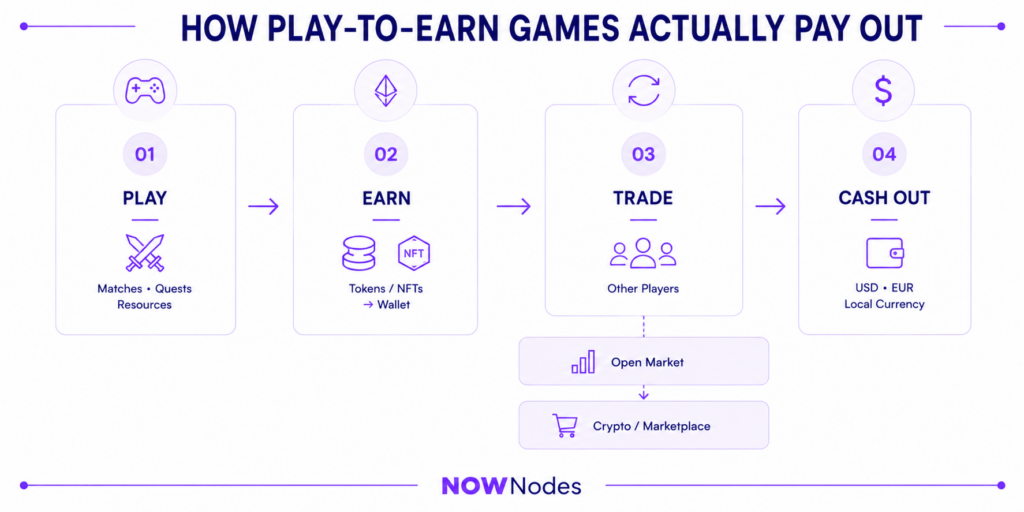
In practice, a payout runs through four steps:
- Play or progress. Win matches, finish quests, farm resources, or simply hold assets that generate yield.
- Earn on-chain. Tokens or NFTs land straight in your wallet.
- Trade. Swap tokens for a major cryptocurrency on an exchange, or sell NFTs on a marketplace.
- Cash out. Turn that crypto into dollars, pesos, or whatever your local currency happens to be.
Almost all the risk hides in step three. An asset is worth exactly what the next buyer will pay, and that number swings with player demand and with how fast the game prints new tokens. Earning is the easy bit. Ending up with something that still has value a month later is where people get caught out.
Why Play-to-Earn Exists
Regular gaming has a quiet imbalance baked into it. Players pour real money into skins, loot boxes, and premium currencies, and none of it is ever truly theirs. You can’t sell it, can’t carry it to another game, and lose the lot if the servers go dark. P2E is a direct reaction to that.
The pitch centers on property rather than pocket money. Yat Siu, co-founder and executive chairman of Animoca Brands, told CoinDesk in December 2024 that “digital property rights can provide the basis for a fairer society.” His logic runs like this: once the value a player creates is written to a blockchain, that player becomes a stakeholder in the game instead of a customer feeding a closed system.
There’s a second driver, and it’s far less philosophical. Assets earned in a game trade on global crypto markets, which don’t care where you live. In a country with a soft local currency, the gap between local wages and dollar-denominated tokens is exactly why P2E stopped being a hobby and started being an income.
Who Plays Play-to-Earn Games?
No single type of person. The crowd runs from people who need the income to collectors who just like owning rare things.
- Income players treat it as a side earner, or in some places a main one.
- Gamers and collectors are in it for fun and hold NFTs they expect to appreciate.
- Traders buy tokens, scarce NFTs, or virtual land purely to flip them.
- Guilds and studios sit at the infrastructure end, lending assets out or building the games in the first place.
The story that put P2E on the map came out of the Philippines in 2020 and 2021. Lockdowns had thrown a lot of people out of work, and Axie Infinity turned into a real paycheck. Some players pulled in up to $400 in their first few weeks, two to three times the local minimum wage at the time, as France 24 reported.
Those players hit a snag, though: you needed three Axie NFTs to start, and they weren’t cheap. Yield Guild Games (YGG) built a fix around exactly that. The guild bought the NFTs and lent them to players, called scholars, who kept the lion’s share of what they farmed. A typical split sent more than 70% to the scholar, 20% to the manager who trained them, and 10% to the guild. At its height the program ran thousands of scholars, earning millions between them.
How Do You Actually Earn? The Main Payout Models
There isn’t one route to earning; there are several, and the better games stack a few of them together. The table below sorts the common ones by how much time versus money each one asks for.
| Payout Model | How It Works | Effort vs. Capital |
|---|---|---|
| Token farming | Earn a game’s currency by playing daily, then sell it | High effort, low upfront cost |
| NFT trading | Buy, earn, or breed NFTs and resell them at a profit | Medium effort, higher capital |
| Staking / holding | Lock tokens or NFTs to earn passive rewards | Low effort, capital required |
| Land and rent | Own virtual land, monetize it or rent it out | Low effort, high capital |
| Tournaments | Win competitive matches for token or NFT prizes | High skill, low cost |
None of these is a money printer. Farming eats the most hours and pays the worst per hour, and the token you grind can quietly inflate away. NFT and land plays flip that: less grinding, more capital on the line. Tournaments reward the genuinely skilled and hand everyone else nothing.
Best Play-to-Earn Games in 2026 (and What They Run On)
A game worth your time in 2026 tends to have three things going for it: real players, an economy that isn’t obviously circling the drain, and rewards that don’t depend entirely on newcomers buying in. Genre and blockchain both matter, because the chain sets the fees and the speed.
| Game | Genre | Runs On | How You Earn |
|---|---|---|---|
| Axie Infinity | Creature battler | Ronin | AXS and SLP tokens; breed and sell Axie NFTs |
| Gods Unchained | Trading card game | Immutable zkEVM | Own and trade card NFTs; earn $GODS |
| The Sandbox | Voxel metaverse | Ethereum / Polygon | SAND token, LAND NFTs, monetized experiences |
| Splinterlands | Card battler | Hive | Ranked-play rewards, card and SPS trading |
| Pixels | Farming MMO | Ronin | Tokens and resources for daily tasks |
| Alien Worlds | Mining strategy | WAX / BNB | Mine TLM tokens, trade NFT tools |
| Sorare | Fantasy sports | Ethereum | Player-card NFTs and prize payouts |
These aren’t side projects. Ronin, the chain Sky Mavis built for Axie, grew daily active wallets 55% to roughly 419,000 in Q3 2025, per DappRadar. Gods Unchained, a trading-card game, watched its NFT trading volume jump 507% to $27.2 million in the same quarter after it finished moving to Immutable zkEVM. Money is still changing hands, even in a down market.
Play-to-Earn Mobile Games
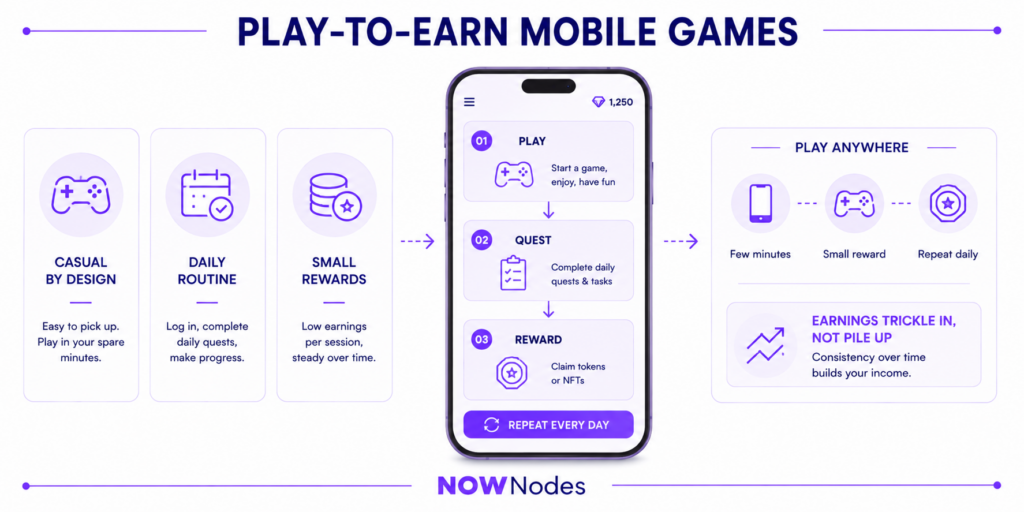
Plenty of it works on a phone. Axie Infinity, Alien Worlds, and Sorare all have mobile versions, and newer arrivals such as FIFA Rivals are chasing the download-and-play mainstream that play-to-earn mobile games have always wanted.
Mobile P2E leans casual by design. You log in, tap through a daily quest, claim a small reward, and get on with your day. It slots neatly into spare minutes. It also pays almost nothing per session, so the earnings trickle in rather than pile up.
The Blockchain Infrastructure Behind Play-to-Earn
Under every payout sits a layer players never think about. Earn an NFT, swap a token, refresh your balance: each of those is a read or write to a blockchain, and to reach the blockchain, the game needs a connection to a node.
A node is just a machine running the network’s software, holding a copy of the ledger and validating transactions. If you want the full picture, Ethereum’s docs on nodes and clients lay it out. For a studio, the choice comes down to running that machinery yourself, which is a genuine operational headache, or renting access from a provider that already runs it. NOWNodes is one of those providers.
The Trade-offs: Is Play-to-Earn Sustainable?
This is where the model gets tested. Much of the first wave ran on what was, underneath, a simple loop: rewards paid to current players came mostly from the money new players spent buying in. Fine while the crowd keeps growing. The moment sign-ups slow, the token sags, rewards buy less, more players leave, and the loop runs in reverse and feeds on itself.
Axie is the textbook case, and the numbers are ugly. Smooth Love Potion, its reward token, lost roughly 94% of its value, sliding from $0.39 in July 2021 to about a cent as the game minted far more than players could absorb. AXS, the governance token, fell close to 99% from a November 2021 peak of $165.37. Then, in March 2022, attackers walked off with about $625 million from the Ronin bridge, one of the largest crypto hacks ever recorded. Two separate failures, one brutal year.
The whole category cooled after that. Investment into blockchain gaming topped $1.8 billion in 2024, then managed only $293 million across the first three quarters of 2025, going by DappRadar’s tally. Daily active wallets settled near 4.66 million in Q3 2025. Still enough to make gaming the busiest slice of Web3, about a quarter of all on-chain activity, but a long way down from the mania.
Play-to-Earn vs. Play-and-Earn
That reckoning rewired how studios think. The pure “play-to-earn” framing, where the payout is the reason to log on, mostly gave way to “play-and-earn” or “play-and-own,” where the game has to stand up as a game and the earning rides along on top.
| Play-to-Earn (early model) | Play-and-Earn (2026 approach) | |
|---|---|---|
| Main draw | Financial reward | Actual gameplay |
| Reward source | Mostly new-player money | Real demand, fees, spending |
| Sustainability | Fragile, inflation-prone | More durable |
| Typical player | Income-seeker | Gamer who also earns |
It’s a handy lens for sizing up anything new. A game that only pencils out if its token keeps climbing is waving a red flag. One that people would happily play with the rewards switched off has a far better shot at still paying out next year.
Conclusion
Strip it back and play-to-earn did one genuinely new thing: it moved ownership of in-game value from the studio to the player. You earn tokens and NFTs, they’re recorded on a blockchain, and you can sell them. That shift is real, and it’s why the model swept up everyone from weekend gamers to full-time Axie scholars in Manila.
The hard lesson was about plumbing, specifically where the money comes from. A token only holds its price if people want to play the game with the rewards set aside, and most of the 2021 crop flunked that test. The play-to-earn games with the best odds in 2026 are the ones built to be fun first, with the payout riding along as a bonus rather than the reason to show up.
FAQ
Is Play-to-Earn Still Profitable in 2026?
Sometimes, but the free-for-all of 2021 is over. What you make now leans heavily on picking a game with a healthy economy, and most casual players earn beer money rather than rent. The real upside goes to people with skill, an early entry, or capital to put in, not the ones simply logging the most hours.
Do You Need Money to Start Play-to-Earn Games?
Not necessarily. A lot of play-to-earn crypto games are free to jump into and let you earn small amounts before spending a cent. The ones that do want NFTs upfront are the reason scholarship programs exist, where a guild fronts you the assets and takes a cut of what you earn.
What’s the Difference Between Play-to-Earn and GameFi?
GameFi is the umbrella term for anything that blends gaming with decentralized finance, staking and lending features included. Play-to-earn is the slice of GameFi aimed squarely at rewarding you with assets you own and can sell.
Can You Actually Withdraw Play-to-Earn Earnings to Cash?
Yes, though it’s a relay rather than a single button. You sell your tokens or NFTs for a major cryptocurrency, move that to an exchange, and convert it into your local currency to withdraw. Fees and slippage nibble at every hop, so what reaches your bank is usually less than the sticker value of your assets.
Are Play-to-Earn Games Legal?
In most places, playing them and earning crypto is fine, but the tax office generally treats what you earn as income or a capital gain. Rules vary a lot between countries, and a handful ban crypto activity outright, so check your local law before you count on P2E for income.
Which Blockchains Do P2E Games Use Most?
The cheap, fast ones. As of 2026 the bulk of activity sits on Ronin, Immutable zkEVM, Polygon, BNB Smart Chain, and WAX, because when a game asks players to make dozens of on-chain moves a day, fractions of a cent per transaction is the only thing that keeps it viable.