

Picking a chain is the first irreversible decision in web3 game development. Get it wrong and you are rewriting smart contracts, re-onboarding wallets and explaining a migration to your players eighteen months from now — while your competitors ship content.
The stakes changed in 2026. Ronin left sidechain life and became an Ethereum L2, Base cut block times to 200 milliseconds, and Avalanche made launching your own chain cost roughly the price of a streaming subscription. The shortlist that made sense in 2024 is out of date, and this guide covers the eight networks that replaced it — with the fee, speed and adoption numbers behind each.
What Is Web3 Game Development?
Web3 game development is the practice of building games where some portion of state — items, currency, progression, ownership records — lives on a public blockchain rather than exclusively on a studio-controlled server. Players hold assets in their own wallets and can trade them outside the game client.
You will see the category labelled GameFi, blockchain games, crypto games or P2E. These terms overlap heavily and mostly signal which part of the stack the speaker cares about. The engineering underneath is the same.
The commercial argument is narrower than the marketing suggests. Immutable co-founder Robbie Ferguson pointed out on NYSE TV that roughly 70% of gaming revenue — about $160 billion a year — comes from in-game item purchases that players can never resell.
“So we have a not-so-radical view, we think gamers should be able to own, sell, and trade those items as if they truly owned them,” Ferguson said.
Web3 vs Traditional Game Development
The differences concentrate in a few specific places rather than spreading across your pipeline. Your renderer, animation system and level design workflow do not change at all.
| Layer | Traditional | Web3 |
|---|---|---|
| Item ownership | Row in your database | Token in the player’s wallet |
| Economy control | Studio sets everything | Studio sets rules, market sets price |
| Account creation | Email or platform login | Wallet — increasingly abstracted behind email |
| Secondary market | Prohibited or grey market | Native, with programmable royalties |
| Cost per action | Server compute | Server compute plus gas |
| Rollback | Ship a patch | Immutable history, plan accordingly |
That last row deserves attention. On-chain state is permanent, so a duplication bug that would be a hotfix in a traditional title becomes a permanent supply problem in a web3 one. Audit your economy contracts before mainnet, not after.
Why Your Chain Choice Decides Your Game’s Economics
Gas is a per-action tax on your design. If a single crafting operation costs $0.02 and your average player crafts 40 times a day, you are paying — or charging — $0.80 per player per day just to exist. Run that across 100,000 daily players and the arithmetic gets serious fast.
On a chain with sub-cent fees, the same loop costs a few hundred dollars a day. On Ethereum mainnet during congestion, it is not a shippable design at all. This is why nearly every game that reached real scale ships on a low-fee network like Ronin, opBNB, Immutable or WAX.
The pressure here is not theoretical. DappRadar’s Q2 2025 report found more than 300 gaming dapps went inactive in a single quarter — 8% of all it tracks — while quarterly investment fell to $73 million, down 93% year over year.
How to Evaluate Gaming Blockchains: Five Criteria That Matter
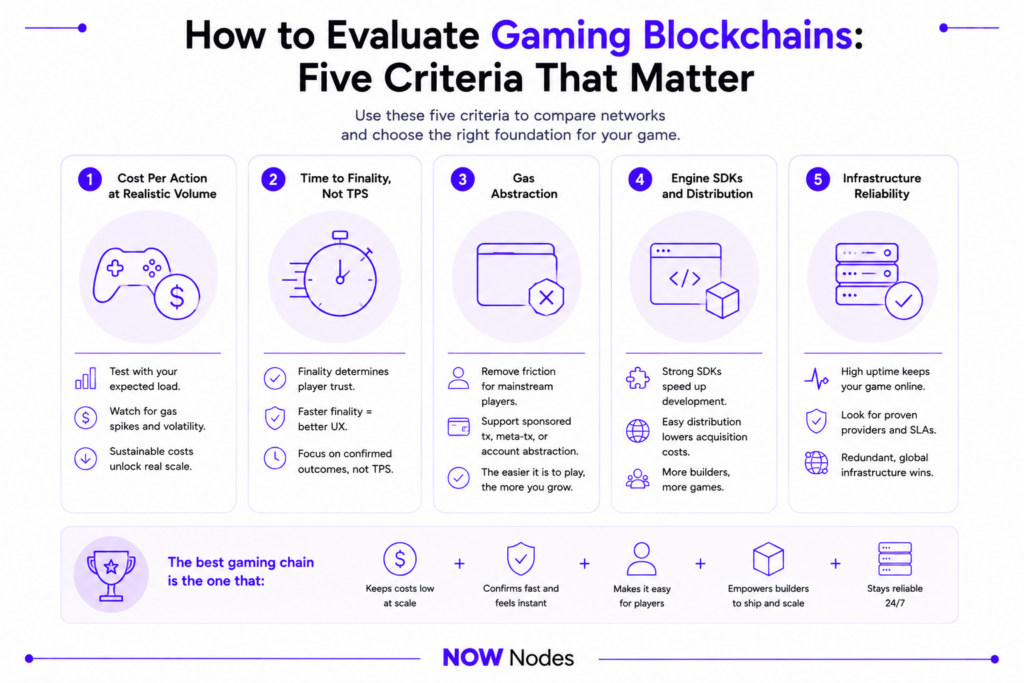
Throughput headlines are the least useful metric here. These six criteria separate the best blockchains for gaming from the ones with good marketing.
1. Cost Per Action at Realistic Volume
Take your busiest gameplay loop, count the on-chain writes, and multiply by median fee and target DAU. If that number frightens you, either the chain is wrong or the loop belongs off-chain.
2. Time to Finality, Not TPS
Players never experience transactions per second. They experience the delay between tapping a button and seeing a result, which finality governs. Sub-second finality feels like a game; twelve-second finality feels like a bank transfer.
3. Gas Abstraction
If a player must acquire a native token before their first action, most leave. The strongest gaming chains let studios sponsor fees so the transaction stays invisible — this moves conversion more than any throughput improvement.
4. Engine SDKs and Distribution
A maintained first-party Unity or Unreal SDK saves months against writing your own bridge, so check commit history rather than the README. Distribution matters just as much: a chain with millions of wallets already installed is a marketing channel, not just infrastructure.
5. Infrastructure Reliability
Every game development blockchain frontend — the client-side layer reading and writing chain state — is only as fast as the endpoint behind it. If that connection is slow or unreliable, no amount of chain-level throughput rescues the player experience.
The 8 Best Blockchains for Web3 Game Development in 2026
Here is the comparison first, details after. Fee figures are typical median costs under normal load and will vary.
| Chain | Type | Finality | Typical fee | Best for |
|---|---|---|---|---|
| Ronin | Ethereum L2 (OP Stack) | Sub-second | Under $0.01 | Mass-market games, emerging markets |
| Immutable | Ethereum L2 (zkEVM) | Seconds | Free for players | Studios wanting invisible web3 |
| BNB Chain / opBNB | L1 + L2 | Sub-second | Fractions of a cent | Reaching the largest active audience |
| Base | Ethereum L2 (OP Stack) | 200ms preconf | Sub-cent | Real-time loops, consumer reach |
| Solana | L1 | Sub-second | ~$0.00025 | High-frequency on-chain actions |
| Sui | L1 | Sub-second | Fractions of a cent | Complex asset logic, AAA ambitions |
| Avalanche | L1 + custom L1s | Near-instant | You set it | Studios wanting a dedicated chain |
| Polygon PoS | Ethereum sidechain | Instant post-Rio | Sub-cent | EVM pragmatism, mature tooling |
Ronin
Ronin is the only network that has demonstrably scaled a single game to millions of daily users. Sky Mavis built it because Axie Infinity was being strangled by Ethereum gas, and the official documentation records over $4 billion in NFT volume and 31 million wallet downloads.
The headline change is architectural. On 12 May 2026, Ronin completed its migration from independent sidechain to full Ethereum L2 on the OP Stack, replacing its nine-validator model with rollup infrastructure secured by Ethereum. RON remains the gas token, median fees stay under a cent, and annual emissions dropped from 45 million RON to 5 million under a new Proof of Distribution system that pays builders by measured on-chain contribution.
The distribution proof point is Pixels. It arrived from Polygon with roughly 3,000 daily active users and peaked at 1.7 million monthly active users by June 2024, with heavy traffic from the Philippines, Brazil, Thailand and Indonesia.
Pick Ronin if your game targets emerging markets and you want the strongest evidence of repeat consumer usage. Look elsewhere if you need a general-purpose DeFi ecosystem around your title.
Immutable
Immutable is less a chain than a growth platform with a chain attached. Its own figures list more than 700 games building, over 220 million total transactions and upwards of $2 billion in funding raised by titles in its ecosystem, with Ubisoft and NetMarble among the studios shipping.
The technical hook is gas abstraction done properly. Games sponsor fees for anyone using Immutable Passport, so players transact without ever holding the native token — Immutable has estimated the cost at roughly $500 to $1,000 per 100,000 users, a rounding error against acquisition spend. Native Unity and Unreal SDKs let your engineers add on-chain assets without becoming blockchain specialists.
Pick Immutable if you are a Web2 studio and want players who never learn the word “gas.” Look elsewhere if you want maximum protocol-level control.
BNB Chain and opBNB
If your metric is raw reach, this ecosystem wins. By BNB Chain’s own reporting, it topped every L1 for daily active users in Q1 2026, averaging around 4.5 million per day across BSC and opBNB combined.
opBNB is the gaming-relevant half — an L2 processing 5,000+ TPS with sub-second finality and fees in fractions of a cent. Individual titles here have posted over a million weekly active players. The trade-off is signal quality: high wallet counts in this ecosystem are frequently incentive-driven, so treat activity charts as a ceiling on your addressable audience rather than a forecast of retention.
Pick opBNB if distribution volume is your primary constraint. Look elsewhere if you are optimising for premium spend per player.
Base
Base became seriously interesting for games in 2026 when Coinbase activated Flashblocks, cutting effective confirmation from two seconds to 200 milliseconds via streamed sub-blocks. That makes it the fastest EVM chain in production.
Two hundred milliseconds is the threshold where on-chain confirmation stops feeling like a wait. Paired with Coinbase’s onboarding funnel, Base is a credible home for real-time loops that previously had to sit off-chain. The caveat is maturity: its gaming ecosystem is younger than Ronin’s or Immutable’s, and it is a general-purpose consumer chain rather than a gaming-first one.
Pick Base if you want Coinbase distribution and the lowest EVM latency available. Look elsewhere if you need gaming-native SDKs out of the box.
Solana
Solana remains the reference point for cheap, fast on-chain actions, with average fees around $0.00025. Mid-2026 analytics put real non-vote throughput between roughly 1,600 and 3,800 TPS depending on demand — well below the headline numbers, but far beyond what any game requires. Firedancer, the independent validator client from Jump Crypto, keeps raising that ceiling as adoption spreads across validators.
The catch for game teams is Rust. Solana programs are not EVM contracts, so your Solidity experience does not transfer and your hiring pool narrows. Star Atlas and others have shown the model works, but budget for the learning curve.
Pick Solana if your design writes on-chain constantly and you have Rust capacity. Look elsewhere if your team is EVM-native and timeline-constrained.
Sui
Sui’s object-centric model treats every asset as a distinct object with its own ownership rules, which maps unusually well onto game inventories. Simple transfers skip full consensus entirely, and its Mysticeti consensus targets sub-second finality with fees in fractions of a cent.
Mysten Labs has been buying its way into the category rather than waiting for it. It acquired Parasol, a gaming infrastructure team offering REST APIs for item tokenisation and marketplaces, and shipped SuiPlay0X1, a handheld built for on-chain titles. The 2026 test is AAA: EVE Frontier, set in CCP Games’ EVE universe, and Xociety are both launching with Sui as the native layer.
Pick Sui if your asset logic is complex and you want a model designed for it. Look elsewhere if you need a large existing player base today.
Avalanche
Avalanche’s proposition is that you should not share a chain at all. Since the Avalanche9000 upgrade activated in December 2024, subnets are called L1s and the cost to run one dropped from a 2,000 AVAX stake to roughly 1.33 AVAX per validator per month.
That turns a dedicated chain from a funding round into a line item. Your L1 sets its own gas token, fee rules, validator policy and governance, so transactions can be free for players by design rather than by subsidy, with no competition for blockspace. Beam, built by Merit Circle DAO, is the reference gaming implementation. The cost is operational — you now own validator ops, security decisions and liquidity bootstrapping.
Pick Avalanche if you want a chain that belongs to your game. Look elsewhere if you would rather not run network operations.
Polygon PoS
Polygon is the pragmatic EVM answer, and the Rio upgrade that hit mainnet in October 2025 modernised it considerably. Sustained capacity moved from around 1,000 TPS to over 5,000, and the Validator Elected Block Producer model eliminated reorgs — a verified block is now final immediately.
Removing reorgs matters more for games than the throughput number. Your backend can trust a confirmation the moment it sees one, with no confirmation-depth policy adding seconds to every player action. Polygon’s tooling remains among the deepest in EVM, though its gaming mindshare has drifted toward gaming-first chains since 2024.
Pick Polygon if you want mature EVM tooling and cheap, final transactions. Look elsewhere if you want to launch inside an active gaming ecosystem.
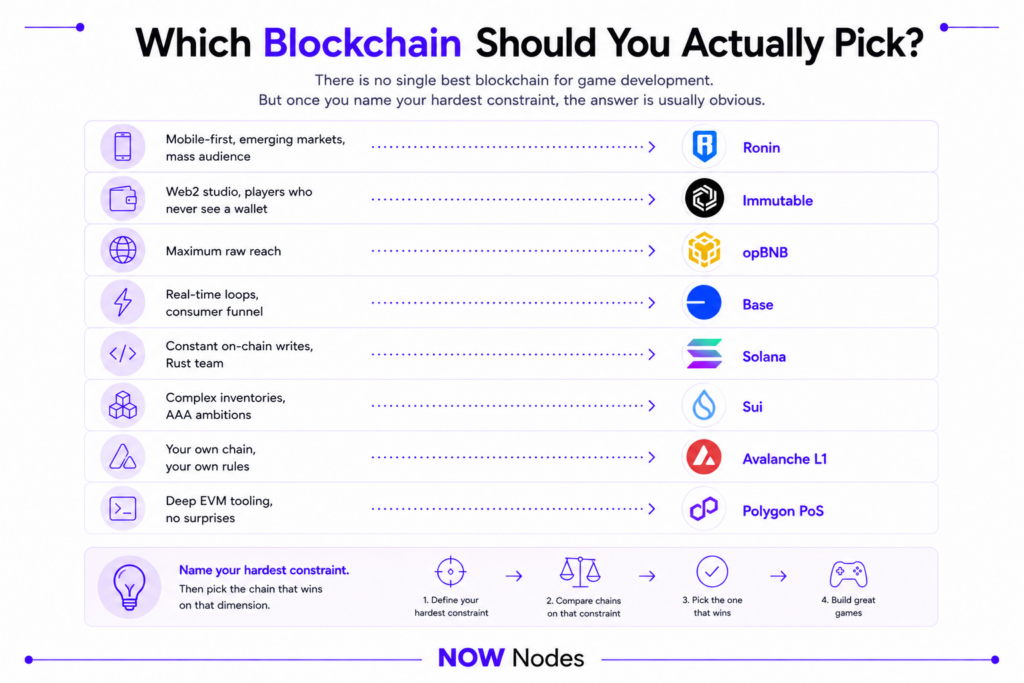
Which Blockchain Should You Actually Pick?
There is no single best blockchain for game development. But once you name your hardest constraint, the answer is usually obvious — here is how the best blockchains for gaming sort by that constraint.
- Mobile-first, emerging markets, mass audience — Ronin
- Web2 studio, players who never see a wallet — Immutable
- Maximum raw reach — opBNB
- Real-time loops, consumer funnel — Base
- Constant on-chain writes, Rust team — Solana
- Complex inventories, AAA ambitions — Sui
- Your own chain, your own rules — Avalanche L1
- Deep EVM tooling, no surprises — Polygon PoS
One warning worth stating plainly. Chains court studios with grants, and a grant is not a strategy — if the network’s players do not want your genre, the money buys you a runway to nowhere. Evaluate the audience first and the incentive second.
The category is also consolidating rather than expanding. DappRadar’s Sara Gherghelas has described blockchain gaming as entering a phase of maturation, driven by layer-2 advances, more sustainable token economies and AAA collaborations. Fewer chains, more real games.
Connecting Your Game to the Network
Once you have chosen, your client needs a reliable path to the chain. Three access types cover the full development cycle: testnet endpoints for building without real funds, mainnet endpoints for live traffic, and WebSocket (WSS) connections for pushing state changes to players in real time.
WebSocket matters more in games than in most applications. Polling for an inventory update introduces a delay players read as lag, while a subscription pushes the change the moment it lands. Plan for WSS from the start if your design has any real-time element.
Running that infrastructure yourself means hardware, sync times, upgrades and an on-call rotation — none of which improves your game. NOWNodes provides API access across 120+ networks with a 99.95% uptime guarantee and sub-second response times, and a free API key covers five of them. That is enough to prototype the same game loop across your shortlist and let real latency numbers decide.
Conclusion
Web3 game development in 2026 is a smaller, more serious field than it was two years ago. Hundreds of dapps went inactive, funding contracted sharply, and the chains still standing are the ones with real players rather than good decks.
That is good news for anyone starting now. The infrastructure question is largely solved — sub-cent fees, sub-second finality and invisible wallets all exist in production — so the remaining differences are about fit rather than capability. Run the arithmetic on your own loop, prototype on two or three candidates, and let the latency numbers decide.
FAQ
What is the best blockchain for game development in 2026?
There is no universal answer. Ronin has the strongest record at mass-market scale, Immutable offers the smoothest path for traditional studios, and Base leads on raw speed. Match the chain to your audience and your loop rather than to a ranking.
How much does it cost to run a web3 game on-chain?
On sub-cent chains, expect a few hundred dollars a day per 100,000 active players for a moderate transaction loop. Immutable estimates gas sponsorship at roughly $500 to $1,000 per 100,000 users. The dominant variable is your design, not the chain.
Do players need a crypto wallet to play?
Increasingly, no. Immutable Passport and comparable systems create wallets from an email login and sponsor gas, so players complete on-chain actions without knowing it. This is now the default expectation for any mainstream title.
Can I put my whole game on-chain?
Almost certainly you should not. Put ownership, scarce items and economic settlement on-chain, and keep physics, matchmaking and session state on your servers. Fully on-chain games are a legitimate genre, not a default architecture.
Is it hard to migrate chains later?
Harder than it sounds. Contracts can be redeployed, but player balances, marketplace history and integrations all need handling, and every migration costs users. Pixels’ move from Polygon to Ronin worked, but it was a deliberate strategic bet rather than a routine upgrade.
Which blockchain has the most game players right now?
BNB Chain led all L1s for daily active users in Q1 2026 at roughly 4.5 million per day. Across the whole sector, DappRadar recorded 4.66 million daily unique active wallets in gaming — about 25% of all Web3 wallet activity.
