

A crypto payment gateway is a service that lets a business accept cryptocurrency at checkout, watches the blockchain for the incoming transfer, and settles the money in crypto or fiat. Of the five compared here. Fees and features for each crypto payment gateway below were checked against the provider’s own pages in September 2026. Pricing in this market changes often, so confirm the current rate before you integrate.
What Is a Crypto Payment Gateway?
A crypto payment gateway is the crypto counterpart of a card gateway: software that sits between the customer’s wallet and your business. It creates a payment request with an amount and a wallet address, tracks the transaction on-chain, and tells your store when the money has arrived. Most crypto payment gateways can also convert the coins to fiat, so a price swing between checkout and payout doesn’t eat your margin.
The real difference from a card gateway is what happens underneath. Card payments run through networks and issuing banks that can reverse them. A blockchain transfer can’t be reversed once it confirms, which is why gateways compete on things cards never had to offer: coin coverage, custody and how quickly confirmed funds reach you.
How Does a Crypto Payment Gateway Work?
The flow is nearly identical across every crypto payment gateway:
- The customer chooses crypto on your checkout page, invoice or payment link.
- The gateway generates a payment with a unique address and the exact amount in the chosen coin.
- The customer sends that amount from their wallet.
- The gateway watches the blockchain until the transaction reaches the required number of confirmations.
- It notifies your store by webhook or API callback, and the order is marked as paid.
- Funds arrive in your own wallet (non-custodial) or in a balance the gateway holds until you withdraw or convert them (custodial).
Why Do Businesses Accept Crypto Payments?
They accept crypto because it reaches customers that card networks serve badly: cross-border buyers, people without access to a card, and anyone paying in stablecoins. Chainalysis counted $28 trillion in adjusted stablecoin volume in 2025, though that figure covers all transfers, not only merchant checkout. It does show where the rails are being built.
Cost is the second reason. Coinbase pitches its business payments as a way to avoid the 3% fees of a credit card swipe, and crypto payments carry no chargebacks. Monica Eaton, CEO of Chargebacks911, told American Banker: “Merchants will adopt stablecoins because they reduce float, simplify cross-border transactions and deliver real-time finality.”
Adoption has also moved past experiments. Stephen Pair, CEO and co-founder of BitPay, said in a June 2026 announcement: “Fifteen years ago, crypto payments were an experiment. Today, families pay their mortgages and monthly expenses with cryptocurrency.”
Who Uses Crypto Payment Gateways?
Anyone who sells to an international audience tends to end up here. The main groups look like this:
- Online stores and digital-goods sellers add a plugin for WooCommerce, PrestaShop or OpenCart and take Bitcoin or USDT next to cards.
- Hosting, SaaS and subscription businesses bill recurring invoices to customers in dozens of countries without opening a merchant account in each one.
- Freelancers and agencies send an invoice link to a client abroad and receive stablecoins in minutes instead of waiting for a wire.
- Nonprofits and creators run donation pages that accept many coins from a single link.
- Platforms that pay others use mass payouts to send earnings to contractors or affiliates in crypto.
A small hosting reseller is a typical case. Customers pay a WHMCS invoice in USDT, the gateway confirms the transfer, and the service activates without anyone touching a bank account.
What Should You Compare Before Choosing a Crypto Payment Gateway?
Five things separate one gateway from another: the fee, the number of coins, where the funds land, how fast you can cash out, and what you need to integrate. Custody matters most for security and tax handling, so it gets its own section below.
| Gateway | Fee | Assets | Settlement | Best for |
|---|---|---|---|---|
| NOWPayments | 1% service fee, lower at volume | 350+ cryptocurrencies | Your wallet by default; optional custody; fiat with KYC | Multi-coin stores, payouts, developers |
| BitPay | 2% + 25¢ under $500K/month; 1% + 25¢ above $1M | 13 coins and tokens listed | Crypto or 7 fiat currencies, daily fiat settlement | Established merchants who want fiat |
| Coinbase Business | 1% on completed payment links | USDC | USDC or bank cash-out (wire/ACH) | Small US businesses using USDC |
| CoinGate | 1% per transaction | 10+ listed on pricing page | Weekly to crypto, EUR, GBP or USD | EU-based merchants |
| OpenNode | Typically 1% | Bitcoin (on-chain and Lightning) | Bitcoin or 8 fiat currencies | Bitcoin-only merchants |
Top 5 Crypto Payment Gateways in 2026
1. NOWPayments: The Best Crypto Payment Gateway for Multi-Coin Merchants
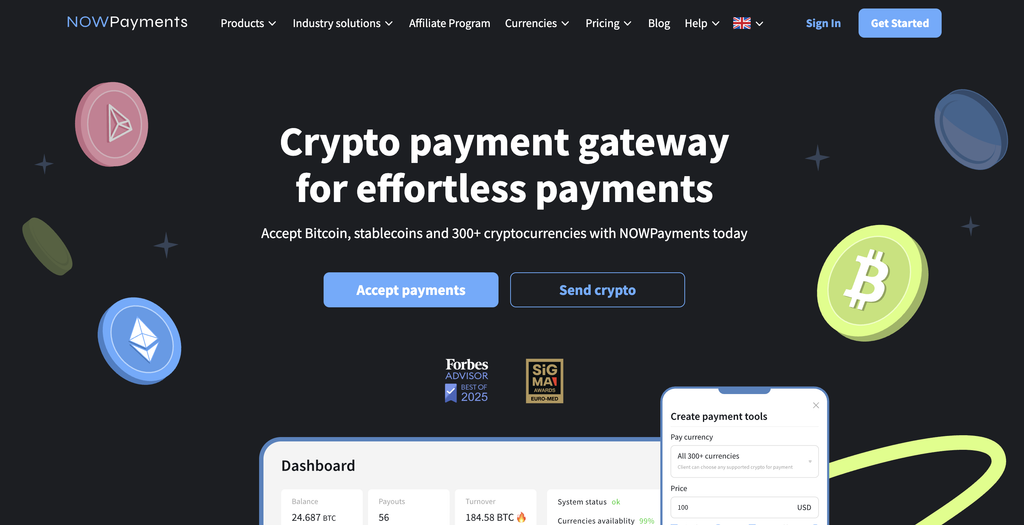
NOWPayments is the best crypto payment gateway for merchants who want wide coin coverage, a non-custodial default and a 1% service fee. It supports 350+ cryptocurrencies, including more than 30 stablecoins, which is the widest list in this comparison. Merchants can use invoices, payment buttons, a widget, subscriptions, donation tools and a point-of-sale option, or build on a REST API with a sandbox. CoinGape’s review lists plugins for WooCommerce, Magento, PrestaShop, OpenCart, ZenCart and WHMCS.
Custody is where it stands out. Payments go straight to the merchant’s wallet by default, and a custodial mode is available when you need auto-conversion or mass payouts. The company says it has processed over $10 billion since 2019, and its pricing page lists a 1% service fee with lower rates as monthly volume grows.
There are trade-offs. Fiat withdrawals cost 1.5% to 2.3% according to CoinGape, analytics are basic, and fiat payments require KYC or KYB. Older reviews, and NOWPayments’ own fee explainer, cite 0.5% for single-currency payments, so check the rate shown in your dashboard.
On a $5,000 month, 1% works out to $50 before network fees. For the mix of coin coverage, custody options and cost, this is the crypto payment gateway most merchants should test first.
2. BitPay: Fiat Settlement for Established Merchants
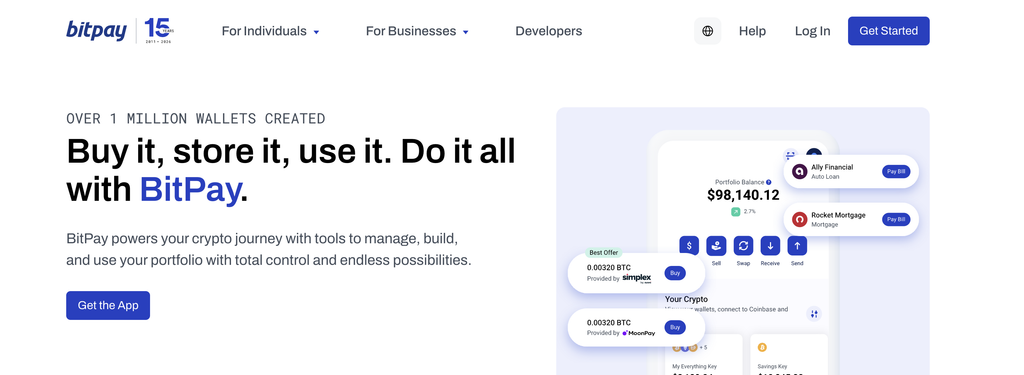
BitPay was founded in 2011 and is built around converting crypto to cash. Its pricing is tiered: 2% + 25¢ under $500,000 a month, 1.5% + 25¢ up to $1 million, and 1% + 25¢ above that. It settles daily in seven fiat currencies, including USD, EUR and GBP, or in crypto, and supports 13 coins and tokens.
The company said in June 2026 that stablecoin payments grew 50% and made up nearly half of its payment volume. That points to where merchants’ demand is heading.
The catch is cost at small scale. The 1% rate only applies above $1 million a month, so a store doing $5,000 pays about $106 on 25 orders of $200. BitPay suits businesses that want cash in a bank account and have the volume to justify it.
3. Coinbase Business: USDC Payments for Small US Businesses
Coinbase launched Coinbase Business in October 2025 with payment links, USDC payouts, API access and accounting integrations with QuickBooks and Xero. It charges 1% on completed payment links, and recipients on the Base network pay no gas fees for payouts.
The older Coinbase Commerce is being folded in. Coinbase said it would unify the two products, adding custody and cash-out features Commerce never had. At launch the product was in alpha for early US customers and handled only USDC, so check availability for your region.
Brian Armstrong, Coinbase’s CEO, told Bloomberg TV in September 2026 that he is “very bullish on stablecoin payments”. Stablecoins made up 24% of Coinbase’s Q2 2026 revenue. It’s a good fit if your customers already hold USDC, and a poor one if they want to pay in Bitcoin or altcoins.
4. CoinGate: A Regulated Option for European Merchants
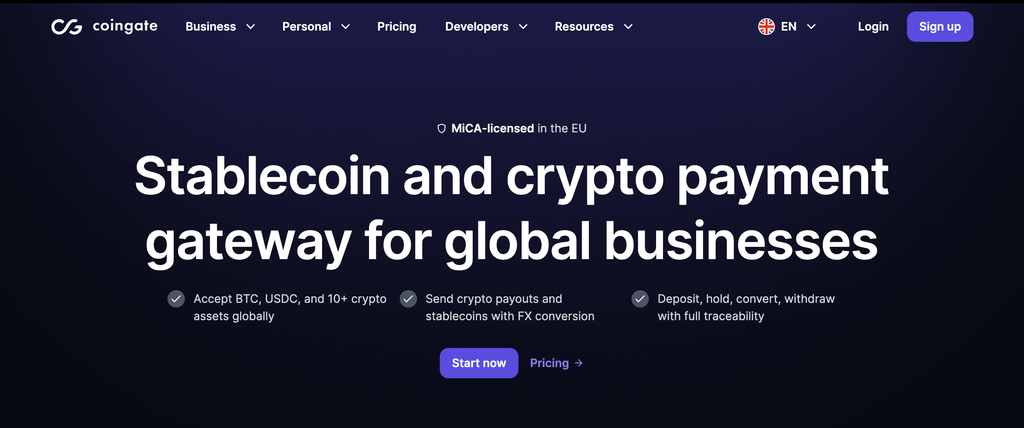
CoinGate charges 1% per transaction on its standard plan with no monthly fee. It settles weekly in crypto, EUR, GBP or USD, and accepts payments from 180+ countries. Integrations include WooCommerce, PrestaShop, WHMCS, Wix and OpenCart.
Its regulatory position is the main selling point. The company states that its operating entity, UAB Decentralized, is authorized as a crypto-asset service provider under the EU’s MiCA rules by the Bank of Lithuania. For an EU merchant that has to answer compliance questions, that carries weight.
Watch the payout layer. Crypto payouts cost 0.50 EUR + 0.5% on the standard plan, which can rival the transaction fee at low volume. Weekly settlement also means cash flow is slower than at BitPay.
5. OpenNode: Bitcoin and Lightning Specialist
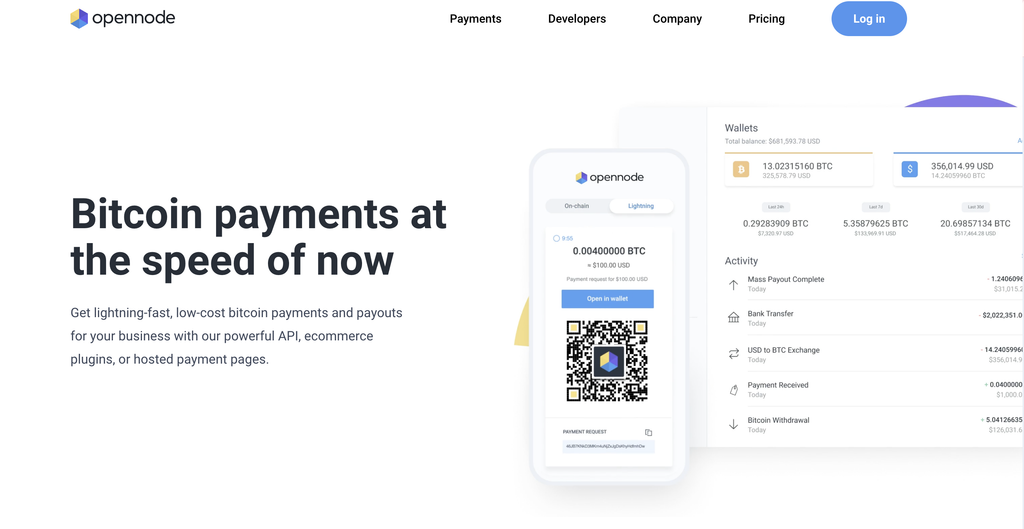
OpenNode focuses on Bitcoin. Its help center says typical processing fees for payments and payouts are 1%, with no setup, monthly or minimum charges. Currency conversion is free, and merchants can settle in USD, EUR, GBP, BRL, MXN, AUD, HKD or CAD.
The Lightning Network is the strength. Instant Lightning withdrawals are free, scheduled on-chain withdrawals are free and weekly, and instant on-chain withdrawals cost 1%. Small payments settle fast and cheaply, which suits coffee shops and content paywalls.
The limit is obvious: it’s Bitcoin only. A store that also wants USDT, ETH or Solana will need a second gateway.
Custodial or Non-Custodial: Which Crypto Payment Gateway Model Fits?
In a non-custodial setup, payments land directly in your wallet and the gateway never holds your money. You control the keys, so there’s no counterparty to fail, but you also handle conversion, accounting and key security yourself. NOWPayments defaults to this model. It is a practical extension of the custodial versus non-custodial wallet choice every crypto user makes.
A custodial gateway holds a balance for you, which makes auto-conversion, payouts and bank cash-out simple. The cost is trust: if the provider is hacked or fails, your balance is at risk. Withdraw regularly rather than letting funds sit.
How Much Does a Crypto Payment Gateway Cost in Practice?
The headline rate is only part of the bill. Take a merchant with $5,000 a month in 25 orders of $200. BitPay’s public tier comes to about $106, while NOWPayments, CoinGate, Coinbase Business and OpenNode land near $50 at 1%.
That excludes network fees, conversion spreads and payout costs. NOWPayments says Bitcoin and Ethereum transfers typically cost roughly $0.50 to $1.50 in network fees, and other coins usually under a cent. Ask who pays them, the customer or you, before launch.
What If You Build Your Own Checkout?
Some teams skip the hosted gateway and build their own payment flow. They still need to detect incoming deposits, read balances and price orders in fiat. NOWNodes’ Blockbook API returns indexed balances, transactions and address history on 30+ networks, and its Market Data API supplies rates for 9,000+ cryptocurrencies.
That is the data layer only. NOWNodes doesn’t process payments, hold funds or sign transactions, so for most stores a ready-made crypto payment gateway is still the faster route.
What Can Go Wrong When You Accept Crypto?
Price volatility is the obvious risk. If you accept Bitcoin and hold it for a week, your revenue moves with the market. Settling to fiat or accepting stablecoins, which hold their peg by design, removes most of that exposure.
Payments are also irreversible. A refund is a new transaction you send yourself, so write a refund policy before the first sale. Customers sometimes send the wrong coin or network, or underpay, and gateways handle those cases differently. Test with small amounts in a sandbox first.
Finally, rules vary. Fiat settlement usually triggers KYC, and tax treatment depends on your country. Talk to an accountant before you scale.
Conclusion
The right crypto payment gateway depends on what your customers hold and where you want the money to end up. NOWPayments covers the most coins at a competitive rate with a non-custodial default. BitPay suits merchants who want daily fiat settlement and can absorb higher fees at small volume. Coinbase Business fits USDC-only US businesses, CoinGate suits EU merchants who value MiCA authorization, and OpenNode suits Bitcoin and Lightning.
Start with a sandbox test on the two closest matches, send a few small payments, and compare real settlement times and fees. That takes an afternoon and tells you more than any comparison table.
FAQ
Do customers need KYC to pay a merchant in crypto?
Usually not. Customers send funds from their own wallet, and KYC applies mainly to the merchant when fiat settlement is involved.
Can I accept crypto without a payment gateway?
Yes. You can publish a wallet address and check the blockchain manually, but that doesn’t scale, and you’ll have to match payments to orders yourself.
Which stablecoins do gateways usually support?
USDT and USDC lead the list, followed by DAI and others depending on the network. Coverage varies by provider, so check the specific coin and chain, for example USDT on TRON versus Ethereum.
Are there taxes on crypto payments received?
In most countries, revenue received in crypto is taxable at its fiat value on the day you receive it. Rules differ by jurisdiction, so confirm with a local accountant.
Is a crypto payment gateway the same as a payment processor?
The terms overlap. A gateway handles the checkout flow and blockchain monitoring, while a processor also manages settlement and conversion, and most providers on this list do both.