
Web3 social media dApps are social apps where your profile, posts, and followers live on a blockchain instead of a company’s servers. That one change means no platform can delete your account, sell your data, or take your audience when you leave. The five below cover the whole range: an open social graph anyone can build on (Lens), a Twitter-style network with real funding (Farcaster), a feeless blogging chain that people actually use every day (Hive), a purpose-built social Layer-1 (DeSo), and a token-gated messaging network (Towns). Here’s the short version — pick by what you want to do (post, blog, chat, or build), keep your real money in a separate wallet, and never hand your seed phrase to anyone.
What Is a Decentralized Social App?
Let’s start simple. A decentralized social app is one where the important data — who you are, what you post, who follows you — sits on a public blockchain rather than in Meta’s or X’s private database. You log in with a crypto wallet you control, not an email and password a company can revoke.
Web3 social media dApp: a decentralized application (dApp) that runs its social features — identity, content, and the follower graph — on a blockchain or open protocol, so users own their accounts and data instead of renting them from a platform. See Ethereum’s introduction to dApps for the underlying concept.
Why does this matter? On a normal platform, your account is a rented room. You fill it, you grow it, and the landlord keeps the keys. Get banned, shadow-banned, or demonetized, and years of work vanish with the click of someone else’s mouse.
Web3 social media dApps flip that. Your identity and your followers are yours, recorded on-chain, and you can carry them to any app that speaks the same protocol.
How a Web3 Social Network Actually Works
Under the hood, most of these apps split into three parts that Facebook bundles into one. The wallet holds your identity. The blockchain (or open storage) holds your posts and follower graph. And the front-end — the feed you scroll — is just one of many possible windows onto that shared data.
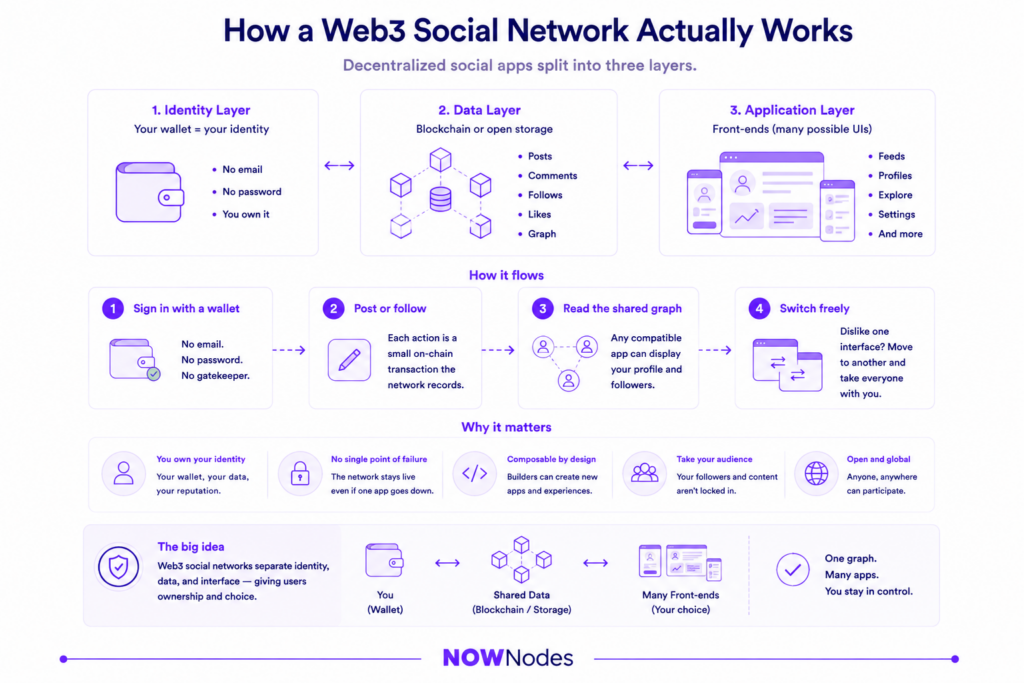
That last part is the interesting bit. Because the data is open, anyone can build a new front-end on top of it, and you keep your audience when you switch. The typical flow looks like this:
- Sign in with a wallet — no email, no password, no gatekeeper holding your login.
- Post or follow — each action is a small on-chain transaction the network records.
- Read the shared graph — any compatible app can display your profile and followers.
- Switch freely — dislike one interface? Move to another and take everyone with you.
For the people building these Web3 social media dApps, all of this depends on reading and writing blockchain data quickly, usually through node or RPC infrastructure like NOWNodes. That plumbing is invisible when you’re just scrolling, but it’s the reason a decentralized feed can load as fast as a centralized one.
Why People Are Moving On-Chain
This isn’t a fringe experiment anymore. The decentralized social network market was worth about $9.4 billion in 2024 and is forecast to hit $61.8 billion by 2034, a 20.6% annual growth rate, according to Market.us. The individual-user slice is growing fastest of all, at roughly 38% a year, as more people go looking for privacy and control.
Strip away the jargon and the appeal comes down to three things. You own your content and your audience. Your posts sit on a distributed ledger, so no single company can quietly erase them. And you can earn directly — through tokens, tips, and paid memberships — instead of watching an algorithm sell your attention to advertisers.
Here’s why that last point lands so hard. On the old model, you are the product. Stani Kulechov, founder of Lens Protocol and the lending platform Aave, put the alternative plainly in an interview: “We believe that the ownership of content and profiles should belong to you in the way that DeFi belongs to you.” That’s the whole pitch in one sentence.
Let’s be honest about the flip side too. The tools are still clunky, the tokens can crater, and adoption is tiny next to Instagram. Web3 social media dApps give you ownership and an exit. They don’t hand you an audience or protect you from a bad token.
What Actually Makes One Worth Using
Not every project with a token is worth your time. The Web3 social media dApps that last share a few real traits, and they’re easy to check before you sign up.
| What to look for | Why it matters |
|---|---|
| User-owned identity | Your profile lives in your wallet, so no platform can delete or lock you out. |
| Portable follower graph | Followers stored on-chain move with you between apps — the core selling point. |
| On-chain monetization | Built-in tips, tokens, or memberships pay creators without an ad middleman. |
| Open front-ends | If many apps can read the same data, you’re never trapped in one interface. |
| Real daily use | A live community beats a big token and an empty feed every time. |
Here’s the thing worth repeating. A healthy network and a hyped token are not the same. Check whether people actually post there before you care what the coin is doing.
Top 5 Web3 Social Media dApps
The five Web3 social media dApps below lean toward what’s genuinely in use in 2026, from beginner-friendly apps up to developer-grade protocols. Funding and user numbers move fast, so treat the figures as recent snapshots and check each project’s own site before diving in.
| Platform | Best For | Chain / Base | Token or Cost |
|---|---|---|---|
| Lens | An open social graph you own | Lens Chain (L2) | Gas in GHO; free to use |
| Farcaster | Twitter-style posting | Optimism + hubs | Small onchain fees |
| Hive | Feeless blogging and content | Hive (L1) | Free; no gas per post |
| DeSo | Creator coins and social tokens | DeSo (L1) | Low onchain fees |
| Towns | Token-gated group chat | Base (L2) | TOWNS token; gas on Base |
1. Lens
Lens isn’t really an app — it’s an open social graph that lots of apps share. Built by the team behind Aave, it turns your profile and followers into data you own, so front-ends like Hey and Orb all plug into the same network. Switch between them and your audience comes along. That portability is the whole point.
In 2025 Lens launched its own Layer-2, Lens Chain, on the ZKsync stack with Avail handling data availability, and it uses Aave’s GHO stablecoin for gas so fees stay steady. The project has raised around $46 million and reports roughly 650,000 profiles and 28 million social connections. For creators who want to own their following outright, it’s the strongest base to build on.
2. Farcaster
Farcaster is the closest thing crypto has to Twitter, and it’s “sufficiently decentralized” — your identity sits on-chain while the high-volume stuff runs on fast dedicated servers. Its main app, long called Warpcast, is being renamed Farcaster to stop confusing the app with the protocol underneath. The feature people know it for is Frames: little interactive apps that run right inside a post.
The money behind it is serious. Farcaster raised a $150 million round led by Paradigm at a $1 billion valuation, on top of an earlier a16z seed. Usage cooled after a wild 2024, which is a fair warning that funding doesn’t equal staying power, but its developer scene is still one of the busiest around.
3. Hive
Hive is the quiet one that just works. It’s a Layer-1 blockchain, forked from Steem back in 2020, and it’s built for content and community rather than trading. Posting costs nothing — instead of paying gas per action, your account draws on Resource Credits that refill over time, and blocks confirm in about three seconds.
That feeless design is why real people use it daily. You’ll find the blogging apps PeakD and Ecency, the video platform 3Speak, and the card game Splinterlands all settling on the same chain, with two native assets, HIVE and the HBD stablecoin, moving underneath. If you want to publish without ever touching a gas fee, start here.
4. DeSo
DeSo, short for Decentralized Social, made a big bet: general chains are too pricey to store social data, so it built a Layer-1 just for it. Posts, profiles, and follows all live cheaply on-chain, and the network adds creator coins, tipping, and NFTs as native features. The stated goal is blunt — scale social to a billion users.
DeSo passed 1.5 million accounts and now pitches itself as a cross-chain “social layer” other networks, including Ethereum and Solana, can tap into. Apps like Diamond and Focus give you a normal-looking feed while the economics run underneath. Whether it reaches its billion-user dream is anyone’s guess, but the architecture is the most single-minded on this list.
5. Towns
Towns handles chat, not public posting, and it feels like Discord with a wallet attached. Built on Base, it lets anyone spin up a “Space” — a token-gated community with on-chain memberships, end-to-end encryption, tipping, and custom bots. The owner of each Space is its creator, not a company that can shut it down overnight.
The network runs on the TOWNS token, which members stake to help govern messaging capacity and earn a yield, with most of the supply set aside for the community. If you run a group that’s tired of living on a platform that could ban it, Towns is the clearest option in 2026.
Also Worth Knowing
A few names come up often without quite making the core five. Mastodon and Bluesky are decentralized in structure but aren’t blockchain-based, so they skip the on-chain ownership and token side entirely — Bluesky alone passed 27 million users by early 2025. Nostr is a lightweight protocol popular with Bitcoiners, and Mirror and Paragraph focus on on-chain publishing for writers. One cautionary name: Friend.tech, the 2023 breakout, shut down in 2025 after activity dried up, its team walking off with about $44 million and its token down 98%. A loud launch and a lasting network are very different things.
Are These Platforms Free?
Mostly yes to start, but “free” needs an asterisk. Setting up a wallet costs nothing, and browsing almost anything costs nothing. The fees show up when you act.
On most Web3 social media dApps, posting or following triggers a tiny on-chain fee — fractions of a cent on a Layer-2, paid in the chain’s gas token. Lens keeps this steady by charging gas in the GHO stablecoin; Towns runs on Base, so you pay Base’s low fees. Hive is the outlier that’s genuinely feeless: you post as much as you want without paying gas, because the network runs on refilling Resource Credits instead.
The cost people forget is the token itself. If a platform’s whole model leans on its coin, that coin can fall, and holding it is a risk separate from using the app. Use the feed all you like. Just don’t confuse an active community with a healthy token.
How to Get Started Safely
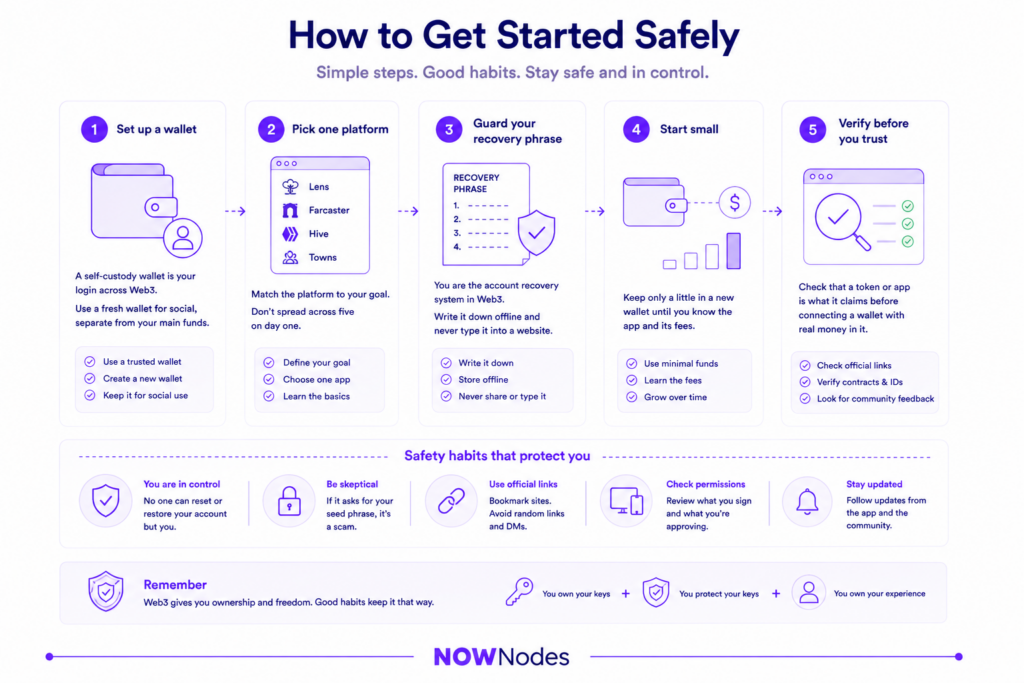
Getting on these Web3 social media dApps is easy. The safety habits matter more than the steps, so build them early:
- Set up a wallet. A self-custody wallet is your login across Web3. Start with a fresh one you keep for social, apart from where you hold serious funds.
- Pick one platform. Match it to what you want — Lens or Farcaster for posting, Hive for blogging, Towns for a private group. Don’t spread across five on day one.
- Guard your recovery phrase. In this model, you are the account recovery system. Write the phrase down offline and never type it into a website.
- Start small. Keep only a little in a new wallet until you know the app and its fees.
- Verify before you trust. Check that a token or app is what it claims before connecting a wallet with real money in it.
The one rule above all the others: a legitimate app will never ask for your seed phrase or private key. Anything that does is trying to empty your wallet. Close the tab and move on.
The Bottom Line
Web3 social media dApps have stopped being a whiteboard idea. They’re live networks with real users, real money, and real drawbacks. Lens, Farcaster, Hive, DeSo, and Towns each prove a slightly different version of the same idea: you should own your identity, your audience, and your posts, not rent them.
Pick the one that fits what you actually do online. Post on Farcaster, blog on Hive, build on Lens, chat on Towns, experiment with DeSo. Keep your main assets in a separate wallet, treat every “free money” token with suspicion, and remember that the app is the easy part — the ownership underneath is the reason to bother. The tech is early and rough, but the direction is set, and it points at users holding the keys.
FAQ
What is a Web3 social media dApp?
It’s a social app that keeps your identity, posts, and followers on a blockchain instead of a company’s servers. You sign in with a crypto wallet, and because the data is open, no single platform can delete your account or stop you moving to another app.
Do I need cryptocurrency to use one?
Not to browse. Setting up a wallet is free, and reading feeds costs nothing. Posting usually needs a tiny amount of the chain’s gas token, though feeless networks like Hive let you participate without holding any crypto at first.
Which one is best for beginners?
Farcaster is the easiest if you want a familiar posting app, and Hive is the friendliest for writing since it charges no fees. Both let you start without touching code.
Can posts really not be censored?
They’re much harder to erase, but “censorship-resistant” isn’t “unmoderated.” The data on the blockchain is very tough to delete, yet individual front-end apps can still choose what they show. The guarantee lives in the protocol, not the interface.
What happens to my followers if an app shuts down?
On networks built around an open social graph, like Lens or Farcaster, your followers sit on-chain and outlive any single app. You log in to another compatible client and they’re still there.
Are Mastodon and Bluesky Web3 social media dApps?
Not really. Both are decentralized in how they’re run, but neither is blockchain-based, so they skip the on-chain ownership and token economics that define the platforms here. Think of them as cousins, not the same thing.