
“UTXO vs account model” is the question behind one of the most basic design choices in blockchain architecture: how does a decentralized network remember who owns what? Bitcoin answers it with the UTXO model, where your balance is really just the sum of individual leftover pieces from past transactions. Ethereum answers it with the account model instead, where a single balance field updates directly, closer to how a bank tracks a checking account.
Here’s the short version: Bitcoin uses UTXO, Ethereum uses accounts, and that one choice shapes transaction fees, privacy, and whether a chain can run smart contracts easily. Neither model is a workaround for the other; both solve the same problem differently. This guide starts with the basic mechanics of each, then works up to where they genuinely diverge.
How Does Bitcoin Track What You Own?
What does UTXO stand for? UTXO stands for Unspent Transaction Output — bitcoin left over from a previous transaction that hasn’t been spent yet. Bitcoin doesn’t store a running balance for your wallet anywhere on the network; your wallet simply adds up every UTXO tied to your addresses to show a total.
UTXO: short for Unspent Transaction Output. Each transaction input spends the coins paid to a previous output, and each output then waits as a UTXO until a later transaction spends it. A UTXO can only be spent once, in full. See the Bitcoin Developer Guide.
Think of it like cash in a wallet. If you have a $20 bill and want to buy a $12 coffee, you don’t tear the bill in half — you hand over the whole $20 and get $8 back in change. Bitcoin works the same way: spending part of a UTXO means consuming the whole thing and creating a new “change” UTXO for whatever’s left over.
That’s also why a single Bitcoin address can sit on dozens of separate UTXOs at once, each one a distinct piece of bitcoin with its own transaction history. As of block height 892,385 in April 2025, the entire network held more than 173.1 million of these unspent outputs, according to research from mempool.space — a count that shifts constantly as coins get spent or consolidated.
How Does Ethereum Track What You Own?
Ethereum skips the UTXO bookkeeping entirely. Every address is an account with a balance field that simply goes up or down, the same way a bank updates your account after a deposit or withdrawal.
Account (Ethereum): an address with four core fields — a nonce, a balance, a code hash, and a storage root. The nonce counts how many transactions an address has sent, which stops the same transaction from being replayed twice. See ethereum.org’s account documentation.
Ethereum actually runs two kinds of accounts. Externally-owned accounts (EOAs) are controlled by a private key — that’s the wallet you hold — while contract accounts are controlled by code instead, which is what makes smart contracts possible in the first place.
This is the core of the account based blockchain approach: one address, one balance, updated in place. There’s no pile of leftover outputs to sum up, just a number that changes with every transaction.
Why Blockchains Need a Way to Prevent Double-Spending
Both models exist to solve the same problem: stopping someone from spending the same money twice on a network with no bank in the middle to check balances. This is the double-spend problem — the reason a blockchain needs a coordinated way to track ownership instead of trusting a client’s own claim.
Bitcoin’s answer is structural. Because a UTXO can only ever be spent once, and every node can check a proposed transaction against the specific outputs it claims to spend, there’s no way to reuse the same coins in two different transactions without one of them getting rejected outright.
Ethereum’s answer is a counter. The nonce on every account has to increase by exactly one with each transaction, so a transaction that tries to reuse an old nonce gets rejected before it ever touches a balance.
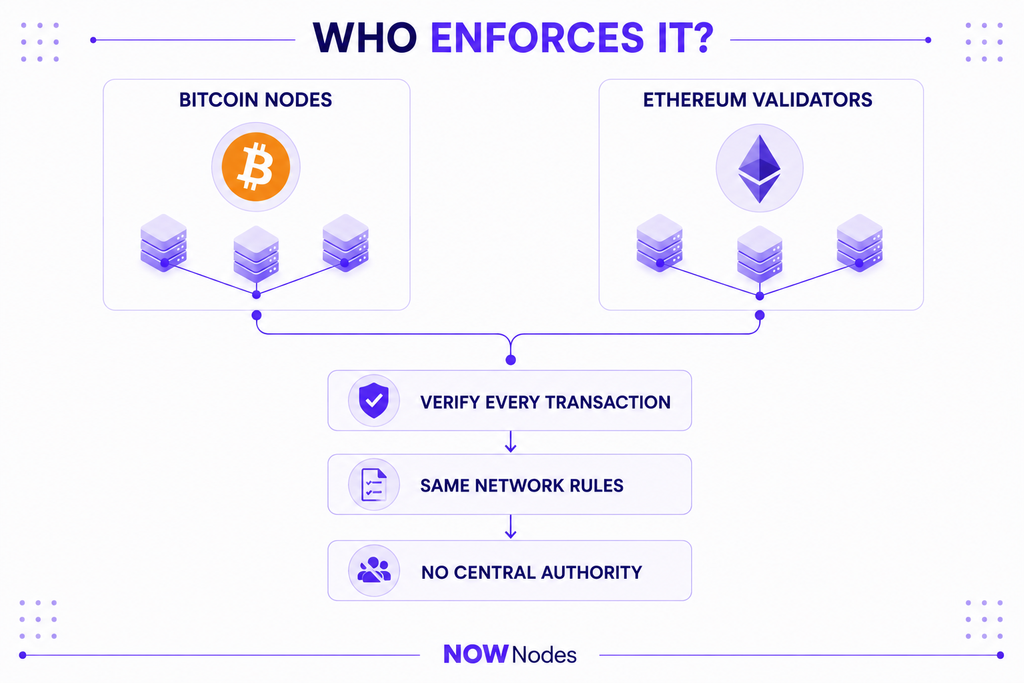
Neither approach relies on trusting a central party. Both depend on thousands of independently operated nodes checking every transaction against the same rules — miners and full nodes on Bitcoin, staked validators on Ethereum. That verification step is what actually keeps either network honest.
Which Blockchains Use Which System?
Bitcoin, Litecoin, Bitcoin Cash, Dogecoin, and Zcash all run on UTXO. Ethereum, BNB Smart Chain, Polygon, and Solana all run on accounts instead. Every new layer-1 blockchain lands on one side of the utxo vs account based split.
The UTXO side traces back to a shared lineage. Litecoin, Bitcoin Cash, Dogecoin, Dash, and Zcash are all UTXO blockchains that inherited Bitcoin’s original codebase through a fork. Zcash adds shielded, note-based outputs on top for privacy, but the underlying accounting is still UTXO at heart.
The account side is where most of today’s smart contract activity lives. Ethereum, BNB Smart Chain, Polygon, and Solana are all account based blockchain networks, and that’s not a coincidence — the model was built with programmability in mind from the start.
In practice, the split maps loosely to what someone is actually doing on-chain. A few scenarios make this concrete:
- Sending or holding bitcoin and other UTXO-based coins as a store of value or payment rail.
- Running a DeFi protocol, NFT marketplace, or any application whose logic needs shared, mutable state.
- Building a wallet or exchange that has to support both, which describes most of them.
Developers rarely get to pick just one. A wallet provider or exchange usually needs to read balances and broadcast transactions on both UTXO and account-based chains from the same backend — that’s where infrastructure choices start to matter more than architecture debates.
Side-by-Side Comparison
The table below lines up the two systems across the areas that matter most in practice. Each row maps to a trade-off covered in more detail afterward.
| Aspect | UTXO Model | Account Model |
|---|---|---|
| How balance is stored | Sum of unspent outputs scattered across past transactions | Single balance field per address |
| State growth | Grows with every new output (173M+ UTXOs on Bitcoin as of April 2025) | Grows with the number of active addresses and contracts |
| Transaction ordering | Independent — no shared state between unrelated transactions | Sequential per account, enforced by the nonce |
| Typical block time | ~10 minutes (Bitcoin) | ~12 seconds (Ethereum) |
| Base-layer throughput | ~7 TPS theoretical capacity (Chainspect) | ~26 TPS on Ethereum L1 (CoinLaw, 2026) |
| Privacy pattern | New address per transaction is standard practice | Same address is typically reused, easier to trace |
| Smart contract support | Limited on Bitcoin; Cardano’s EUTXO adds scripting | Native — built for complex, stateful contract logic |
| Example networks | Bitcoin, Litecoin, Bitcoin Cash, Dogecoin, Zcash | Ethereum, BNB Smart Chain, Polygon, Solana |
Neither column is “better” in the abstract. The UTXO model optimizes for simple, auditable, parallel-friendly value transfer, while the account model optimizes for shared, programmable state — which is exactly what the next section digs into.
Trade-Offs You Should Know
Processing Transactions in Parallel
UTXO transactions that don’t touch the same inputs can be validated independently of each other, since there’s no shared account balance to lock or update first. That independence is what makes parallel processing genuinely straightforward on a UTXO chain: two transactions spending two different UTXOs simply don’t interact.
Account-based chains don’t get that for free. Every transaction from the same account has to process in nonce order, and a contract call can touch state that other pending transactions also depend on — exactly the interdependency that makes parallelizing Ethereum-style execution a much harder engineering problem.
Privacy and Traceability
A UTXO wallet can generate a fresh address for every incoming payment at essentially no cost, which makes it harder — though not impossible — for an outside observer to link all of someone’s activity to one identity. Chain-analysis firms have gotten good at clustering related UTXOs anyway, so this is a mitigation, not a guarantee of privacy.
Account-based chains work against you here by default. One address accumulates a full transaction history over time, so anyone looking it up on a block explorer sees a complete activity log tied to a single, reused identifier.
Building Smart Contracts
The account model became the default for smart contracts because global, mutable state is easier to reason about when a contract needs to call another contract, check a balance, and update state in one transaction. Ethereum’s entire DeFi ecosystem depends on that composability working reliably.
UTXO chains had to work harder to catch up here. This is critical context for what comes next: UTXO can support smart contracts, but doing it well took a genuinely different architecture.
Can a Blockchain Combine Both Approaches?
Yes — Cardano’s Extended UTXO model, or EUTXO, is the clearest proof. Introduced with the Alonzo upgrade in 2021, EUTXO keeps Bitcoin’s basic UTXO structure but lets outputs carry scripts and arbitrary data instead of just an address and an amount, according to Cardano’s developer documentation.
That extra flexibility closes UTXO’s biggest historical gap. A EUTXO transaction’s success or failure depends only on the transaction itself and its inputs, never on unrelated activity elsewhere on the chain. Ethereum-style execution can’t make that same promise: a contract call there can fail mid-script, something the documentation says “can never happen” under EUTXO. That determinism means fees can be calculated before a transaction is ever submitted.
Ethereum’s own team is watching this space closely, too. In August 2026, Ethereum co-founder Vitalik Buterin pointed to Utreexo — a Bitcoin-derived UTXO compression technique — while discussing research into a hybrid state model for Ethereum. “Bitcoiners deserve a lot of credit for pioneering many of these ideas,” he wrote, describing an approach that would blend UTXO-style state with Ethereum’s conventional accounts rather than replace one with the other, as reported by The Crypto Times.
The line between a UTXO chain and an account chain is a useful starting point, not a permanent wall. Even Ethereum’s own core developers are borrowing ideas from the other side.
How Developers Connect to Both Kinds of Networks
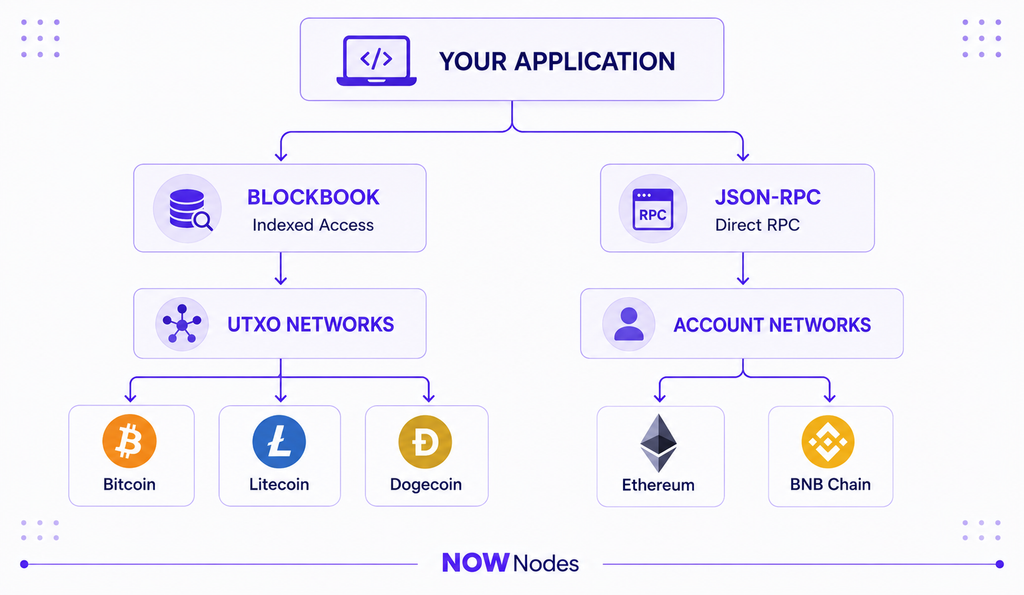
Reading a balance means something different depending on which model sits behind the endpoint. On a UTXO chain, an application either tracks and sums every relevant output itself or relies on an indexed interface that has already done the math; on an account chain, it’s a single lookup against one address field.
That difference is exactly why Blockbook — a read-optimized indexing layer built for UTXO chains — exists as its own category of tool, separate from plain JSON-RPC. NOWNodes offers Blockbook access for UTXO networks like Bitcoin, Litecoin, and Dogecoin alongside RPC access for account-based chains such as Ethereum and BNB Smart Chain, across 120+ supported networks.
For a team building a wallet or an exchange, that split matters practically, not just architecturally. Simulating an Ethereum transaction before broadcasting it depends on nonce ordering and contract state that simply don’t exist in the same form on a UTXO chain — the tooling has to branch by model, not just by network name.
Conclusion
UTXO vs account model isn’t a contest with a single winner — it’s two different answers to the same problem, each optimized for something different. Bitcoin’s UTXO design favors simple, auditable, parallel-friendly value transfer; Ethereum’s account model favors the shared, programmable state that smart contracts depend on.
Knowing which is which changes how you build. An application built on Bitcoin UTXO logic needs to think in terms of outputs and change, while one built on an account based blockchain needs to think in terms of balances and nonces. Hybrid designs like Cardano’s EUTXO, and Ethereum’s own research into UTXO-inspired scaling, show the two models will keep borrowing from each other.
None of this is financial or technical advice. The right model depends entirely on what you’re building, not on which one sounds more advanced.
FAQ
Is “UXTO” the same as UTXO?
Yes. “UXTO” is simply a common transposition typo for UTXO, short for Unspent Transaction Output. Both refer to the same Bitcoin balance-tracking mechanism.
Which came first, the UTXO model or the account model?
UTXO came first. Bitcoin launched with the UTXO model when its genesis block was mined in January 2009, and Ethereum introduced the account model when it launched in July 2015, more than six years later.
What happens to the leftover amount in a Bitcoin transaction?
It comes back to you as a new UTXO. Since a UTXO must be spent in full, a wallet automatically routes any unused amount to a new “change” output, usually at a fresh address you control.
How do I see my balance if it’s spread across many UTXOs?
Your wallet software handles this automatically. It scans every UTXO tied to your addresses and adds them together, so you only ever see one combined total on screen.
Do I need to understand any of this to use a crypto wallet?
No. Wallet software abstracts both models away completely, showing a single balance regardless of whether it’s summing UTXOs or reading an account field. Understanding the difference mostly matters for developers, node operators, and anyone comparing infrastructure across chains.