
A merkle tree is a cryptographic data structure that summarizes a large set of data in a single hash while making individual pieces of that data easy to verify. Instead of checking an entire dataset, a system can verify one item using a small set of hashes and compare the result with the known root.
This structure is especially useful in distributed systems, where different computers need to agree on data without constantly exchanging complete copies. Merkle trees became particularly important in blockchain because they allow nodes and applications to verify transaction or state data efficiently.
The name comes from computer scientist Ralph Merkle, whose work on cryptographic tree structures dates back to the late 1970s. The spelling merkel tree sometimes appears in searches, but Merkle tree is the correct term.
What Problem Does This Data Structure Solve?
Large datasets create a simple verification problem: how do you prove that one particular item belongs to the dataset without transferring and checking everything?
Imagine a block containing thousands of transactions. A straightforward approach would require a verifier to obtain every transaction before confirming that one specific transaction belongs to that block. That works, but it wastes bandwidth, storage, and computation when the verifier only needs evidence about one item.
A merkle tree solves this by turning the dataset into a hierarchy of cryptographic hashes. The final hash, known as the Merkle root, acts as a compact commitment to everything underneath it.
Bitcoin uses this principle directly. Its block header contains a Merkle root derived from the transactions in the block, meaning a modification to those transactions changes the corresponding root. (Bitcoin Developer Documentation)
The important distinction is that the root does not contain the underlying information. It is a cryptographic fingerprint that can be used together with additional hashes to verify the data.
How Does Hash-Based Verification Work?
To understand what is a merkle, it helps to start with hashing. A cryptographic hash function takes an input and produces a fixed-size output, often called a hash or digest.
A useful cryptographic hash function has several properties: the same input produces the same output, changing the input changes the resulting hash, and reconstructing the original input from its hash should be computationally impractical. Merkle structures use these properties repeatedly across several levels.
Suppose we have four pieces of data:
- Transaction A
- Transaction B
- Transaction C
- Transaction D
Each transaction is hashed first. These hashes become the leaves at the bottom of the structure.
The hashes are then paired and hashed again:
                  Root
                 /    \
              HAB      HCD
             /  \      /  \
           HA   HB    HC   HD
           |     |     |    |
           A     B     C    D
HA, for example, represents the hash associated with A. HAB is calculated from the hashes of A and B, while the root is calculated from HAB and HCD.
The result is one root hash representing the complete dataset. Change Transaction C and its leaf hash changes, followed by HCD and finally the root.
How Is the Root Calculated?
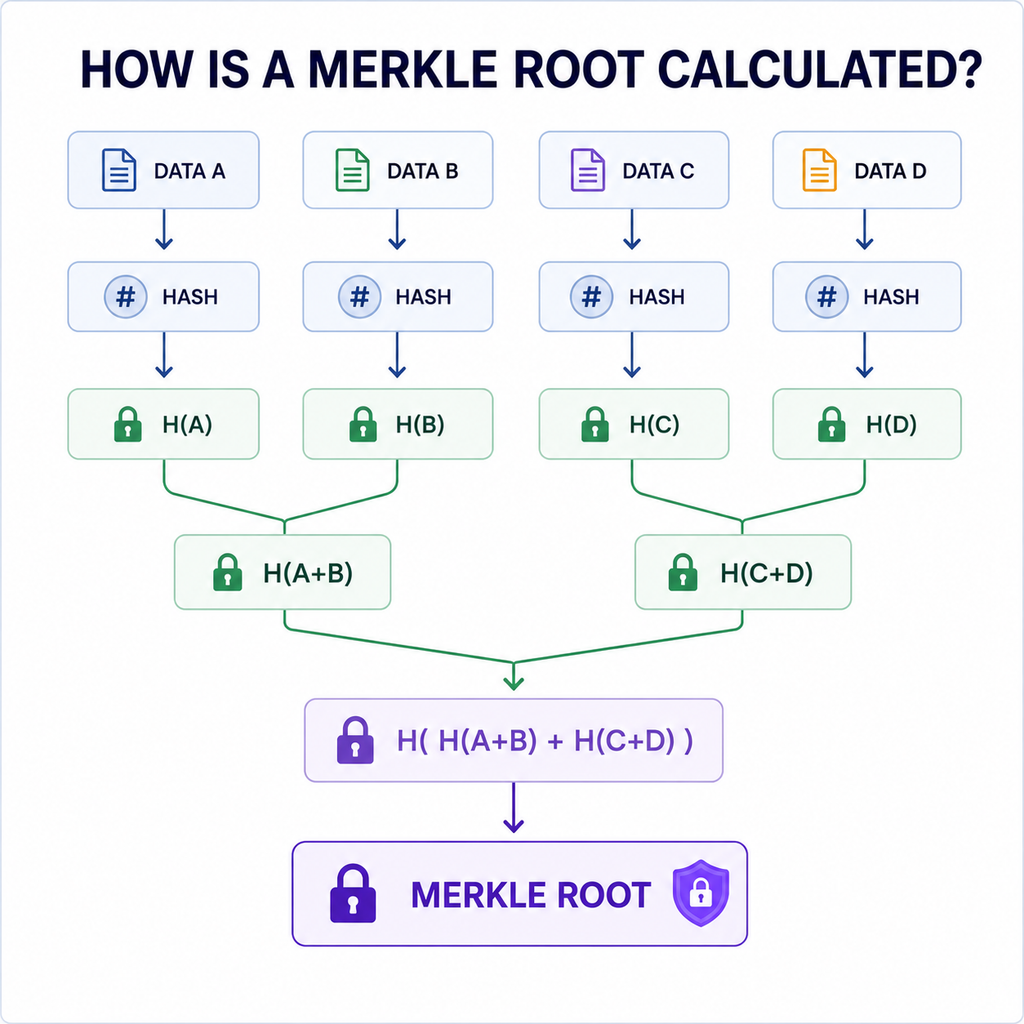
Building a simple binary merkle tree can be understood as a sequence of hashing operations.
- Hash every original data item to produce the leaf hashes.
- Group neighboring hashes into pairs.
- Concatenate or otherwise encode each pair according to the protocol’s rules.
- Hash each pair to produce the next level.
- Repeat the process until only one hash remains.
That final value is the Merkle root.
The exact construction depends on the protocol. Bitcoin, for example, constructs its transaction Merkle root from transaction IDs and uses double SHA-256 when hashing pairs. Its specification also defines how special cases, such as particular numbers of transactions, are handled.
This protocol-specific detail matters. “Merkle tree” describes a family of authenticated hash-tree structures, not one universal serialization and hashing procedure that every system implements identically.
Why Not Just Hash All the Data Together?
A single hash of an entire dataset could also reveal whether the dataset had changed. What it cannot do efficiently is prove that one specific item belongs to that dataset without providing much more of the original data.
The tree structure solves this problem because a verifier only needs the hashes along the relevant path. The rest of the dataset can remain unavailable to that verifier.
For a balanced binary tree containing n leaves, an inclusion proof grows roughly logarithmically with the number of leaves. This is why the structure remains useful even when datasets become very large.
The value of merkle trees therefore comes from more than data integrity. Their real advantage is selective verification.
What Is a Merkle Proof?
A Merkle proof is the collection of hashes required to demonstrate that a particular leaf belongs to a tree represented by a known root. It is also commonly called an inclusion proof or Merkle path.
Suppose you want to prove that Transaction C belongs to our four-transaction example. You already have C, so you can calculate its hash yourself.
You do not need A, B, and D in full. You only need the sibling hash next to C and the hash representing the opposite branch.
The verifier can then:
- Hash Transaction C.
- Combine its hash with the supplied sibling hash.
- Hash that pair to reconstruct its parent.
- Combine the parent with the supplied hash from the other branch.
- Calculate the root and compare it with the trusted root.
If both roots match, the verifier has cryptographic evidence that the supplied data is consistent with the committed dataset, assuming the hash function and proof construction are secure.
This is the same core idea described in Ethereum’s documentation: a relatively small number of nodes can be supplied to prove a branch, while modifying underlying information ultimately produces a different root. (ethereum.org)
Why Are Hash Trees Important for Blockchain?
A merkle tree blockchain implementation allows large amounts of transaction or state information to be cryptographically committed to a compact root. That is valuable because blockchain participants frequently need to verify information they have not stored in full.
Without structures of this kind, lightweight verification would require substantially more data. Nodes would either need larger proofs or more complete copies of the information they were trying to verify.
The benefits include:
- Data integrity: changing committed data changes hashes above it and eventually the root.
- Compact proofs: a verifier can check inclusion without receiving the entire dataset.
- Lower bandwidth requirements: only relevant data and proof elements need to be transmitted.
- Efficient synchronization: distributed participants can compare cryptographic commitments before investigating individual differences.
- Support for lightweight clients: applications can verify selected information without behaving like full archival nodes.
These properties do not make blockchains secure by themselves. They provide an efficient mechanism for committing to and verifying data, while consensus rules, digital signatures, networking, and other cryptographic mechanisms solve different parts of the system.
How Does Bitcoin Use Hash Trees?
Bitcoin uses a binary merkle tree to commit to the transactions included in a block. Transaction IDs form the basis of the leaves, and successive levels of hashes eventually produce the Merkle root stored in the block header.
This design means the header can commit to the block’s transactions without containing them individually. If a transaction used to construct that root changes, the resulting commitment changes as well.
Merkle proofs also historically support simplified verification models in which a client can obtain block headers and request evidence that a transaction is included in a particular block. The client does not need every transaction from that block merely to verify one inclusion.
That distinction is important: an inclusion proof proves membership relative to a particular root. It does not independently prove that the transaction itself is valid, that the chain is canonical, or that sufficient confirmations have accumulated.
How Does Ethereum Use Authenticated Trees?
Ethereum’s execution layer uses a more sophisticated structure called the Merkle Patricia Trie, rather than simply applying Bitcoin’s transaction-tree design to every kind of data. It combines cryptographic hashing with trie-based key-value retrieval.
Ethereum block headers contain roots associated with state, transactions, and receipts. The global state structure represents account information, while contract storage introduces additional authenticated structures beneath individual accounts.
This makes Ethereum a useful example of how the general merkle concept can evolve for different requirements. The goal is not merely to prove that an item appears in a list, but to maintain cryptographically verifiable structured state that changes as transactions execute.
Ethereum has also been researching a transition toward Verkle trees because the witnesses required by its current state structure can become large. Verkle structures are intended to enable substantially smaller witnesses, particularly in the context of stateless-client designs.
Who Uses These Structures?
Blockchain protocol developers are the obvious users, but merkle trees appear anywhere large datasets need compact, independently verifiable commitments.
| User or system | Why the structure is useful |
|---|---|
| Blockchain nodes | Verify and commit to transaction or state data |
| Lightweight clients | Check selected information without storing every underlying item |
| Wallet infrastructure | Verify or retrieve blockchain-related data through node-backed systems |
| Smart contracts | Validate membership in predefined datasets |
| Rollups and scaling systems | Commit to large datasets or state and use compact proofs |
| Distributed databases | Detect differences between replicated datasets |
| Transparency logs | Provide auditable inclusion and consistency proofs |
The concept is not exclusive to cryptocurrency. Certificate Transparency, for example, specifies binary Merkle structures for efficiently auditing append-only logs of TLS certificates. RFC 9162 defines both inclusion and consistency proofs for these logs. (RFC Editor)
This broader use helps explain why the structure matters. Blockchain popularized the term, but the underlying problem is general: proving properties about large collections of data without requiring every verifier to process the entire collection.
How Do Developers Interact With This Data in Practice?
Most application developers do not manually reconstruct every merkle tree used by a blockchain. They normally interact with nodes through protocol APIs and retrieve blocks, transactions, receipts, state, proofs, or other chain-specific information.
That makes node infrastructure part of the practical path between authenticated blockchain data and an application. NOWNodes provides API access to full nodes and other blockchain interfaces across 100+ networks, allowing applications such as wallets, exchanges, explorers, and dApps to query blockchain data without maintaining each underlying node themselves.
For Bitcoin specifically, NOWNodes exposes interfaces for reading blocks and transactions and broadcasting transactions, alongside indexed data access through Blockbook. The underlying Bitcoin protocol still determines how transaction commitments and Merkle roots work; the infrastructure provider supplies access to node data rather than changing those cryptographic rules.
This distinction matters when designing blockchain applications. RPC access gives an application blockchain data, while Merkle proofs provide a cryptographic mechanism for verifying specific claims against a known commitment.
Hash Tree vs Regular Hash: What Is the Difference?
Both approaches rely on cryptographic hashing, but they solve different verification problems.
| Property | Single hash | Hash tree |
|---|---|---|
| Detect changes to the complete dataset | Yes | Yes |
| Produce one compact commitment | Yes | Yes |
| Efficiently prove one item’s inclusion | No | Yes |
| Requires the full dataset for recomputation | Usually yes | Not for an inclusion proof |
| Supports branch-based verification | No | Yes |
| Structural complexity | Low | Higher |
If the only requirement is detecting whether a small file has changed, a normal cryptographic hash is usually sufficient. Building an entire tree would add complexity for no meaningful benefit, because humanity does occasionally manage not to turn every problem into distributed infrastructure.
A tree becomes valuable when the dataset is large, distributed, or frequently subject to partial verification.
What Are the Main Limitations?
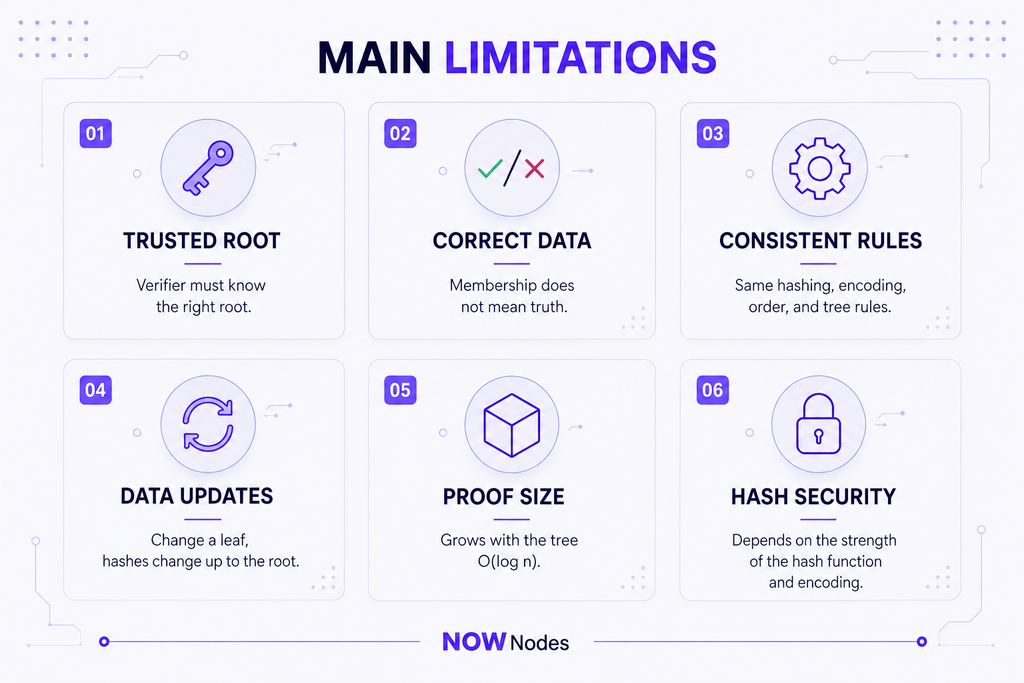
Merkle trees provide strong integrity properties, but they are not magical certificates of truth. A valid proof only shows that data is consistent with a particular root.
That creates several important limitations:
- The verifier still needs a trustworthy way to obtain or authenticate the expected root.
- Membership does not imply that the underlying information is factually correct.
- Implementations must agree on hashing, encoding, ordering, and tree-construction rules.
- Updating data changes the hashes along the path to the root.
- Proof sizes still increase as the tree grows, even though the growth is logarithmic in a balanced binary structure.
- Different applications may need more specialized authenticated data structures.
The choice of hash function also matters. A Merkle construction inherits important security assumptions from the cryptographic primitives and encoding rules used to build it.
Inclusion Proofs vs Consistency Proofs
An inclusion proof answers: does this item belong to the dataset represented by this root? A consistency proof answers a different question: is a newer version of an append-only tree a valid extension of an older version?
The second concept is particularly important for transparency systems. Certificate Transparency uses consistency proofs so auditors can determine whether a log has grown without silently rewriting previously committed entries. (RFC Editor)
Blockchains and transparency logs therefore demonstrate two related but distinct uses of authenticated trees. One focuses heavily on proving membership in committed blockchain data, while the other can also use tree structure to verify append-only history.
Why Do These Structures Still Matter?
The underlying problem has not disappeared: distributed systems need efficient ways to prove that pieces of information belong to much larger datasets. Sending the entire dataset every time is technically possible, in roughly the same sense that moving house by carrying one brick at a time is possible.
A merkle tree turns a large dataset into a compact cryptographic commitment while preserving the ability to verify individual branches. That combination of integrity, compactness, and partial verification explains why the structure remains fundamental across blockchain protocols and other cryptographic systems.
Understanding merkle trees also makes more advanced topics easier to follow. State tries, blockchain proofs, rollups, stateless clients, authenticated databases, and newer structures such as Verkle trees all build on the broader idea that large amounts of data can be represented and verified through carefully constructed cryptographic commitments.
FAQ
Can a Merkle root be reversed to recover the original data?
No. A Merkle root is built from cryptographic hashes and is not an encoded copy of the underlying dataset. Recovering all original entries from the root alone is not what the structure is designed to allow.
Does every blockchain use the same tree design?
No. Protocols can use different authenticated structures, hash functions, branching schemes, serialization rules, and methods for handling leaves. Bitcoin and Ethereum alone demonstrate why treating every blockchain implementation as identical would be misleading.
What happens if a tree has an odd number of leaves?
That depends on the implementation. Some constructions duplicate a hash, while others define different rules for handling unpaired nodes, so proof generation must follow the exact protocol specification rather than assuming a universal convention.
Can the same root represent two different datasets?
A secure construction is designed to make meaningful collisions computationally infeasible. In practice, this property depends on the security of the hash function and on unambiguous rules for encoding and constructing the tree.
Are Merkle proofs stored permanently on-chain?
Not necessarily. A proof can often be constructed from the underlying tree data when it is needed. Whether proofs themselves are stored, generated dynamically, transmitted between participants, or verified inside a smart contract depends on the protocol and application.
Is a Merkle proof the same as a zero-knowledge proof?
No. A Merkle proof demonstrates membership or another property of an authenticated tree relative to a root. Zero-knowledge proof systems address a broader cryptographic problem and can prove statements without revealing all of the information used to establish them.