
If you have ever tried to interact with an Ethereum smart contract from a web application, script, wallet, or blockchain library, you have probably encountered an ABI. A smart contract ABI, or Application Binary Interface, describes how external software can communicate with a compiled smart contract.
The easiest way to think about it is as an instruction manual for contract interaction. The blockchain executes bytecode, but an application still needs to know which functions exist, what arguments they accept, what values they return, and which events the contract can emit.
That is the job of the ethereum ABI. It gives tools such as ethers.js and web3.py a structured description they can use to turn ordinary function calls into data the Ethereum Virtual Machine understands.
What Does ABI Mean?
ABI stands for Application Binary Interface. In Ethereum, it defines how applications encode calls to smart contracts and decode the information those contracts return.
This answers the common question about the ABI full form in blockchain, although the term itself is not unique to crypto. In conventional programming, an ABI defines how compiled software components interact at a binary level.
Ethereum applies the same general idea to smart contracts. The Solidity documentation defines the Contract ABI Specification as the standard for encoding and decoding data when interacting with contracts.
So, what is ABI in smart contract development? In practical terms, it is the machine-readable interface that tells other software how to communicate with a deployed contract.
Why Do Smart Contracts Need an Interface?
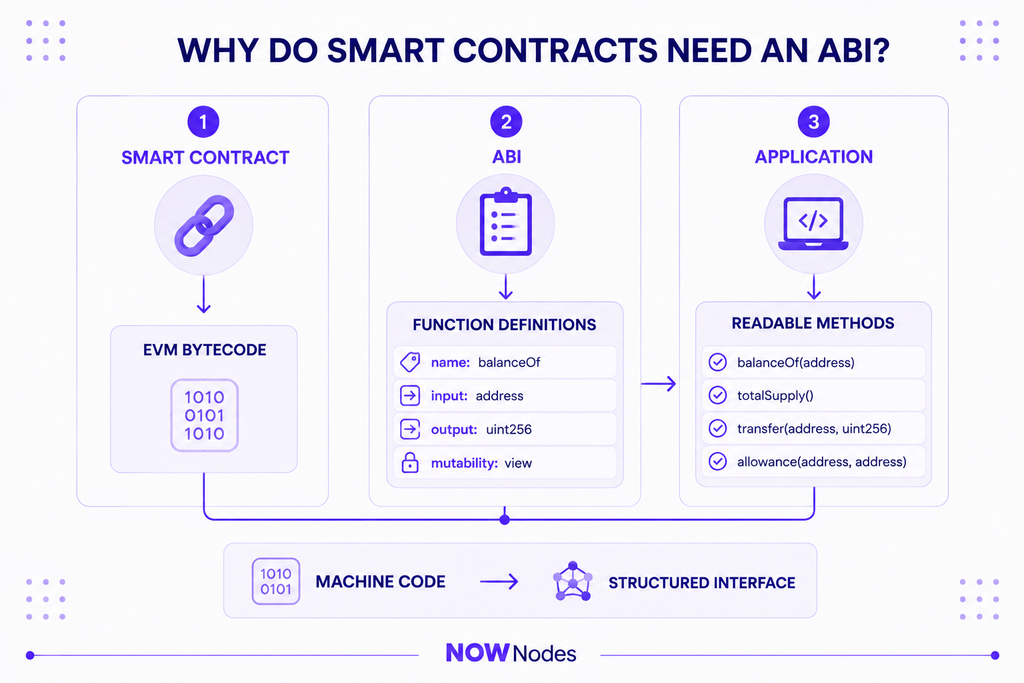
A deployed contract does not expose its original Solidity code as a convenient application interface. Ethereum executes compiled EVM bytecode, which is excellent for machines and rather less charming for a developer trying to build a frontend.
Imagine a contract contains a Solidity function called balanceOf. The function accepts an account address and returns a uint256 representing that account’s balance.
A developer reading the Solidity source understands that immediately. An application needs the same information in a structured form: the function name is balanceOf, its input type is address, its output type is uint256, and its state mutability is view.
The contract ABI provides those definitions. Without it, developers would have to construct and decode low-level call data manually instead of working with recognizable functions and typed arguments.
What Information Does an ABI File Contain?
An ethereum abi file is normally represented as structured JSON containing descriptions of the contract elements available to external callers. It does not contain the executable smart contract itself.
A contract ABI can describe functions, constructors, events, custom errors, fallback behavior, and receive behavior. The Solidity ABI specification defines how these elements and their Solidity types are encoded.
How Does an Application Call a Contract?
The ABI blockchain interaction process happens between an application, a blockchain library, a node, and the smart contract. Most of the awkward binary work disappears once the application knows the contract address and its ABI.
- Choose a function. A user action or backend process triggers a method such as
balanceOf(address)ortransfer(address,uint256). - Read the interface. The ABI tells ethers.js, web3.js, web3.py, or another library which arguments and types the function expects.
- Encode the request. The library converts the function call and arguments into EVM-compatible data.
- Send the request. A read-only call queries blockchain state; a state-changing operation is submitted as a transaction.
- Decode the result. The same ABI tells the library how to convert returned bytes into usable values.
What Is a Function Selector?
An external Ethereum function call starts with a four-byte function selector. Ethereum derives it from the Keccak-256 hash of the function’s canonical signature.
For example, the ERC-20 signature transfer(address,uint256) produces a selector identifying that function, while the arguments are ABI-encoded after it. The Solidity documentation explains function selectors as part of the standard calling convention.
ABI vs. Bytecode: What Is the Difference?
ABI describes the contract interface: functions, arguments, return types, events, and errors. Bytecode contains the executable machine instructions that the EVM runs.
The simplest distinction is this: the ABI tells software how to talk to a contract, while bytecode tells Ethereum what the contract does. Tools such as Hardhat and Foundry generate these artifacts during compilation.
Who Actually Uses Contract Interfaces?
Frontend developers use ABIs to turn buttons and forms into valid contract calls. Backend services use them to retrieve balances, monitor events, execute automated transactions, and collect contract data.
Wallets, block explorers, bots, indexers, analytics platforms, and automated agents also depend on structured contract interfaces. Whenever software needs predictable interaction with a contract, the contract ABI becomes part of the integration layer.
How Does a Web Application Use an ABI?
An ABI web application normally needs the deployed contract address and its ABI. The address identifies where the contract lives; the ABI describes how it can be called.
A JavaScript application using ethers.js can combine the address, ABI, and a provider or signer to create a contract instance. The ethers Contract API then exposes methods based on the supplied interface.
Where Does Blockchain Access Fit In?
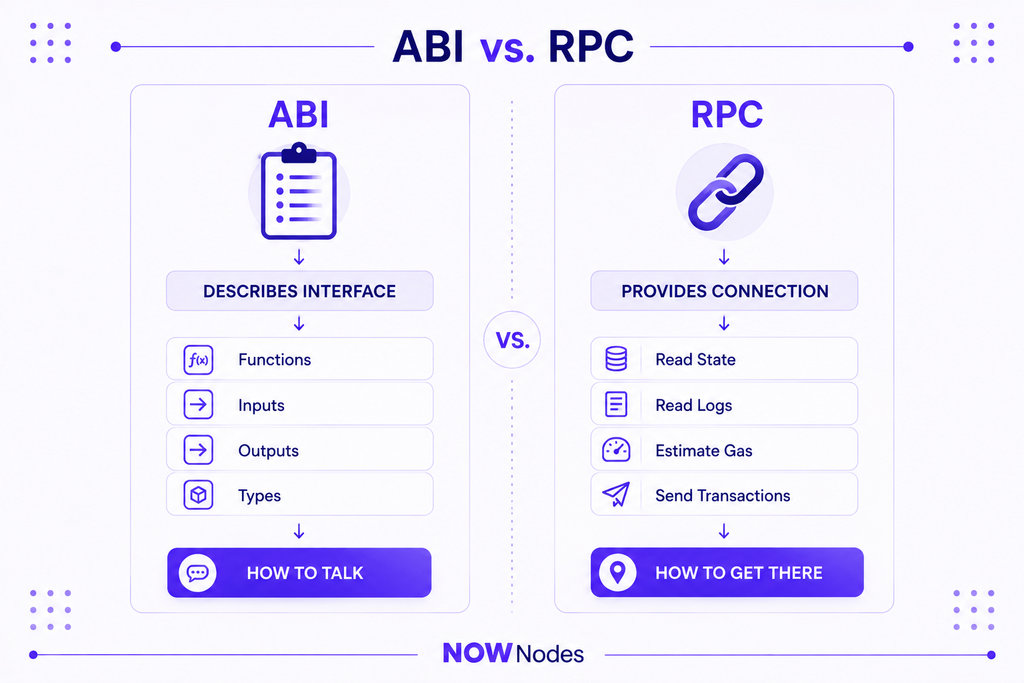
The ethereum ABI explains how to format an interaction, but it does not provide the actual connection to Ethereum. The application still needs access to a blockchain node to retrieve state, read logs, estimate transactions, or submit signed transactions.
That connection is normally made through an RPC endpoint. Developers can operate their own nodes or use infrastructure providers such as NOWNodes when they want their application to communicate with a network without maintaining the underlying node infrastructure themselves.
The distinction is important: the ABI describes the contract interface, while the blockchain connection carries the encoded request to the network and returns the response.
Where Do Developers Get a Contract ABI?
The cleanest source is the project itself. Compiling a Solidity contract generates development artifacts that normally contain the ABI.
Verified contracts can also expose interface information through block explorers. Etherscan’s contract verification process associates a deployed address with its source code and compiler settings.
Official repositories, packages, documentation, and SDKs are also common sources. Developers should avoid copying ABI files from unknown sources because an incorrect interface may not correspond to the deployed contract.
Can You Interact With a Contract Without Its ABI?
Technically, yes. If you know the exact function signature and Ethereum’s encoding rules, you can construct call data and decode responses manually.
In practice, dynamic arrays, nested tuples, overloaded functions, custom errors, and complex events make that increasingly error-prone. The ABI exists so normal applications do not need to reproduce low-level encoding logic for every interaction.
Does an ABI Reveal the Contract’s Source Code?
No. A contract ABI describes its externally accessible interface, not the internal implementation.
An ABI can tell you that withdraw(uint256) exists and accepts an unsigned integer, but it does not reveal every permission, calculation, storage operation, or security assumption behind the withdrawal. Source-code review, testing, bytecode analysis, and audits are separate security tasks.
How Are Events Represented?
Events are part of the Ethereum ABI because applications need a standard way to decode contract logs. An ERC-20 token, for example, commonly emits a Transfer event containing sender, recipient, and amount information.
Wallets, explorers, analytics services, indexers, and backend systems use these definitions to transform raw log data into recognizable activity. The ABI therefore helps software understand both what it can call and what has already happened on-chain.
What Happens When a Contract Is Upgraded?
Upgradeable contracts complicate ABI management because the address users interact with may be a proxy rather than the current implementation contract. A proxy can keep the same address while its underlying implementation changes.
If the new implementation adds, removes, or modifies external functions, applications may need an updated interface. A stale ABI can cause missing methods, failed calls, or incorrect decoding.
Why Is Interface Compatibility Important?
Contract integrations often depend on predictable function signatures. ERC-20 is the obvious example: wallets and applications can interact with many tokens because those contracts expose a common set of methods and events.
A stable contract ABI allows frontends, bots, SDKs, indexers, and other integrations to keep working as internal implementation details evolve. Once external software depends on an interface, changing it deserves the same care as a breaking API change.
How Do Libraries Use ABI Encoding?
Libraries such as ethers.js and web3.py sit between application code and Ethereum’s low-level encoding. They read the ABI, identify the function and parameter types, build the selector, encode arguments, and construct the request data.
When Ethereum returns data, the process happens in reverse. The library reads the output types from the ABI and decodes raw bytes into JavaScript, Python, or other native values.
What Can Go Wrong With an ABI?
The most common problem is using the wrong interface for the deployed address. An application may call a function that does not exist, encode parameters incorrectly, or decode returned data using the wrong types.
Upgradeable contracts create another source of mismatch when an application uses an old ABI against a newer implementation. Keeping addresses, deployment versions, and interface definitions aligned is therefore a basic part of maintaining a Web3 application.
FAQ
Is an ABI Stored on Ethereum?
Not normally as a JSON file. Ethereum stores deployed bytecode and contract state, while ABI definitions are usually distributed separately through compilation artifacts, repositories, SDKs, applications, or block explorers.
Is an ABI the Same as an API?
No. An API defines an application-level interface, while an Application Binary Interface defines lower-level rules for binary interaction. In Ethereum, the ABI determines how smart contract calls, arguments, return values, events, and errors are encoded and decoded.
Can Two Contracts Use the Same ABI?
Yes. Multiple contracts can expose identical external functions and events, meaning the same ABI may work with several deployed addresses. ERC-20 tokens are a common example. Matching interfaces, however, do not mean the contracts have identical internal logic.
Does Every Solidity Contract Have an ABI?
A compiled Solidity contract can have an ABI describing its externally accessible interface. Functions, events, constructors, custom errors, and other ABI-relevant elements can appear in it. Internal and private functions do not appear as normal externally callable entries.
Can an ABI Contain Events?
Yes. Event definitions are included so applications can decode transaction logs. For example, a token ABI can describe the Transfer event, allowing an indexer to interpret raw log topics and data as sender, recipient, and amount values.
Can an ABI Change After Deployment?
The ABI corresponding directly to immutable deployed bytecode does not spontaneously change. The complication comes from proxy-based upgradeable systems, where the implementation behind an address can change. If the implementation exposes a different interface, applications may need an updated ABI.
Do I Need the Entire ABI to Call One Function?
No. Many libraries can work with a minimal interface containing only the exact function definition an application needs. A full ABI becomes more useful when the application needs many
functions, events, and custom errors.
Can I Reconstruct an ABI From Bytecode?
Only partially. Analysts can identify selectors and infer some behavior, but compiled bytecode does not preserve all the rich information available in the original ABI. A verified contract or official build artifact is much more useful than trying to reconstruct the complete interface from bytecode.
Is It Safe to Interact With a Contract Because Its ABI Is Public?
No. ABI availability says nothing by itself about whether a contract is secure. The interface tells software how to call the contract, not whether its internal logic is correct or malicious. Source verification, permissions, upgradeability, audits, and the transaction being signed still matter.
What Happens If I Use the Wrong ABI?
A call may fail, target a nonexistent function, encode parameters incorrectly, or decode returned data incorrectly. The ABI and deployed address should always correspond to the same contract version.