
An Ethereum transaction is a signed instruction, sent from an account you control, that either moves ETH to another address or triggers code on a smart contract. Every transaction is cryptographically signed with a private key, broadcast to the network, and — once a validator includes it in a block — becomes a permanent, unchangeable part of Ethereum’s history.
That single mechanism covers a lot of ground. A $5 ETH transfer to a friend, a token swap on a decentralized exchange, and the deployment of a brand-new smart contract are all, technically, the same kind of object: a transaction with different data inside it. This guide walks through what a transaction actually contains, why Ethereum needs them structured this way, who sends them and why, and where the real complexity — gas, transaction types, and failure modes — starts to matter.
Why Does Ethereum Need Transactions at All?
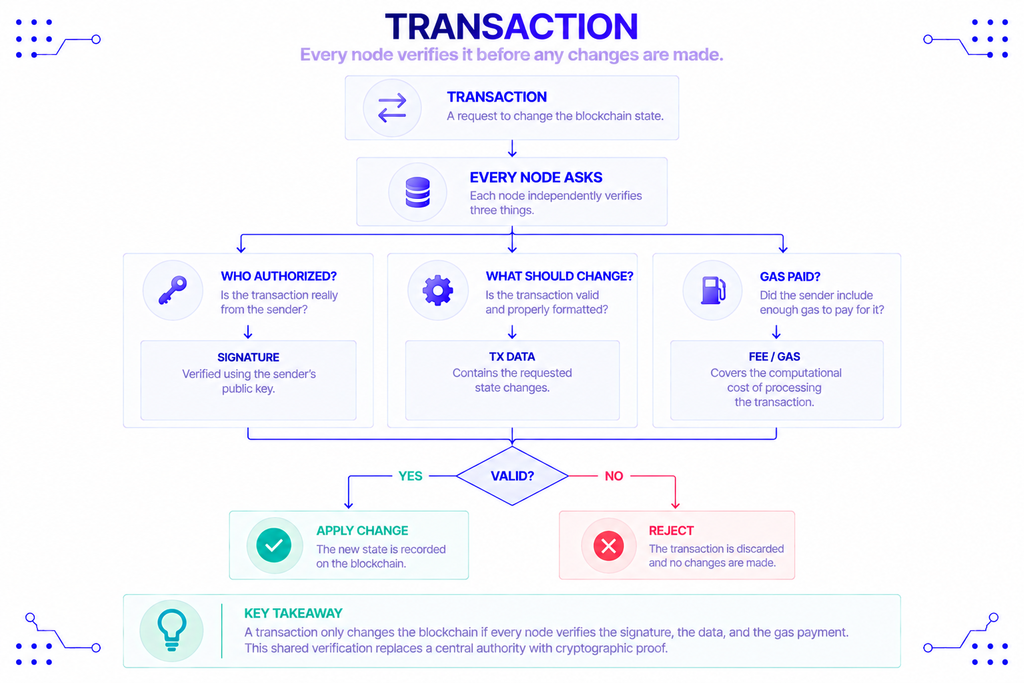
Ethereum has no central server tracking who owns what. Every account balance, every token holding, and every smart contract’s stored data lives in a shared state that thousands of independent nodes maintain in parallel, and a transaction is the only way to change any of it.
Here’s why that matters: without a strict, verifiable format for state changes, there’d be no way for a decentralized network to agree on what actually happened. A transaction gives every node the same three things to check — who authorized this, what should change, and did the sender pay for it — before applying it identically everywhere. That verification step, repeated by every node, is what replaces a bank’s ledger with no bank at all.
Who Actually Sends Ethereum Transactions?
Almost anyone interacting with Ethereum ends up sending transactions, though the reasons vary a lot by who’s doing it.
- Everyday users send ETH or tokens, approve token spending, or mint an NFT — usually through a wallet interface that hides the raw transaction fields entirely.
- DeFi traders submit swaps, add liquidity, or open leveraged positions, often several transactions in quick succession as market conditions shift.
- Smart contract developers deploy new contracts and call existing ones while building and testing, typically against a testnet first.
- Validators and block builders don’t send transactions themselves in the usual sense, but they decide which pending transactions actually make it into the next block.
- Bots and automated systems — arbitrage bots, liquidation bots, market makers — generate a disproportionate share of total transaction volume, often reacting to a single price change within milliseconds.
That last group is bigger than most people assume. Ethereum processed roughly 1.9 million transactions on September 14, 2026 alone, according to YCharts’ daily transaction tracker — and a meaningful share of that volume never touches a human clicking “confirm.”
What Does an Ethereum Transaction Actually Contain?
Strip away the wallet interface and every Ethereum transaction is a structured object with a fixed set of fields. Here’s what’s inside one, and what each field is actually for.
| Field | What it does |
| nonce | A counter of how many transactions the sender’s account has already sent — stops the same transaction from being replayed twice |
| to | The recipient address, or blank for a contract-creation transaction |
| value | The amount of ETH to send, denominated in wei (1 ETH = 10^18 wei) |
| data | Optional payload — empty for a plain transfer, or encoded function call data for a smart contract interaction |
| gasLimit | The maximum gas units the transaction is allowed to consume before it’s rejected |
| maxFeePerGas / maxPriorityFeePerGas | The most the sender will pay per gas unit, and the tip offered to the block proposer |
| signature (v, r, s) | Cryptographic proof, generated with the sender’s private key, that the account owner actually authorized this |
That nonce field is doing more work than it looks like. Because Ethereum uses an account-based model rather than Bitcoin’s UTXO system, there’s no natural way to stop someone from broadcasting the same signed transaction twice — the nonce is what closes that gap, by rejecting any transaction that doesn’t match the account’s next expected count.
What Types of Ethereum Transactions Exist?
Not every transaction on Ethereum follows the exact same format anymore. The network has added new transaction types over several upgrades, each identified by a type byte at the start of the transaction, per ethereum.org’s developer documentation.
| Type | Name | What changed |
| 0 | Legacy | The original format — a single gasPrice field, no access lists |
| 1 | EIP-2930 | Added an optional access list, introduced in the Berlin upgrade |
| 2 | EIP-1559 | Replaced gasPrice with a base fee plus a priority fee, from the London upgrade |
| 3 | Blob (EIP-4844) | Carries “blob” data for Layer 2 rollups, introduced in Dencun |
| 4 | EIP-7702 | Lets a regular wallet temporarily behave like a smart contract, from the Pectra upgrade |
Type 2 — the EIP-1559 format — is what almost every wallet builds by default today. It splits the fee into a base fee that the protocol burns outright and a priority fee, or tip, that actually reaches the validator, which is also why calculating a validator’s real earnings looks so different from the pre-2022 mining era.
Message Calls vs. Contract Creation
Within any of those types, a transaction does one of two things. A message call sends ETH, calls a contract function, or both, and always has an address in the to field. A contract creation transaction leaves to empty and puts compiled bytecode in the data field instead — the network computes a brand-new address for the deployed contract and stores that code there permanently.
How Does a Transaction Get From Your Wallet to the Blockchain?
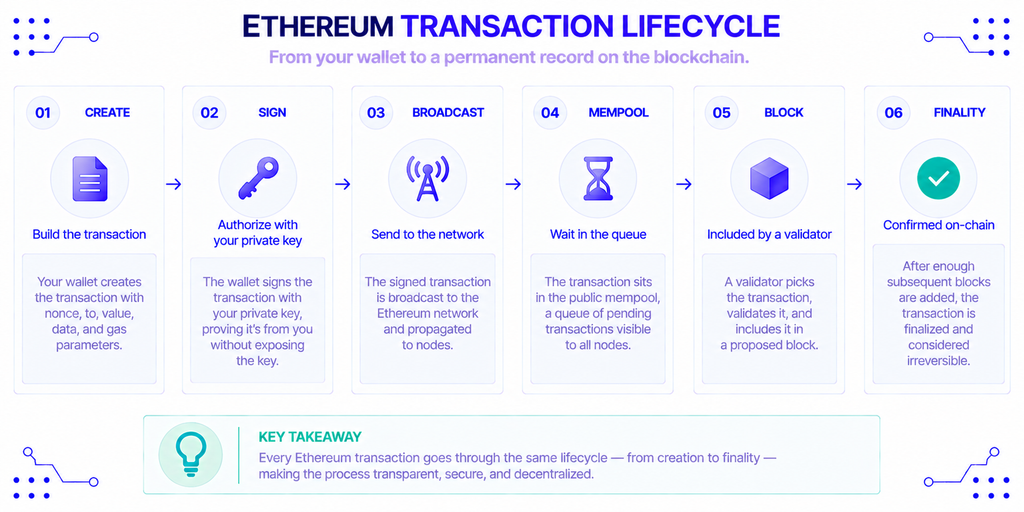
Every transaction, regardless of type, moves through the same sequence of steps before it’s considered final.
- Creation. Your wallet builds the transaction object — nonce, recipient, value, data, and gas parameters.
- Signing. The wallet signs it with your private key, producing the v, r, s values that prove you authorized it without ever exposing the key itself.
- Broadcasting. The signed transaction is sent to the network and lands in the mempool, a public holding area of transactions waiting to be included in a block.
- Inclusion. A validator picks it up, checks it against current state, and bundles it into a proposed block.
- Finality. Once enough subsequent blocks confirm on top of it, the transaction is considered irreversible under Ethereum’s finality rules.
That mempool step is worth pausing on. It’s public — any node connected to the network can see a pending transaction before it’s confirmed, which is exactly the visibility window that MEV bots exploit to front-run or sandwich a large trade sitting in the queue.
How Much Does an Ethereum Transaction Cost?
Every transaction costs gas, and gas costs ETH. A simple ETH transfer between two accounts uses a fixed 21,000 gas units; a smart contract interaction can use anywhere from tens of thousands to well over a million, depending on how much computation it triggers.
The actual fee works out to gas used × (base fee + priority fee). At a 0.065 gwei base fee and a 0.001 gwei tip — roughly where Ethereum mainnet sat in mid-September 2026, per Etherscan’s gas tracker — a plain transfer costs about 0.0000014 ETH, a fraction of a cent. That’s a dramatic drop from Ethereum’s earlier years, when double-digit gwei base fees were routine and a single swap could cost several dollars.
Vitalik Buterin has been explicit about where he thinks that number needs to land for Ethereum to work at real-world scale. “Needs to get under $0.05 to be truly acceptable imo,” he said on the Bankless podcast, adding that scaling upgrades were making “great progress” toward that target. Most of that progress has actually landed on Ethereum’s Layer 2 rollups rather than the mainnet itself, where activity — and fee pressure — has increasingly shifted.
Why Do Ethereum Transactions Fail?
A transaction can fail even after it’s confirmed and included in a block — and here’s the part that surprises people: you still pay gas for a failed transaction, because the network did real computational work checking it before it reverted.
The most common causes are running out of gas mid-execution, a smart contract’s logic explicitly reverting the call (an unmet condition in a swap, for instance), or a nonce that’s out of sequence with the account’s transaction history. Wallets and dashboards can catch most of this in advance by simulating a transaction against current network state before ever broadcasting it for real — a quick, gas-free check that shows exactly what would happen without the cost of finding out the hard way.
How Do Applications Actually Send and Read Transactions?
Behind every wallet, exchange, and dApp sits a piece of infrastructure that talks to the Ethereum network directly: an RPC node. When you hit “confirm” in MetaMask, the wallet doesn’t broadcast your transaction into the void — it sends it to an RPC endpoint, which relays it to the network and reports back the transaction hash.
That’s the layer where a provider like NOWNodes fits in. It gives developers RPC access to Ethereum — reading balances, checking transaction status, or broadcasting a signed transaction — without the team running and syncing its own Ethereum node, alongside the same kind of access across 120-plus other blockchain networks. Whether an application needs it is purely a question of scale: a hobby project can call a public endpoint directly, while a wallet or exchange serving real transaction volume needs dedicated, metered access it can rely on.
Conclusion
An Ethereum transaction is a signed, structured request to change shared state — move ETH, call a contract, or deploy new code — and every wallet click, swap, and mint ultimately compiles down to one. The mechanics that matter in practice are the ones covered here: what fields go into a transaction, which of the five current types it uses, how gas actually gets priced, and why a transaction can still fail after real money’s been spent checking it.
None of that complexity is optional overhead. It’s what lets a network with no central authority agree, block after block, on a single shared version of who owns what.
FAQ
What’s the difference between a transaction hash and a transaction?
A transaction is the full signed object — sender, recipient, value, data, and signature. A transaction hash is a short, unique fingerprint of that object, generated by hashing it, and it’s what you actually search for on a block explorer to look up a transaction’s status.
Can an Ethereum transaction be canceled or reversed?
Not once it’s confirmed on-chain — Ethereum has no reversal mechanism. Before confirmation, a pending transaction can sometimes be replaced by broadcasting a new one with the same nonce and a higher fee, which is what wallets mean by “speed up” or “cancel.”
How long does an Ethereum transaction take to confirm?
A transaction typically gets included in a block within 12 to 15 seconds if the fee is competitive, but full finality — the point at which reversal becomes practically impossible — takes closer to 15 minutes under Ethereum’s current consensus rules.
Do you need ETH to send any transaction, even a token transfer?
Yes. Gas is always paid in ETH, regardless of which token or contract the transaction interacts with, so a wallet holding only USDC or another ERC-20 token still needs a small ETH balance to cover the fee.
What happens to unused gas from a gasLimit?
It’s refunded. A transaction only pays for the gas it actually consumes; setting a gasLimit higher than necessary is a safety margin, not an extra cost, as long as the transaction succeeds.