Liquid staking lets you earn staking rewards on your crypto without locking the coins away and losing access to them. You deposit an asset like ETH, a protocol stakes it for you, and in return you get a new token that represents your deposit plus the rewards it earns. That token stays in your wallet, and you can trade it, lend it, or use it as collateral — all while the original coins keep working behind the scenes. In plain terms, it takes the one big downside of normal staking — your money sits frozen — and removes it. That single change is why liquid staking grew into one of the largest sectors in all of decentralized finance, with more than $40 billion locked across protocols by mid-2026, according to DeFiLlama.
How Ordinary Staking Works First
To see what problem this solves, start with regular staking. Proof-of-stake networks like Ethereum are secured by validators — participants who lock up coins as a financial guarantee that they’ll follow the rules. Behave honestly and you earn rewards. Act maliciously or go offline, and part of your stake gets “slashed,” or taken away as a penalty.
Here’s the catch. To run your own validator on Ethereum, you need exactly 32 ETH — worth well over $100,000 at 2026 prices. Since the Pectra upgrade, a single validator can hold up to 2,048 ETH, but that 32 ETH floor to get started hasn’t moved. For most people, that’s simply out of reach.
The bigger issue is what happens after you stake. Those coins are locked. You can’t sell them, you can’t spend them, and you can’t put them to work anywhere else. Your capital earns a modest yield — base rewards run around 2.8% a year, closer to 3.5–4% once MEV is factored in — but it’s completely stuck. And with roughly 30% of all ETH staked as of 2024, per Ethereum co-founder Vitalik Buterin, that’s a lot of frozen capital sitting idle.
How the Model Frees Up Locked Coins
This is the gap the whole idea was built to close. Instead of staking directly and waiting, you hand your coins to a protocol that stakes them on your behalf. The moment you deposit, it mints and sends you a brand-new token — a receipt that proves you own the staked asset and everything it earns.
That receipt is the key. It’s transferable, so it behaves like any other token in your wallet. You can hold it, swap it on an exchange, drop it into a lending pool, or use it as collateral to borrow against. Meanwhile, your underlying deposit stays staked and keeps accruing rewards, which flow into the value of the receipt token over time.
Liquid staking token (LST): a tradable token minted by a staking protocol when a user deposits an asset. It represents a claim on the staked coins plus accrued network rewards, and can be transferred or used across DeFi while the original assets remain staked.
So you end up earning in two places at once. The base staking reward accrues to your receipt token, and you can layer a second yield on top by putting that same token to work elsewhere. If you’ve ever searched what is liquid staking crypto, this is the payoff: your capital stops being dead weight and becomes something you can actually build on.
The Process, Step by Step
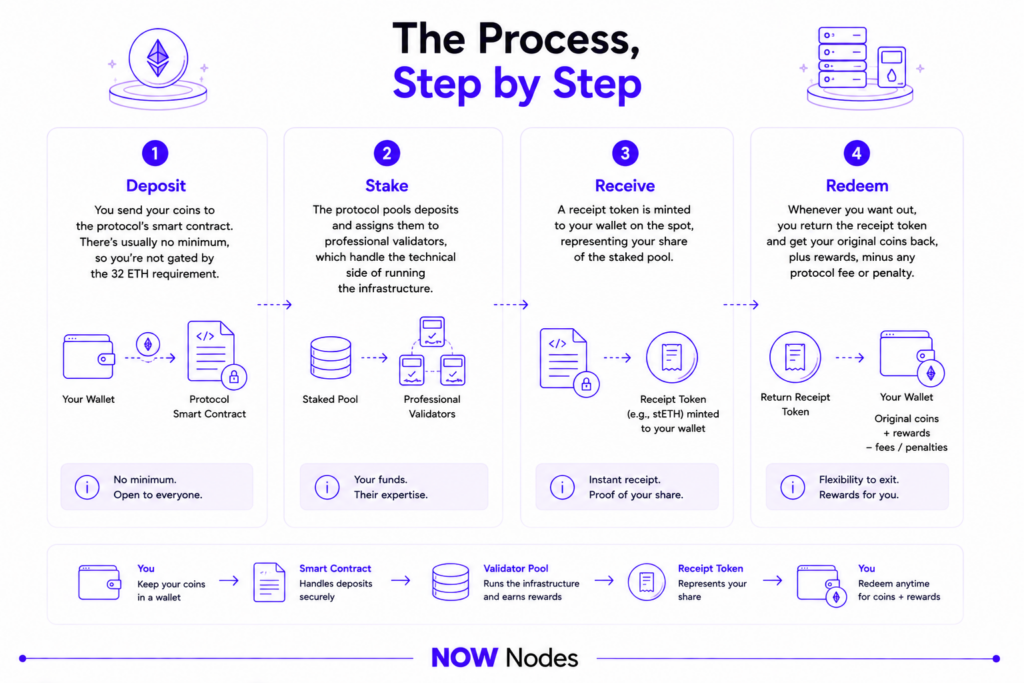
The mechanics are simpler than the jargon suggests. Nearly every liquid staking protocol follows the same four-step loop, whether you’re staking ETH, SOL, or another proof-of-stake coin.
- Deposit — you send your coins to the protocol’s smart contract. There’s usually no minimum, so you’re not gated by the 32 ETH requirement.
- Stake — the protocol pools deposits and assigns them to professional validators, which handle the technical side of running the infrastructure.
- Receive — a receipt token is minted to your wallet on the spot, representing your share of the staked pool.
- Redeem — whenever you want out, you return the receipt token and get your original coins back, plus rewards, minus any protocol fee or penalty.
This is critical to understand: you never lose exposure to your rewards while your token is out earning elsewhere. The receipt keeps accruing value even as you lend or trade it, which is exactly the “capital efficiency” that makes the model so popular.
Three Ways to Stake, Compared
Liquid staking isn’t the only option, and it isn’t always the right one. It helps to line it up against the two traditional routes: running your own validator (solo staking) and handing coins to a custodial service such as an exchange (pooled or centralized staking).
| Solo staking | Custodial / pooled staking | Liquid staking | |
|---|---|---|---|
| Entry requirement | 32 ETH + hardware | Any amount | Any amount |
| Who controls the keys | You | The provider | The protocol (non-custodial) |
| Access to your capital | Locked | Usually locked | Freed via a receipt token |
| Use in DeFi | No | No | Yes |
| Technical effort | High | None | None |
| Main trade-off | Cost and complexity | You trust a custodian | Smart contract and market risk |
Solo staking gives you the most control and the full reward, but it’s expensive and demanding. Custodial staking is easy but hands control to a third party. Liquid staking sits in between — low effort, no minimum, and the added bonus that your position stays usable. The price of that flexibility is extra risk, which we’ll get to.
Why Investors Choose It

The appeal comes down to putting idle money back to work. Here are the reasons that come up most often.
Unlocked liquidity. Your staked value is no longer frozen. The receipt token can be sold or moved at any time, so you’re not forced to choose between earning rewards and keeping your funds accessible.
Composability across DeFi. Because the receipt is a standard token, it plugs into the wider ecosystem. You can supply it to lending markets like Aave, pair it in liquidity pools, or use it as collateral — stacking yield on top of your base rewards.
No high barrier to entry. You don’t need 32 ETH or any hardware. Deposit whatever amount you have and you still share in validator rewards, which opens staking to people who were priced out before.
Outsourced infrastructure. Professional operators handle uptime, key management, and upgrades. You get the reward without babysitting a machine that has to stay online around the clock.
Who actually uses all this? Retail holders who want yield without the 32 ETH hurdle. Active DeFi users chasing capital efficiency. And increasingly, institutions and corporate treasuries — providers such as Liquid Collective built their LsETH token specifically to meet enterprise compliance needs.
Which Providers Lead the Market?
A handful of protocols dominate. The biggest by a wide margin is Lido, whose stETH token accounts for roughly a quarter of all staked ETH and close to half of the entire liquid staking sector. Behind it sit decentralized alternatives, exchange-issued tokens, and multi-chain options.
| Provider | Token | Network(s) | Notable trait |
|---|---|---|---|
| Lido | stETH | Ethereum, others | Market leader; deepest liquidity |
| Rocket Pool | rETH | Ethereum | Decentralized; permissionless operators |
| Coinbase | cbETH | Ethereum | Exchange-backed, custodial |
| Binance | WBETH | Ethereum | Exchange-backed, custodial |
| Liquid Collective | LsETH | Ethereum, Solana | Built for institutions |
| Jito | JitoSOL | Solana | Leading Solana LST |
There’s a real design split here worth knowing. Decentralized protocols like Rocket Pool are non-custodial — no single company holds your coins, and anyone can run a validator for the network by staking as little as 8 ETH plus RPL collateral. Centralized providers, mostly exchanges, are custodial: convenient, but they control the assets. Decentralized options carry smart contract risk; custodial ones carry counterparty risk. Neither is free of trade-offs, which is the running theme of this whole space.
What Are the Risks?
No yield comes without strings. Before depositing anywhere, weigh these four risks honestly.
Slashing Passes Through to You
When you use a liquid staking protocol, you’re outsourcing validator duties to someone else. If that operator misbehaves or suffers an outage, the resulting slashing penalty is shared among depositors — including you. You’re trusting the protocol’s operators to run clean infrastructure.
Smart Contract Exploits
Your coins sit inside code. A bug in the protocol’s contracts, or a compromised operator key, can put deposited funds at risk. This is why audits and a long track record matter more than a slightly higher advertised yield.
The Token Can Trade Below Its Peg
A receipt token isn’t hard-pegged to the asset it represents — its price is set by the market. Most of the time it tracks closely, but during a liquidity crunch it can slip. In June 2022, as Celsius and Three Arrows Capital unraveled, stETH fell to roughly 0.93–0.95 ETH — a discount of 5% to 8%. Direct redemptions weren’t live back then, so arbitrage couldn’t close the gap; today, with withdrawals enabled, pegs generally hold much tighter, but the risk hasn’t vanished.
Centralization Is the Quiet, Bigger Worry
When one protocol controls a huge share of staking, it becomes a systemic risk to the network itself. This is a concern Vitalik Buterin has flagged directly. In his October 2024 roadmap post “The Scourge,” he wrote:
“One of the biggest risks to the Ethereum L1 is proof-of-stake centralizing due to economic pressures… A single liquid staking token could take over the bulk of the stake and even taking over ‘money’ network effects from ETH itself.”
That’s the tension at the heart of the sector. The same convenience that draws users toward the biggest provider is what makes that provider’s dominance a problem. Spreading deposits across smaller, decentralized options is one way holders can push back.
What Comes Next: Restaking
Once receipt tokens existed, builders found a way to squeeze even more out of them. Restaking lets you take a staked asset or its receipt token and pledge it a second time to help secure other protocols, earning an extra layer of rewards. Do this through a liquid restaking service and you get yet another token — a liquid restaking token, or LRT — that represents the twice-staked position.
The growth was explosive. Liquid restaking value locked jumped from about $284 million to roughly $17 billion over the course of 2024, driven largely by EigenLayer on Ethereum. The upside is more yield from the same capital; the downside is more risk stacked on top of more risk. It’s the frontier of the space, and not a place for beginners.
This layering is also why staking protocol development has become a specialized field. Any team building a liquid staking protocol — or simply wiring an existing receipt token into a lending app — needs a stable connection to the underlying network to read balances, track rewards, and broadcast transactions. Most teams rent that plumbing rather than run it themselves; a provider like NOWNodes supplies the RPC access so builders can focus on contract logic instead of infrastructure.
The Bottom Line
Liquid staking answers a simple frustration: why should staked coins have to sit frozen? By minting a tradable receipt token the moment you deposit, it lets you keep earning validator rewards while your capital stays free to move through DeFi. That combination — yield plus liquidity, with no 32 ETH minimum — is why the sector holds tens of billions of dollars and keeps growing.
Just go in with clear eyes. You’re trading some safety for that flexibility: smart contract risk, possible price slippage on the receipt token, and the broader centralization question that even Ethereum’s founder keeps raising. Pick audited protocols, understand what you’re holding, and consider spreading your stake. Used carefully, liquid staking is one of the more genuinely useful tools in crypto. Used carelessly, it’s just another way to be surprised by risk you didn’t price in.
FAQ
Can I unstake anytime, or is there a waiting period?
You have two exits. You can redeem through the protocol, which can take anywhere from minutes to several days depending on the network’s validator exit queue, or you can sell the receipt token instantly on an exchange at its current market price without waiting.
What’s the difference between liquid staking and restaking?
Liquid staking secures one network and gives you a receipt token. Restaking takes that already-staked asset and pledges it a second time to secure other protocols for extra yield, producing a separate liquid restaking token (LRT). Restaking stacks more reward and more risk on the same capital.
Do you still earn rewards if you sell or lend the receipt token?
Yes. The staking rewards accrue to the token itself, so whoever holds it benefits even while it’s deposited in a lending market or trading hands. That dual-earning ability is the main draw of the model.
Can you lose money with liquid staking?
Yes. A protocol exploit, a slashing event, or a sharp discount on the receipt token during a liquidity crunch can all leave you with less than you put in. The rewards are real, but they are not risk-free.