

One morning in September 2020, hundreds of thousands of people opened their wallets to find 400 UNI tokens they never asked for. It was a gift from Uniswap — worth roughly $1,200 that day, and about $16,800 for anyone who held to the token’s peak the following spring, when UNI traded near $42. That single event turned “airdrop” into one of the most searched words in crypto.
Since then, free token distributions have handed out billions. But there’s a darker mirror image. Chainalysis estimates on-chain scams pulled in at least $14 billion in 2025, and a large share of that starts with a fake “claim your airdrop” page.
So consider this your airdrop guide for 2026 — built to take you from the basics to the fine print. Here’s the plan: what a crypto airdrop actually is, why projects give tokens away, how to find the ones worth your time, and the part that matters most, how to claim without handing your wallet to a scammer.
What Is a Crypto Airdrop?
Let’s start simple, then build up.
Crypto airdrop: a distribution of free tokens sent directly to blockchain wallet addresses — usually to reward early users of a protocol, bootstrap a new community, or spread ownership of a token more widely.
At its core, an airdrop is a marketing and distribution tool. A project mints a token, decides which wallets deserve a share — often based on past activity — and sends it out, either automatically or through a claim page you visit yourself.
The tokens are free to receive, but they’re rarely free of strings. Most airdrops reward things you did earlier: swapping on a decentralized exchange, bridging funds, testing a new network, or holding another token on a specific snapshot date. Here’s the catch that trips up beginners — you usually have to earn eligibility before anyone announces the drop.
Why Projects Give Away Free Tokens
Handing out money sounds like a strange business move, so here’s the logic. A new protocol needs three things fast: users, attention, and a token spread across many holders instead of concentrated in a few hands. An airdrop buys all three at once.
Rewarding early users also builds loyalty and decentralizes governance, since many airdropped tokens carry voting rights. And there’s a competitive edge to it. When Uniswap distributed UNI, it was partly a response to a rival exchange that had started luring away its liquidity with token incentives — the airdrop kept users loyal.
The result reshaped how tokens launch. According to CoinGecko’s 2024 annual report, 36 notable airdrops that year added over $20 billion to the total crypto market cap. That’s proof “free” tokens move real money.
The Main Types of Airdrops
Not every airdrop works the same way, and knowing the categories helps you spot which ones are worth chasing. These are the formats you’ll run into most.
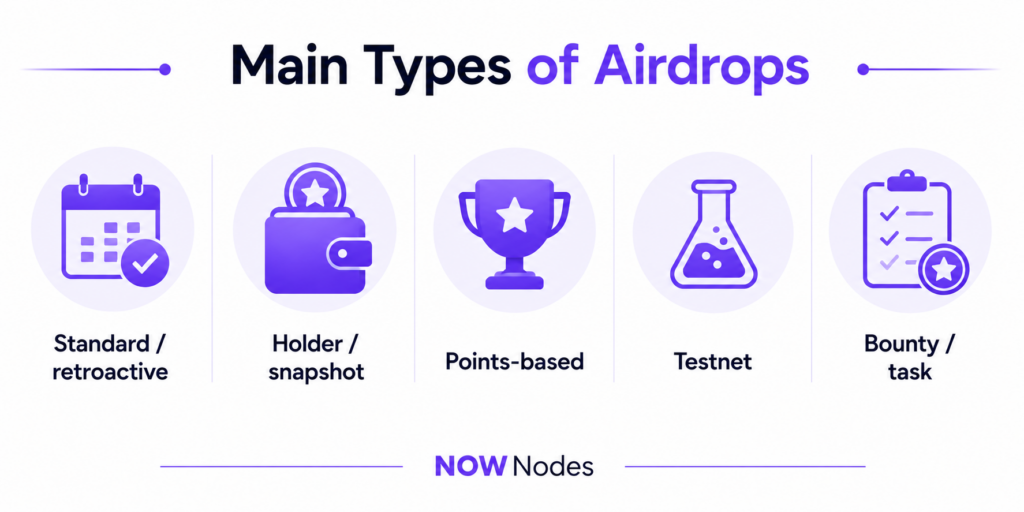
| Type | How it works | Example |
|---|---|---|
| Standard / retroactive | Tokens sent to past users after a snapshot of activity | Uniswap (UNI) |
| Holder / snapshot | Tokens sent to holders of another asset on a set date | Spark to XRP holders |
| Points-based | You earn visible points for on-chain activity that convert to tokens at launch | Hyperliquid (HYPE) |
| Testnet | Rewards for testing a network before it goes live on mainnet | Various Layer 2s |
| Bounty / task | Tokens for completing promotional tasks like referrals or social posts | Many smaller projects |
| Hard-fork | New coins created when a blockchain splits into two | Bitcoin Cash |
The Points Era
One format now dominates the scene, so it’s worth understanding well. Since 2024, most major projects have replaced the surprise retroactive drop with points programs. You trade, stake, provide liquidity, or bridge, and you earn a running score that converts to tokens at the token generation event (TGE).
The appeal is transparency — you can watch your points climb and adjust your strategy in real time. The downside is dilution: every new farmer who piles in makes each point worth a little less, which is why getting in early beats grinding late. Hyperliquid set the template in late 2024, distributing 31% of its supply to more than 94,000 users based on trading points, in what became the most valuable airdrop to date.
How to Find Airdrops Worth Your Time
This is where most guides wave their hands, so let’s be specific. Finding good airdrops is less about secret lists and more about being active on promising projects before they have a token.
Where to Look
Start with the projects themselves. Follow official accounts on X and Discord, and treat those as your only source of truth for claim links — never a link from a DM or a stray reply. Trackers like CoinGecko, Airdrops.io, and DeFiLlama aggregate confirmed and rumored drops in one place.
The sharpest signal is funding. There’s a rule of thumb among farmers: follow the venture capital. A chain or protocol that has raised serious money but hasn’t launched a token is a prime candidate, because a token is often exactly how it rewards early users down the line.
How to Actually Qualify
Eligibility usually comes down to genuine, sustained use — not a single transaction the day before a snapshot. Projects increasingly filter out “Sybil” wallets, where one person runs dozens of addresses to farm multiple allocations, so spreading thin across fake accounts tends to backfire.
Two habits raise your odds. First, use products you’d use anyway, consistently, over weeks or months. Second, when a project runs a testnet, take part — testnet activity is a common eligibility path, and you can rehearse the whole flow on a testnet first without risking a cent of real money.
How to Claim an Airdrop Safely
Here’s the part that separates a good day from a drained wallet. The mechanics of claiming are simple; the security discipline around them is everything.
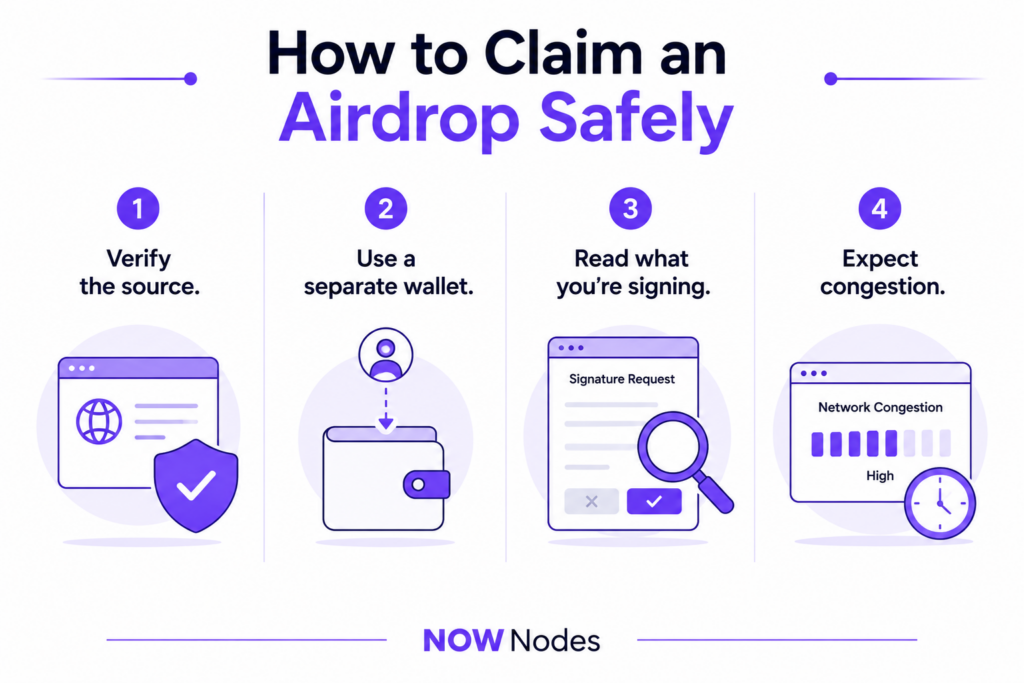
The Basic Claim Steps
- Verify the source. Confirm the token and the claim URL through the project’s official channel, and cross-check it in more than one place before connecting anything.
- Use a separate wallet. Connect a burner wallet you keep only for this kind of activity, never the one holding your main assets.
- Read what you’re signing. A legitimate claim is just a claim. It should not ask for open-ended permission to spend your other tokens.
- Expect congestion. When a major drop opens, everyone rushes at once — plan for slow confirmations.
That last point is easy to underestimate. When a big airdrop goes live, thousands of people try to claim in the same few minutes, public endpoints get overloaded, and claim transactions stall or fail outright. If you’re claiming at scale or building a tool to check eligibility across several wallets, a stable connection to the network matters more than people expect — a lagging or dropped connection can mean a missed window.
The Scam You Actually Need to Fear
Now the critical part. The number-one way people lose money to fake airdrops isn’t a stolen password — it’s approval phishing. You land on a convincing “claim” page, connect your wallet, and click approve on what looks like a routine transaction. Hidden inside is permission for a stranger to move your tokens whenever they like.
Chainalysis tracks this at scale, and its investigators describe why the trap keeps paying off. As one Chainalysis investigator puts it, “one case is never just one” — scammers reuse the same wallets, approval contracts, and cash-out routes across thousands of victims. And blockchain transactions are irreversible: once the approval is signed and the funds move, there’s no undo button.
The scale is sobering. Chainalysis estimates on-chain scams took in at least $14 billion in 2025, with the average payment to a scam address jumping 253% year over year — from $782 to $2,764 — as AI-generated fakes made the lures far more convincing.
Walk away immediately if an “airdrop” ever:
- Asks for your seed phrase or private key — no legitimate airdrop ever does.
- Requires an upfront payment or “gas fee” to unlock a claim.
- Reaches you through an unsolicited DM, reply, or lookalike domain.
- Pushes urgency — “claim in the next 10 minutes or lose it.”
- Requests a token approval far larger than the claim itself.
The single rule that protects you: a real airdrop gives you tokens, it never needs access to what you already hold. When in doubt, revoke old wallet approvals regularly and keep your farming activity walled off in a burner.
Don’t Forget the Tax Bill
Here’s the detail almost everyone misses, and it’s an expensive one. In the US, the IRS treats airdropped tokens as ordinary income at their fair market value the moment you gain “dominion and control” — meaning the instant you can move, sell, or swap them.
You report that value as “Other income” on Form 1040 Schedule 1, and it becomes your cost basis going forward. This is critical because of the timing trap: if you receive $10,000 of tokens and they crash to $1,000 before you sell, you still owe income tax on the original $10,000.
Rules vary by country, and the IRS hasn’t issued guidance covering every airdrop scenario, so none of this is tax advice — check your local rules or a professional before filing. But the principle holds almost everywhere. Free tokens are taxable when received, and again as capital gains when you sell.
Conclusion
Strip away the hype and a crypto airdrop is a simple bargain. Projects give away tokens to win users, attention, and a wider base of holders, and you receive them for being early and active. The upside is real — Uniswap and Hyperliquid turned ordinary users into holders of five- and six-figure allocations.
But the same feature that makes airdrops exciting makes them a favorite disguise for scammers, and $14 billion in 2025 losses is the reminder that speed and greed are exactly what they exploit. Approach airdrops the way experienced hunters do: use good projects you actually believe in, keep your real assets in a separate wallet, verify every claim link, never sign away token approvals, and set something aside for the tax bill.
Do that, and airdrops are one of the few corners of crypto where showing up early genuinely pays. Do it carelessly, and “free money” becomes the most expensive lesson you’ll learn.
FAQ
What is a crypto airdrop?
It’s a distribution of free tokens sent directly to wallet addresses, usually to reward early users, build a community, or spread ownership of a new token. You typically qualify by using a protocol before it launches its token, then receive the tokens automatically or through a claim page.
Are airdrops really free money?
Free to receive, but not free of catches. You usually have to earn eligibility through past activity, you owe tax on the value when you get them, and many “airdrops” are outright scams. A real distribution costs you nothing to claim — if one asks for payment or your seed phrase, it’s a trap.
How do I find legitimate airdrops in 2026?
Be genuinely active on promising projects that haven’t launched a token yet, follow their official X and Discord channels, and use trackers like CoinGecko or DeFiLlama. A useful signal is funding: well-funded protocols without a token are strong candidates, since a token is often how they reward early users.
How do I claim an airdrop safely?
Verify the claim link through the project’s official channel, connect a burner wallet rather than your main one, and read every transaction before signing. Never approve open-ended spending permissions, and never share your seed phrase — a legitimate claim only sends you tokens, it never needs access to your existing funds.
Do I have to pay tax on airdrops?
In most jurisdictions, yes. The IRS treats airdropped tokens as ordinary income at their fair market value when you gain control of them, reported on Form 1040 Schedule 1. You may also owe capital gains tax when you later sell. Rules differ by country, so confirm your local treatment.
Why do projects run airdrops?
To grow fast. An airdrop attracts users, generates buzz, decentralizes token ownership and governance, and rewards the early community all at once — often more cheaply than paid marketing. It can also be a defensive move to keep users from switching to a competitor.
What’s the biggest crypto airdrop ever?
Hyperliquid’s HYPE distribution in November 2024, which sent 31% of the token’s supply to more than 94,000 users and overtook Uniswap’s 2020 UNI airdrop as the most valuable on record.