
A decentralized exchanges let you swap one cryptocurrency for another straight from your own wallet, with no company holding the funds in between. No sign-up, no deposit, no waiting on a support ticket if something goes wrong — just a wallet connection and a signed transaction. That model has grown from a niche experiment into a meaningful share of all crypto trading: DEX spot volume hit 24% of centralized exchange volume in July 2026, up from 17% a year earlier, according to The Block.
When people search for a “DEX exchange” or the top decentralized exchanges to trade on, they’re usually trying to compare exactly this kind of platform against the alternatives. This guide ranks the decentralized crypto exchanges that actually carry that volume today — spot-trading leaders like Uniswap and PancakeSwap, derivatives platforms like Hyperliquid, aggregators like 1inch, and cross-chain tools like THORChain. It starts with the basics — what qualifies as a DEX and who actually trades on one — then works through how to pick a platform and what runs underneath the interface.
What Makes a Trading Platform “Decentralized”?
A decentralized exchanges, or DEX, run on smart contracts: self-enforcing code deployed on a blockchain that lets two people trade tokens directly, with no company holding either side of the trade. You connect a wallet, the contract prices and executes the swap, and the new tokens land back in your wallet within seconds. Nobody approves the trade, and nobody can freeze it once it’s confirmed. (You’ll also see it spelled “decentralised crypto exchange” outside the US — same mechanics, different spelling.)
That’s a different experience from most people’s first crypto trade, where an exchange holds the balance in its own database until you withdraw. On a decentralized crypto exchange, your wallet never gives up custody — the contract just moves tokens directly between addresses. Because the decentralized exchange software behind most platforms is open-source, competing front ends frequently plug into the exact same liquidity pools rather than building their own from scratch.
For the full mechanics of how a swap settles on-chain, NOWNodes’ guide to what a DEX is breaks the process down step by step. Uniswap, PancakeSwap, and Curve are common examples of decentralized exchanges built on this model, and more than 700 platforms are actively tracked for trading volume on CoinGecko alone.
Why Traders Choose Permissionless Trading
The core appeal of a decentralized trading platform is straightforward: nobody but you can move your funds. When an exchange holds customer deposits, those funds are only as safe as the company managing them, and that company can pause withdrawals, freeze accounts, or collapse entirely, taking customer balances down with it.
Decentralized Exchanges remove that single point of failure by design. The smart contract that runs the trade has no “pause withdrawals” button and no management team that can decide to stop honoring requests. That’s not just a hypothetical — exchange failures still happen, and they’re not rare.
Access is the second reason. Anyone with a wallet and an internet connection can trade — no identity check, no account approval, no waiting period. New tokens routinely launch on a DEX first, often weeks before a centralized platform lists them.
The market has backed this trade-off with real money. The DEX-to-CEX volume ratio climbed from 17% to a record 24% over the twelve months to July 2026, even as centralized spot volume shrank, per The Block. That’s not a one-off spike. It’s a multi-year shift in where trading activity actually happens.
Who Relies on Permissionless Trading Venues?
Different groups turn to a crypto DEX for different reasons:
- Active traders chasing newly listed tokens before they reach a centralized exchange, often using bots to catch a liquidity pool the moment it opens.
- Liquidity providers who deposit token pairs into a pool and earn a share of every trade’s fee, effectively renting out capital to the market.
- DeFi builders who plug swaps directly into lending markets, yield vaults, or structured products that never touch a centralized platform.
- Traders in restricted regions where centralized exchanges are slow to onboard, geo-blocked, or unavailable entirely.
- Institutions and treasuries that want on-chain settlement and a public, auditable trade history instead of an off-chain ledger.
That range is wider than most people assume going in. A beginner swapping stablecoins and a quant fund running automated strategies rely on the exact same underlying infrastructure, just through very different interfaces.
How Do These Protocols Execute a Trade?
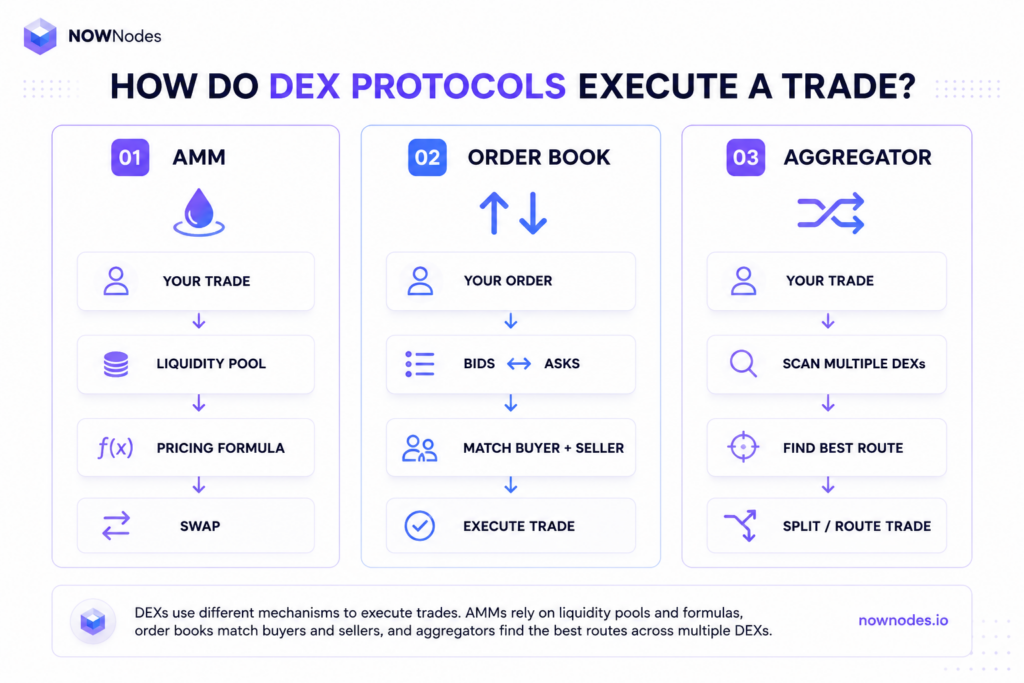
Most DEX trading falls into one of three designs: automated market makers, on-chain order books, or aggregators that combine both. Each matches a buyer with a seller in a different way.
Automated Market Makers
An automated market maker, or AMM, replaces order matching with a liquidity pool and a pricing formula.
Automated market maker (AMM): a pricing mechanism that lets a trade execute against pooled funds instead of a matched order, using a formula that moves the price as the pool’s balances shift. See Uniswap’s own explanation of the model.
Uniswap popularized the design and still runs on it today, processing $42.9 billion in swaps over the 30 days to mid-August 2026, according to DefiLlama. Hayden Adams, the protocol’s founder, has pushed back hard on claims that the model is losing ground to order books:
“AMMs are only just getting started.” — Hayden Adams, Uniswap founder, January 2026
Adams points to lower capital requirements and composability — the ability for other DeFi protocols to plug straight into a pool — as the model’s lasting edge over order-book alternatives.
Order Books and Derivatives Platforms
Some platforms skip pooled liquidity entirely and match bids and asks directly, closer to how a traditional exchange works. This approach needs a fast, cheap chain to stay practical, since posting and canceling orders costs gas every time.
This is where decentralized derivatives exchanges live. Hyperliquid, built on its own dedicated chain, processed more than $208 billion in perpetual futures volume over 30 days — more than the entire $159 billion spot DEX market combined, per DefiLlama and altfins. Spot and perpetuals are tracked as separate markets, but the gap shows how fast leveraged on-chain trading has grown. dYdX and GMX run similar order-book and pooled-collateral models for leveraged positions.
Aggregators That Route Across Pools
A third category doesn’t hold any liquidity at all. Tools like 1inch on Ethereum and Jupiter on Solana scan dozens of pools simultaneously and split a trade across whichever combination gives the best net price after fees and slippage, the cost of moving a large order against a limited pool. For anyone who doesn’t want to manually check five different DEX platforms before trading, an aggregator is usually the simplest way to get a fair rate.
This aggregation approach is also used by broader crypto services aggregators. Swapzone brings together offers from different crypto exchange providers and includes a dedicated DEX section, where users can compare offers from multiple decentralized exchanges. Users can select an offer and complete the swap directly through the Swapzone interface, without having to leave the site to use a separate DEX interface. This adds another way to find and compare options to swap crypto, while giving those searching for a crypto swap exchange a wider selection of services in one place.
Comparing the Leading Platforms by Volume
The table below is a working list of decentralized exchanges ranked by the volume they actually process, not just name recognition. The whole DEX ecosystem moved roughly $159 billion over the 30 days to mid-August 2026, spread across hundreds of platforms, but a small handful carry most of it, per DefiLlama.
| Platform | Chain(s) | Model | 30-day volume / TVL* | Fee |
|---|---|---|---|---|
| Uniswap | 47 chains incl. Ethereum, Base, Arbitrum | AMM | $42.9B volume (26.9% share) | 0.05%–1% |
| PancakeSwap | BNB Chain + 8 others | AMM | $20B–27B volume | ~0.25% |
| Hyperliquid | Dedicated L1 | Order book (perps) | $208B+ perp volume | 0.01%–0.035% |
| Aerodrome | Base | AMM | $10.4B volume (6.5% share) | ~0.2% |
| Curve Finance | 27 chains | AMM (stablecoins) | $2.1B–2.7B TVL | ~0.04% |
| Swapzone | Multichain | Crypto services aggregator | Aggregates offers | Varies |
| 1inch | Ethereum + multichain | Aggregator | Routes across all above | Network fee only |
| Jupiter / Raydium / Orca | Solana | Aggregator / AMM | Dominant on Solana | Varies |
| THORChain | Cross-chain | Native swap | Wrapping-free swaps | ~0.1%–0.3% |
Spot-Trading Leaders
Uniswap holds close to a third of all DEX spot volume and runs on more chains than any competitor, which is why it’s usually the default answer to “what’s the best DEX” or “best decentralized exchange.” PancakeSwap leads on BNB Smart Chain specifically, where lower gas costs suit smaller, more frequent trades — worth knowing if you’re also weighing Ethereum against BNB Smart Chain as networks. Aerodrome plays the same role on Base, and Curve remains the reference point for swapping stablecoins with minimal slippage.
Derivatives and Perpetuals
Perpetual futures on decentralized platforms have grown into a category of their own, and Hyperliquid’s volume now regularly rivals or exceeds the entire spot DEX market. That’s a real shift from a few years ago, when order-book trading at this scale only worked on centralized platforms. GMX and dYdX cover similar ground with different trade-offs in fee structure and collateral requirements.
Aggregators and Cross-Chain Swaps
1inch and Jupiter don’t compete with Uniswap or Raydium so much as sit on top of them, splitting orders to find the best combined price. THORChain solves a different problem: swapping native assets like BTC directly for ETH without wrapping either one, using its own cross-chain liquidity network instead of a bridge.
How to Pick the Right Venue for Your Trades
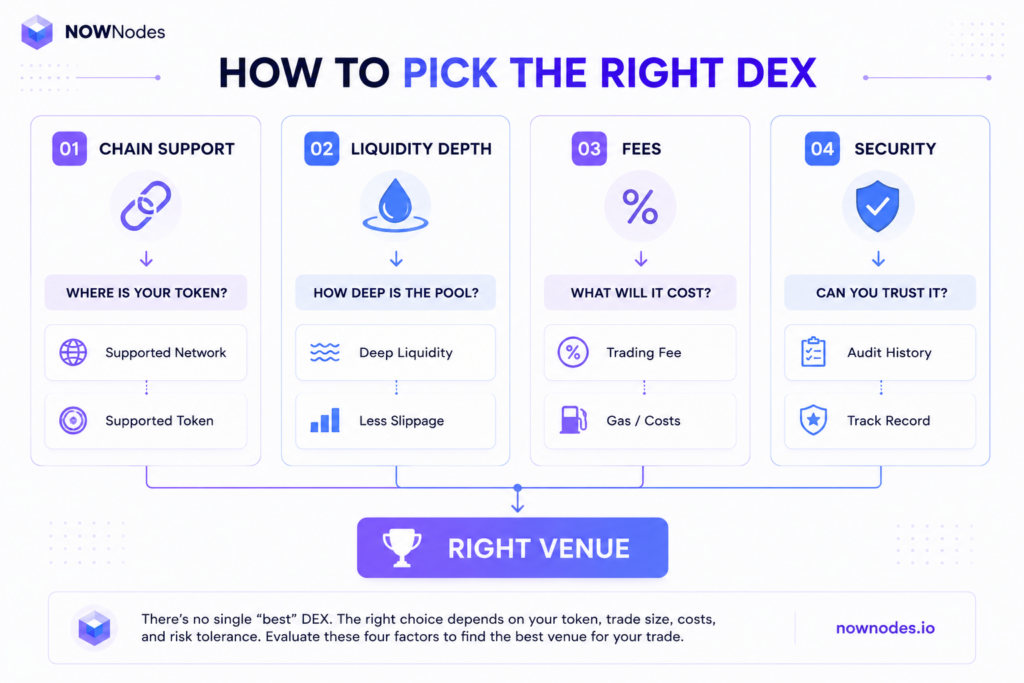
There’s no single best DeFi crypto exchange for every situation — the right pick depends on what you’re trading and where. Four factors matter more than the rest.
Chain support comes first: a Decentralized Exchange only works with tokens that live on the chains it supports, so choosing a platform is really choosing a blockchain. Liquidity depth matters just as much, since a thin pool lets a large order move the price against you before it fully fills. Fees vary meaningfully between a 0.01% perpetuals platform and a 1% long-tail AMM pool, and the gap compounds fast for active traders.
Finally, check audit history before trusting any platform with real money. A protocol reviewed by an established security firm, with years of uptime and no major exploit, carries less risk than a new fork running unaudited code — see this breakdown of smart contract auditing firms for how that review process actually works.
What Are the Trade-Offs and Risks?
Self-custody cuts both ways. Full control over your funds also means full responsibility, with no support line to call if a transaction goes wrong.
The biggest risks cluster around a few patterns: scam tokens with no real liquidity behind them, smart contract bugs in newer or unaudited protocols, and slippage on thin pools during volatile markets. Liquidity providers face a separate risk called impermanent loss, where a pool’s automatic rebalancing leaves them with less value than simply holding the two tokens outright.
None of this makes a decentralized platform uniquely dangerous — it just moves the risk from “the company might fail” to “the code and the token might be bad.” Sticking to established, audited protocols and verifying a token’s contract address before trading covers most of the practical danger.
How These Platforms Stay Connected to the Chain
Every quote, balance check, and swap on a DEX has to be read from, or written to, the blockchain in real time. That connection runs through an RPC endpoint: a server that lets an application query network data and broadcast signed transactions on the application’s behalf.
Running that infrastructure yourself means syncing a node, keeping it updated, and scaling it as trading volume spikes. A provider like NOWNodes supplies API access to blockchain nodes across 120-plus networks, which is how a DEX front end, aggregator, or trading bot reads pool reserves and submits swaps without its team running that infrastructure chain by chain. Some of these same applications pull the USD prices shown next to a quote from a market data API instead of computing them independently.
Conclusion
The best decentralized exchange isn’t a single platform. It’s whichever one matches your chain, your trade size, and how much you value speed over liquidity depth. Uniswap and PancakeSwap cover general spot trading, Hyperliquid and its peers dominate leveraged derivatives, and aggregators like 1inch exist so you don’t have to compare pools by hand.
Start with an established, audited protocol, check the fee and slippage before confirming any trade, and treat every wallet approval as final. On a DEX, it is.
FAQ
Can You Use a DEX Without Already Owning Crypto?
No. A decentralized exchange only swaps tokens you already hold in a connected wallet, including enough of the network’s native token to cover gas. You’ll need to buy your first crypto through a centralized platform or an on-ramp before a DEX becomes useful.
Do Decentralized Exchanges Support Bank Transfers or USD Deposits?
Not directly. DEX smart contracts only handle token-to-token swaps, though some front ends embed a third-party on-ramp that converts a card payment or bank transfer into crypto before the swap happens.
Which Platform Has the Lowest Trading Fees?
Among major platforms, Curve Finance charges around 0.04% per trade on its stablecoin pools, among the lowest in the industry, while Hyperliquid’s maker fee runs as low as 0.01% on perpetuals. Either way, you’ll also pay network gas on top of the platform’s own fee.
Is a DEX’s Governance Token the Same as Owning Equity?
No. Tokens like UNI or CAKE grant voting rights over protocol parameters — fee levels, treasury spending, new pool approvals — not a legal ownership stake or a claim on profits the way company shares do.
Can a Decentralized Exchange Be Shut Down?
Not easily. The smart contracts keep running on the blockchain even if the team behind a front-end website disappears or a domain gets seized, since the code itself isn’t hosted on anyone’s server. A front end can be taken down; the underlying protocol usually can’t.
Do You Need to Complete KYC to Trade on a DEX?
No. The smart contract itself has no identity check built in, so you just need a wallet and enough crypto to trade. Some front ends do restrict access by IP address for regulatory reasons, but that’s a website-level choice, not a protocol requirement.