
Creating an NFT means turning a digital file — art, music, a short video — into a unique token recorded on a blockchain, where ownership can be tracked, transferred, and sold. For a single piece, the whole thing can take an afternoon. Building a collection of thousands, or the marketplace it lives on, is a different kind of project.
This guide covers all three. It starts with the simplest path — minting one NFT through an existing marketplace — and works up to the decisions behind launching a collection or building a platform of your own.
What is an NFT?
An NFT, or non-fungible token, is a record on a blockchain that points to a specific digital item and marks who owns it. “Non-fungible” means it isn’t interchangeable the way one dollar or one unit of a cryptocurrency is. Each token is distinct and tracked on its own.
The file itself — the image, the audio clip — usually lives somewhere else. The token is the ownership certificate, and the blockchain is the public ledger that keeps the record consistent. Because that record is hard to alter and open to inspection, anyone can trace an NFT’s history: when it was minted and every wallet that has held it since.
NFTs can represent NFT art, music, video, domain names, in-game items, event tickets, or virtual land. The common thread is a piece of digital property whose ownership needs to be provable.
What is an NFT marketplace, and how does it work?
An NFT marketplace is a website where creators mint tokens and buyers browse, bid, and buy. It connects a crypto wallet and a blockchain to a storefront in one workflow, so you can list a file for sale without writing a smart contract or managing blockchain infrastructure yourself.
The major marketplaces differ mainly in which blockchains they support, what they charge, and how curated the listings are.
| Marketplace | Blockchains | Marketplace fee | Known for |
|---|---|---|---|
| OpenSea | Ethereum, Solana, Base, Polygon, and 20+ others | ~0.5% (cut from 2.5% in the 2025 “OS2” rebuild) | Largest, most beginner-friendly |
| Blur | Ethereum, Blast | 0% | Built for active, high-volume traders |
| Magic Eden | Solana, Bitcoin, Ethereum, Base | ~2% (often discounted) | Solana and Bitcoin Ordinals, gaming |
| Rarible | Ethereum, Polygon, Base, and more | ~1% per side | Creator-focused, stronger royalty enforcement |
Fees and supported chains shift often. OpenSea has run promotional zero-fee periods for eligible collections, and Blur rewards token holders who stake, so it’s worth checking a platform’s current fee page before you list rather than relying on older figures.
Why mint an NFT?
The core reason is verifiable ownership of something digital. A file on its own can be copied endlessly, with no built-in way to tell an original from a duplicate. A token fixes a single, traceable provenance to it.
Creators can sell a work directly to a buyer this way, and attach a resale royalty that pays out automatically on future sales — no gallery or platform standing in between. Enforcement of those royalties has grown less consistent since OpenSea made creator royalties optional in 2023, so the exact payout depends on where the NFT trades.
The same mechanism shows up in business settings: membership passes, event tickets, and loyalty programs where ownership has to be both verifiable and transferable.
Who makes and collects NFTs?
The audience is wider than the profile-picture collections of 2021 suggested. Common groups include:
- Digital artists and illustrators selling original or generative NFT art straight to collectors.
- Musicians and video creators releasing limited editions or fan memberships.
- Game studios issuing items, skins, or land that players actually own and can trade.
- Brands and event organizers using tokens as tickets, loyalty rewards, or proof of attendance.
- Developers and startups building the wallets, marketplaces, and tools the ecosystem runs on.
The market is quieter than the peak frenzy but still active. Ethereum NFTs alone recorded roughly $5.8 billion in trading volume in Q1 2026, with Blur and OpenSea handling most daily transactions. Early collections like CryptoPunks and Bored Ape Yacht Club proved that a generative set could work as both art and community membership — a model that has since spread into gaming, ticketing, and brand loyalty.
What you need before you start
A few things have to be in place before you mint. Most marketplaces expect:
- A crypto wallet such as MetaMask, Phantom, or Coinbase Wallet, matched to the blockchain you plan to use.
- A small amount of cryptocurrency to cover network fees — unless the marketplace offers lazy minting (more on that below).
- The digital file itself (image, video, audio, or 3D model), plus a title and description.
- An account on the marketplace where the NFT will be listed.
Wallet and blockchain choice come first, because they decide which marketplaces, fees, and buyers are realistically open to you.
How to make an NFT, step by step
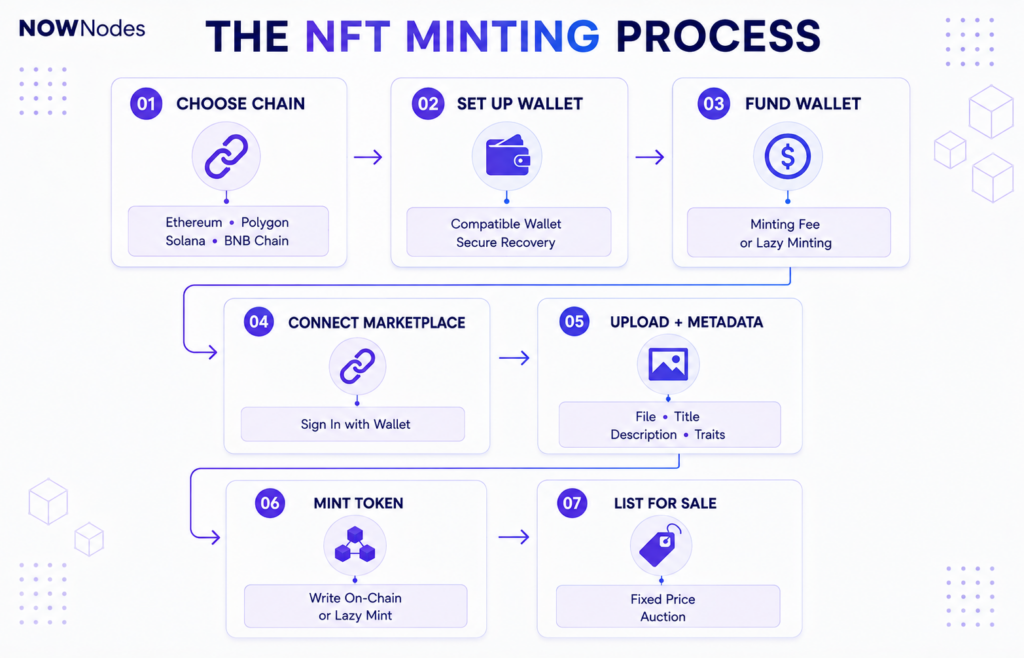
The screens differ from one marketplace to the next, but the underlying sequence to create an NFT stays consistent:
- Choose a blockchain network. Ethereum, Polygon, Base, Solana, and BNB Chain are the most common for NFTs. The choice affects fees, speed, and which marketplaces and wallets are compatible.
- Set up a crypto wallet. Install one that supports your chosen chain and store the recovery phrase somewhere safe — it’s the only way to restore access if the device is lost.
- Fund the wallet, if required. Some marketplaces charge to mint; others use lazy minting, which defers the on-chain transaction and its cost until the NFT sells.
- Connect the wallet to a marketplace. Platforms like OpenSea, Rarible, or Magic Eden let you sign in by connecting a wallet instead of a username and password.
- Upload the file and add metadata. This includes the title, description, traits or properties, and any unlockable content the marketplace supports.
- Mint the token. Confirming the transaction writes the token to the blockchain — or queues it for lazy minting — under a smart contract that defines its ownership rules.
- List it for sale. Set a fixed price or an auction, and the marketplace handles the transaction once a buyer commits.
Steps 1 and 2 lock in everything after them. A token minted on one chain doesn’t move to another later, so switching blockchains usually means creating the NFT again from scratch.
How to sell an NFT after minting
Selling happens through the listing you create during minting. A fixed-price sale is the simplest: whoever pays the asking price first gets the NFT, which suits anyone who’d rather have a quick, predictable sale than wait for a better offer.
Auctions work differently. A timed auction runs for a set window and goes to the highest bidder at the end. Some platforms also support Dutch auctions, which start high and drop until someone buys. An open, no-reserve auction skips the clock entirely and leaves the token listed until you accept an offer.
On top of any format, a resale royalty can route a percentage of future sales back to you automatically. How reliably that holds depends on the marketplace, so check the current policy rather than assuming it matches older norms.
Which blockchain should you use?
It comes down to a trade-off between fees, speed, and where your buyers already are. Ethereum has the deepest marketplace liquidity and the most established collections; its base-layer fees are the highest of the group, though far lower now than during past congestion.
| Blockchain | Best for | Relative fees | Notes |
|---|---|---|---|
| Ethereum | High-value art, blue-chip collections | Highest of the group (still low today) | Widest buyer reach; fees rise during demand |
| Polygon | Large drops, gaming items | Fraction of a cent | EVM-compatible; listed on most marketplaces |
| Base | New collections, consumer apps | Fraction of a cent | Ethereum layer-2 with fast-growing NFT activity |
| Solana | High-volume trading, gaming | Fraction of a cent | Fast finality; separate tooling (Metaplex) |
| BNB Chain | Budget collections, regional platforms | Low | EVM-compatible; fewer curated marketplaces |
Marketplace support is the real constraint in most cases. Match the chain to where your intended buyers are active, not just to the lowest fee.
How much does it cost to mint an NFT?
Most of the cost is the blockchain’s network (gas) fee, not the marketplace — and on Ethereum that fee has fallen sharply. During the 2021–2022 peaks, a single Ethereum mint could run $50 to $200 in gas. After the Dencun upgrade in 2024 and further scaling since, a routine Ethereum mint in 2026 typically costs from well under a dollar to a few dollars, climbing higher only during heavy demand. On Polygon, Solana, and Ethereum layer-2s like Base, it’s usually a fraction of a cent.
Lazy minting removes the upfront cost entirely — the closest thing to creating an NFT for free. Instead of writing the token on-chain immediately, the marketplace stores the file and metadata off-chain and only executes the mint, with the buyer typically covering gas, at the first sale.
Beyond network fees, marketplaces take a commission on completed sales, now commonly in the 0.5% to 2.5% range, with curated platforms sometimes charging more. Network fee plus commission are the two numbers worth comparing before you decide where to mint and list.
One NFT vs. a full collection
A single NFT and a full collection use the same technology but different production processes. One NFT is minted from one file, usually through a marketplace’s standard upload flow.
A collection — often hundreds or thousands of tokens released together — is generated programmatically. Traits like background, expression, and accessories get combined algorithmically into unique results, then minted in batch through a smart contract built for the purpose, rather than uploaded one at a time.
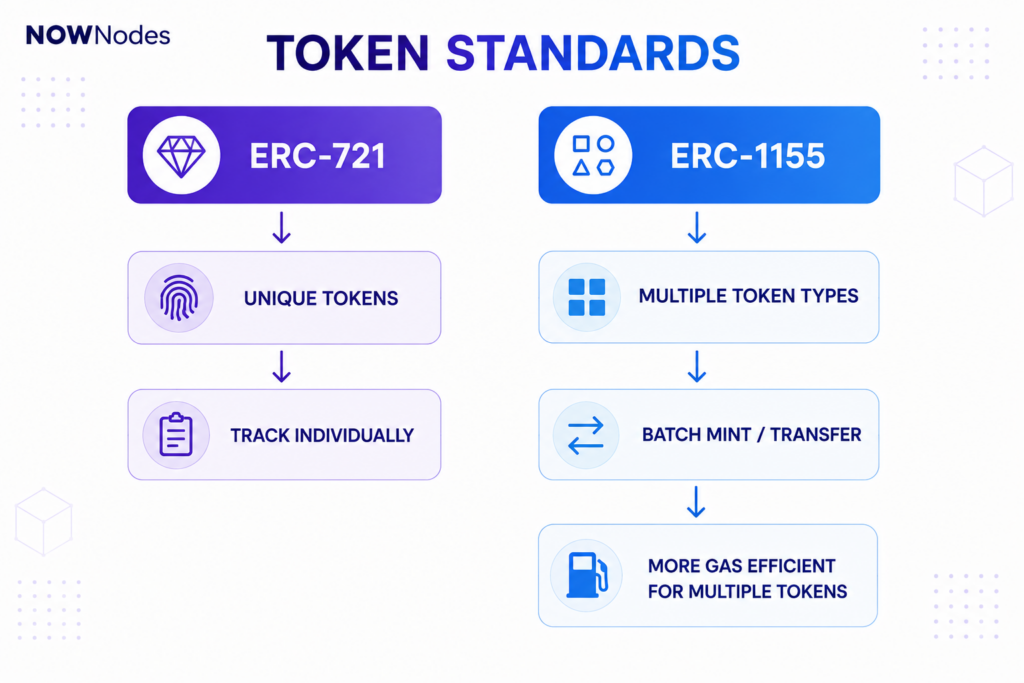
Two Ethereum standards cover most of this. ERC-721 treats each token as one of a kind and tracks it individually, while ERC-1155 lets a single contract manage many token types more efficiently (Ethereum’s token standards documentation). ERC-1155 is common for gaming items and large collections because it cuts the gas cost of minting and moving many tokens at once.
Figuring out how to start an NFT project at collection scale raises questions a single mint doesn’t. You need a minting website with wallet-connect built in, often a reveal mechanism that hides metadata until after the mint, and a plan for when demand outstrips supply. At that point it looks less like an upload and more like a small software project.
How to build your own NFT marketplace
Most creators never need to — an existing marketplace is faster and cheaper. Teams build their own when they need something OpenSea or Magic Eden can’t give them: in-game trading, a brand-owned storefront, or custom fee and royalty rules. Building one comes down to three fairly independent pieces.
The smart contract defines the token standard, ownership rules, and any custom logic like royalties or mint limits — usually written in Solidity for EVM chains and audited before launch. The front end handles browsing, wallet connection, listing, and checkout, built like any web app with wallet-connection libraries doing the crypto-specific work. And the backend reads blockchain state and submits transactions: it checks who owns a token, indexes transfer history, and confirms that a mint or sale actually went through.
That backend has to stay in constant contact with the blockchains it supports. Every balance check, ownership lookup, and transaction a marketplace broadcasts depends on reliable access to those networks, and keeping that access running across several chains is a separate job from building the storefront. This is where providers like NOWNodes fit: it offers API access to 120+ networks — including Ethereum and other EVM chains — through one connection, so a team can read chain data and send transactions without operating that infrastructure in-house.
Going this route means building a product and a piece of blockchain infrastructure at the same time. Most creators stick with an existing marketplace for exactly that reason, and only build their own once the product genuinely needs it.
FAQ
Do you need coding skills to create an NFT?
No. Minting through a marketplace like OpenSea or Rarible takes no code, whether you’re making one NFT or a whole collection — it’s a file upload and a wallet connection. Code becomes necessary only when you build a custom smart contract, a generative collection, or a marketplace of your own.
How long does minting an NFT take?
The mint itself usually takes seconds to a few minutes, depending on how fast the blockchain confirms the transaction. Preparing the file, metadata, and wallet beforehand typically takes longer than the mint.
Do you keep the copyright after selling an NFT?
Usually, yes. Owning the token means owning that specific certificate, not automatically the copyright to the underlying work. The marketplace’s terms and any attached license are what actually decide it.
What file formats can an NFT use?
Most marketplaces accept images, video, audio, and 3D model files, with size and format limits that vary by platform. The token is just a record on the blockchain; the file it points to is usually stored separately, often on decentralized storage such as IPFS.
Can an NFT’s metadata change after minting?
Some can, depending on how the smart contract was written. Many NFTs have fixed, immutable metadata by design, but a few contracts intentionally allow updates — revealing artwork after a mint, or letting traits evolve based on outside conditions.
Does minting an NFT harm the environment?
Far less than it used to. Ethereum’s 2022 move to proof-of-stake cut its energy use by more than 99%, and chains like Polygon and Solana were low-energy by design, so minting on any of these carries a much smaller footprint than the proof-of-work era NFTs are still associated with.