

Yield farming is the practice of putting crypto to work in a DeFi protocol — lending it, pairing it in a liquidity pool, or staking it — in exchange for a return paid in interest, trading fees, or reward tokens. That’s different from simply buying a coin and hoping the price rises: the return comes from the protocol itself, not from the market re-pricing the asset.
This guide covers what yield farming is, why it exists, and who uses it in 2026. It also covers which platforms currently handle most of it — Aave, Lido, Curve, Convex, Yearn, Pendle, and PancakeSwap among them — plus what most guides skip: what can go wrong, with real numbers attached.
Total value locked (TVL) across DeFi — the combined value deposited in these protocols — sat at $71.77 billion in mid-June 2026, down 37.3% from $114.49 billion at the start of the year, per CoinLaw’s DeFi market data. That contraction is the backdrop for everything below: farming in 2026 is smaller and more selective than at its 2020–2021 peak, and the platforms that still matter are the ones that survived the shakeout.
What Is Yield Farming?
Yield farming means depositing crypto into a DeFi protocol so it can be lent out, pooled for trading, or staked — and earning a return for doing so. That reward arrives as interest, a cut of trading fees, a protocol’s own governance token, or some mix of the three.
Yield farming is the practice of deploying cryptocurrency into DeFi protocols — as loanable capital, pooled trading liquidity, or staked collateral — to earn a return, typically measured as an annual percentage yield (APY). See Binance Academy’s glossary entry.
A farmer’s return comes from the protocol doing something with the deposit — lending it to a borrower, filling trades with it, or putting it to work securing a network — not from the market re-pricing the asset itself. You can lose money farming even if the underlying token’s price never moves, and profit even while it drops. That distinction is worth holding onto before anything else, and most farming activity runs through one of three mechanisms: lending, liquidity provision, or staking, each broken down in detail further down.
Why Do DeFi Protocols Pay You to Deposit?
DeFi protocols need capital to function, and yield is how they attract it. A lending market can’t lend anything out until someone deposits first, and a decentralized exchange can’t fill a trade until someone has funded its liquidity pool. Yield farming pays depositors to solve that cold-start problem: protocols get the capital they need, and depositors get a return on crypto that would otherwise sit idle. Some protocols sweeten the deal further with their own governance token on top — a practice called liquidity mining, since new tokens are effectively earned by supplying liquidity rather than by computation.
This is where the modern term comes from: Compound began distributing its COMP governance token to users on June 15, 2020, and the rush to farm it is widely credited with kicking off what the industry still calls “DeFi Summer.” The mechanics haven’t changed much — what’s changed is which protocols are trusted enough to hold the money.
Who Actually Uses These Platforms?
Retail holders are the simplest case: someone with idle USDC or ETH deposits it into an established lending market for a modest, predictable return instead of leaving it in an exchange account earning nothing. That’s the low-risk end, usually built around blue-chip protocols and major stablecoins.
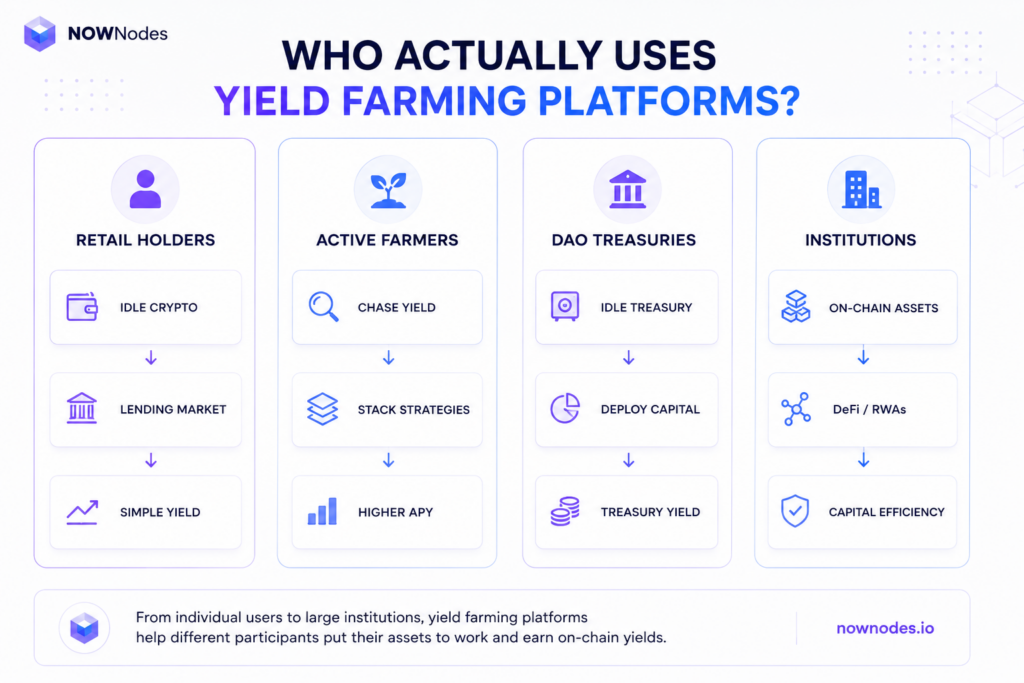
Active farmers sit further up the risk curve, moving capital between protocols to chase the highest current APY and often stacking strategies — supplying an asset to a lending market, then using the receipt token elsewhere for a second yield. Convex exists specifically to boost returns for people already farming on Curve, which is exactly this kind of layering.
DAOs and protocol treasuries farm too, deploying idle assets rather than letting them sit in a multisig earning nothing, tied to how DAOs govern and hold funds in the first place. Increasingly, the user base includes institutions: Aave V4, launched on Ethereum in March 2026, pulled in more than $250 million in net deposits within months.
“It’s about using the infrastructure we’ve built, which is successful with native crypto assets, and applying that to all asset classes that are coming onchain. There is an enormous opportunity with RWAs.” — Stani Kulechov, Aave founder, The Block, July 2026
Tokenized real-world assets — treasury bills, private credit, and similar instruments — already total roughly $60 billion on-chain, a figure Kulechov expects to reach $100 billion by the end of 2026. That’s a different kind of farming from a retail wallet chasing a stablecoin rate, but it runs through the same protocols.
How Do These Platforms Generate a Return?
Strip away the branding and nearly every farming strategy is a variation on three mechanisms: lending, liquidity provision, and staking. Each pays differently, and each carries its own risk profile.
Lending on a Money Market
Deposit an asset into a protocol like Aave, and borrowers pay interest on the other side. Your deposit earns a floating APY that moves with borrowing demand — more borrowers wanting that asset means a higher rate for you. Aave’s USDC market on Ethereum has recently paid supply rates in the mid-single digits, resetting constantly with market conditions.
Providing Liquidity to a Pool
On an AMM like Curve or Uniswap, you deposit a pair of assets into a shared pool instead of lending to one borrower, and earn a cut of every trade that pool fills. Curve specializes in stablecoin pairs because similarly priced assets minimize a risk unique to this method: impermanent loss.
Impermanent loss happens when the price of your pooled assets diverges after depositing, leaving you with a mix worth less than if you’d simply held the originals, per Coinbase’s explainer. It’s “impermanent” only if prices recover before you withdraw; if they don’t, it’s a realized loss.
Staking and Auto-Compounding Vaults
Staking-based farming means locking an asset to help secure a network for a share of its rewards. Lido is the largest single protocol in DeFi by that measure — $15.17 billion in TVL, per CoinLaw — because it lets users stake ETH while holding a liquid, tradable receipt token (stETH) redeployable elsewhere for extra yield.
A step up in complexity, vaults like Yearn Finance automate the process: deposit once, and the strategy rotates capital between pools and reinvests rewards automatically. That convenience comes with higher smart contract risk, since a vault typically touches several protocols at once instead of just one.
Comparing the Leading Platforms in 2026
The table below covers platforms carrying real, verifiable usage across the mechanisms above, from beginner-friendly lending to advanced strategies. TVL and rates move constantly, so treat these as a snapshot, not a live quote.
| Platform | Category | Chain(s) | Scale (2026) | Fee / rate note |
|---|---|---|---|---|
| Aave | Lending | Ethereum + 15 others | $12.10B TVL | USDC supply APY recently mid-single digits |
| Lido | Liquid staking | Ethereum, Solana | $15.17B TVL | Largest single DeFi protocol by TVL |
| Curve Finance | Stablecoin AMM | 27 chains | ~$2.1–2.7B TVL | ~0.04% base swap fee |
| Convex Finance | Yield booster | Ethereum | Layers onto Curve | Boosts CRV rewards for LPs |
| Yearn Finance | Auto-compounding vaults | Ethereum + others | Vault yields vary widely | Automated multi-protocol strategies |
| Pendle | Yield tokenization | Ethereum + others | Hit $8.3B TVL (Aug 2025) | Fixed-rate yield trading |
| PancakeSwap | AMM / farms | BNB Smart Chain + 8 others | Leading BSC DEX | Lower gas than Ethereum options |
Aave is usually the starting point, with stablecoin rates about as predictable as DeFi gets. Lido‘s stETH keeps staked capital usable — you earn Ethereum’s staking reward while redeploying the token into Aave or Curve for a second yield. Curve and Convex are usually paired: Curve pays base swap fees, and Convex exists purely to boost CRV rewards on top, which is why stablecoin farmers rarely use one without the other.
Yearn Finance takes the opposite approach from picking pools by hand — deposit once and let its strategy chase yield across protocols, trading manual control for more layered risk. Pendle separates an asset’s future yield from its principal, letting users lock in a fixed rate or speculate on where yield is headed. PancakeSwap is the main non-Ethereum option, since BNB Smart Chain’s lower gas makes small, frequent positions practical in a way they often aren’t on Ethereum.
How to Choose a Platform
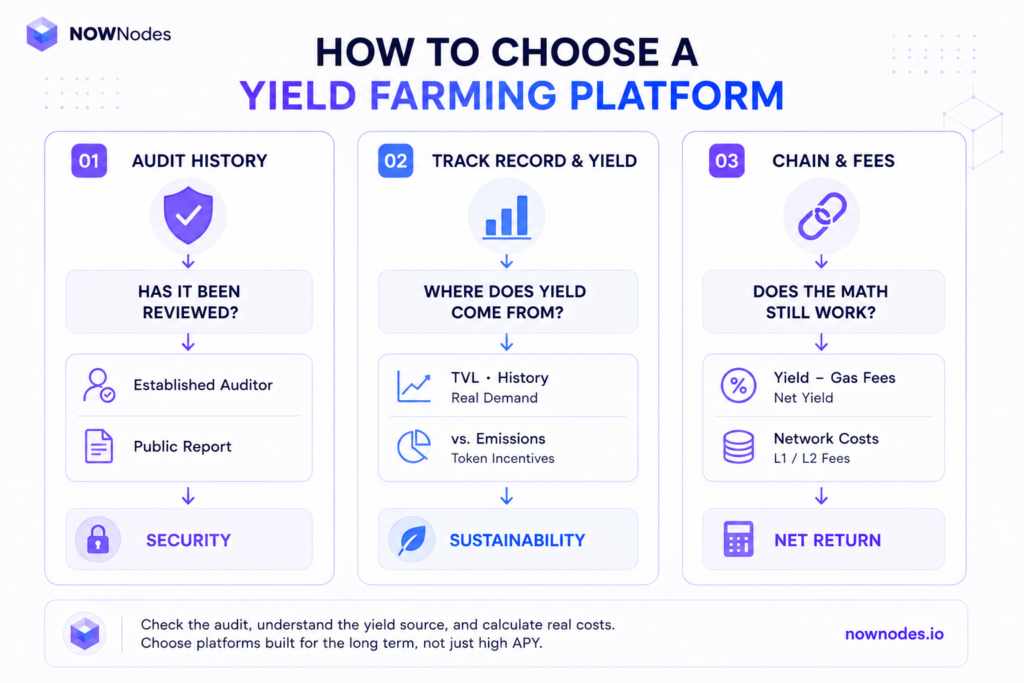
What separates a reasonable choice from a reckless one isn’t simply “highest APY”:
- Audit history. Check whether an established firm has reviewed the protocol and whether the report is public — see this breakdown of smart contract auditing firms for what a credible review involves.
- TVL, track record, and yield source. A protocol that has held billions for years without incident, paying a rate backed by real borrowing demand or fees, has earned more trust than a fresh fork with a triple-digit APY funded mostly by token emissions.
- Chain and fee fit. A stablecoin position earning 4% isn’t worth much if Ethereum gas eats a meaningful slice of it, which is why cheaper chains still pull in farming activity despite Ethereum’s larger TVL.
What Are the Risks?
None of this is free money, and the risks are specific enough to name directly. Smart contract risk is the big one: a bug in a protocol’s code can drain it in a single transaction, and unlike a bank, there’s usually no one to make depositors whole afterward. Attackers stole $3.1–3.4 billion from crypto platforms in 2025 alone, per CoinLaw.
Composability risk is less obvious but just as real — DeFi protocols plug into each other, so a failure in one cascades into others. On April 19–20, 2026, an attacker exploited a $292 million flaw in Kelp DAO’s cross-chain bridge, then used the stolen restaked ETH as collateral on lending markets that trusted it. Total DeFi TVL fell $13.21 billion in 48 hours, and Aave alone saw $8.45 billion withdrawn as users rushed for the exits, per CoinDesk.
“It’s similar to conning a traditional bank by depositing fake fiat and taking out loans against it, ultimately leaving the lender with bad debt.” — Peter Chung, Head of Research at Presto Research, on the Kelp DAO exploit, CoinDesk
Impermanent loss affects liquidity providers specifically, as covered above, and it’s easy to underestimate until a volatile week turns a “safe” pool into a paper loss. Yield decay is the quieter risk: a headline APY built mostly on token emissions drops as more farmers pile in and the reward splits more ways — the same pool can pay 40% one month and 8% the next with nothing having gone wrong. None of this is investment advice; check current rates and audit status on the protocol itself before depositing anything.
How Farmers Track Positions Across Chains
Farming across several protocols and chains creates a practical problem before a financial one: keeping track of it all. Dashboards such as YieldWatch and DeBank pull balances, pending rewards, and pool positions from multiple networks into one screen, since checking each protocol’s own interface separately stops scaling past a couple of positions.
Every one of those checks is a blockchain read — a wallet’s stake in a pool, its accrued rewards, a token’s current price. Running that against a self-hosted node for a handful of chains is a real infrastructure burden, which is why most dashboards connect through an RPC provider instead. NOWNodes, for instance, supplies API access to nodes across 120-plus networks plus a market data API for the prices that turn raw balances into a dollar-denominated APY.
Conclusion
Yield farming in 2026 is narrower and more selective than it was at its 2021 peak, and that’s arguably an improvement. The protocols that still hold the most capital — Aave, Lido, Curve — are the ones that survived several years of exploits, market cycles, and competitors, which is a better filter than any single APY number.
The practical takeaway holds even where the ecosystem doesn’t: start with audited, established protocols and major stablecoins, understand where a yield actually comes from before chasing it, and treat any rate far above the table above as a signal to look harder, not a reason to move faster. None of this is financial advice — verify current rates, audit reports, and risks directly before committing funds.
FAQ
Is Yield Farming Still Profitable in 2026?
It can be, though rates have compressed as DeFi’s TVL fell more than 37% over the course of 2026. Aave and Curve still pay real yield on stablecoins, typically in the low-to-mid single digits, while higher rates elsewhere usually mean higher risk rather than a better deal.
What’s the Difference Between Yield Farming and Staking?
Staking means locking a token to help secure a network in exchange for rewards, while yield farming is the broader category that also includes lending and providing liquidity to trading pools. Every staking position is a form of yield farming, but not every yield farming strategy involves staking.
How Much Money Do You Need to Start Yield Farming?
There’s no protocol-set minimum, but network fees make small positions impractical on Ethereum specifically, where gas can eat a meaningful share of a small deposit’s return. Starting on a cheaper chain, or with at least a few hundred dollars on Ethereum, keeps fees from outweighing the yield.
Are Yield Farming Rewards Taxable?
In most jurisdictions, yes — tax authorities generally treat farming rewards as income when received, and apply capital gains rules again when the tokens are later sold. Rules vary by country, so check current guidance with a tax professional.
What Counts as a Good APY for Yield Farming?
It depends on where the yield comes from: a mid-single-digit stablecoin rate from an audited, blue-chip protocol is solid, while double- or triple-digit APYs almost always come from token emissions that dilute as more farmers arrive. Compare the rate to its source, not just the number.