
There are two broad routes to create a meme coin on Solana in 2026. You can use a no-code tool — a launchpad or a token-creator app — and have a token live in a few minutes, or you can write a short script and mint your own SPL token for full control over supply, authorities, and distribution. Both are inexpensive, since Solana’s transaction fees are a fraction of a cent.
Here’s the part most guides skip: creating the token is the easy 5%. Getting people to buy it, hold it, and trust it is the other 95%. This guide walks the whole arc — what a Solana meme coin actually is, the fastest way to launch one, the developer method when you want control, and the liquidity, community, and security work that decides whether your coin survives its first week.
What Is a Solana Meme Coin?
A meme coin is a cryptocurrency whose value comes from community, culture, and attention rather than from a product or cash flow. On Solana, the best-known examples are BONK and dogwifhat (WIF), along with the 2025 political meme coins $TRUMP and $MELANIA. The joke — or, more precisely, the community around it — is the value proposition.
Meme coin (a.k.a. meme token): a fungible crypto token, usually with no formal utility, whose price is driven by social attention and speculation rather than underlying revenue or a working product.
Technically, a Solana meme coin is a fungible token, but it works differently from a token on Ethereum. On Solana, a token is a mint account managed by a shared on-chain program — either the original Token Program or the newer Token-2022 Program. It is not its own individually deployed smart contract the way an ERC-20 token is; the comparison to ERC-20 is a loose analogy for intuition, not a technical equivalence.
Token-2022 adds optional “token extensions” such as transfer fees or on-chain metadata. That flexibility comes with a caveat: support depends on the wallet or protocol and on which extensions you enable. Not every wallet, DEX, or launchpad supports every extension, so confirm compatibility before you build around one. You can review the full list in the official Token-2022 extensions docs.
Why Do People Create Meme Coins on Solana?
Solana became a default home for meme coins because it’s fast and cheap. The network currently targets a slot time of approximately 400 milliseconds, though a slot doesn’t always produce a block. Transaction costs are low: the base fee is fixed at 5,000 lamports per signature, with optional priority fees on top that vary with the compute-unit limit you request, the compute-unit price, and current network demand. The official Solana fee structure explains exactly how those are calculated.
The network is also evolving. Solana’s Alpenglow upgrade is still under development; it targets finality of roughly 150 milliseconds and currently has an expected mainnet activation around Q3 2026, though both the timing and the performance target may still change. Faster finality would mean quicker confirmations for buyers piling into a launch. You can track its status on the official Alpenglow upgrade page.
Then there’s the ecosystem: Solana has the launchpads, the DEXs, and one of the most active meme coin trading scenes in crypto. But be clear-eyed about what you’re building. Even Solana’s own co-founder is blunt about it.
“Memecoins and NFTs are digital slop and have no intrinsic value.” — Anatoly Yakovenko, co-founder of Solana, in a July 2025 post on X
That’s the co-founder of the chain these tokens run on. His point isn’t that no one makes money — meme coins drove a large share of Solana’s app revenue in 2025 — it’s that the value is crowd psychology. You’re betting on what other people will chase next, not on fundamentals. Hold that framing and you’ll make better decisions as a creator.
Before You Start: What You Actually Need
You don’t need much to create a Solana meme coin, but skipping any of these will stall you halfway. Get them ready first.
- A Solana wallet — Phantom or Solflare are the standard picks. This holds your SOL and, later, your token.
- Some SOL — for network fees and, if you launch on a curve, your optional first buy.
- A brand — name, ticker symbol, and a logo or image. This is most of what a buyer actually sees.
- A plan for liquidity and community — where people will trade it, and where they’ll gather. More on both below.
How to Create a Meme Coin on Solana: The No-Code Way
For most people in 2026, this is the answer. “No-code” covers two related options: a launchpad that mints and lists your token automatically, or a token-creator tool that generates a standard SPL token you then list yourself. The dominant launchpad is Pump.fun, with LetsBonk and Raydium LaunchLab competing for the same users.
Launchpad: a platform that mints your token and makes it tradable automatically, usually through a “bonding curve” that sets the price based on how much has been bought so far.
Step-by-Step on a Launchpad
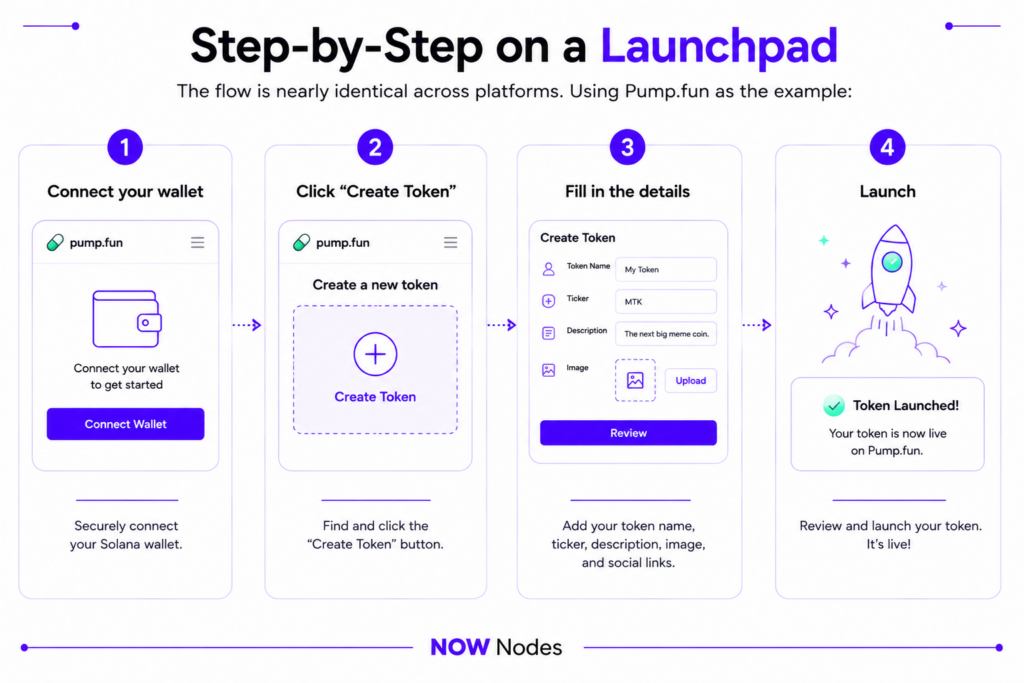
The flow is nearly identical across platforms. Using Pump.fun as the example:
- Connect your wallet — link Phantom or Solflare to the platform.
- Click “Create Token” — you’ll get a simple form.
- Fill in the details — name, ticker symbol, description, image, and social links.
- Launch — creating the coin currently has no upfront platform fee; you can optionally make the first buy to seed momentum.
Your Solana meme coin is live and tradable within minutes, with no smart contract to write or audit.
How Fees and “Graduation” Work
On Pump.fun, the token launches on a bonding curve — an automated pricing mechanism where each buy nudges the price up. Trades on the curve carry a fee that is split between the protocol and you, the creator. As of mid-2026 that’s a total of 1.25% (roughly a 0.95% protocol fee and a 0.30% creator share), but these rates change often, so treat any figure as a snapshot.
When the bonding curve completes — enough of the supply has been bought — the token “graduates” and migrates to PumpSwap, Pump.fun’s own DEX. PumpSwap applies market-cap-based fee tiers rather than one flat rate, and creators can keep earning a share of trading fees there. Because Pump.fun tunes these parameters over time, confirm the current numbers in the official Pump.fun fee docs and bonding-curve docs before you rely on them.
No-Code Platforms Compared
| Platform | Best for | Cost to create | Notes |
|---|---|---|---|
| Pump.fun | Fastest reach, most traders | No upfront platform fee | Bonding curve → graduates to PumpSwap when the curve completes |
| LetsBonk | BONK-ecosystem exposure | No upfront platform fee | Tied into the BONK community and its DEX flow |
| Raydium LaunchLab | Direct Raydium liquidity | No upfront platform fee | Launches into Raydium’s DEX rails |
| Token-creator tools (e.g. Smithii) | Control + trust features | Small flat fee | Produces a standard SPL token you configure and list yourself |
The trade-off with launchpads is control and consistency. How token authorities are handled is defined by each platform’s token program and launch process, so don’t assume you’ll be able to set mint or freeze authority the way you would on a self-launched token — check what each platform actually does. If fine-grained control matters to you from day one, a token-creator tool or the developer route gives you that.
How to Create a Meme Coin on Solana: The Developer Way
If you want to set your own supply, control the authorities, and own the whole process, you mint the SPL token yourself. It’s a short script — but a couple of dozen lines you should understand before running.
A tooling note for 2026: the libraries in this example, @solana/web3.js and @solana/spl-token, are now legacy. The recommended modern stack is Solana Kit (@solana/kit) paired with @solana-program/token (or @solana-program/token-2022). We use the legacy spl-token helpers below because they’re the most compact way to illustrate the mint flow; for anything production-grade, prefer the modern packages — see the official JavaScript client docs.
Install the libraries:
bash
npm install @solana/web3.js @solana/spl-tokenThen create and mint your token. This runs as an ES module, so set "type": "module" in your package.json (or use a .mjs file):
js
import { Connection, Keypair } from "@solana/web3.js";
import {
  createMint,
  getOrCreateAssociatedTokenAccount,
  mintTo,
  setAuthority,
  AuthorityType,
} from "@solana/spl-token";
import fs from "node:fs";

async function main() {
  // Connect to Solana through NOWNodes — the API key goes in the
  // api-key HTTP header, NOT in the URL path.
  const connection = new Connection("https://sol.nownodes.io", {
    commitment: "confirmed",
    httpHeaders: { "api-key": "YOUR_API_KEY" },
  });

  // Load a securely stored, ALREADY-FUNDED keypair.
  // A freshly generated Keypair holds no SOL, so every step below would fail.
  const secret = JSON.parse(fs.readFileSync("payer.json", "utf-8"));
  const payer = Keypair.fromSecretKey(Uint8Array.from(secret));

  // 1. Create the mint. Decimals are your choice — 9 is a common
  //    convention, not a requirement.
  const mint = await createMint(
    connection,
    payer,
    payer.publicKey, // mint authority
    payer.publicKey, // freeze authority (revoked below)
    9
  );

  // 2. Create an account to hold the supply.
  const tokenAccount = await getOrCreateAssociatedTokenAccount(
    connection, payer, mint, payer.publicKey
  );

  // 3. Mint the total supply — e.g. 1,000,000,000 tokens (adjusted for decimals).
  await mintTo(
    connection, payer, mint, tokenAccount.address, payer,
    1_000_000_000n * 10n ** 9n
  );

  // 4. Revoke the mint authority so the supply is fixed forever.
  await setAuthority(
    connection, payer, mint, payer, AuthorityType.MintTokens, null
  );

  // 5. Revoke the freeze authority so you can never freeze holders' accounts.
  await setAuthority(
    connection, payer, mint, payer, AuthorityType.FreezeAccount, null
  );

  console.log("Mint address:", mint.toBase58());
}

main().catch(console.error);
On-chain, creating these accounts isn’t a fee — it’s a rent-exempt deposit the network holds while the account exists. Expect roughly 0.0015 SOL for the mint account and about 0.002 SOL for the token account, plus small per-signature transaction fees. That rent deposit is separate from fees and is recoverable if you later close a closable account. For the authoritative reference and the modern Solana Kit syntax, see the official Solana token docs.
What the Script Does — and Doesn’t — Cover
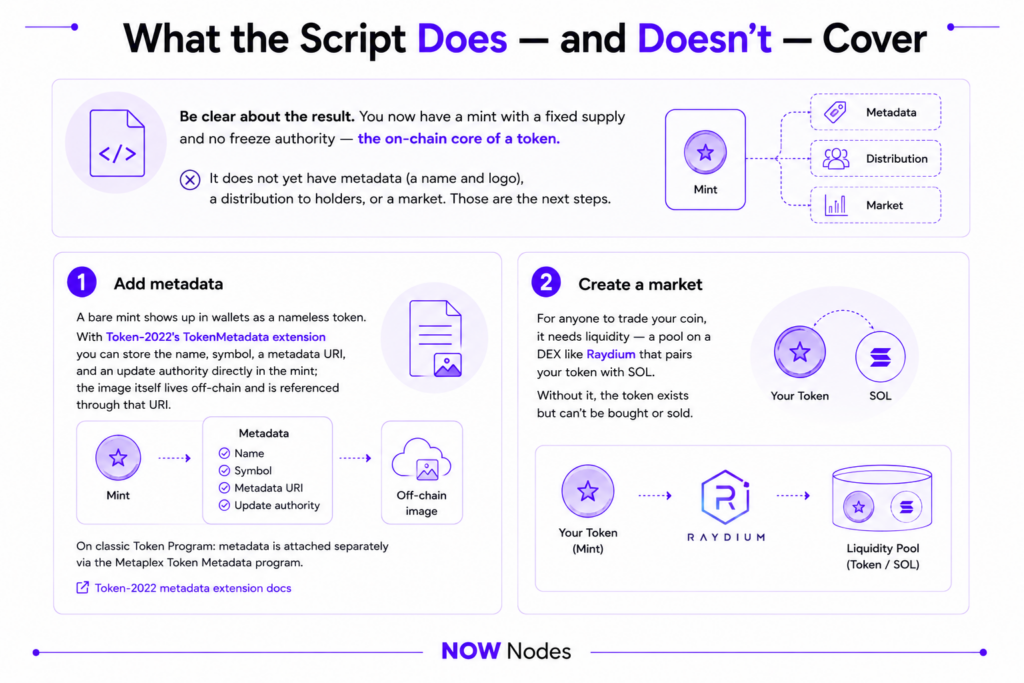
Be clear about the result. You now have a mint with a fixed supply and no freeze authority — the on-chain core of a token. It does not yet have metadata (a name and logo), a distribution to holders, or a market. Those are the next steps.
Add metadata. A bare mint shows up in wallets as a nameless token. With Token-2022’s TokenMetadata extension you can store the name, symbol, a metadata URI, and an update authority directly in the mint; the image itself lives off-chain and is referenced through that URI. On the classic Token Program, metadata is attached separately via the Metaplex Token Metadata program. See the Token-2022 metadata extension docs.
Create a market. For anyone to trade your coin, it needs liquidity — a pool on a DEX like Raydium that pairs your token with SOL. Without it, the token exists but can’t be bought or sold.
Connecting to Solana with NOWNodes
Whichever route you take, the moment you build anything around your coin — a mint script, a trading bot, a site that reads balances — you need a dependable way to reach Solana. Public endpoints throttle and lag exactly when it matters most: during a launch, when traffic spikes. A failed or delayed transaction in that window can cost you the launch.
That’s where NOWNodes comes in — a blockchain infrastructure provider that gives you API access to Solana through a single endpoint, with no servers to run. Getting connected takes a few minutes:
- Sign up at nownodes.io and verify your email (no KYC required).
- Create an API key from your dashboard.
- Use the endpoint
https://sol.nownodes.ioand send your key in theapi-keyheader — exactly as the script above does.
The free START plan is enough to build and test with. Grab your endpoint from the Solana access page, and you’re set for both creating the token and running whatever you build on top of it.
After Launch: Liquidity, Community, and Security
The token exists. Now comes the work that actually decides its fate.
Liquidity — and it depends on how you launched. If you used Pump.fun, the graduated token’s canonical liquidity is created and managed by the protocol, not by you. If you launched your own SPL token, you create the DEX liquidity position yourself, and you can lock or burn the LP tokens to show you can’t quietly pull it. Treat locked liquidity as one risk-reduction signal, though — not proof of safety. It says nothing about token distribution, who holds the authorities, or whether trading is organic.
Community. A meme coin with no community is a dead entry on a block explorer. Set up an X account, a Telegram or Discord, and a simple site before you launch, not after. Post consistently, answer holders, and give people a reason to care beyond the price chart.
Security and honesty. The failure rate here is sobering. A Solidus Labs report analyzing Pump.fun found that about 98.6% of the tokens it examined had fallen below $1,000 in liquidity — effectively worthless, which the report treats as an indicator of pump-and-dump activity rather than a legal finding that each one was a rug pull. The takeaway for a creator is simple: buyers have seen numbers like these, so verifiable transparency — revoked authorities, a clear token distribution, a real team presence — is now the cost of being taken seriously.
One last point, and it isn’t legal advice: meme coin regulation varies widely by country and is still evolving. If your token starts to look like an investment product, it can attract scrutiny. Be transparent about supply and distribution, and check the rules where you operate before you promote.
Conclusion
Creating a meme coin on Solana in 2026 is genuinely easy: a no-code tool like Pump.fun gets you live in minutes, and the developer route is a short SPL script when you want control over supply and authorities. The technical part is cheap, fast, and well-documented.
What decides the outcome is everything after the mint — real liquidity, an engaged community, and the transparency signals that keep you out of the majority that quietly go to zero. Build on reliable infrastructure, be honest with your holders, and treat the launch as the starting line, not the finish. That’s the difference between a coin that trends and one that flatlines by Friday.
FAQ
How much does it cost to create a meme coin on Solana?
On a no-code launchpad like Pump.fun there’s currently no upfront platform fee to create the token — you mainly pay a percentage on trades. If you mint your own SPL token, the on-chain cost is a small rent deposit (roughly 0.0015 SOL for the mint plus about 0.002 SOL for a token account, recoverable if you later close the account) plus tiny transaction fees. The bigger real-world costs are liquidity and marketing.
Can I create a Solana meme coin without coding?
Yes. Launchpads and token-creator tools require no code — you fill in a form and launch. Coding only becomes necessary if you want to mint the SPL token yourself for control over supply, authorities, and distribution.
What’s the difference between using Pump.fun and minting an SPL token myself?
Pump.fun handles everything automatically through a bonding curve and manages the graduated liquidity for you, but the platform defines how the token’s authorities and market are set. Minting your own SPL token lets you choose the supply, revoke the mint and freeze authorities, add your own metadata, and set up liquidity yourself — at the cost of doing more of the work.
How do I make my meme coin look trustworthy?
Revoke the mint authority (fixing supply), revoke the freeze authority, publish your token distribution, and — if you control the liquidity — lock or burn the LP tokens. Treat each as one signal among several rather than a guarantee; buyers weigh them together, and none of them proves the project itself is sound.
Which libraries should I use to create a token in 2026?
For new projects, the recommended stack is Solana Kit (@solana/kit) with @solana-program/token or @solana-program/token-2022. The older @solana/web3.js and @solana/spl-token libraries still work and are more compact for tutorials, but they’re now considered legacy.
Why do most meme coins fail?
Because their value depends entirely on sustained attention, and attention is scarce. Analyses of launch platforms consistently find that the large majority of tokens lose nearly all their liquidity soon after launch. Creating a coin is easy; earning and keeping a community is the part almost everyone underestimates.
How long does it take to create a meme coin on Solana?
On a launchpad, a few minutes. With the developer method, running the mint script takes minutes once your funded wallet and code are ready. Building the liquidity and community around it takes far longer — and never really stops.