
A Solana RPC provider is a service that gives your application access to the Solana blockchain through hosted nodes, so you can read account data and submit transactions without running your own infrastructure. NOWNodes, Helius, QuickNode, Alchemy, Chainstack, and Triton One all sell this as their core product, and the right pick depends on how you use one specific method — getProgramAccounts — plus whether you need multi-chain coverage or Solana-only tooling.
Solana’s RPC layer behaves differently from Ethereum’s in one important way: reads aren’t cheap. “For most of them — Bitcoin, Ethereum, and all EVM-based chains, and even Solana — it’s JSON-RPC. It’s just a specific kind of API,” QuickNode co-founder Auston Bunsen said in an interview with Sacra. The protocol is standardized, but Solana’s account model makes some of those standard calls far heavier to run than their Ethereum equivalents. Below is what a Solana RPC provider actually does, who needs one, and how the main options compare this year.
Why Do You Need a Solana RPC Provider?
Running your own Solana validator is a heavier operational commitment than most teams expect, and a handful of RPC methods are expensive enough that a provider’s handling of them matters more here than on other chains.
Running Your Own Node Takes Real Hardware
Solana nodes need more than disk space — they need raw compute and fast storage to keep up with the network’s ~400-millisecond block time. Triton One specifies gen4/5 AMD CPUs, 768 GB of RAM, and multiple gen4/5 NVMe drives as a baseline configuration for a production Solana RPC node, per its enterprise infrastructure guide.
That’s before client upgrades. Solana now runs two independent validator implementations — Agave and Jump Crypto’s Firedancer, which reached roughly 26% of validator stake by May 2026, per Coinlaw’s 2026 network data — and keeping either one current through frequent protocol changes is ongoing work, not a one-time setup.
getProgramAccounts Is the Method That Breaks Public Endpoints
getProgramAccounts doesn’t look up one record — it filters through every account a program owns, which is why most public and shared endpoints throttle or restrict it. Benchmarks published by Helius in 2026 measured p95 latency on this single method ranging from 82 milliseconds on the fastest providers to 532–558 milliseconds on slower ones, a gap wide enough to change which provider a data-heavy application can actually use.
An RPC provider absorbs this by indexing program accounts ahead of time instead of scanning on demand — a different engineering problem than Ethereum’s eth_getLogs cost issue, though both teach the same lesson: check how a provider prices and handles your heaviest method, not just its entry-tier price.
Who Actually Uses Solana RPC Providers?
Almost anything that touches Solana programmatically ends up behind an RPC provider somewhere in its stack, though the specific need shifts by use case.
- Wallets need fast balance and token-account lookups (
getTokenAccountsByOwner), plus reliable transaction broadcast. - DEXs and DeFi protocols call program state constantly and need low latency to keep quotes and order books current.
- Trading and sniper bots depend on sub-second data delivery, since Solana sniper bots act inside a single ~400ms slot window where a slow RPC connection is the whole bottleneck.
- NFT platforms and explorers lean on indexed data — compressed NFTs and metadata — rather than raw account scans.
- Analytics and monitoring tools query historical state, which usually means archive access rather than a standard node.
A wallet checking a balance and an NFT marketplace pulling metadata for ten thousand assets both “use an RPC provider,” but they stress completely different parts of the infrastructure — and that’s what actually drives provider choice.
What to Compare Between Providers
Once you move past “does it have a Solana endpoint,” the real differences show up in a handful of specific capabilities.
| Feature | What It Does | Who Needs It |
|---|---|---|
| getProgramAccounts handling | Determines how fast filtered program scans return | DEXs, NFT platforms, indexers |
| Streaming (WebSocket / gRPC) | Pushes live updates instead of polling | Wallets, trading bots, monitoring |
| Priority-fee and MEV routing | Access to Jito bundles or similar MEV protection | Trading bots, arbitrage systems |
| Archive access | Retains state beyond the standard few-day window | Analytics, tax and compliance tools |
| Dedicated nodes | Isolated infrastructure for one customer | High-volume or latency-sensitive apps |
| Multi-chain coverage | One account across many blockchains | Wallets and exchanges supporting several assets |
Solana providers rarely charge a flat per-request rate. Most use credit or compute-unit systems where getProgramAccounts or a large getBlock call costs far more than getBalance — model cost against your actual method mix, not the cheapest example on a pricing page.
Best Solana RPC Providers in 2026
The six providers below span multi-chain generalists and Solana-specific specialists. Pricing and rate limits change often — treat the figures here as a starting point to verify on each provider’s current page.
| Provider | Best For | Standout Feature |
|---|---|---|
| NOWNodes | Multi-chain products that include Solana | 120+ networks under one account |
| HighTower (HTW) | Geo-distributed RPC and real-time streaming | 75+ nodes across 15+ cities with Yellowstone gRPC |
| AllenHark | MEV searchers and HFT trading bots | European co-location with sub-slot transaction landing |
| Helius | Solana-native applications | Indexed getProgramAccounts and NFT (DAS) data |
| QuickNode | High-volume, request-heavy apps | Cached endpoints tuned for getBlock at scale |
| Alchemy | Consumer-facing Web3 apps | Enhanced NFT and token APIs on top of RPC |
| Chainstack | Cost-sensitive production workloads | Lower entry pricing per request |
| Triton One | Enterprise and data-pipeline teams | Open-source tooling, dedicated bare-metal nodes |
NOWNodes
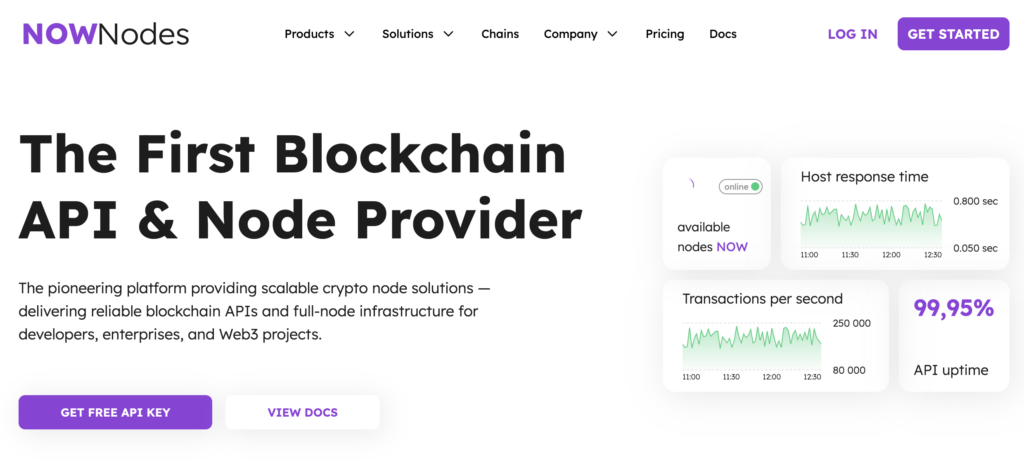
NOWNodes provides Solana RPC and WebSocket access alongside coverage for 120+ other blockchain networks, from Bitcoin to Ethereum to Polygon — one account and API key instead of a separate provider per network. It offers both shared and dedicated Solana nodes; dedicated nodes carry no predefined requests-per-second cap, with throughput bound instead by allocated hardware. The trade-off mirrors any multi-chain provider: a team building Solana-only tooling around indexed program data may find a Solana-native specialist offers deeper features out of the box. NOWNodes fits best when Solana is one piece of a broader multi-chain product.
HighTower (HTW)
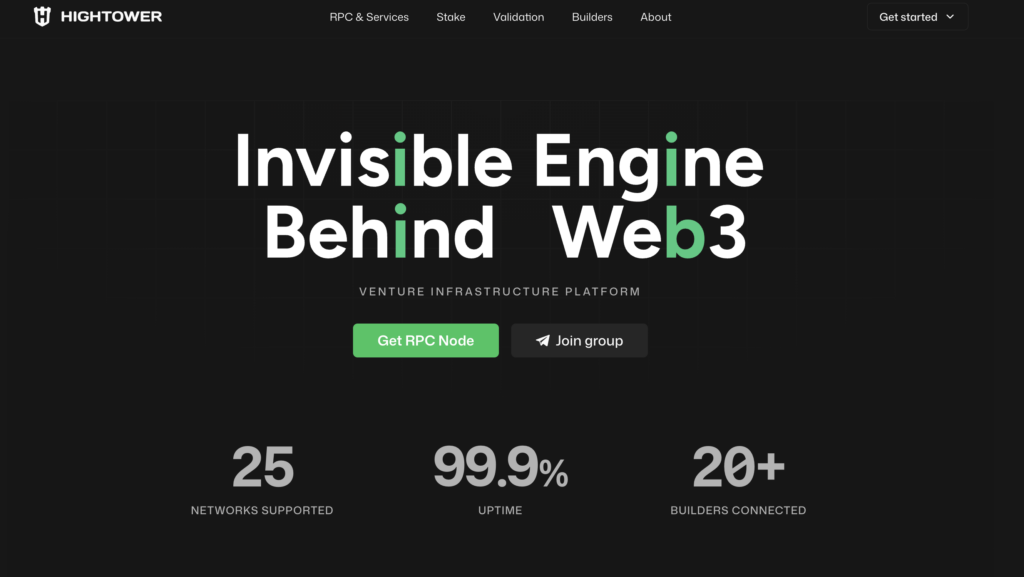
HighTower runs Solana RPC on a geographically distributed network — 75+ nodes across more than a dozen cities on multiple continents, from Frankfurt and Amsterdam to Singapore, Tokyo, New York, and São Paulo — so calls can be served closer to where your users or bots actually run. For Solana it supports Yellowstone gRPC and WebSocket streaming, plus a transaction-landing path covering priority-fee handling, simulation, and confirmation, detailed in its Jupiter and Pump AMM integration guides. Both shared and dedicated nodes are offered.
The platform extends past raw RPC into validators, indexers, monitoring dashboards, and on-chain data APIs, and HighTower reports 99.9% uptime across three owned server locations and 18 partner facilities. Teams building a new product can apply to its venture-backed builders program for infrastructure access instead of paying standard rates.
The trade-offs are the flip side of that model: RPC is provisioned through HighTower’s team rather than instant self-serve signup, so there’s no public price sheet to compare, and a Solana-only project that wants turnkey indexing may still prefer a Solana-native specialist. It fits best where a product needs low-latency nodes in several regions with streaming and reliable transaction landing.
AllenHark
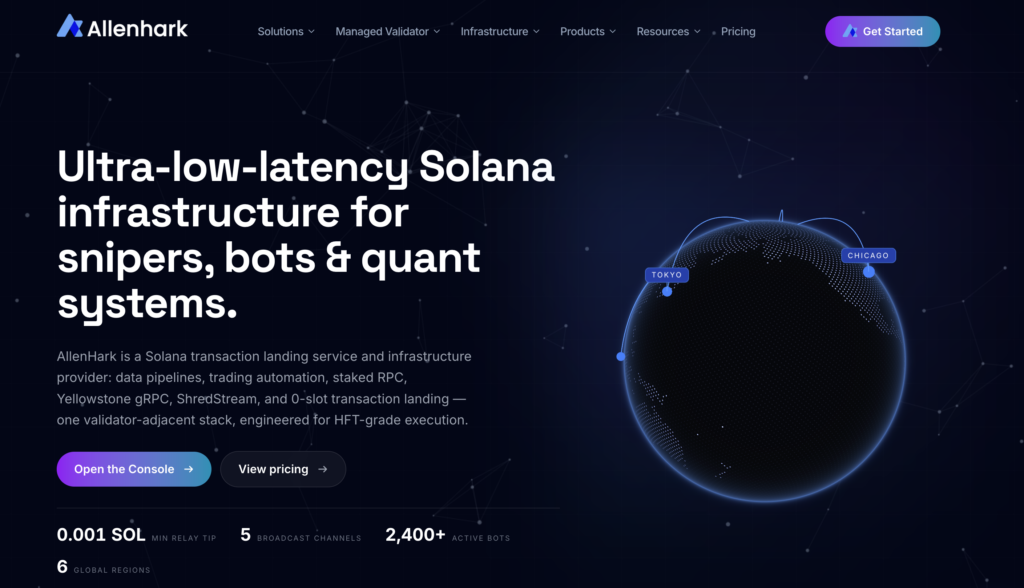
AllenHark skips general-purpose RPC entirely and builds for one workload: latency-sensitive transaction submission. Its stack pairs a staked RPC tier ($49/month) with Yellowstone gRPC for same-slot state subscriptions ($99/month) and ShredStream raw shred access from $10/day, running on bare-metal co-location in Frankfurt alongside Jito and Helius validators.
That co-location is the pitch — AllenHark cites an 80–150ms physical latency advantage for European transaction submission over US-only infrastructure, and the company reports over 2,400 trading bots running on its platform. It’s a poor fit for a wallet or NFT dashboard with no latency pressure, but for sniping bots and cross-DEX arbitrage, that’s exactly the workload it’s built around.
Helius
Helius is built specifically for Solana and leans into the problems generic RPC doesn’t solve well — indexed program-account queries, compressed NFT data through its DAS API, and priority-fee estimation. In Helius’s own 2026 benchmark, it posted the fastest measured getProgramAccounts p95 latency among the providers tested, at 82 milliseconds.
Being Solana-only is also its limitation: a team supporting multiple chains gets nothing from Helius elsewhere and needs a second provider regardless. For a Solana-first product, that specialization is exactly the point.
QuickNode
QuickNode supports Solana alongside 80-plus other chains and focuses on throughput at scale — its cached endpoints reportedly sustain around 5,000 requests per second on getBlock, well above a standard Agave node’s unassisted capacity. Its credit-based pricing charges roughly 30 credits per Solana call, which shifts real cost depending on which methods you lean on most.
That tooling is built for volume, and a small app with light traffic may not need most of it. For request-heavy trading and data pipelines, it’s a legitimate fit.
Alchemy
Alchemy pairs Solana RPC with the same application-level API layer it built for Ethereum — NFT metadata, token balances, and developer dashboards — aimed at teams that would otherwise build that indexing logic themselves. Independent benchmarking has consistently placed it behind Solana-native competitors on getProgramAccounts latency, since its infrastructure wasn’t built Solana-first. It remains reasonable for teams already standardized on Alchemy elsewhere.
Chainstack
Chainstack focuses on lower-cost access with a generous free tier — 3 million requests at 25 RPS, no card required — and a published entry rate around $2.45 per million requests. That makes it a common starting point for testing Solana integration.
The catch is feature depth: it doesn’t match Helius’s Solana-specific indexing or QuickNode’s volume tooling. For straightforward RPC and WebSocket access at a lower price, it’s a solid fit; for heavy getProgramAccounts workloads, usually not the first choice.
Triton One
Triton One runs open-source Solana infrastructure — including Yellowstone for gRPC streaming — and sells dedicated, bare-metal capacity rather than a shared multi-tenant pool. It’s built for enterprise teams and data pipelines needing predictable, isolated performance over a pay-per-call developer plan.
Its prepaid-plus-usage pricing and dedicated-first approach make it a poor fit for a small prototype, but a strong one for a team that has outgrown shared infrastructure.
Shared vs. Dedicated Solana Nodes: Which Do You Need?
Every provider above splits its offering into shared and dedicated infrastructure, and the choice affects both cost and performance ceiling. A shared node runs on infrastructure used by multiple customers at once, governed by request quotas and plan-based rate limits. A dedicated node is isolated to one customer, with throughput limited by allocated hardware rather than a fixed quota.
Shared nodes make sense for development, testing, and moderate production traffic where cost-efficiency matters more than a guaranteed ceiling. Dedicated nodes fit high-load trading systems, NFT platforms running constant getProgramAccounts scans, or anyone who has hit the limits of a shared plan. Neither option is universally better — they solve different problems.
How to Choose the Right Solana RPC Provider
Work through these questions in order rather than starting from a pricing page:
- Map your actual RPC calls. List the methods your app depends on —
getAccountInfo,getProgramAccounts,sendTransaction— since pricing and performance vary sharply by method on Solana. - Decide if you need indexed program data. If your app filters program accounts often, a Solana-native provider’s indexing usually outperforms a generic multi-chain endpoint.
- Weigh multi-chain simplicity against specialist depth, and test latency under your own load rather than a vendor’s advertised average.
- Confirm the migration cost. Since JSON-RPC is standardized, switching later is usually just an endpoint change, so it’s fine to start on a free tier and upgrade once real traffic patterns emerge.
Risks and Limitations to Watch For
A single RPC provider is a dependency, and dependencies fail. If your application only points at one endpoint, an outage or rate-limit spike becomes your outage — the common mitigation is running a second provider as failover.
Solana’s own characteristics add a layer most EVM chains don’t have. Real mainnet throughput has run around 1,900–2,500 transactions per second against a theoretical maximum of 65,000, per Coinlaw’s 2026 statistics, and finality is about to change: the Alpenglow consensus upgrade is expected to cut finality from roughly 12.8 seconds to about 150 milliseconds, altering what “confirmed” versus “finalized” means for indexing. Confirm how your provider plans to handle that transition.
Credit-based pricing is the other recurring issue. A plan that looks generous on its headline request count can still throttle you hard if your workload leans on getProgramAccounts or large getBlock calls, which cost far more per call than a basic balance check.
Conclusion
There’s no single best Solana RPC provider — only the one that matches your method mix, chain coverage needs, and tolerance for managing your own infrastructure. A multi-chain wallet or exchange gets the most value from a provider like NOWNodes that covers Solana alongside 120+ other networks under one account; a Solana-native NFT or DeFi app may lean toward Helius’s indexed data; a high-volume trading pipeline may need QuickNode’s or Triton One’s dedicated options.
What matters more than the brand name is verifying the specifics before you build on them: how a provider handles getProgramAccounts, the real cost of your heaviest methods, and what happens to your application the moment your provider has a bad day. Solana’s parallel execution model, covered in what the Solana Virtual Machine actually does, is what makes the network fast — but that speed only reaches your application through the RPC layer connecting you to it.
FAQ
Why is getProgramAccounts more expensive than a typical RPC call?
It scans every account a program owns rather than looking up a single record, and a Solana program can own hundreds of thousands of accounts. Providers handle this by pre-indexing program accounts, which is why performance on this one method varies more between providers than almost any other call.
Can I switch Solana RPC providers without changing my code?
Usually, yes. Since Solana RPC uses the standard JSON-RPC protocol, switching is typically an endpoint and API-key change rather than a logic rewrite — though credit costs and rate limits for specific methods differ between providers.
Do I need a dedicated Solana node for a prototype?
No. Shared nodes are built for development and moderate traffic, and most providers offer a free or low-cost tier that covers early-stage testing. Move to dedicated infrastructure once your getProgramAccounts load outgrows shared-tier limits.
Is a public Solana RPC endpoint safe to use in production?
Free public endpoints are useful for prototyping but typically enforce strict rate limits and often disable resource-intensive methods like getProgramAccounts. Use an authenticated plan once your application handles real user traffic.