
The best prediction markets in 2026 are Kalshi and Polymarket by volume, followed by a newer group of brokerage and sportsbook-branded apps: Robinhood, Fanatics Markets, OG.com and Crypto.com. A prediction market lets you buy shares in the outcome of a real event, and the share price doubles as the crowd’s probability estimate. Buy “Yes” at 62 cents and the market is pricing roughly a 62% chance.
The category has grown fast. Combined Kalshi and Polymarket volume more than doubled from $25.7 billion in May to $53.0 billion in July 2026, according to Pew Research Center’s analysis of data from The Block, and sports drove most of it.
This guide starts with the basics and works up to the details. You’ll see how prediction markets differ from sportsbooks, how to compare prediction market apps, what welcome offers actually are, and how on-chain settlement works. It also covers where trading is legal after a summer of conflicting court rulings.
What Is a Forecasting Market?
A prediction market turns a yes-or-no question into something tradable. Every contract is priced between $0 and $1, and it pays $1 if the event happens and $0 if it doesn’t. The price in between is the live estimate of the odds.
That’s the difference from a fixed-odds bet. A stock at $150 tells you nothing about what will happen next, but in a prediction market a Yes contract at 70 cents says traders collectively see a 70% chance.
You don’t have to wait for the result, either. Prices move as news breaks, so many traders sell their shares back before the event is decided. A prediction market position often feels closer to a stock trade than to one fixed wager.
Why Do Event-Contract Exchanges Exist?
They exist because a sportsbook and a poll both have a weakness. A sportsbook sets its own odds and takes the other side of your bet, so it profits when you lose. A poll is a snapshot that goes stale the moment news breaks.
A prediction market matches traders against each other and lets supply and demand set the price. Nobody in the middle has a stake in which side wins. Anyone who knows something the crowd doesn’t has a financial reason to act on it, which pulls that information into the price quickly.
Economist Robin Hanson has studied prediction markets for decades. He summarizes the research record this way:
“Our consistent experience with speculative markets is that when we compare them to other mechanisms like polls or committees they’re either about the same or substantially better.” — Robin Hanson, George Mason University, interview with Richard Hanania
The academic evidence is older and broader. In a widely cited paper in the Journal of Economic Perspectives, Justin Wolfers and Eric Zitzewitz found that market-generated forecasts are “typically fairly accurate” and outperform most conventional approaches.
Who Trades on These Platforms?
Politics gets the headlines, but sports gets the volume in every major prediction market. In July 2026, Kalshi’s sports contracts traded $31.4 billion and Polymarket’s traded $10.6 billion, per Pew. That is roughly 79% of the $53.0 billion combined total (my calculation from Pew’s figures), boosted by the FIFA World Cup.
Different groups come to a prediction market for different reasons:
- Sports bettors and daily-fantasy players who prefer exchange-style pricing to a sportsbook’s built-in margin. This is the audience behind Fanatics Markets, OG.com and Robinhood’s sports listings.
- Political and macro traders who use contract prices on elections, rate decisions or inflation prints as a live read on expectations.
- Crypto-native users who fund a wallet instead of a bank account and trade on-chain.
- Forecasters and researchers who treat the price as data, not a bet.
Which Trading Venues Lead in 2026?
Prediction market websites and apps fall into two groups. Some are exchanges in their own right, and others are front-ends that route your order to someone else’s exchange. Among the best prediction markets for US users, both types are common. The table below covers the ones people search for most, based on RotoWire’s platform pages, DeFiRate and company reporting as of September 2026.
| Platform | Who runs the exchange | US availability | Minimum age | Fees noted |
|---|---|---|---|---|
| Kalshi | Own CFTC-regulated exchange | 47 states + DC (not MN, NV, WA) | 18 | 2% deposit fee on cards, Venmo, PayPal, Google Pay; free by bank transfer |
| Polymarket US | QCEX-based, CFTC-regulated | 48 states + DC (not NY, NV) | 18 | 0.10% taker fee; USDC-funded |
| Robinhood | Robinhood Derivatives, routing to Kalshi, ForecastEX, Rothera and OG.com | 50 states + DC; sports limited in MD, NJ, NV | 18 | $0.02 per contract in total |
| Fanatics Markets | Cleared by Crypto.com | Derivatives North America | 22 states + 4 territories | 21 | Not stated |
| OG.com | Crypto.com spinoff, CFTC-licensed | Most states; some sports contracts excluded | 18 | Flat 2% per trade |
| Crypto.com | Crypto.com | Derivatives North America | Varies; New York excluded | 18 | $0 to $0.20 per contract, by outcome |
Fees and state lists change often. Confirm them inside the app before you deposit.
Regulated Exchanges: Kalshi and Polymarket
Kalshi is the larger US-regulated prediction market, and CoinDesk reported in June that it was seeking funding at about a $40 billion valuation, up from $22 billion. Polymarket, seeking about $15 billion at that point, took a longer road back to the US.
The CFTC fined its parent company $1.4 million in 2022 for running an unregistered event-contract facility. Polymarket then bought the licensed exchange QCEX for $112 million in July 2025, and the US version went live in early 2026.
Brokerage and Sportsbook-Branded Apps
These prediction market apps, Robinhood, Fanatics Markets and OG.com among them, mostly sit on top of licensed exchanges. On September 8, 2026, Robinhood announced a multi-year deal to route event-contract volume through OG.com and take an equity stake in it, according to Axios. Robinhood previously relied on Kalshi alone and now spreads flow across several exchanges.
The practical difference for you is small: the contracts look similar, but sign-up steps, age limits and state coverage differ. Fanatics Markets, for example, requires you to be 21 and isn’t live in every state.
Do Welcome Offers, Coupons and Discounts Exist?
Mostly not in the form people search for. Every prediction market app advertises a welcome offer, but queries like “Robinhood promo code” or “Robin Hood coupon” lead to welcome offers that apply automatically, and codes you find on affiliate sites are usually referral links.
Here is what the offers looked like in September 2026, per RotoWire and DeFiRate:
- Robinhood: No promo code. New users get $5 to $200 in free reward stock automatically, and most receive the $5 tier. The stock has a three-day hold before you can sell it.
- Fanatics Markets: The Fanatics Markets promo is an automatic trade-match paid in FanCash, described as up to $350 over 14 days with daily caps, and only trades priced at $0.90 or below count, according to RotoWire. Other trackers list a smaller $75 credit, so the amount clearly varies.
- OG.com: Searches for “og bonus.com” lead to a trade-match offer, but reviewers quote $10 in some places and $25 in others. Treat the figure as unsettled.
- Crypto.com: There’s no Crypto.com discount code. What lowers your cost is the fee design: per DeFiRate, contracts that settle out of the money carry no fee, in-the-money contracts pay $0.10, and closing early costs $0.20.
One rule applies across the board. Bonus credit usually can’t be withdrawn until you’ve traded it, and it doesn’t change the odds on any contract.
How Does an On-Chain Market Work?
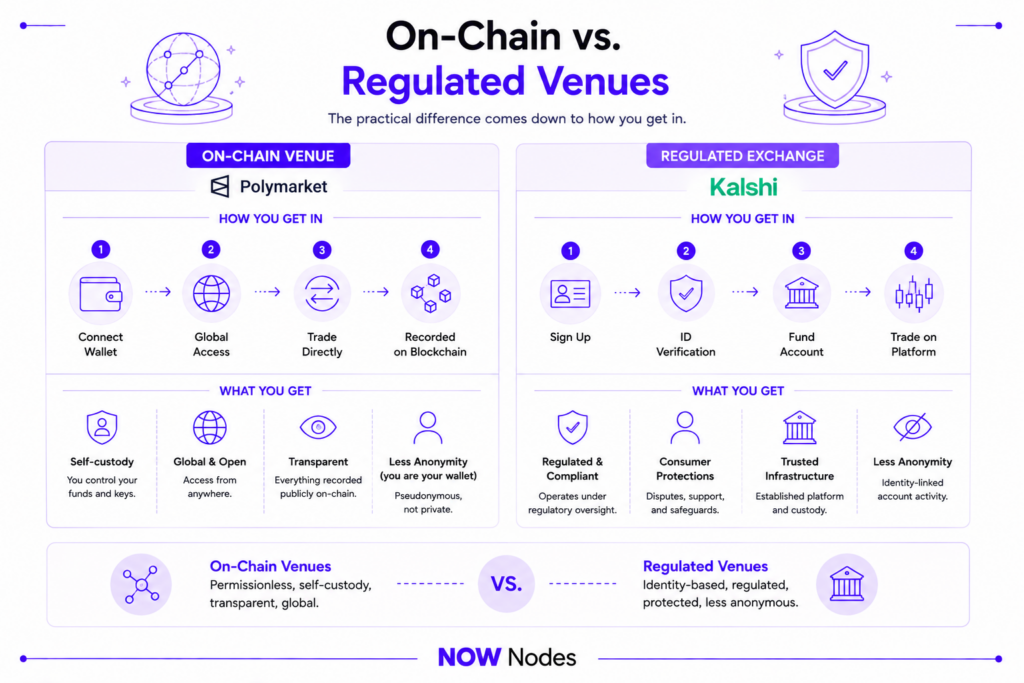
The Polymarket prediction market platform is the clearest example of on-chain settlement. Per Polymarket’s documentation, $1 of pUSD, an ERC-20 token backed by USDC, mints one Yes share and one No share. The shares are ERC-1155 tokens on Polygon, and trades happen on an order book where users deal with each other rather than a house.
Who decides the winner is where it gets interesting. Polymarket uses the UMA Optimistic Oracle, which works in four steps:
- A proposer submits an outcome and posts collateral.
- A challenge window opens, and anyone can dispute the proposal.
- If nobody disputes, the outcome becomes final.
- If someone does, UMA token holders vote, and winning shares redeem for $1.
Regulated exchanges skip this crowd vote. Kalshi and its peers resolve markets under their own published rulebooks, with a regulator supervising the exchange.
Because Polymarket’s shares live on Polygon, developers building position trackers or analytics dashboards read that chain directly. One option is NOWNodes’ Polygon access, which supports WebSocket connections for live updates, alongside a Market Data API covering 9,000+ cryptocurrencies for price context. You can browse supported networks if your project spans other chains.
Is Trading Legal Where You Live?
Federally, yes: these contracts trade on CFTC-regulated exchanges. States are pushing back, and the courts disagree with each other. Here is the timeline, drawn from RotoWire’s legal tracker:
- April 2026: The Third Circuit held that federal law preempts state gambling rules for sports contracts on CFTC-registered exchanges.
- July 31, 2026: New York sued Kalshi, calling it an illegal gambling operation. RotoWire reports the suit seeks more than $36 billion, and that the CFTC responded with emergency authority to keep Kalshi operating.
- August 28, 2026: The Ninth Circuit reached the opposite conclusion, ruling that states can regulate sports event contracts.
- September 2, 2026: New Jersey petitioned the Supreme Court to resolve the split.
That’s why platform availability differs so much by state. Until the Supreme Court weighs in, a venue open in your state today could restrict access tomorrow, so check the current rules before you fund an account.
What Are the Risks and How Do You Choose?
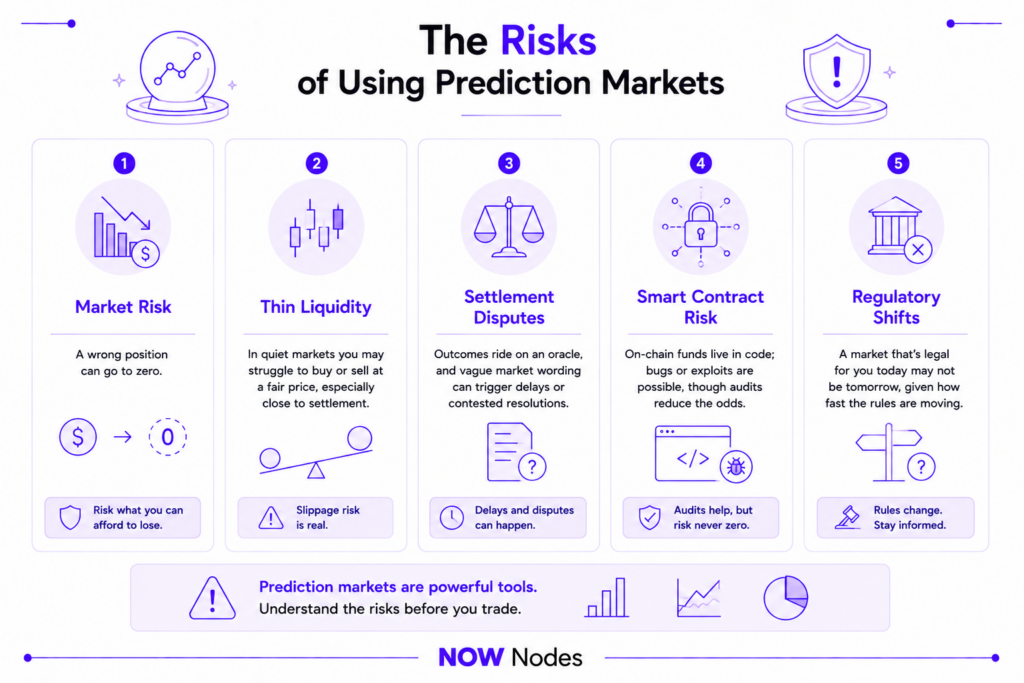
Losses are bounded: a standard contract can lose at most what you paid for it, unlike margin trading. That doesn’t make it safe. Thin markets can show prices you can’t actually trade at, and a contract can resolve in a way you didn’t expect if you skip the rules.
Smart contract risk applies to on-chain venues, and regulatory risk applies to all of them. A decision usually comes down to four checks:
- Availability: Is the platform live in your state, and are you old enough there?
- Custody: Do you want a bank-linked account or a wallet you control?
- What you’ll trade: Sports-heavy apps and politics-and-macro venues list different things.
- Total cost: Add up deposit fees, per-contract fees and withdrawal terms, not just the headline promotion.
Conclusion
There’s no single winner among prediction markets, and the best prediction markets for you depend on your state, your custody preference and what you trade. Kalshi and Polymarket lead on volume, while Robinhood, Fanatics Markets, OG.com and Crypto.com win on convenience if you already use them. The mechanic behind all of them is the same: a price that doubles as a probability.
Volume has doubled in two months and the legal picture is unresolved. Treat every figure in this guide as a September 2026 snapshot, and read a platform’s current terms before you deposit anything.
FAQ
Do event-contract winnings get taxed?
In the US, profits from event contracts are generally treated as taxable, but the exact category is still being contested. This isn’t tax advice, so check with a qualified professional.
Can you lose more than you put in?
No. A contract’s price is capped between $0 and $1, so the most you can lose is what you paid. Leveraged products work differently, so check what you’re actually buying.
What is the minimum age to trade?
Most platforms require 18, but Fanatics Markets requires 21, and some states set a higher bar for gambling-adjacent products. Check your state’s rule and the platform’s terms.
Can you withdraw a welcome bonus straight away?
Usually not. Most offers pay out as credit or reward stock that must be traded or held for a set period first. Read the terms on the offer page before you rely on it.