
The two largest decentralized exchanges on TON are STON.fi and DeDust, and the main venue for leveraged trading is Storm Trade. But “best” is the wrong question until you know what you’re trying to do. Swapping one jetton for another, parking liquidity to earn fees, and shorting Bitcoin with leverage all point to different apps.
This guide compares the TON DEXs worth using in 2026, what each one is good at, and where it falls short.
First, a naming note that trips people up. The network is The Open Network, still called TON. Its native coin was renamed in June 2026: after an 81.22% community vote, Toncoin became Gram, with the ticker moving from TON to GRAM on June 15. Balances, addresses, and smart contracts didn’t change, and no migration was ever required. So when you see “GRAM” below, that’s the coin you used to know as Toncoin, and “TON” refers to the chain it runs on.
What is a decentralized exchange on TON?
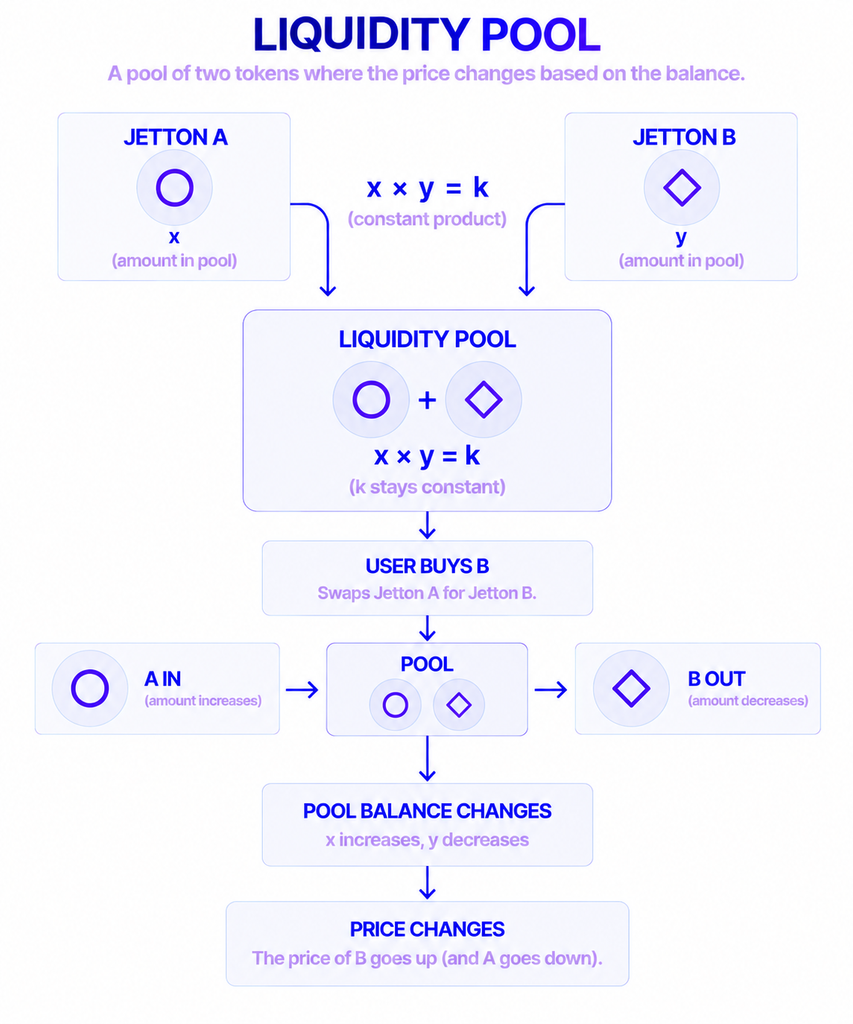
A decentralized exchange on TON is a set of smart contracts that lets you trade tokens straight from your wallet, with no account, no KYC, and no company holding your coins. You connect a TON wallet, approve a swap, and the contract does the rest on-chain.
Most of these trades run on an automated market maker (AMM). Instead of matching buyers to sellers through an order book, an AMM prices trades against a liquidity pool: a smart contract holding a pair of tokens, where the price shifts along a formula as the balance changes. STON.fi’s pools use the classic constant-product formula, written x*y=k, documented in its developer docs.
Two terms show up constantly. Jettons are TON’s fungible-token standard, roughly the equivalent of ERC-20 on Ethereum. Liquidity providers are the users who deposit token pairs into a pool and earn a cut of the trading fees in return. Everything stays non-custodial, which means the coins sit in your wallet until the moment a swap executes.
Why trade on a DEX instead of a centralized exchange?
A centralized exchange holds your funds and asks for identity documents before you trade. A DEX does neither, and on TON that difference has teeth. New jettons almost always appear on a decentralized exchange first, often long before any listing on Binance or Bybit, so a DEX is where early liquidity lives.
The TON chain also suits this style of trading. Blocks are produced every few seconds and fees are tiny, so a swap settles in seconds for a fraction of a cent. Because much of the ecosystem runs inside Telegram, you can reach many of these apps without leaving a chat.
People generally come to a DEX on TON for one of three reasons: to swap tokens, to provide liquidity and earn passive fees, or to trade derivatives like perpetual futures. The right platform depends on which of those you’re doing.
Who uses decentralized exchanges on TON?
Four groups, mostly. Everyday users swap GRAM for USDT or a jetton, often through a Telegram mini-app. Liquidity providers deposit pairs into pools to earn yield. Active traders use leverage and derivatives venues to go long or short. And builders rely on the same infrastructure to power swaps and payments inside their own products.
If you only ever move small amounts between tokens, a simple swap interface is all you need. The deeper features — farming, concentrated pools, perpetuals — matter once the sums get larger or the strategy gets more active.
How to choose a DEX on The Open Network
Start with liquidity. A pool with deep liquidity fills your trade close to the quoted price; a thin one moves the price against you, an effect called slippage. For any sizeable trade, the venue with the most liquidity in that specific pair usually gives the better fill.
A few other factors decide the rest:
- Fees — most TON swaps cost around 0.3%, but the exact rate is set per pool, so check before you confirm.
- Pool types — stable pairs (like two stablecoins) and volatile pairs are priced differently; some DEXs run specialized pools for each.
- Track record and audits — established contracts with a public history and third-party audits carry less risk than a brand-new, unaudited one.
- Aggregator coverage — increasingly, you don’t have to pick at all. Aggregators route a single swap across several DEXs to find the best price, which matters more below.
The best decentralized exchanges on TON in 2026
TON’s DeFi sector is modest next to Ethereum or Solana — total value locked sits around $71 million as of late 2026, per DefiLlama — but it’s active, and liquidity concentrates in a handful of venues. Here are the ones that matter.
| DEX | Type | Best for | Standout feature | Typical fee |
|---|---|---|---|---|
| STON.fi | AMM (spot swaps) | Everyday swaps, major pairs | Omniston smart routing; largest liquidity | ~0.3% per swap |
| DeDust | AMM (spot swaps) | Stable and specialized pools, jettons | Native TON design (Protocol 2.0) | Set per pool |
| Storm Trade | Perpetuals / derivatives | Leverage, forex, and commodities | Up to 500x; Telegram-native | Funding + trading fees |
STON.fi — the largest DEX on TON
STON.fi is the default starting point for most swaps on TON. It’s the biggest decentralized exchange on the chain by total value locked, holding roughly $29 million of the network’s DeFi liquidity according to DefiLlama, and it’s usually the deepest market for major pairs like GRAM/USDT.
Under the hood it’s a constant-product AMM with yield farms, where liquidity providers stake LP tokens for extra rewards, and a native STON token for governance. Its v2 pools added single-sided liquidity, so you can supply one token instead of a balanced pair. Core pool contracts are immutable and router upgrades carry a seven-day time-lock, both aimed at reducing the “the team changed the code overnight” risk. The protocol has powered over 29 million swaps and more than $6.5 billion in volume.
STON.fi also runs Omniston, a liquidity aggregation layer that now sources quotes across multiple TON DEXs and turns on by default inside the app. “Omniston transforms how liquidity flows through the TON ecosystem,” said Slavik Baranov, CEO of STON.fi, describing it as a single integration point for builders. The practical result: a swap on STON.fi can pull liquidity from several venues at once.
Who it’s for: anyone who wants the deepest liquidity and the simplest path to a good price on a standard swap.
DeDust — native design and strong specialized pools
DeDust is the second-largest DEX on TON and the one built most deliberately around the chain’s own architecture. Its DeDust Protocol 2.0 leans on TON’s actor model and sharding rather than porting a design from Ethereum, which the team argues makes it more gas-efficient on this network specifically.
For traders, the useful detail is its pool structure. DeDust runs both volatile pools and stable pools (the Curve-style design for assets meant to hold the same value, like two stablecoins), plus multi-hop routing that swaps token A to token C through an intermediate pair when no direct pool exists. That makes it a strong choice for stablecoin pairs and for jettons that trade better on DeDust than elsewhere.
Who it’s for: liquidity providers and traders who want native-TON pools and solid depth on stable or specialized pairs. In practice, it’s worth quoting both DeDust and STON.fi and taking the better price.
Storm Trade — perpetuals and leverage on TON
Storm Trade is a different animal: a derivatives venue, not a spot DEX. It’s the leading perpetual-futures platform on TON, and perps now drive real volume on the chain — weekly perpetuals volume has at times run higher than spot DEX volume, per DefiLlama.
You connect a TON wallet, post GRAM or USDT as margin, and open long or short positions. Storm supports up to 500x leverage on some markets and lists crypto, forex, equities, and commodities, so it functions like a decentralized derivatives desk inside Telegram. It uses a virtual AMM for pricing, requires no KYC, and layers on copy trading and trading tournaments, plus a STORM utility token for fee discounts and staking. The platform reports more than $4.5 billion in cumulative trading volume.
One honest caveat: leverage this high amplifies losses as much as gains, and positions liquidate fast when the market moves against you. Perpetuals are a high-risk product regardless of how clean the interface is.
Who it’s for: experienced traders who want leverage and non-crypto markets without bridging off TON.
Newer venues and the rise of aggregation
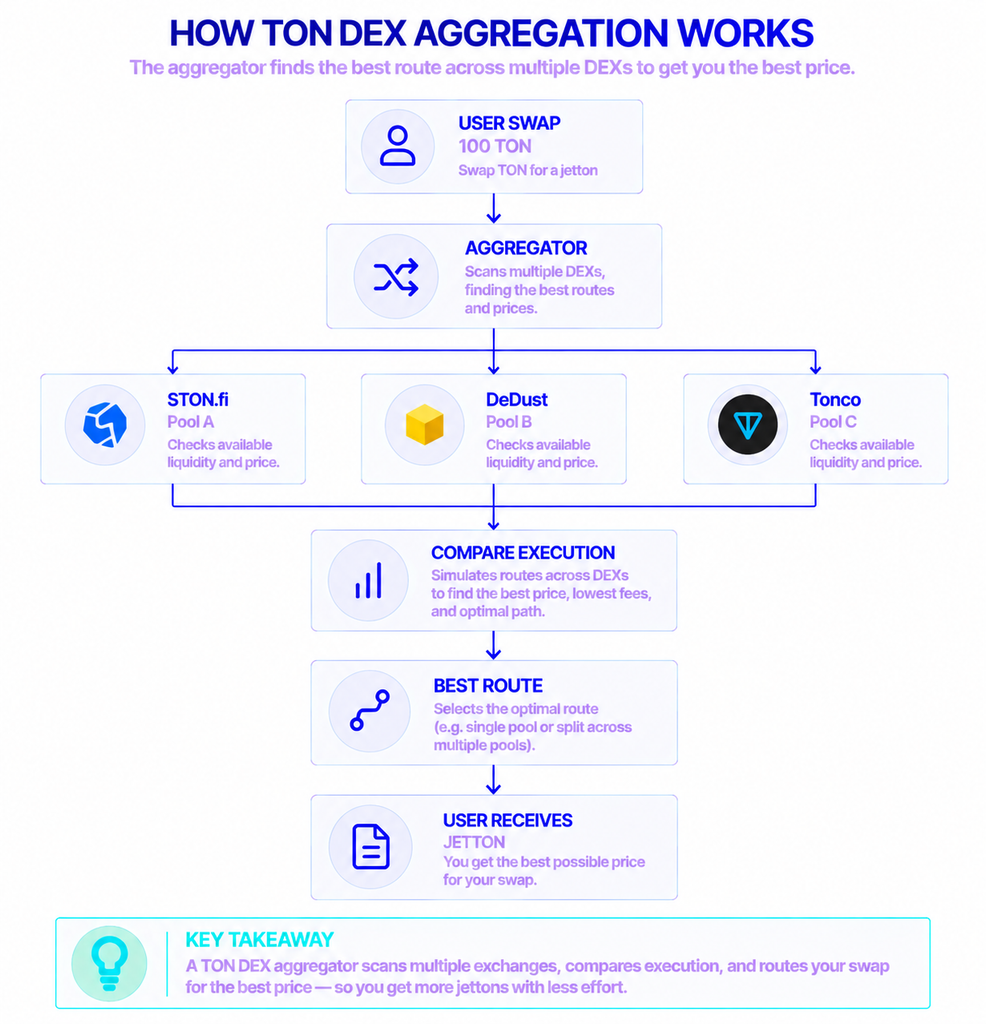
Two shifts are reshaping how TON trading actually works. First, newer DEXs keep arriving — Tonco is a growing venue for swaps and pools, and swap.coffee operates as an aggregator — so liquidity is spreading across more places, not fewer.
Second, aggregation is absorbing that fragmentation. By April 2025, liquidity on TON was already spread across more than 115,000 DEX pool instances, which is great for decentralization and terrible for getting a clean price by hand. Aggregators like Omniston now scan STON.fi, DeDust, Tonco, swap.coffee, and other pools and route one swap across several at once. For a simple trade in 2026, the more useful question is often “which app gives me the best routed price” rather than “which single DEX should I use.”
How to stay safe on TON decentralized exchanges
The chain itself is hard to attack, but the human layer is not. A few habits remove most of the risk.
Confirm the official domain before you connect a wallet. Fake lookalike sites and copycat apps are common, and the wrong URL can drain an account in one approval. This is also worth remembering for names that circulate in searches or ads but aren’t among the chain’s real liquidity leaders — “TonSwap,” for instance, is a label that’s attached to small and early TON projects over the years rather than a top venue, so stick to established exchanges and verify the address yourself.
Then check the token before you trade it. Scam jettons copy real names and logos, so match the contract address against an official source. On thin pools, watch slippage and be aware that low-liquidity trades are the easiest targets for sandwich-style MEV. And favor platforms with audits and a track record over anything brand-new and unproven. No swap can be reversed once it’s on-chain, so the checks happen before you confirm, not after.
Where NOWNodes fits for TON builders
Most readers just want to trade. But if you’re building the app — a wallet, a swap widget, a bot that reads GRAM balances or tracks jetton transfers — your product needs a reliable connection to TON running behind it.
Operating that yourself means syncing and maintaining backend infrastructure around the clock. NOWNodes offers hosted API access to TON, alongside 120+ other networks, so a team can query balances, follow transactions, and broadcast payments through an endpoint instead of running the backend. NOWNodes exposes standard interfaces and developer docs for the network; it’s infrastructure for builders, not a DEX or a wallet. The exchanges above are where end users actually trade.
The bottom line
For a straightforward swap, STON.fi is the sensible default: the deepest liquidity on TON and smart routing that pulls from other venues automatically. DeDust is the one to quote alongside it, especially for stablecoin and specialized pairs. For leverage, forex, or commodities, Storm Trade is the venue that brings real derivatives onto the chain. And with aggregation now routing trades across all of them, the gap between “which DEX” matters less every month. Match the platform to what you’re doing, verify the domain, and size your trades for the liquidity that’s actually there.
FAQ
Which decentralized exchange on TON is best for beginners?
STON.fi. It has the largest liquidity on the chain, a simple swap interface, and smart routing that finds a good price across venues without you configuring anything. It’s the lowest-friction place to make a first trade.
Do I need GRAM to use a DEX on TON?
Yes. TON charges network fees in GRAM (the coin formerly called Toncoin), so you need a small amount to cover gas even when you’re swapping other tokens. Keep a little GRAM in your wallet before you start, or your swap won’t go through.
How do I connect my wallet to a TON decentralized exchange?
Open the DEX, choose “connect wallet,” and approve the TON Connect prompt in a non-custodial TON wallet such as Keeper (formerly Tonkeeper). The DEX never holds your keys; it only asks your wallet to sign each transaction, and your funds stay in the wallet until a swap executes.
What fees do decentralized exchanges on TON charge?
Spot swaps typically cost around 0.3%, though the exact rate is set per pool, and you also pay a tiny network fee in GRAM. Derivatives venues like Storm Trade work differently, charging trading fees plus funding payments on open perpetual positions rather than a flat swap fee.