
DeFi apps are on-chain applications (also called crypto dapps) that let you lend, borrow, trade, or earn yield through smart contracts instead of a bank or broker. The best DeFi apps in 2026 are the ones that kept real capital through this year’s shakeout: Lido, Aave, Morpho, Uniswap, and Hyperliquid lead their categories.
DefiLlama shows $94.2 billion locked across DeFi protocols on September 24, 2026. That follows a rough year: DeFi TVL fell about 39% from roughly $115 billion in January to around $70 billion, according to CryptoRank via Yahoo Finance. TVL, or total value locked, is the dollar value of assets deposited in a protocol’s smart contracts.
This guide gives the DeFi meaning in plain language, shows who uses these DeFi platforms, and lays out a DeFi protocols list with current numbers, organized as a dapps ranking by category. It also covers how to vet a platform and what the year’s biggest exploits taught the industry.
What Is Decentralized Finance?
Decentralized finance is a set of financial services, such as saving, lending, trading, and insurance, that run as smart contracts on a public blockchain and are open to anyone with a wallet. Ethereum.org defines it as “a collective term for financial products and services that are accessible to anyone who can use Ethereum.” A smart contract is code that executes automatically when its conditions are met, with no clerk approving anything.
Three building blocks make it work:
- Smart contracts hold funds and enforce the rules, such as a loan’s collateral ratio.
- Wallets give you self-custody: you sign every transaction with your own private key.
- Stablecoins and oracles supply the dollar-priced unit of account and the off-chain price data that contracts can’t see on their own.
Stablecoins matter most here. DefiLlama tracks a $306 billion stablecoin market, with USDT at roughly $183.5 billion (about 60%) and USDC at $75.4 billion.
Why Does On-Chain Finance Exist?
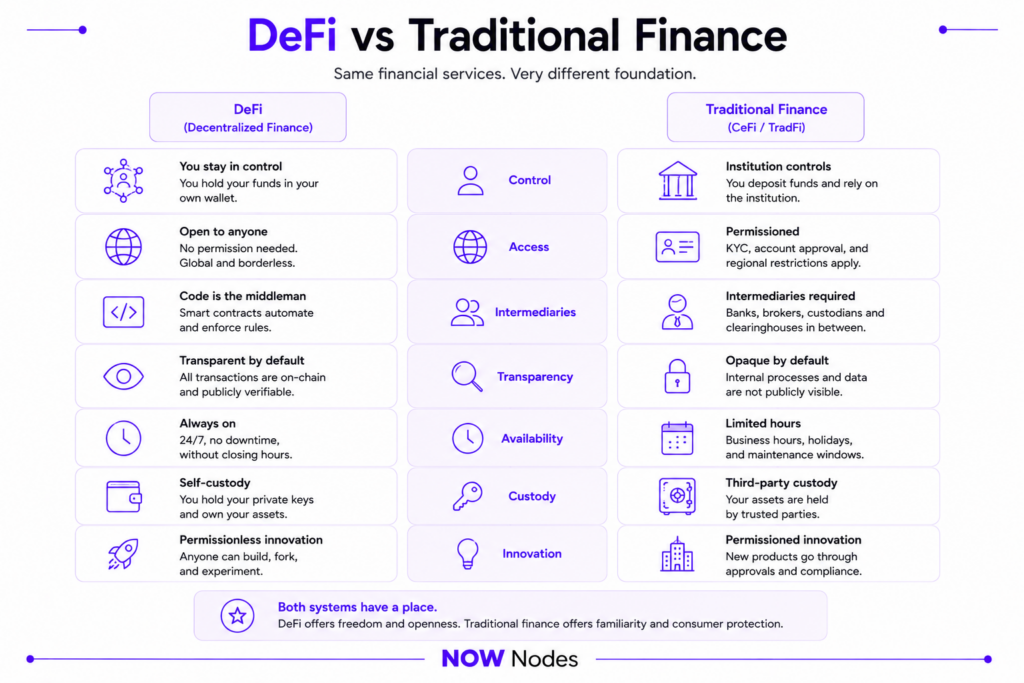
It exists because traditional finance is gated: you need an account, a credit check, and business hours. A wallet and an internet connection replace all three. Markets run 24/7, and every transaction sits on a public ledger that anyone can audit.
The trade-off is real. There’s no deposit insurance, no chargeback, and no support desk. Most actions are final the moment they confirm.
| Area | Traditional finance | DeFi |
|---|---|---|
| Access | Application, ID, credit check | Wallet and internet connection |
| Custody | Institution holds your funds | You hold your keys |
| Hours | Business hours | 24/7 |
| Transparency | Private ledgers | Public, auditable transactions |
| Recourse | Insurance, chargebacks | None, actions are final |
Who Uses These Apps?
Retail users of DeFi apps park stablecoins in lending markets for a variable rate, or swap tokens straight from a wallet. Active traders pick a DeFi trading platform for tokens that haven’t reached a centralized exchange yet. Developers treat web3 DeFi as open-source building blocks, since one protocol’s output can feed another, a property called composability.
DAOs and protocol treasuries put idle funds to work as well, which ties into how a DAO holds and governs money. The newest group is institutions. Aave V4 went live on Ethereum in March 2026 and passed $250 million in net deposits, and founder Stani Kulechov sees tokenized real-world assets as the next wave:
“It’s about using the infrastructure we’ve built, which is successful with native crypto assets, and applying that to all asset classes that are coming onchain.” — Stani Kulechov, Aave founder, The Block
Tokenized assets already total about $60 billion on-chain, and Kulechov expects $100 billion by the end of 2026. Whether that happens is a forecast, not a fact.
What Types of On-Chain Finance Apps Exist?
Most top DeFi platforms fall into six categories. The table below is a working DeFi list built from DefiLlama’s live rankings on September 24, 2026, so treat every number as a snapshot.
| Category | What it does | Leading examples | Scale |
|---|---|---|---|
| Liquid staking | Stake ETH, get a tradable receipt token | Lido, ether.fi | Lido $26.1B TVL; ether.fi $5.0B |
| Lending | Deposit for interest, borrow against collateral | Aave, Morpho, Spark | Aave $19.2B; Morpho $10.8B; Spark $7.2B |
| Exchanges (DEX) | Swap tokens from your wallet | Uniswap, PancakeSwap, Curve | $8.5B DEX volume in 24 hours (all DEXs) |
| Perpetuals | Leveraged futures on-chain | Hyperliquid, GMX | $25.2B perp volume in 24 hours (all venues) |
| Stablecoin issuers | Mint dollar-pegged tokens against collateral | Sky (ex-MakerDAO), Ethena | Sky $5.8B; Ethena USDe $4.9B |
| Restaking | Reuse staked ETH to secure other services | EigenCloud | $7.0B TVL |
Source: DefiLlama. Categories and figures follow DefiLlama’s own classification.
Lending Markets: Aave, Morpho, Spark
A lending market lets you deposit an asset and earn interest paid by borrowers, who must post more collateral than they borrow. Aave is the largest by TVL and runs on 23 chains, while Morpho has grown to $10.8 billion across 45 chains by letting curators set up isolated markets. Aave V4’s “Hub and Spoke” design lets separate markets tap shared liquidity while keeping their own risk settings.
Lending rates on these DeFi protocols float with demand. More borrowers wanting an asset means a higher rate for depositors.
Exchanges and Perpetuals: Uniswap, PancakeSwap, Hyperliquid
A decentralized exchange swaps one token for another against a pool of funds instead of matching buyers and sellers. Uniswap and PancakeSwap are the best-known DeFi dapps in this group, and how a DEX settles a trade is worth understanding before you use one. On the derivatives side, Hyperliquid’s bridge holds $7.4 billion, and perpetual futures now trade at roughly three times the daily volume of spot swaps across all venues.
That gap says something about demand. Leverage-hungry traders moved on-chain faster than casual swappers did.
Liquid Staking and Restaking: Lido, ether.fi, EigenCloud
Liquid staking lets you stake ETH and get a receipt token, such as Lido’s stETH, that you can still lend or trade. Lido holds $26.1 billion and is the largest of all DeFi projects on DefiLlama by a wide margin. Restaking goes a step further and lets the same staked ETH secure additional services, at the cost of stacking more risk on one deposit.
Bitcoin Finance and Other Application Types
Bitcoin DeFi is smaller than most people assume. According to Spark’s 2026 BTCFi research, only about 91,300 BTC, 0.46% of circulating supply, sits in Bitcoin DeFi, against roughly 15% for Ethereum. The survivors include Babylon (native BTC staking, $4 billion+), Lombard (liquid staking, $1.5 billion), and Core DAO ($314 million).
For Bitcoin dapps, the lesson was that copying Ethereum’s designs onto new chains didn’t work without new primitives. Outside finance, the most popular dapps by category include prediction markets like Polymarket, games, and social apps such as Farcaster.
How Do You Vet an On-Chain Finance Platform?
Picking the best DeFi app for your goal starts with the protocol’s track record. Then work down this list:
- Check age and TVL. Look the protocol up on DefiLlama. Billions held for years is a stronger signal for DeFi projects than a new fork with a triple-digit APY.
- Read the audit and ask who holds the admin keys. A clean code audit doesn’t cover a compromised operator, and smart contract auditing firms explain what a review actually checks.
- Find where the yield comes from. Interest from borrowers or trading fees is durable. Token emissions dilute as more users arrive.
- Match the chain to your budget. A 4% stablecoin yield can vanish into Ethereum gas on a small deposit.
- Verify the URL and contract address, then start small. Bookmark the official site and send a test transaction first.
The community-maintained awesome decentralized finance repository on GitHub is a good place to browse categories beyond those above.
What Are the Main Risks?
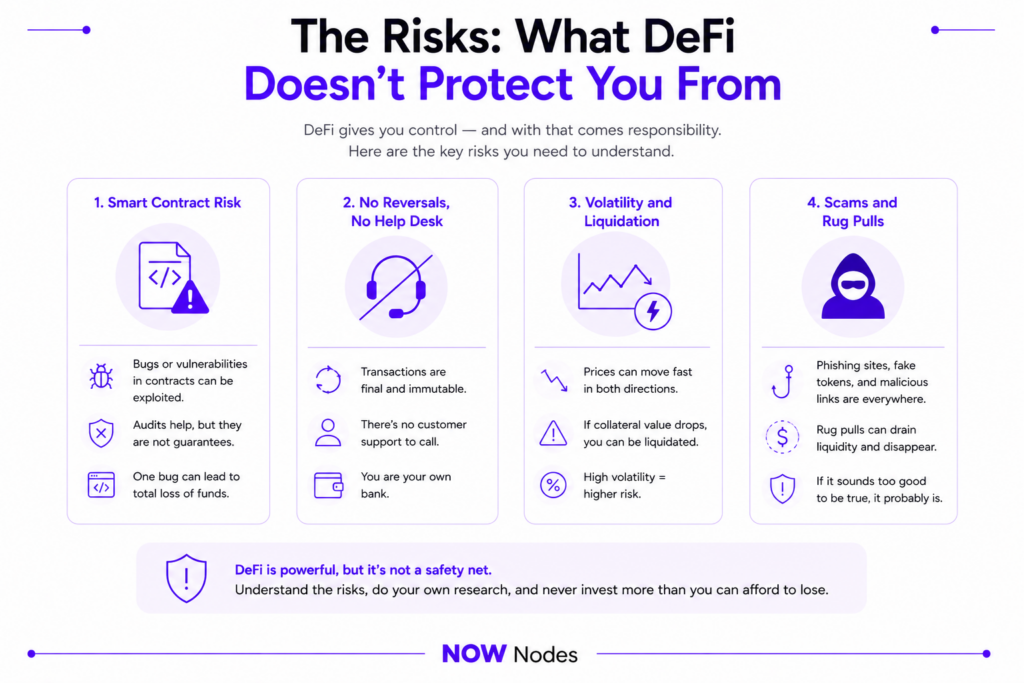
The largest risk for DeFi apps in 2026 wasn’t a coding bug. Compromised private keys and admin credentials now cause more stolen dollars than smart contract vulnerabilities, a first on record, per CertiK’s Hack3d report as covered by crypto.news. DeFi lost about $1.3 billion to hacks in the first half of 2026 alone.
“A protocol can pass a flawless code audit and still lose millions because of a compromised admin key.” — Ronghui Gu, CertiK, via crypto.news
The April KelpDAO exploit shows how one failure spreads. An attacker took about $292 million through a flaw in a bridge integration, then deposited the unbacked rsETH into Aave and borrowed roughly $190 million against it, per CoinDesk. Aave’s TVL dropped 46%, from $26.4 billion to $14.3 billion, as depositors withdrew.
Other risks are older and still active:
- Liquidation: if collateral value falls below the required ratio, the protocol sells it automatically.
- Impermanent loss: liquidity providers can end up with less value than if they’d simply held both tokens.
- Scams: fake tokens and rug pulls exploit the fact that anyone can deploy a contract.
- Theft at scale: Chainalysis counted over $3.4 billion stolen across crypto in 2025, $1.5 billion of it from the Bybit breach.
None of this is investment advice. Verify rates, audits, and current incidents on the protocol’s own channels before depositing.
What Infrastructure Runs Underneath These Apps?
Every balance, quote, and swap in crypto DeFi apps is a blockchain read or write, and that traffic goes through RPC endpoints: servers that query chain data and broadcast signed transactions. Running your own node for each chain means syncing, updating, and scaling it, which is why most DeFi companies and independent teams building DeFi applications use a provider instead.
NOWNodes shared nodes give API access to blockchains across 120+ networks, so a wallet, dashboard, or bot can read chain state without a self-hosted node. Teams with heavy or private workloads can move to dedicated nodes, and the Market Data API covers 9,000+ cryptocurrencies for the prices that turn raw token balances into dollar values.
Conclusion
The DeFi landscape in 2026 is smaller than its peak, but the DeFi platforms that remain are the ones that survived several exploits and a 39% drawdown. Lido, Aave, and Morpho lead on capital, Uniswap and Hyperliquid on trading, and Babylon on Bitcoin.
Whichever DeFi app you pick, choose by track record and yield source, not headline APY. Watch operational security as closely as code audits, and start with an amount you can afford to lose.
FAQ
Do You Need ETH to Use These Apps?
You need the native token of whichever chain you use to pay network fees. That’s ETH on Ethereum, BNB on BNB Smart Chain, and SOL on Solana. Without it, you can’t sign a transaction, even if you hold plenty of stablecoins.
How Does an On-Chain Application Differ From a Protocol?
A dapp is any application whose backend logic runs on smart contracts. Examples of dapps include games, marketplaces, and social apps, and the top Ethereum dapps by usage are mostly financial. A DeFi protocol is the financial contract set itself, such as Aave’s lending pools. The website you click is usually just one of several front ends for it.
Are Bitcoin Lending and Staking Apps Built on Bitcoin Itself?
Mostly no. Many use wrapped BTC on Ethereum or sidechains, which adds custody and bridge risk. Babylon is the notable exception, since it stakes native BTC without wrapping it.
Are Rewards and Interest Taxable?
In most jurisdictions, yes. Interest and rewards are usually treated as income when received, and selling later can trigger capital gains. Rules vary by country, so confirm with a tax professional.
Can a Protocol Be Shut Down?
A website can be taken down, but the smart contracts keep running on the blockchain regardless. That’s why DeFi protocols often stay reachable through alternative front ends after a domain is seized.