
What Is GetBlock?
GetBlock is a Web3 infrastructure provider that gives developers RPC access to blockchain networks without running their own nodes. Instead of syncing and maintaining servers, you send JSON-RPC or WebSocket requests to GetBlock’s endpoints and get back on-chain data — balances, transactions, smart contract state, and more.
The service has grown into a broad multi-chain platform. GetBlock now supports 130+ blockchain networks across EVM, non-EVM, L2, and enterprise ecosystems, with geo-selectable endpoints in Frankfurt, New York, and Singapore. It offers three product tiers: Shared Nodes billed on Compute Units, a flat-rate Limitless Node, and fully isolated Dedicated Nodes.
It’s a capable provider, but it isn’t the right fit for every team. Some developers hit its rate limits, want wider chain coverage, need stronger compliance documentation, or simply want to compare pricing before committing. That’s where looking at GetBlock alternatives makes sense — the market has matured, and several providers now match or exceed GetBlock on specific axes.
This guide walks through seven strong GetBlock alternatives, starting with a side-by-side table and then covering each in detail so you can match a provider to your actual workload.
Why Look for a GetBlock Alternative?
Because no single node provider is best at everything, and the right choice depends on what you’re building. A few concrete reasons teams switch or add a second provider:
- Chain coverage gaps. If your project spans many networks — especially newer L1s or non-EVM chains — you may need broader support than any one endpoint offers.
- Rate limits and throughput. Shared plans cap requests per second. High-frequency workloads like trading bots or indexers often outgrow entry tiers fast.
- Pricing predictability. Compute Unit and credit models can produce surprise overage bills. Some teams prefer flat, RPS-based pricing they can forecast.
- Compliance requirements. Regulated fintechs often need SOC 2 Type II or ISO 27001 documentation, which not every provider publishes.
- Support quality. When an endpoint degrades in production, ticket-queue response time becomes a real business risk.
- Redundancy. Best practice in 2026 is a multi-provider setup with automatic failover, so most serious teams run at least two providers anyway.
The point isn’t that GetBlock is weak — it’s that “best provider” only means something once you name your chains, your request volume, and your budget.
GetBlock Alternatives at a Glance
Here’s how seven leading alternatives compare on the specs that matter most. NOWNodes leads on raw chain coverage; each of the others has a distinct strength.
| Provider | Networks | Uptime SLA | Pricing model | Free tier | Best for |
|---|---|---|---|---|---|
| NOWNodes | 120+ | 99.9%+ | Flat, no RPS limits on paid plans | Yes | Widest coverage, fast human support |
| QuickNode | 80+ | 99.99% | Credit-based + flat-rate RPS | No permanent free plan | Performance, enterprise compliance |
| Alchemy | 100+ | 99.9%+ | Compute Units (CU) | 30M CU/month | Developer tooling, enhanced APIs |
| Chainstack | 70+ | 99.99% | Flat request-based | Limited | Cost predictability, compliance |
| Ankr | 80+ (Premium) | 99.9%+ | Credit-based (DePIN) | 200M credits/month | Generous free volume, decentralization |
| Infura | 20+ | 99.9%+ | Credit-based | Yes | Ethereum-first, MetaMask integration |
| dRPC | 100+ | 99.9%+ | Pay-as-you-go | Yes | Decentralized routing, redundancy |
A quick word on reading this table: chain count is a starting filter, not a verdict. A provider with 120 networks may still be weaker than a specialist on your one specific chain, so always benchmark your actual methods before committing. Now, the detail on each.
1. NOWNodes — Widest Chain Coverage with Human Support
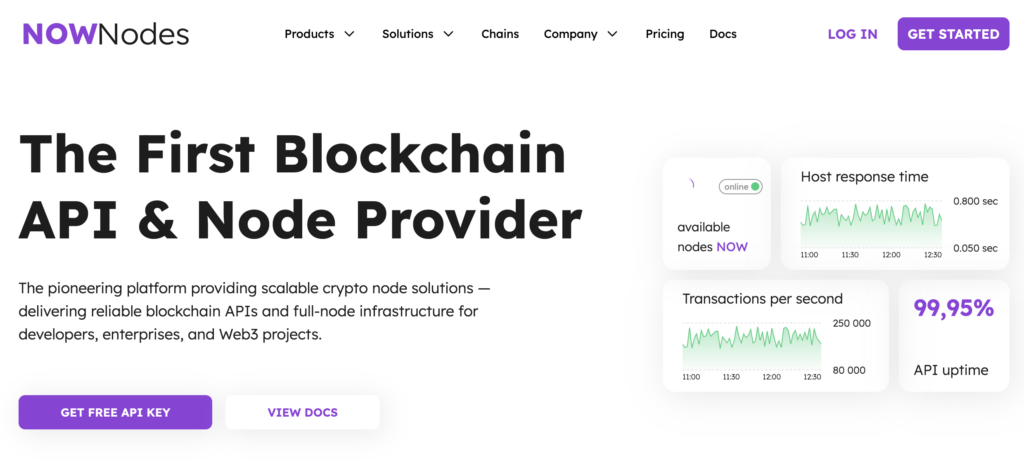
NOWNodes is the strongest all-round GetBlock alternative for teams that want breadth without giving up support quality. It provides shared and dedicated node access through a simple API-key model across 120+ blockchain networks, which is one of the widest ranges tested in independent comparisons. Recent third-party analysis lists NOWNodes among the leaders specifically for multi-chain coverage.
Where NOWNodes distinguishes itself operationally is throughput and reliability. The service runs on a 99.9%+ uptime SLA and applies no RPS limits on any paid plan — a meaningful contrast with providers that cap shared endpoints at a few hundred requests per second. Its GEO-balanced architecture routes traffic across USA and EU servers, with any region available for dedicated nodes, and the network handles up to 15,000 transactions per second at around 200 ms response time.
The developer surface is deep enough for production work: gRPC, WebSocket, Webhooks, archive data, a Debug and Trace API, Blockbook, and full Mainnet and TestNet access. Beyond raw RPC, NOWNodes also exposes data products like market data and an MCP endpoint, plus public tools including public nodes and a blockchain explorer.
Support is a genuine differentiator. NOWNodes staffs L2 support with operations specialists rather than bots or long queues, targeting a 3-minute response time. Pricing is flexible across free, Pro, Pro Plus, Business, Business Plus, Enterprise, and custom tiers. It’s also backed by well-known partners including Trust Wallet, CoinGate, ChangeNOW, and Tangem.
For a plain-English sense of what a node provider actually removes from your plate — you skip syncing, storage, and 24/7 uptime babysitting — it helps to understand what a full node does in the first place. If you’re weighing whether to self-host or use a provider like NOWNodes, that trade-off is worth reading up on before you decide.
2. QuickNode — Performance and Enterprise Compliance
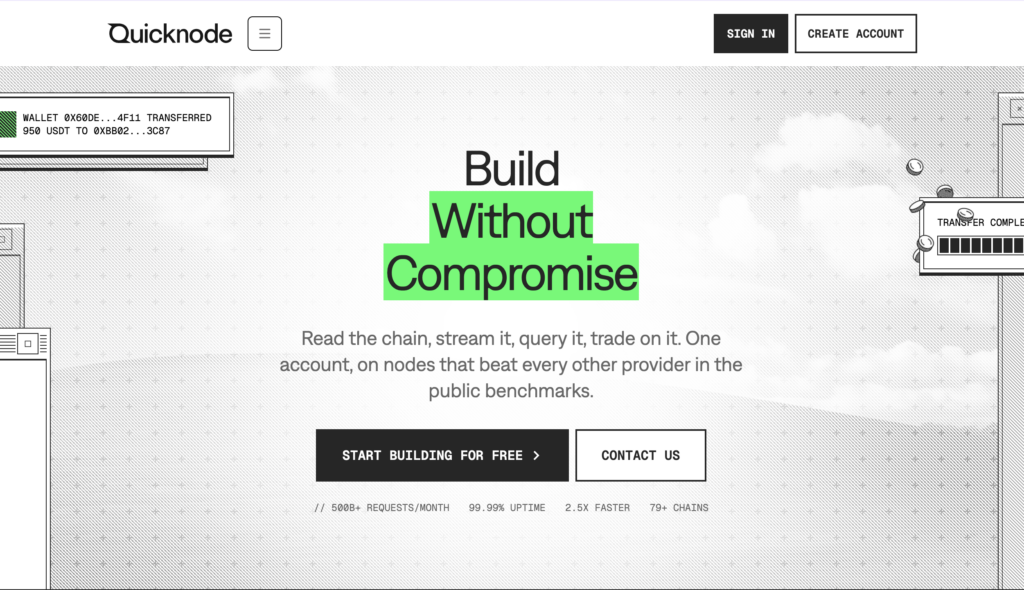
QuickNode is the go-to alternative when raw performance and formal compliance are non-negotiable. It supports 80+ chains with a 99.99% uptime SLA and is among the most feature-complete providers in the market, covering Ethereum, Solana, Base, Polygon, BSC, Arbitrum, and more.
Its compliance portfolio is the broadest in the field. QuickNode holds SOC 1 Type II, SOC 2 Type II, and ISO 27001 — audited by Grant Thornton and recertified in Q1 2026. For regulated applications, that combination is hard to match. In March 2026, QuickNode also introduced Flat Rate RPS pricing for high-volume workloads — starting at $799/month for 75 RPS on EVM chains with no credit metering and no overage risk.
The trade-off: QuickNode’s default credit-based model can produce overage charges when certain calls consume more credits, and there’s no permanent free plan. It suits performance-sensitive products — wallets, trading platforms, user-facing dApps — more than budget-first hobby projects.
3. Alchemy — Richest Developer Tooling
Alchemy is the pick for teams that want more than an endpoint URL. It layers enhanced APIs — Notify, Transact, NFT and token APIs, transaction simulation, and analytics — on top of standard RPC, which can save hundreds of engineering hours you’d otherwise spend building indexers and notification systems in-house.
Alchemy supports 100+ chains, holds SOC 2 Type II, and offers a generous permanent free tier of 30M Compute Units per month. The main caveat is cost predictability: its CU model charges different amounts per method, which makes costs harder to predict at scale. If you lean heavily on its tooling, that’s usually a fair trade.
4. Chainstack — Predictable Pricing and Compliance
Chainstack is built for teams that prioritize cost predictability and enterprise-grade infrastructure. It supports 70+ protocols and, crucially, lets you deploy dedicated nodes inside your own cloud environments (AWS, GCP, Azure) via its Hybrid Cloud feature — useful when a compliance review asks where your data physically lives.
On billing, Chainstack uses transparent request-based pricing where almost every call counts equally, avoiding the surprise overages of credit models. It holds SOC 2 Type II certification and advertises 99.99%+ uptime. Its Unlimited Node add-on offers flat monthly pricing at a chosen RPS tier. Pricing skews enterprise-heavy, so solo builders may find the onboarding steeper than a simple API-key service.
5. Ankr — Generous Free Tier and Decentralization
Ankr operates as a decentralized physical infrastructure network (DePIN), serving billions of requests daily across 30+ regions. It’s the strongest option if early-stage runway matters: Ankr offers the most generous free tier by volume (200M credits/month) with a straightforward pay-as-you-go model.
Chain coverage is wide — 80+ chains on its Premium tier, 65+ on Freemium, and 40+ on its free public endpoints. The catch is that public endpoints throttle aggressively and carry no SLA, so treat them as a testing convenience rather than production infrastructure. Its decentralized routing also makes Ankr a common choice as a cost-effective secondary provider in a failover setup.
6. Infura — The Ethereum-First Veteran
Infura is the established, Ethereum-first choice, now owned by Consensys and serving as the default backend for MetaMask. In 2026 it transitioned to a credit-based pricing model and introduced its Decentralized Infrastructure Network (DIN) for improved reliability.
Its coverage is narrower than the multi-chain leaders: Infura supports 20+ blockchains including Ethereum (mainnet and testnets), Polygon PoS, Optimism, Arbitrum, Base, Linea, Mantle, Avalanche C-Chain, Starknet, Aurora, and IPFS/Filecoin. If your project lives in the Ethereum ecosystem and you value a long track record plus tight MetaMask integration, Infura is a natural fit. For heavily multi-chain products, it’s usually a secondary rather than a primary.
7. dRPC — Decentralized Routing and Redundancy
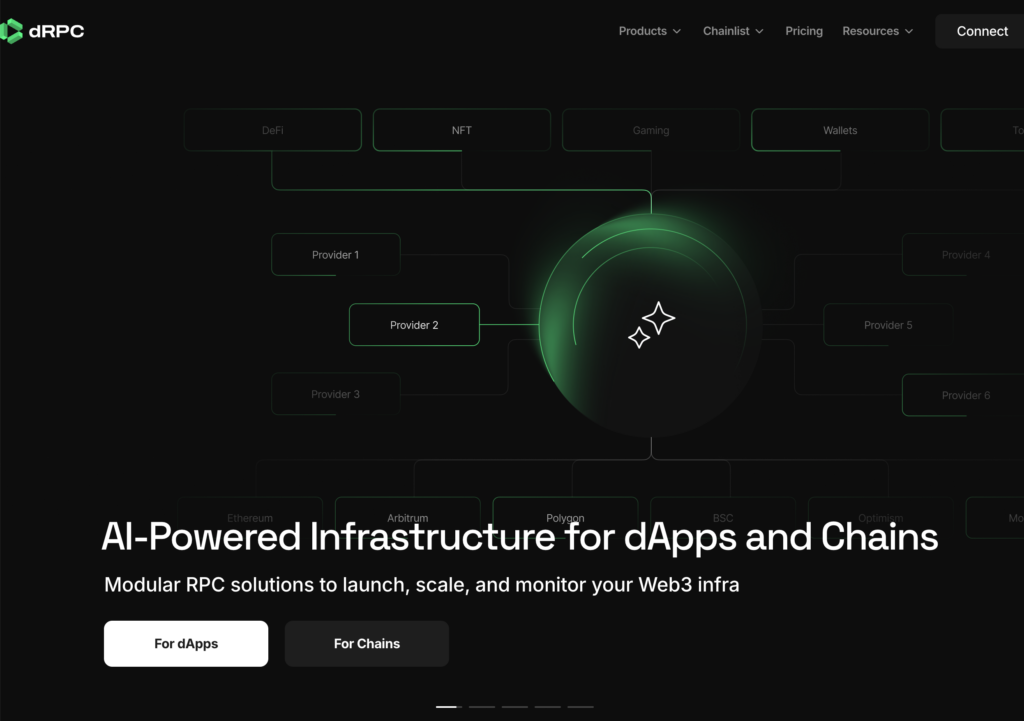
dRPC rounds out the list as a decentralized RPC network that routes requests across many independent node operators, supporting 100+ chains on a pay-as-you-go model with a free tier. Its design goal is resilience: by distributing requests rather than relying on one operator, it reduces single-point-of-failure risk.
Industry guidance in 2026 frequently names dRPC as a cost-effective secondary in a multi-provider failover architecture, paired with a high-performance primary. If your priority is redundancy and privacy-aware routing rather than a bundled tooling suite, dRPC earns a place in the mix.
How to Choose the Right GetBlock Alternative
Start by naming your requirements before you compare vendors, because the “best” provider changes entirely depending on them. Work through these in order:
- List your chains. Confirm each required network is supported — and test it, since a provider strong on Ethereum can be weak on a smaller chain.
- Estimate your request volume. Map your peak RPS and monthly call count against each plan’s limits and pricing model.
- Decide on pricing tolerance. Flat/request-based billing is predictable; credit and CU models can be cheaper but riskier at scale.
- Check compliance needs. If you’re regulated, filter to providers publishing SOC 2 Type II or ISO 27001.
- Benchmark, don’t trust marketing. Create an endpoint, run your actual methods, and measure real latency before signing anything.
- Plan for redundancy. Run at least two providers with automated failover so one outage doesn’t take your app down.
As one widely cited 2026 comparison of RPC providers for production workloads put it, the best providers match your workload, not your marketing preferences. That’s the whole discipline in a sentence — the invoice and the feature list only matter relative to what you’re actually building.
Conclusion
GetBlock is a solid multi-chain provider, but it’s one option among several, and the strongest teams pick their infrastructure by workload rather than reputation. For the widest chain coverage with no paid-plan RPS limits and fast human support, NOWNodes is the standout alternative. QuickNode leads on performance and compliance, Alchemy on developer tooling, Chainstack on predictable pricing, Ankr on free-tier volume, Infura on Ethereum depth, and dRPC on decentralized redundancy.
The practical move is to shortlist two providers that fit your chains and budget, benchmark your real methods on both, and run them together with automatic failover. In a market where a single degraded endpoint can make an otherwise well-built app unusable, that redundancy is worth more than any one provider’s spec sheet.
FAQ
Is GetBlock free to use?
GetBlock offers a free plan that can be used indefinitely with limited features — 50K CUs per day for RPC calls on any supported chain. Paid Shared, Limitless, and Dedicated Node plans unlock higher limits, better SLAs, and support. Several alternatives, including NOWNodes and Ankr, also provide free tiers for onboarding.
Which GetBlock alternative supports the most blockchains?
Among the providers here, NOWNodes leads on breadth with 120+ networks, followed by Alchemy and dRPC at around 100+, and GetBlock itself at 130+. Chain count is a useful first filter, but always verify and benchmark support for your specific chains, since coverage depth varies from network to network.
Do I need to run my own node instead of using a provider?
Usually not. Running a full node means syncing large amounts of data and maintaining 24/7 uptime yourself, which is why most teams use a provider that handles infrastructure through a single API connection. Self-hosting offers the most control if you have the operations capacity to maintain it; for everyone else, a managed provider is simpler and often cheaper in practice.
What’s the difference between shared and dedicated nodes?
A shared node routes many customers’ requests through common infrastructure with per-plan RPS limits, while a dedicated node is isolated to one client with throughput determined by its hardware. Dedicated nodes cost more but deliver consistent performance for high-volume production traffic. Flat-rate options like GetBlock’s Limitless Node or Chainstack’s Unlimited Node sit between the two.
Should I use more than one node provider?
For production applications, yes. The 2026 best practice is a two-provider setup with automatic failover — a high-performance primary plus a cost-effective secondary — so a single outage can’t take your app offline. This also lets you route different call types (for example, archive-heavy reads) to whichever provider handles them best.