
Most cryptocurrencies ask you to pay a fee to move money and wait for confirmation. Nano (ticker: XNO) does neither. Send any amount, to anyone, and the recipient sees it in well under a second — with nothing skimmed off the top. That combination of zero fees and near-instant settlement is the whole reason Nano exists, and it comes down to one architectural decision most blockchains never made.
This guide walks from the basics up to the technical detail: what Nano is, why traditional chains charge fees in the first place, how Nano’s block-lattice removes them, what the network actually achieves under real load in 2026, and where the limits still sit. If you’ve read older explainers, some of their numbers are now out of date — the network has shipped several major upgrades, so we’ll flag what changed.
What Is Nano Cryptocurrency?
Nano is a decentralized digital currency built for one job: moving value instantly and without fees. It was launched in October 2015 by software engineer Colin LeMahieu, originally under the name RaiBlocks, specifically to fix the scalability and cost problems that made early Bitcoin impractical for everyday spending. The entire supply — 133,248,297 XNO — was distributed for free through a captcha-secured faucet that closed in 2017, so there is no mining and no new issuance.
Unlike most cryptocurrencies, Nano is not a smart-contract platform and does not try to be. The native token, XNO, exists purely as a medium of exchange and store of value. There are no gas fees to erode a transfer, no staking rewards, and no coin burns. That narrow focus is deliberate: by doing one thing, the protocol can be optimized for speed and cost in ways a general-purpose chain cannot.
Here’s the short version of what makes it distinct. Bitcoin confirms in roughly ten minutes with a variable fee; Ethereum charges gas that spikes with demand. Nano confirms in under a second and charges nothing, which is why its community describes the experience as closer to handing over physical cash than sending a bank transfer.
Why Traditional Cryptocurrencies Charge Fees
To understand why Nano is free, it helps to see why almost everything else isn’t. Most blockchains, Bitcoin and Ethereum included, record every transaction in a single shared ledger. Every participant competes for space in the next block, and because block space is scarce, users bid for it with fees. When the network is busy, those bids climb.
That design creates three linked problems. Throughput is capped, because only so many transactions fit in each block — Bitcoin handles roughly seven transactions per second, and Ethereum’s base layer sits around fifteen to thirty. Fees rise with congestion, which makes small payments uneconomic. And Proof-of-Work chains burn enormous energy to secure that shared ledger.
The knock-on effect is that microtransactions — tipping a creator, paying for a single API call, buying a coffee — stop making sense when the fee can exceed the payment itself. This is the exact gap Nano set out to close, and it did so by questioning the assumption that everyone must share one ledger.
How Nano Removes Fees: The Block-Lattice Architecture
Nano’s core innovation is a data structure called the block-lattice — a variant of a directed acyclic graph (DAG) in which every account operates its own blockchain. Instead of one global chain that everyone competes to write to, each user owns a personal ledger that only they can update. Value moves through direct peer-to-peer transfers between these individual chains.
Send and Receive as Separate Blocks
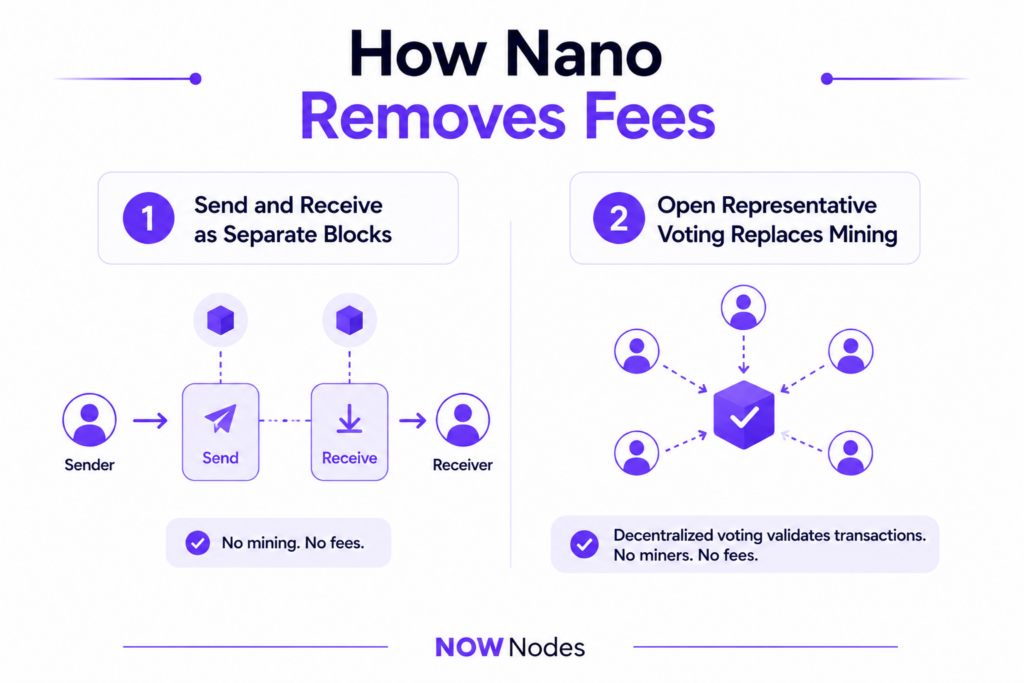
A single Nano transaction is actually two blocks. When you send XNO, you publish a send block on your own chain that debits your balance. The recipient then publishes a receive block on their chain that credits theirs. Because only the account owner can modify their own ledger, these updates happen asynchronously — you don’t wait for the whole network to agree on a global block order before your transaction settles.
This is the mechanism that removes fees. There is no shared block space to bid for, so there is no auction, and no auction means no fee. It also removes the primary bottleneck behind congestion: accounts update in parallel rather than queuing for the same slot.
Open Representative Voting Replaces Mining
Nano still needs a way to prevent double-spends without miners. It uses Open Representative Voting (ORV), a consensus model where XNO holders delegate their voting weight to a representative node of their choice. If two conflicting transactions appear, representatives vote, and the first to reach a quorum of the total online voting weight is confirmed while the other is rejected.
Representatives earn no block rewards and no fees for this work, which is unusual and intentional — it removes the economic pull toward centralization that mining rewards create. As Nano creator Colin LeMahieu framed the network’s founding goal in the Nano whitepaper, Nano was designed as a system offering “quicker, more deterministic transactions while still maintaining a strong, decentralized system.” Node operators run representatives because a fast, feeless network is valuable to them, not because they’re paid per block.
If you want the deeper mechanics of how account chains and voting fit together at the infrastructure level, NOWNodes’ guide to how blockchain nodes work covers the fundamentals that apply here.
Nano Cryptocurrency Fees and Speed in 2026: What the Network Actually Does
Marketing claims are easy; measured performance is what matters. Here is where Nano genuinely stands after its recent upgrades, with the numbers sourced rather than rounded up.
On energy, a single Nano transaction has been calculated to use as little as 0.111 Wh, according to the Nano Foundation’s sustainability page — low enough that the entire network runs on a few hundred machines, comparable to the output of a single wind turbine. For contrast, that is roughly eight million Nano transactions for the energy of one Bitcoin transaction.
On speed, confirmation is consistently sub-second in normal conditions. In lab profiling on commodity hardware Nano has reached around 7,000 transactions per second, while the live production network has been reliably tested above 300 TPS, a ceiling largely set by how fast testers could pre-compute the small anti-spam Proof-of-Work rather than by the protocol itself.
The most important recent evidence comes from stress-testing the network’s newest defenses. Under a controlled spam test that pushed a sudden influx of 200,000 blocks at the network, Nano’s V28 release notes report that legitimate transactions still confirmed in under 1.5 seconds while the backlog processed at a sustained ~300 TPS. That is the number that matters for real use: not the peak in ideal conditions, but the floor when the network is under attack.
| Metric | Bitcoin | Ethereum (base layer) | Nano (XNO) |
|---|---|---|---|
| Transaction fee | Variable, market-priced | Variable gas | None |
| Typical confirmation | ~10 minutes | Seconds to minutes | Under 1 second |
| Energy per transaction | ~950 kWh | Lower post-Merge | ~0.111 Wh |
| Consensus | Proof-of-Work | Proof-of-Stake | Open Representative Voting |
The Upgrades That Fixed Nano’s Old Weak Spot
Older articles on Nano — including earlier versions of this one — described the network as “theoretically” able to handle high throughput without addressing its real historical weakness: behavior under spam. During heavy artificial load in 2021, unconfirmed transactions could pile up faster than the network cleared them, and confirmation times for ordinary users stretched out. Honest coverage has to acknowledge that this was a genuine problem, and it’s the main thing that has changed.
Bounded Block Backlog
The fix arrived with the V28 “Electrum” release, which introduced the Bounded Block Backlog (BBB). BBB places a hard ceiling — currently 100,000 — on the number of unconfirmed blocks the network will hold at once, according to the V28 release notes on Nano’s documentation. Instead of letting a backlog grow without limit during an attack, the network prioritizes and caps it, keeping confirmation rates predictable even under load. Paired with the fair-queuing and traffic-shaping work from V27, this is what let the network hold sub-1.5-second confirmations through the 200,000-block spam test above.
Where the Node Software Stands Now
As of mid-2026, V28.2 is the recommended production release every node operator should be running, per Nano’s node releases page. The next version, V29 “Piotric,” is in development and focuses on ledger-integrity checks, faster bootstrapping, and internal election-scheduler improvements rather than a single headline feature. Protocol updates ship roughly every one to four months, and older node versions eventually stop peering — a detail worth knowing if you or a service you rely on runs Nano infrastructure.
The takeaway: if a comparison you’re reading treats Nano’s spam resistance as an open weakness, check its date. The commercial-grade hardening the project spent years on has largely landed.
What Nano’s Fees and Speed Are Actually Good For
Zero fees and instant settlement aren’t abstract virtues — they unlock specific use cases that fee-based chains handle poorly.
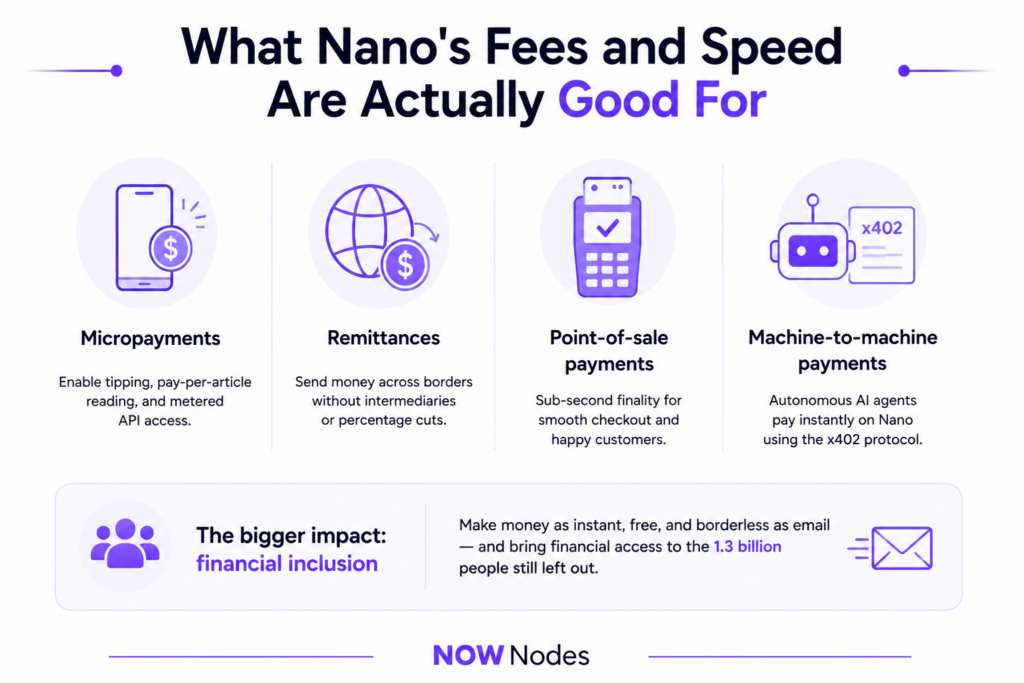
Micropayments are the obvious one. When a transfer costs nothing, paying a fraction of a cent becomes viable, which makes tipping, pay-per-article reading, and metered API access practical. Remittances are another: sending money across borders without an intermediary or a percentage cut matters most to the people moving small amounts. Point-of-sale payments benefit from sub-second finality, since neither a merchant nor a customer wants to wait on a confirmation at the till.
A newer and fast-growing use case is machine-to-machine payments. Since early 2026, autonomous AI agents have begun settling payments on Nano’s mainnet using the x402 protocol, which lets software pay for API access with instant, feeless transactions — no account, no API key, just a payment. NOWNodes covers this emerging standard in its explainer on the x402 payment protocol. Feeless micropayments are close to a hard requirement for an economy where agents transact thousands of times a day, and it’s a space Nano is well-suited to.
The human case for all this was put plainly by Nano Foundation Director George Coxon, who argued in a February 2026 piece that email made communication instant, free and borderless while money still moves like a 1980s postal service — a gap she ties to the 1.3 billion people currently locked out of financial systems.
The Honest Limitations
No payment network is without trade-offs, and a useful guide says so. Nano’s design choices carry real costs alongside their benefits.
Because there are no fees, there is no direct financial incentive to run a representative node — operators do it voluntarily, which raises fair questions about long-term participation as the network grows. The absence of fees also means no built-in economic penalty for spam, so the network leans on a small Proof-of-Work stamp per transaction plus systems like the Bounded Block Backlog to deter flooding; that arms race is ongoing rather than finished. And Nano’s price volatility, like any crypto asset, complicates its use as a day-to-day currency despite the fee and speed advantages.
None of these erase the core value proposition, but they’re the reasons Nano hasn’t displaced fee-based chains outright. Weigh them for your own use case rather than treating “feeless” as the end of the analysis.
Conclusion
Nano solves the fee-and-speed problem that holds back everyday crypto payments by throwing out the shared ledger. Give every account its own chain, let those chains update in parallel, and confirm conflicts through weighted voting instead of mining — and you get transactions that settle in under a second, cost nothing, and use a fraction of a watt-hour each. The 2026 upgrades, especially the Bounded Block Backlog, closed the network’s main historical weakness by keeping those guarantees intact under spam.
Whether Nano becomes a mainstream payment rail depends on adoption and the durability of its no-incentive node model, not on the technology’s basic capability, which is proven. For anyone building on it — from merchant tools to AI-agent payments — reliable Nano node access from NOWNodes gives a consistent view of the network without running your own infrastructure.
FAQ
Does Nano cryptocurrency really have no fees?
Yes. Nano charges no transaction fees at all — 100% of what you send reaches the recipient. This is possible because Nano’s block-lattice architecture gives each account its own chain, so there’s no shared block space to bid for and therefore no fee auction. Representatives who secure the network earn no rewards, either.
How fast are Nano transactions?
Nano confirms in under one second in normal conditions. Even under a controlled spam test of 200,000 blocks, legitimate transactions still confirmed in under 1.5 seconds, per the network’s V28 release notes. Lab profiling has reached around 7,000 transactions per second, with the live network reliably tested above 300 TPS.
How does Nano make money without fees?
It doesn’t, and that’s by design. Nano’s supply was fully distributed via a free faucet that closed in 2017, there is no mining or new issuance, and node operators run representatives voluntarily because a fast, feeless network is useful to them. The Nano Foundation funds development separately.
Why is Nano so energy-efficient?
Because it uses Open Representative Voting instead of Proof-of-Work mining, a single Nano transaction has been calculated at roughly 0.111 Wh — about eight million transactions for the energy of one Bitcoin transaction. The whole network runs on a few hundred machines.
What was Nano’s main weakness, and is it fixed?
Historically, Nano struggled under spam, with unconfirmed transactions piling up during heavy artificial load. The V28 “Electrum” release introduced the Bounded Block Backlog, which caps unconfirmed blocks at 100,000 and keeps confirmation rates predictable under attack. As of 2026 the recommended node version is V28.2, with V29 in development.
Is Nano good for AI agent payments?
Yes — feeless, sub-second micropayments are close to a requirement for machine-to-machine commerce. Since early 2026, autonomous AI agents have transacted on Nano mainnet via the x402 protocol, which lets software pay for API access instantly with no account or API key.