TRON dApp development means writing a smart contract in Solidity, deploying it to the TRON Virtual Machine, and connecting it to a user-facing app. The workflow looks a lot like building on Ethereum, but the fees, the resource model, and the tooling are different enough to trip up anyone who assumes they’re identical.
This guide walks through what a TRON dApp is, why teams build on this chain, the tools you’ll use, and the actual steps from contract to deployment. It also covers the question a lot of founders ask first: build it in-house or hire someone?
What Is a TRON dApp?
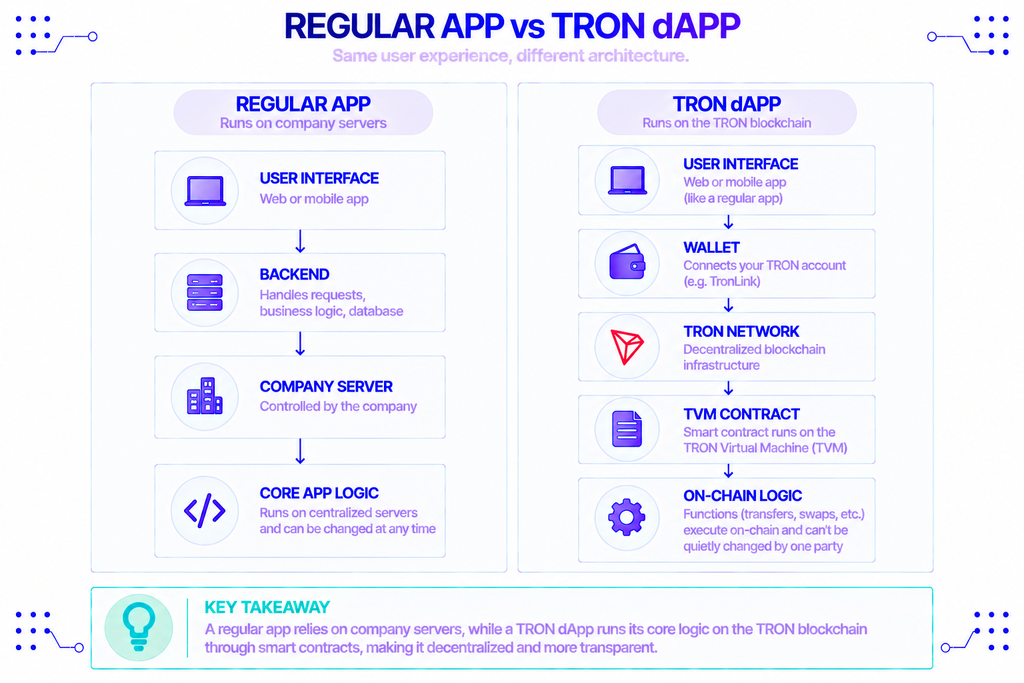
A TRON dApp is a decentralized application whose logic runs in smart contracts on the TRON blockchain instead of on a company’s private servers. The frontend can look like any normal web or mobile app; what makes it “decentralized” is that core functions — transfers, swaps, lending, minting — execute on-chain and can’t be quietly altered by one party.
TRON is an open-source blockchain launched in 2017, with its own token, TRX. Smart contracts run on the TRON Virtual Machine (TVM), which is compatible with the Ethereum Virtual Machine. That compatibility is the reason Ethereum developers can move over without relearning everything.
Tokens on TRON follow two main standards. TRC-10 is a lightweight native token standard, and TRC-20 is the smart-contract standard used by most assets, including USDT. If you’ve issued an ERC-20 token before, TRC-20 will feel familiar.
What runs the contract: the TVM
The TVM executes compiled Solidity bytecode, the same language and tooling you’d use for Ethereum. The practical difference is how execution gets paid for. Ethereum charges gas; TRON uses two resources called Energy and Bandwidth, which we’ll get to below. For most contract code, you write Solidity the same way and only adjust for TRON-specific details like address encoding.
Why Build a dApp on TRON?
The short answer: cheap, fast transactions and an enormous stablecoin user base. TRON has positioned itself as a settlement layer for dollar-pegged assets, and that’s where most of its activity lives.
The numbers are lopsided toward stablecoins. In Q2 2026, USDT on TRON reached an all-time high of roughly $89 billion, about 28.7% of the entire stablecoin market. The network processed around 11.8 million transactions a day, and 93% of them were stablecoin transfers. If your dApp touches payments or dollar-denominated value, the audience is already here.
Fees are the other draw. A TRC-20 USDT transfer costs a fraction of a cent, versus dollars on Ethereum mainnet. Blocks are produced roughly every three seconds, so confirmation feels close to instant. For microtransactions and high-frequency apps, that cost difference decides whether a product is viable at all.
Here’s a side-by-side for anyone coming from Ethereum:
| Factor | TRON | Ethereum (L1) |
|---|---|---|
| Typical transfer fee | Fraction of a cent | Dollars, variable with congestion |
| Block time | ~3 seconds | ~12 seconds |
| Throughput | ~137 average TPS, higher capacity | ~15–30 TPS |
| Contract language | Solidity (on TVM) | Solidity (on EVM) |
| Fee model | Energy + Bandwidth (stakeable) | Gas, paid per transaction |
| Dominant use case | Stablecoin payments | DeFi, NFTs, broad ecosystem |
The trade-off is decentralization. TRON uses Delegated Proof of Stake with 27 Super Representatives electing block producers every six hours, a smaller validator set than Ethereum’s. That’s the design choice that buys the speed and low fees.
Who Builds on TRON, and What Do They Build?
TRON dApp developers tend to build around the chain’s strengths rather than against them. The clearest fit is anything involving stablecoins at scale.
Common categories include:
- Payments and remittance — apps that move USDT cheaply across borders, where a few cents of fees beat traditional rails and higher-fee chains.
- DeFi — lending, borrowing, and trading. JustLend, TRON’s largest lending protocol, held around $3.3 billion in total value locked in early 2026, and SunSwap handles most DEX volume.
- Games and NFTs — low per-action costs make on-chain game mechanics and TRC-721 collectibles practical.
- Merchant and fintech tools — point-of-sale and payout systems that accept stablecoins.
The people building these range from solo developers shipping a side project to startups and established fintechs adding a stablecoin rail. If your product’s core loop depends on frequent, small, dollar-denominated transactions, TRON is worth a serious look.
What Tools Do You Need for TRON dApp Development?
TRON offers a full toolchain that mirrors the Ethereum stack almost one-to-one. If you know the Ethereum equivalents, you already understand the roles.
Here’s the mapping:
| What you need | Ethereum tool | TRON tool |
|---|---|---|
| JavaScript/TypeScript SDK | ethers.js / web3.js | TronWeb |
| Compile, deploy, test contracts | Truffle / Hardhat / Foundry | TronBox |
| Browser-based IDE | Remix | TronIDE |
| Browser wallet | MetaMask | TronLink |
| Hosted network access | Infura / Alchemy | TronGrid, NOWNodes |
| Wallet connection protocol | WalletConnect | WalletConnect for TRON |
A few notes on the main ones. TronWeb is the JavaScript library most dApps use to talk to the chain; its current major version (6.x) is TypeScript-native and needs Node.js 14 or later. TronBox is a Truffle-style framework for compiling, migrating, and testing contracts — recent releases (4.5.0 as of early 2026) added an EVM mode alongside the standard TVM workflow. TronIDE is the lowest-friction option for a first contract: it runs in the browser, like Remix, with no local setup.
For languages beyond JavaScript, there’s Trident (Java) and GoTron (Go). Most dApp teams, though, live in TronWeb plus TronBox.
How to Build a dApp on TRON: Step by Step
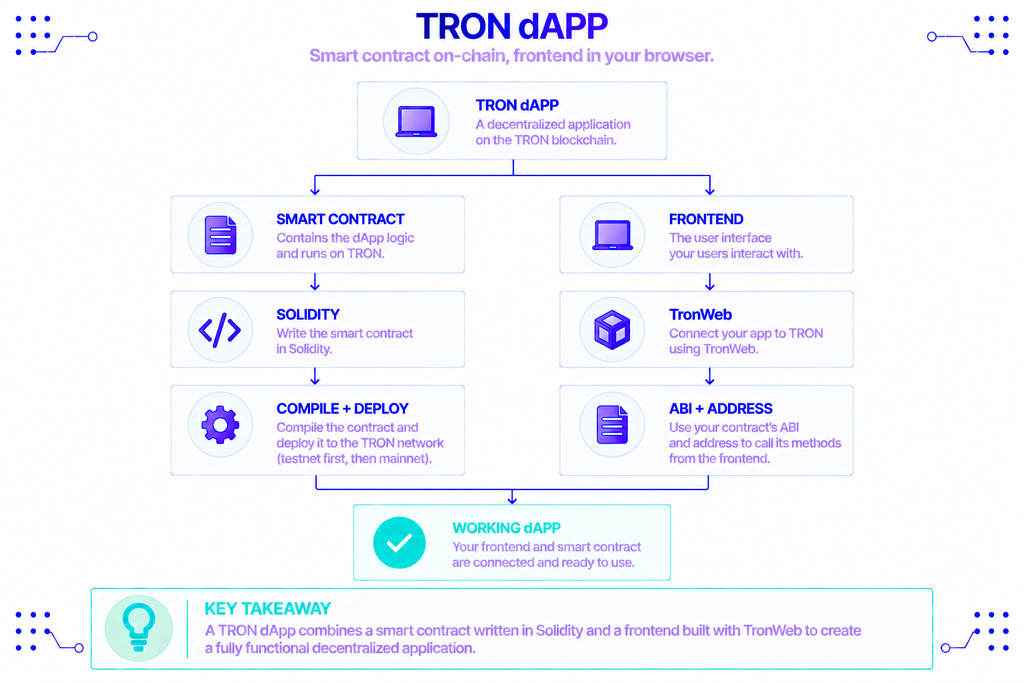
Below is the core path from zero to a deployed, working dApp. The first deployment should always go to a test network so mistakes cost nothing.
- Set up a wallet and get test TRX. Install the TronLink extension, create an account, and switch it to a test network — Shasta or Nile. Grab free test TRX from the matching faucet so you can pay for deployment.
- Write your smart contract in Solidity. Pin the compiler version rather than using a caret range, so a minor release doesn’t change behavior.
- Compile and deploy. Use TronIDE for a point-and-click flow, or TronBox from the command line for anything you’ll maintain long term.
- Connect your frontend with TronWeb. Point it at a TRON endpoint, load your contract’s ABI and address, and call its methods from your app.
- Test on a testnet, then ship to mainnet. Once the contract behaves and the UI works end to end, deploy the same contract to mainnet and repoint your app.
Writing the contract
A minimal contract looks like this. Note the pinned version and the standard Solidity syntax:
solidity
// SPDX-License-Identifier: MIT
pragma solidity 0.8.6;

contract Message {
    string public message;

    function setMessage(string calldata newMessage) public {
        message = newMessage;
    }
}
This stores a string on-chain and lets anyone update it. It compiles on the TVM exactly as written. For a real app you’d follow a standard like TRC-20 for tokens or TRC-721 for NFTs.
Deploying with TronBox
With TronBox installed, the loop is three commands: compile your sources, run your migration against a chosen network, and check the result. A config file holds your network settings — which TRON endpoint to deploy against, your fee limit, and the deploying account. For a first pass, TronIDE’s “Injected TronWeb” environment deploys straight through your connected TronLink account, which is simpler while you’re learning.
Connecting the frontend
Once the contract is live, your app interacts with it through TronWeb:
javascript
import { TronWeb } from 'tronweb';

const tronWeb = new TronWeb({
  fullHost: 'https://api.trongrid.io',
  headers: { 'TRON-PRO-API-KEY': 'your-api-key' },
  privateKey: 'your-private-key'
});
From here you load your contract by address, read values, and send transactions. In a browser dApp, you’d typically use the account injected by TronLink instead of a hardcoded private key, so users sign with their own wallet.
Understanding Energy and Bandwidth
This is the part that surprises Ethereum developers, so it’s worth its own section. TRON doesn’t charge a single gas fee. It uses two resources.
Bandwidth covers the “size” cost of a transaction — basic transfers and TRC-10 operations. Every account gets 600 free Bandwidth points a day. Energy covers computation: smart contract execution, including TRC-20 transfers like USDT. There’s no free daily Energy, so contract-heavy apps need a plan for it.
You get these resources in one of two ways. Stake TRX to receive Energy or Bandwidth without spending it, or let the network burn a small amount of TRX automatically when you’re short. Staking also grants voting power in TRON’s governance. Under the current Stake 2.0 model, you can redelegate resources without fully unstaking first.
Why this matters for builders: a dApp can subsidize user costs by supplying Energy, so people interact without holding TRX themselves. That’s a real UX advantage for onboarding non-crypto users, and it’s a deliberate design decision you won’t find on gas-based chains.
Should You Build In-House or Hire a TRON dApp Developer?
Not every team wants to write and audit contracts themselves. The decision usually comes down to how much blockchain-specific risk you’re willing to own.
Building in-house makes sense when you have developers comfortable with Solidity, you want tight control over the roadmap, and the dApp is central to your product. The tooling above is approachable for anyone with Web3 experience, and TRON’s EVM compatibility shortens the learning curve.
Hiring tron dapp developers or a dedicated tron dapp development company makes sense when you need to ship fast, lack in-house smart contract expertise, or want an external audit before real funds touch the code. A specialist firm typically covers contract design, security review, frontend integration, and deployment.
If you go the hiring route, a few things to check when you find tron dapp developers:
- TRON-specific experience, not just generic Solidity — they should understand Energy, Bandwidth, and TRC-20/TRC-721 standards.
- Security practices — ask how they test and whether contracts get an independent audit.
- A portfolio of shipped dApps you can actually inspect on-chain.
- Clear ownership of keys, source code, and infrastructure after handoff.
Whichever path you pick, the underlying build is the same — the difference is who holds the Solidity knowledge and the security responsibility.
Connecting Your dApp to TRON
A dApp is only as reliable as its connection to the chain. Your frontend has to read balances, submit transactions, and listen for events, and that requires a stable TRON endpoint behind it.
Public endpoints work for early testing, but they rate-limit and offer no guarantees once you have real traffic. For production, teams usually move to managed access. NOWNodes provides TRON API access across 120+ networks, so you can point TronWeb at a reliable endpoint and get a dedicated API key without running infrastructure yourself.
Getting started is straightforward: create an account, generate a TRON API key, and drop the endpoint and key into your TronWeb config exactly as shown earlier. That keeps your app responsive as usage grows, whether you’re serving a handful of testers or millions of stablecoin transfers.
Final Thoughts
TRON dApp development rewards teams that lean into what the chain is good at: cheap, fast, stablecoin-heavy applications with a built-in user base. The tooling is mature and closely mirrors Ethereum’s, so the real work is in solid contract design, understanding the Energy and Bandwidth model, and testing thoroughly on a testnet before mainnet.
Start small — deploy a simple contract on Shasta, wire it to a basic frontend, and get the full loop working. Once that clicks, scaling to a production dApp is mostly a matter of engineering discipline and reliable infrastructure.
FAQ
How much does it cost to build a dApp on TRON?
On-chain costs are low — deployment and transactions run from cents to a few dollars, depending on contract complexity, and you can offset them by staking TRX for Energy. The larger expense is development time: a simple dApp can be built solo, while a production DeFi app with audits typically costs more if you hire a team.
Can I reuse my Ethereum smart contracts on TRON?
Often, yes. The TVM is EVM-compatible, so most Solidity contracts port over with minor changes, usually around address encoding, certain opcodes, and chain-specific details. Recompile for the TVM and test carefully rather than assuming a clean copy-paste.
How long does it take to build a TRON dApp?
A basic proof of concept — one contract plus a simple interface — can take a few days. A polished, audited production dApp usually takes weeks to months, driven mostly by security review and frontend work rather than the TRON integration itself.
Do I need to know Solidity to build on TRON?
For custom smart contracts, yes — TRON contracts are written in Solidity and run on the TVM. You can get far with TronIDE and existing contract templates (like TRC-20), but understanding Solidity is essential for anything beyond the basics.
Which test network should I use for TRON development?
Shasta is the long-standing public testnet and a safe default. Nile tracks TRON’s development branch and updates faster, which is useful for testing newer protocol features. Both have faucets that give you free test TRX for deployment.