
To check a crypto wallet balance, copy the public address, paste it into a block explorer for the right network, and read the total. No login, seed phrase or private key is involved. Anyone can do it for any address, because balances on public blockchains are open data. Whether you call the tool a wallet checker, a bitcoin checker or an ETH tracker, it does the same thing: reads the chain for one address.
The steps differ slightly by chain, and the number you see can be confusing: bitcoin shows up in satoshis, ethereum in wei, and tokens live in a different place from the native coin. This guide starts with what a balance lookup actually is, then covers who uses it, the step-by-step methods to check bitcoin wallet balance, ETH, BNB and SOL, and how developers pull the same data through an API.
What Does a Balance Lookup Actually Do?
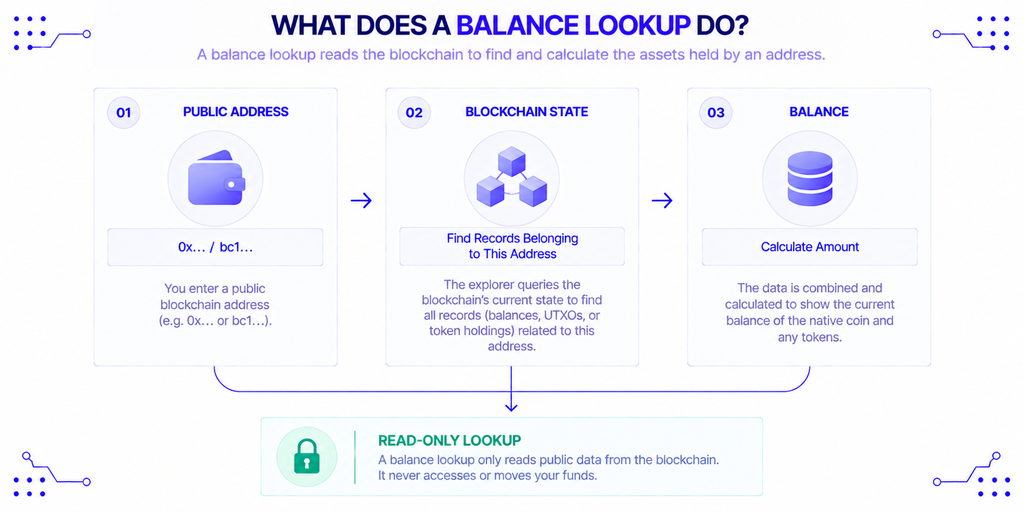
A balance lookup reads the current state of a blockchain for one address and reports how much of an asset that address controls. Your wallet app doesn’t store the coins. It stores keys, and the coins exist only as records on the network.
That’s why a crypto balance is always a calculation the network’s data makes possible, not a number kept in a file. On Bitcoin, the total is the sum of all unspent outputs tied to the address. On Ethereum and most other account-based chains, it’s a single field on the account. The UTXO vs account model explainer covers the difference in detail.
Either way, a public address is enough. Sharing an address never exposes the funds, and it’s the only input any crypto wallet address checker asks for. In some markets people search for the same thing as “saldo crypto”, the local word for a crypto balance.
Why Look Up an Address Instead of Opening the Wallet App?
Because an independent lookup confirms what the chain says, not what an app displays. A wallet can lag, cache old data, or hide tokens it doesn’t recognise. An explorer shows the raw result.
There are three practical reasons to do it:
- Confirming a payment arrived. Before shipping goods or releasing a service, you can see the transaction and its confirmations yourself.
- Checking an address before sending. Looking at an unfamiliar address’s history is a quick sanity check against typos and scams.
- Reading balances without the keys. Accountants, auditors and family members can view holdings safely, with no ability to move anything.
Bitcoin developer Adam Back put the principle in three words when he wrote about running a node: “Don’t trust, verify.” A lookup by address is the simplest version of that habit.
Who Uses Balance Lookups?
Almost everyone who holds crypto does, at some point, and the reasons differ by role:
| Who | Typical goal |
|---|---|
| Everyday holders | Confirm a deposit or withdrawal landed |
| Traders and DeFi users | Track balances across several chains and addresses |
| Merchants and payment services | Detect incoming payments |
| Tax filers and accountants | Reconcile holdings and cost basis |
| Developers | Show balances inside a wallet, dashboard or bot |
Tax reporting is a growing driver. The IRS requires brokers to report gross proceeds on Form 1099-DA for transactions on or after January 1, 2025, and to report cost basis on certain transactions from January 1, 2026, according to its digital assets guidance. Self-custody wallets aren’t brokers, so holders there need their own records, and a balance history is where that starts.
How to Look Up a Balance With a Block Explorer
A block explorer is a website that indexes a blockchain and lets you search it by address, transaction hash or block. The process is the same on every chain.
- Copy the public address from your wallet’s “Receive” screen. Never copy a seed phrase or private key.
- Open the explorer for that network.
- Paste the address into the search bar and press Enter.
- Read the balance at the top, then scroll to the transaction list to see the history.
- Compare the last few transactions with what you expect, including the confirmation count.
Bitcoin and Other UTXO Coins
To check BTC wallet balance, use an explorer such as mempool.space or Blockchair. Either one works as a bitcoin wallet checker, and a single BTC balance check takes seconds. Bitcoin addresses start with 1, 3, bc1q or bc1p, and the page shows a confirmed balance and, separately, an unconfirmed one for transactions still in the mempool.
Read both. A payment with zero confirmations can still be dropped or replaced, so treat only confirmed balances as final. Mempool.space’s API returns balances in satoshis, and you get the confirmed figure by subtracting spent_txo_sum from funded_txo_sum in the chain_stats object (mempool.space API docs).
Ethereum and BNB Smart Chain
An ETH address starts with 0x and is 42 characters long. As an ETH wallet checker and ETH balance checker, Etherscan is the standard choice; for a BNB balance check, use BscScan with the same format of address.
The same 0x address exists on every EVM chain, so the network you select matters as much as the address. Funds sent on Arbitrum won’t show on Etherscan’s mainnet page. If a balance looks empty, try the other networks before assuming something went wrong.
Solana
For a SOL address lookup, use the Solana Explorer or a third-party explorer such as Solscan. Solana addresses are base-58 strings, typically 32 to 44 characters, with no 0x prefix.
One quirk: the SOL balance shown is only the native coin. Token balances sit in separate token accounts under the same owner, and explorers list them in a “Tokens” tab.
Why Do Units Look Different on Each Chain?
Each chain reports balances in its smallest indivisible unit, then converts for display. If you read raw API output, you need to do the conversion yourself.
| Chain | Smallest unit | Conversion |
|---|---|---|
| Bitcoin | satoshi | 1 BTC = 100,000,000 sats |
| Ethereum / BNB Chain | wei | 1 ETH = 10^18 wei |
| Solana | lamport | 1 SOL = 1,000,000,000 lamports |
Ethereum’s eth_getBalance method returns the balance in wei as a hex-encoded value, so 0x0234c8a3397aab58 in the Ethereum docs example equals 158,972,490,234,375,000 wei, or about 0.159 ETH. Solana’s getBalance returns lamports as an integer (Solana docs).
Tokens add a second layer. An ERC-20 token’s balance isn’t part of the account’s native balance; it’s stored inside the token’s contract and read with a separate call (ERC-20 standard). That’s why an address can show 0 ETH and still hold thousands of dollars in stablecoins.
Explorer, Portfolio Tracker or API: Which Method Fits?
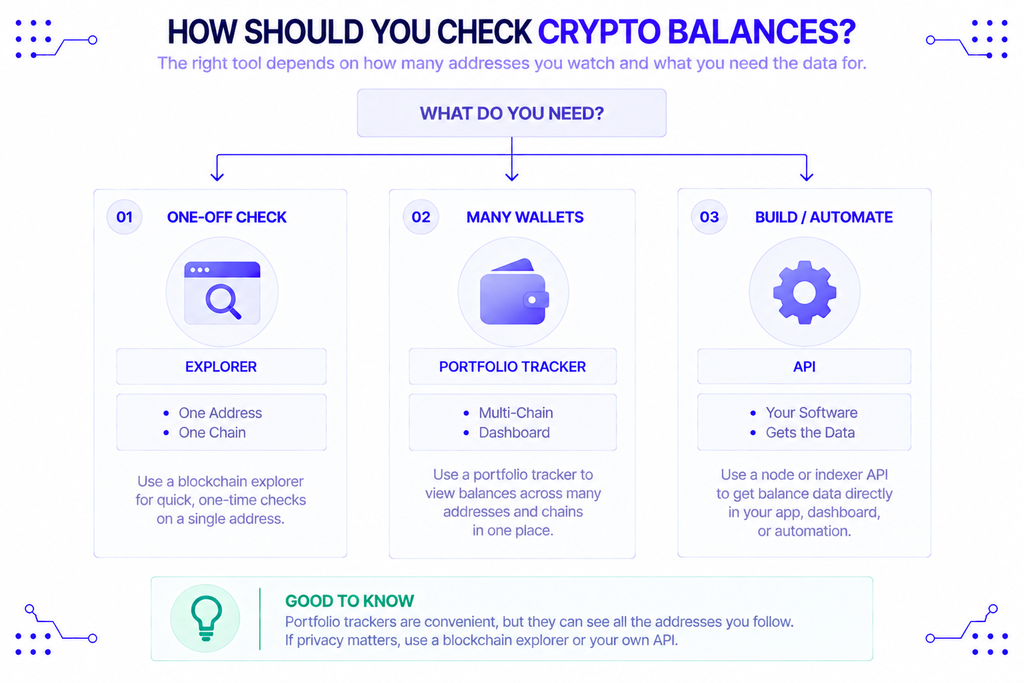
The right tool depends on how many addresses you watch and whether you need the data inside your own software.
| Method | Best for | Trade-off |
|---|---|---|
| Block explorer | One-off checks on one chain | Manual; one address at a time |
| Portfolio tracker | Many addresses across many chains | Third party sees which addresses you follow |
| Node or indexer API | Apps, dashboards, automation | Needs an API key and some code |
An ETH wallet tracker or multi-chain dashboard is convenient, but it links your addresses together on someone else’s server. If privacy matters, use an explorer per chain, or query the chain yourself.
How Do Developers Read Balances Programmatically?
They call a node API or an indexed data API. Which one depends on the chain model, and it’s the same split from earlier: UTXO chains have no balance field to read.
Bitcoin Core has no simple “get balance for any address” call. Its listunspent only covers addresses in the node’s own wallet, and scantxoutset returns unspent outputs you then have to add up (Bitcoin RPC reference). That’s the reason indexed interfaces such as Blockbook exist. NOWNodes offers Blockbook on 30+ networks, including Bitcoin, Litecoin and Ethereum, so a single request to an address endpoint returns the total, plus transaction history. That’s the practical way to build a BTC wallet checker or a bitcoin balance check into your own app.
For account-based chains, the query is direct. This request reads an ETH balance through an Ethereum endpoint:
bash
curl -X POST "https://eth.nownodes.io" \
  -H "Content-Type: application/json" \
  -H "api-key: YOUR_API_KEY" \
  -d '{"jsonrpc":"2.0","id":1,"method":"eth_getBalance","params":["0xYOUR_ADDRESS","latest"]}'
The response is a hex string in wei. Use "finalized" instead of "latest" if you need a balance that won’t be reorganised. Solana works the same way with getBalance on a Solana endpoint.
If you’d rather not poll, address monitoring can push updates. NOWNodes’ webhooks send an HTTPS POST when the balance of a tracked Bitcoin or Dogecoin address changes, up to 5 addresses per webhook, and the product is currently in free beta.
Why Isn’t My Balance Showing Up?
Almost always it’s one of five things:
- Wrong network. The same
0xaddress exists on many EVM chains, so check each one. - Unconfirmed transaction. The funds are in the mempool and don’t count as confirmed yet.
- Token not displayed. The explorer’s “Tokens” tab lists them separately, and wallets hide unrecognised ones by default.
- Address type mismatch. Bitcoin has several address formats, and a wallet may show a balance spread across many addresses derived from one seed. Explorers only see the single address you pasted.
- Chain in transition. Some networks are in the middle of migrations, and old addresses may not show what you expect.
Zilliqa is the current example of the last case. After its move to Zilliqa 2.0 with EVM compatibility, legacy zil1 addresses and EVM 0x addresses both derive from the same private key but display balances on separate sides of the network (PlunderSwap’s address guide). A flaw in the Zilliqa Ledger app exposed keys on 6,772 accounts and led to 683,130,969.66 ZIL being drained, according to a report on the September 2 hard fork, and legacy transactions have been disabled since July. Exchange balances are being moved to EVM addresses in staged hard forks; check the team’s migration update and your exchange’s notices before acting on any number you see.
What Are the Risks When You Copy and Paste Addresses?
The main one is address poisoning: an attacker sends you a tiny transaction from a lookalike address that matches the first and last characters of one you use, hoping you’ll copy it from your history later.
It works. In December 2025, a user lost $49,999,950 in USDT after copying an address from their own transaction history, CoinDesk reported. Chainalysis found that one 2024 campaign generated 82,031 fake addresses over 66 days to target a single victim’s habits.
Three habits cut the risk sharply:
- Never copy a destination address from transaction history.
- Compare the whole address, not just the first and last characters.
- Send a small test amount before a large transfer, as Chainalysis recommends.
Keep in mind that a lookup only ever needs the public address. Anyone asking for a seed phrase to “verify your balance” is running a scam. For the difference between holding your own keys and letting a platform hold them, see the guide to custodial vs non-custodial wallets.
Conclusion
Checking a crypto wallet balance is a public, read-only step: pick the right network, paste the address, and read the confirmed total. The same routine works to check BTC wallet balance, ETH, BNB or SOL holdings. Watch the units, confirmations and tokens, because those account for most confusion. Developers who need the same data in an app can use an indexed API for UTXO chains and a direct balance method for account-based ones. And whichever route you take, the address is the only thing you ever need to share.
FAQ
Can someone steal my crypto if they know my wallet address?
No. A public address only lets others see the balance and history. Funds can only move with the private key, so keep that and your seed phrase offline.
Is a wallet lookup anonymous?
Not fully. Addresses are pseudonymous, but analytics firms link them to identities through exchange KYC and on-chain patterns, so treat any address you use as traceable.
How many confirmations should I wait for on Bitcoin?
Most services treat one confirmation as a minimum and six as the conventional standard for large amounts. The exact number is a risk decision, not a protocol rule.
Does a lookup show the balance of my whole wallet app?
Only for the single address you paste. Many wallets derive multiple addresses from one seed, so the app’s total can be the sum of several addresses.
Can I check a balance on a testnet?
Yes, using the testnet’s own explorer. Testnet coins have no market value and don’t appear on mainnet pages.
How often does an explorer update?
At each new block, roughly every 12 seconds on Ethereum and about every 10 minutes on Bitcoin. Unconfirmed activity appears sooner in the mempool view.