
A Solana public RPC is a free endpoint, run by someone else, that lets any wallet, script or app read Solana data and submit transactions without an account or an API key. The official one from the Solana Foundation is https://api.mainnet.solana.com, and it caps every IP address at 100 requests per 10 seconds. That is plenty to learn on and nowhere near enough to run a product on.
This guide covers what a public RPC endpoint does, who uses it, which endpoints are worth trying, and the exact limits you’ll hit. Figures were checked against Solana’s documentation and provider pages in September 2026, and providers change them without notice.
What Is a Solana Public RPC?
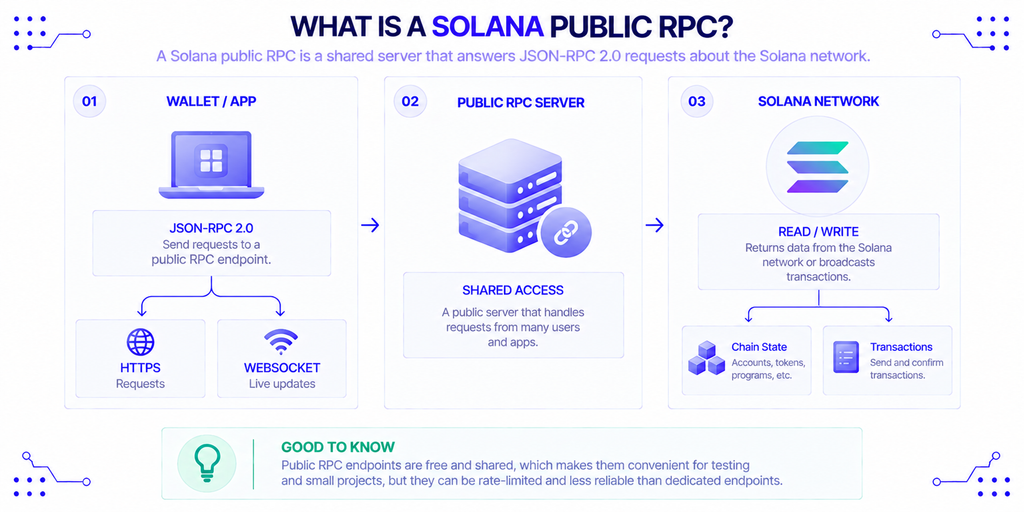
A Solana public RPC is a shared server that answers JSON-RPC 2.0 requests about the Solana network. You send a method name such as getBalance or sendTransaction over HTTPS, and it returns the result. For live updates, the same endpoint usually offers WebSocket subscriptions.
Solana’s RPC documentation lists three official public clusters: mainnet, devnet and testnet. Mainnet is the live network with real SOL. Devnet is the playground for app builders, and testnet is used mostly by validator operators and core contributors.
Two words in that definition carry the weight: shared and free. Thousands of other apps hit the same URL, and nobody owes you uptime.
Why Does Solana Need Public RPC Endpoints?
Because the machines that serve blockchain data are not the machines that produce blocks. According to Solana’s RPC infrastructure page, RPC servers are “typically dedicated to the task rather than participating in consensus,” acting as an application’s gateway to the cluster. Somebody has to run that gateway.
Running one yourself means syncing and maintaining a Solana server that keeps up with a network producing a block roughly every 400 milliseconds. That is a heavy commitment for someone who only wants to check a balance. A public endpoint removes the barrier: paste a URL and start.
There is a second reason. Every wallet, explorer and dApp needs some way to reach the chain on day one, and a free default lowers the cost of trying Solana at all. The catch is that the same URL becomes a bottleneck for anyone who stays.
Who Uses Solana Public RPC Endpoints?
Solana’s own guidance says public services suit “real-world testing, early demos, and small, private beta programs.” In practice that covers a fairly narrow group:
- Students and first-time developers learning how accounts, signatures and transactions work.
- Hackathon teams that need a working connection in five minutes.
- dApp and wallet developers running integration tests on devnet before real users exist.
- Script writers who check a balance or a token account a few times a day.
- Anyone verifying a transaction without setting up an account anywhere.
Notice what’s missing: trading bots, payment flows and anything with a paying user. A Solana sniper bot that has to land a transaction inside one slot cannot live on a shared endpoint capped at 10 requests per second.
What Are the Official Solana Public RPC Limits?
The Solana Foundation applies the same limits to mainnet, devnet and testnet. These come straight from the clusters documentation:
| Limit | Value |
|---|---|
| Requests per 10 seconds, per IP | 100 |
| Requests per 10 seconds, per IP, for one method | 40 |
| Concurrent connections per IP | 40 |
| New connections per 10 seconds, per IP | 40 |
| Data transferred per 30 seconds | 100 MB |
Convert that to something you can feel. One hundred requests per 10 seconds is an average of 10 requests per second across everything, and the single-method cap works out to 4 per second. A page that polls getAccountInfo for a dozen accounts every second breaks that rule on its own.
The same documentation adds a blunt line: “The public RPC endpoints are not intended for production applications.” Many older tutorials still use the previous hostname, api.mainnet-beta.solana.com, so copy the URL from the docs instead.
Which Public Solana RPC Endpoints Are Worth Using?
The Foundation endpoint is the default, but it isn’t the only free URL. CompareNodes currently catalogs 22 public Solana endpoints across HTTPS, WebSocket and gRPC, measured from 30 locations. These are the mainnet HTTPS ones from that list:
| Provider | Endpoint | What to know |
|---|---|---|
| Solana Foundation | https://api.mainnet.solana.com | Official; documented limits above |
| PublicNode (Allnodes) | https://solana-rpc.publicnode.com | Markets itself as privacy-first and MEV-protected; archive data on request |
| OnFinality | https://solana.api.onfinality.io/public | Public tier of a commercial provider |
| Tatum | https://solana-mainnet.gateway.tatum.io/ | Gateway URL from a commercial provider |
| Pocket Network | https://solana.api.pocket.network/ | Decentralized gateway |
| Solana Vibe Station | https://public.rpc.solanavibestation.com/ | Dedicated public URL |
Only the Foundation publishes hard numbers. For the others, treat any limit as best-effort and unpublished, because providers can tighten it when traffic grows. RPC Fast’s 2026 comparison found the same pattern among free tiers: getProgramAccounts and token-account methods are the first things throttled or switched off.
So which is “best”? For learning, the official endpoint, because its behavior is documented. For a script that values privacy, PublicNode. For a project you plan to ship, none of them, which brings us to production.
How to Connect to a Solana Public RPC
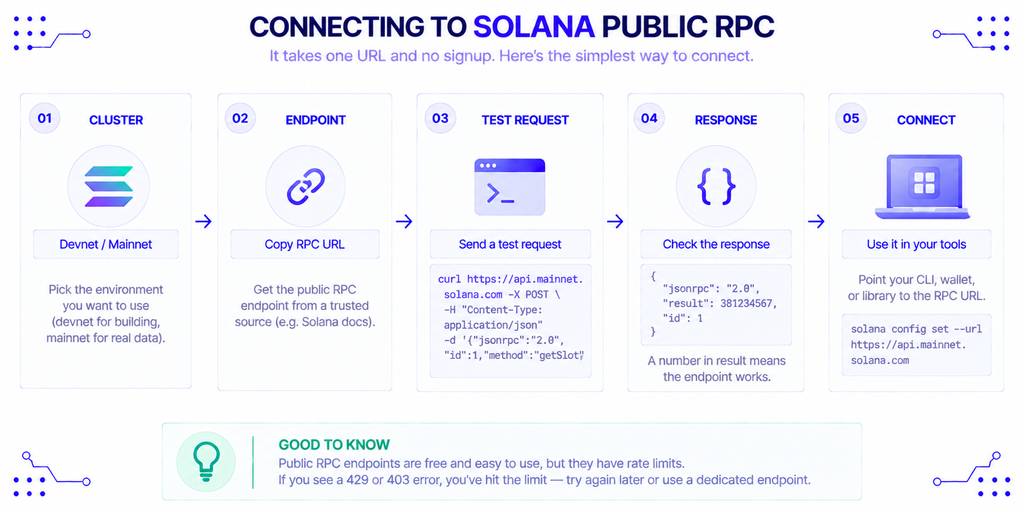
Connecting takes one URL and no signup. Here’s the shortest route.
- Pick the cluster. Use devnet for building, mainnet only for reading real data.
- Copy the endpoint from the table above or from Solana’s docs.
- Send a test request. This call asks for the current slot:
bash
curl https://api.mainnet.solana.com -X POST \
  -H "Content-Type: application/json" \
-d '{"jsonrpc":"2.0","id":1,"method":"getSlot"}'- Read the response. A number in
resultmeans the endpoint works. A429or403means you’ve hit a limit (more on that below). - Point your tooling at it. In the Solana CLI, run
solana config set --url https://api.mainnet.solana.com. Wallets and libraries take the same URL in their network settings.
Devnet works the same way, and you’ll want test tokens first. Our Solana faucet guide covers how to get them.
What Do 429 and 403 Errors Mean on a Public Endpoint?
Solana’s documentation says shared endpoints can return 429 (too many requests) or 403 (traffic blocked). A 429 means you exceeded a rate limit, and it usually clears if you slow down. A 403 means your IP or website has been blocked, and the docs’ advice is to run your own server or find a private service.
Before giving up on the free endpoint, cut what you send. OrbitFlare’s rate-limit breakdown suggests a handful of fixes:
- Replace polling loops with WebSocket subscriptions such as
accountSubscribe. - Batch reads with
getMultipleAccounts, which handles up to 100 accounts per call. - Cache data that never changes, like finalized transactions.
- Retry with exponential backoff and jitter, not an immediate loop.
- Use
dataSliceand filters so responses carry less data.
These help, but they only stretch a fixed budget. They don’t raise it.
Is a Solana Public RPC Safe for Production?
No. Solana’s production readiness guide says it outright: “Never use public RPC for production.” The reasons are practical, not theoretical.
- No SLA. Public endpoints are “rate-limited with no SLA,” so an outage is your outage. Solana’s RPC page adds that free services “typically do not autoscale” and “are not afraid to ban abusers.”
- Heavy methods get restricted.
getProgramAccounts, which OrbitFlare calls the most intensive method in the API, is routinely limited on free tiers. Apps that index data feel this first. - Latency swings. Chainstack reports public response times ranging from about 50 ms to several seconds under congestion. That range is fatal for trading, gaming and payments.
- Your traffic is visible. Every request shows your IP and request pattern to whoever operates the endpoint. Irrelevant for a balance check, but not for a strategy whose timing is the secret.
The production guide also recommends more than one provider, because “RPC providers can experience downtime or periods of degraded performance.” A single free URL can’t give you that redundancy.
When Should You Move to a Private Endpoint?
Move when the free URL starts costing you more than it saves. Chainstack lists the signals: 429 errors during normal traffic, a user base pushing past a few hundred requests per second, partners asking for uptime guarantees, and latency-sensitive features on the roadmap.
If you’re there, the migration itself is small. Solana RPC is standard JSON-RPC, so switching is usually a URL change plus an API key, not a rewrite. That’s the reason it’s safe to prototype on a public endpoint first.
Providers that serve Solana include NOWNodes, which offers Solana RPC and WebSocket access with both shared and dedicated options. Its free Start plan covers 100,000 requests, though it needs an API key, and NOWNodes’ keyless public endpoints currently cover Bitcoin, Ethereum and BNB Smart Chain rather than Solana. The NOWNodes Solana docs list the 50+ supported JSON-RPC methods. If you want to know why Solana’s RPC layer is so demanding in the first place, the Solana Virtual Machine explains the parallel execution behind it.
Conclusion
A Solana public RPC is the right starting point: free, keyless and documented. Use the Foundation’s endpoint to learn, PublicNode or another gateway for light reads, and devnet for everything you’re still breaking. Stay under 10 requests per second and expect nothing beyond that.
Treat the first 429 on normal traffic as a scheduling signal, not a bug. The moment real users, real money or heavy methods like getProgramAccounts enter the picture, a private endpoint with a second provider as backup is the setup Solana’s own docs recommend.
FAQ
What is the difference between a public RPC and a private RPC on Solana?
A public RPC is shared, free and rate-limited with no SLA. A private RPC is tied to your account or hardware and offers higher limits, support and often extra features like indexing or streaming.
Do I need an API key for a Solana public RPC?
No. The Foundation’s endpoints and services like PublicNode work without a key. Commercial providers usually ask for one, even on free plans.
Can I send transactions through a public RPC?
Yes. You sign the transaction locally and submit it with sendTransaction, so your private key never leaves your machine. Just expect throttling when traffic is high.
Are the devnet and testnet endpoints different from mainnet?
They use the same JSON-RPC methods and, per Solana’s docs, the same rate limits. Devnet and testnet can be reset, which erases balances and deployed programs.
Why did my request work yesterday and fail today?
Limits are counted per IP over rolling windows, and shared endpoints get busier and more aggressive with abusers. A different network, VPN or shared office IP can change what you’re allowed.