

A Sepolia faucet is a free service that sends Sepolia ETH to your wallet, so you can pay gas on Ethereum’s main public test network without spending real money. You paste in an address, pass a small anti-bot check, and the test coins usually land within a minute or two. That’s the whole idea, but getting a claim to go through has become harder than it sounds.
Most sepolia testnet faucets now cap what you can take, ask for a small mainnet balance, or require a login, because bots drained free tokens for years. This guide covers what the coins are, who needs them, how each major eth faucet compares in 2026, and a step-by-step claim flow. It also covers something most tutorials skip: the network itself is on a retirement schedule.
What Are Test Coins and Where Do They Come From?
Sepolia ETH is the native currency of Sepolia, an Ethereum test network launched in October 2021. It has no market value and can’t be swapped for real ETH. Its only job is to pay gas, the fee that every transaction and contract deployment costs.
A faucet is the tap that hands these coins out. You can’t simply earn them by staking, because ethereum.org notes that Sepolia runs a permissioned validator set controlled by client and testing teams. So each ethereum sepolia faucet, whether it’s a sepolia eth faucet from a cloud vendor or a community project, holds a stockpile and releases it in small portions.
The network itself is easy to identify: chain ID 11155111, proof-of-stake, and roughly 12-second blocks, the same cadence as mainnet. Ethereum’s own documentation calls it the recommended default testnet for application development.
Why Do Developers Need Free Test Coins?
Every write to a blockchain costs gas, and on mainnet that gas is real money. A minimal contract deployment needs about 66,862 gas, which is cheap at today’s sub-1 gwei prices. The problem isn’t the fee. It’s that a deployed contract is permanent and a mistaken transfer is irreversible.
A test network removes that risk. You can deploy the same contract thirty times in an afternoon, break it on purpose, and lose nothing. Here’s why this matters in practice: a bug found on Sepolia costs a few free coins, while the same bug found on mainnet can cost users their funds.
Who Actually Claims Test Coins?
Anyone who needs to send a transaction on the testnet needs a balance first, and that balance comes from an eth sepolia faucet or one of its rivals. The people who do this most often:
- Smart contract developers deploying and debugging with Hardhat, Foundry or Remix.
- dApp and wallet teams checking that sign-in, approval and transfer flows work before launch.
- Layer-2 builders. Base Sepolia, Arbitrum Sepolia and OP Sepolia currently settle to Sepolia, so their tooling often needs coins on both layers.
- QA and CI pipelines that run automated tests sending real transactions on every commit.
- Students and hackathon teams learning how a wallet, a signature and a block confirmation fit together.
How to Get Free Test Coins Step by Step
Claiming takes five steps and about five minutes when the dispenser accepts your wallet. The steps are the same for every option in the next section.
- Open your wallet and copy your
0xaddress. In MetaMask, turn on “Show test networks” in settings so Sepolia appears in the network list. - Confirm the network settings: chain ID
11155111and currency symbol SepoliaETH. - Pick a sepolia testnet faucet from the comparison table below. If one asks for a mainnet balance you don’t have, move to one that doesn’t.
- Paste your address and complete the verification, which can be a login, a captcha, a wallet connection or a short mining session.
- Wait for the transfer, then check the wallet or a Sepolia block explorer. Delivery is usually fast, though Chainstack warns it can take up to 15 minutes when the network is busy.
How to Confirm the Balance Through an API Endpoint
If you’re scripting deployments, you’ll want to check the balance from code rather than from a wallet screen. NOWNodes is a blockchain infrastructure provider that gives API access to Ethereum mainnet and Sepolia without running your own client. Create an account, generate an API key in the dashboard, and send a standard JSON-RPC call to the Sepolia endpoint:
bash
curl -X POST https://eth-sepolia.nownodes.io \
  -H "api-key: YOUR_API_KEY" \
  -H "Content-Type: application/json" \
  -d '{"jsonrpc":"2.0","method":"eth_getBalance","params":["0xYOUR_WALLET","latest"],"id":1}'
The answer comes back in wei as a hex string. A fresh 0.1 ETH claim shows as 0x16345785d8a0000. The free Start plan includes 100,000 requests, which covers a lot of test runs, and the public endpoints page lists keyless access for a selection of networks, so check there whether Sepolia is currently included. Our guide to blockchain test networks covers the wider picture.
Which Free Dispensers Work Best in 2026?
No single option wins for everyone. The right one depends on whether you have mainnet ETH, want to avoid logins, or need a larger amount at once. Limits below come from each provider’s own page or, where marked, from a third-party comparison, and they change often.
| Dispenser | Amount and frequency | Requirements | Best for |
|---|---|---|---|
| Alchemy Sepolia faucet | 0.1 ETH every 24 hours | At least 0.001 ETH on mainnet, some mainnet activity, low existing testnet balance; no Alchemy account | Developers with an active wallet |
| Cloud Sepolia faucet from Google | Varies with reserve levels | Google sign-in | Fresh wallets with no mainnet history |
| Chainstack | Up to 0.5 ETH per 24 hours | 0.002 ETH on mainnet, Chainstack account and API key | Larger one-off amounts |
| QuickNode | About 0.05 ETH every 12 hours (per DataWallet) | 0.001 ETH on mainnet | Multi-chain testing |
| Chainlink | One drip per request, plus test LINK | Wallet connection | Oracle work that also needs test LINK |
| Sepolia PoW faucet | You mine until you reach the minimum payout | Address only, no login | Wallets that fail every other check |
The trade-off is visible in the table. The strictest requirements sit on the dispensers with the highest, most predictable payouts. The looser ones ask you for time or a login instead.
Mining-Based Option
The PoWFaucet project run by pk910 asks your browser to solve small puzzles before it pays out. Its documentation is explicit that it does not create new coins through mining. The work exists only to make bot farming inefficient, and the wiki notes GPU mining isn’t allowed. You start mining, stop once you reach the minimum withdrawal, and claim.
It’s slower than a one-click claim, yet it has one advantage: it works when a wallet has no mainnet history and you’d rather not sign in anywhere.
Options for Layer-2 Test Networks
Layer-2 test networks need their own coins. Alchemy’s Base Sepolia faucet applies the same 0.1 ETH per 24 hours and the same eligibility checks, and the Arbitrum Sepolia faucet sits on the same platform. Every Alchemy Sepolia faucet page follows the same pattern, so a wallet that qualifies for one usually qualifies for the rest.
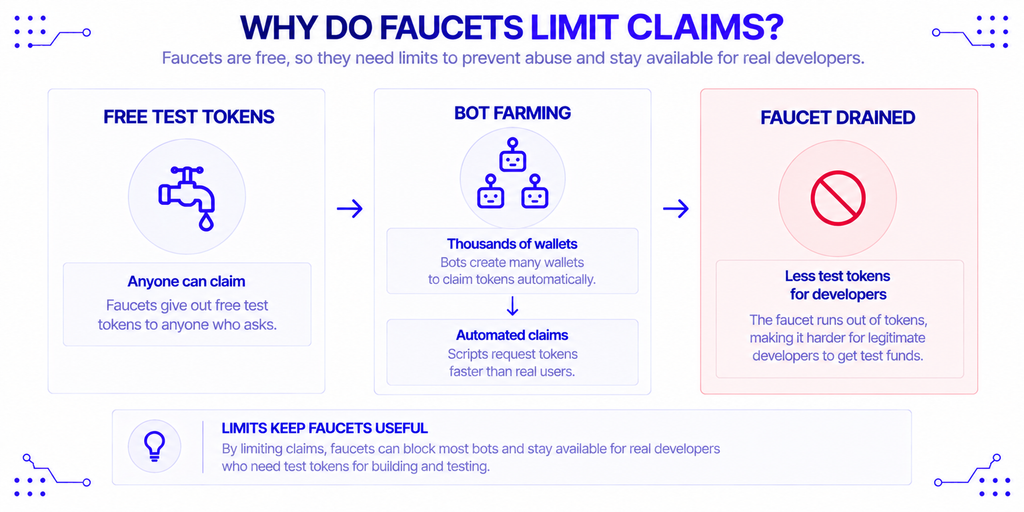
Why Do Dispensers Limit Claims?
Because bots ruin free things. Automated scripts claimed tokens faster than people could use them, and legitimate developers ended up with empty queues. Rene Reinsberg, co-founder of Self, described the problem when Google’s Web3 test-token pages added proof-of-humanity checks in January 2026: “We are making testnet faucets useful again for real, human developers after bots have overwhelmingly exhausted resources across the industry.” In that setup, verified humans can receive up to 10x more test tokens than unverified ones.
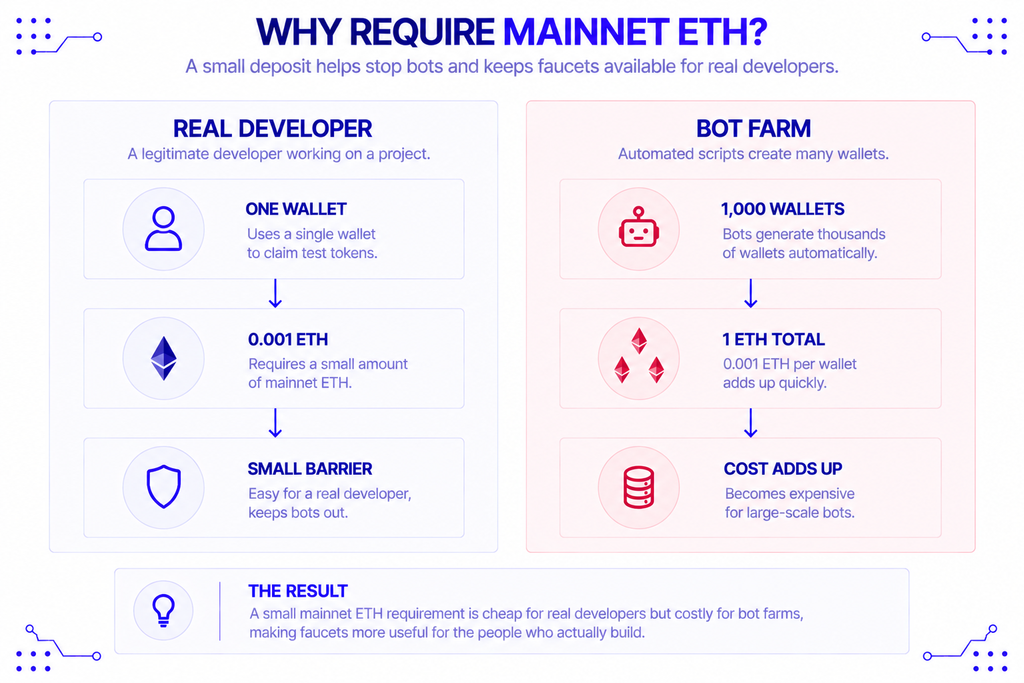
The mainnet balance rule is a lighter version of the same idea. A 0.001 ETH deposit is cheap for a real developer and costly for someone farming a thousand wallets. The catch is that genuine newcomers with an empty mainnet wallet get blocked too, which is exactly when the login-based or mining-based options earn their place.
How to Spot a Fake Dispenser
A real one never asks for a seed phrase, a private key or a payment. Test coins have no market price, so anyone selling Sepolia ETH is running a scam. A page that asks you to approve a token spend instead of just entering an address should be closed immediately.
Look-alike sites also thrive on search traffic. The old sepoliafaucet.com address currently redirects to Alchemy’s page, so bookmark the official alchemy.com link or follow the list on ethereum.org rather than clicking an ad.
What Is Happening to the Network in 2026 and 2027?
Sepolia is scheduled for retirement, and the timeline is still in flux. The Ethereum Foundation’s March 2025 announcement set end of support for Sepolia at September 30, 2026, with a replacement network planned first. Hoodi, the open-validator network, is scheduled to run until September 30, 2028, but it targets validators and staking providers instead of app developers.
A newer proposal stretches the timeline. Parithosh posted in May 2026 on Ethereum Magicians that the network’s state is growing too large to run cheaply. In his words: “Currently it seems like we’d start hitting sepolia state being too big to run cheaply issues around mid next year.” His proposal has a new network reaching the latest fork by Q1 2027 and Sepolia sunsetting in Q2 or Q3 2027, though he frames it as open to pushback rather than a final decision.
What this means for you: claiming test coins still works today, but hardcoded dispenser links and scripts tied to chain ID 11155111 will need a review before the cutoff. Pin your test-network target explicitly in the config instead of relying on a library default, and check the eth-clients repository for the current status before building anything long-lived.
Conclusion
Getting Sepolia ETH takes a wallet, an address and one sepolia faucet that fits your situation. The alchemy faucet sepolia page suits wallets with a little mainnet history, Google’s cloud sepolia faucet works for fresh addresses, Chainstack pays the most but wants an account, and the sepolia pow faucet is the fallback when everything else says no. Verify the URL before connecting a wallet, and never share a seed phrase.
Once the coins arrive, the useful part begins: deploying, calling contracts, and confirming balances from code through an endpoint. Just keep one eye on the retirement timeline, because the test network you build on today won’t be the one you use forever.
FAQ
Can I Sell or Swap Test Coins for Real Money?
No. Test coins have no market value and can’t be bridged to mainnet. Anyone offering to buy or sell them is running a scam.
How Much Do I Need for a Contract Deployment?
A basic deployment burns only a small fraction of a single 0.1 ETH claim, so one day’s allowance normally covers many attempts. Larger contracts and busier periods cost more, so claim again the next day if you run low.
What Should I Do If Every Claim Gets Rejected?
Check whether the dispenser wants mainnet activity and a low existing test balance. If your wallet is new, switch to one that only asks for a Google sign-in or use the mining-based option.
Do Layer-2 Test Networks Use the Same Coins?
No. Base Sepolia and Arbitrum Sepolia use their own test ETH, claimed from their own dispensers, even though they settle to Sepolia underneath.
Will My Test Contracts Disappear When the Network Retires?
Yes, once a network is shut down, its contracts and balances stop being reachable in practice. Redeploy on the successor network and keep deployment scripts configurable so a chain ID change is a one-line edit.