
Every Ethereum developer knows the small jolt that comes with clicking “Deploy.” Once a smart contract lands on mainnet, the code is frozen — no edits, no undo, and any bug is now handling real money. That is exactly the problem Sepolia was built to solve.
Sepolia is Ethereum’s main testnet for application and smart contract work: a near-identical copy of mainnet where the ETH is fake and mistakes cost nothing. You can deploy a contract, break it, fix it, and redeploy as many times as you need before touching real funds.
This guide moves from the basics — what Sepolia is, what Sepolia ETH is — up to the parts that matter in 2026: how its consensus works, who uses it, how it compares to the newer Hoodi network, and the retirement timeline you’ll want to plan around. Here’s the full picture, start to finish.
What Is Sepolia?
Let’s start simple. Sepolia is a testnet — a fully working blockchain that mirrors Ethereum mainnet but runs on its own separate ledger, using tokens with no real-world value.
Sepolia: a proof-of-stake Ethereum test network, launched in October 2021 and maintained by Ethereum’s core developers, built for testing smart contracts and decentralized apps in conditions that closely match mainnet — without spending real ETH.
The name comes from a neighborhood in Athens, Greece, where one of the Ethereum developers grew up. Small piece of trivia, but a handy one: the testnets are all named after real places, which is one way to keep them straight.
What makes Sepolia the default choice is straightforward. If a contract behaves correctly here, it will almost always behave the same way on mainnet — same Ethereum Virtual Machine, same proof-of-stake consensus, same transaction mechanics. You’re rehearsing on a stage built to the exact dimensions of the real one.
What Is Sepolia ETH?
To do anything on Sepolia, you need Sepolia ETH — the testnet’s version of ether, used to pay gas for transactions.
Here’s the part that trips people up: Sepolia ETH has no monetary value whatsoever. You can’t buy it, sell it, or move it to mainnet, and anyone offering to sell it to you is running a scam. It exists only to let you pay for test transactions, and you get it free from a faucet — more on that shortly.
Why Sepolia Exists
The reason testnets exist comes down to one hard fact about Ethereum: deployed code is immutable. Once your contract is live on mainnet, you can’t patch it, and a single overlooked bug can drain a protocol.
Sepolia removes that risk. It gives you a consequence-free environment to catch mistakes, measure gas costs, and confirm your front-end talks to the chain properly — all before a single real dollar is involved. This is why virtually every serious dApp has a copy running on a testnet first.
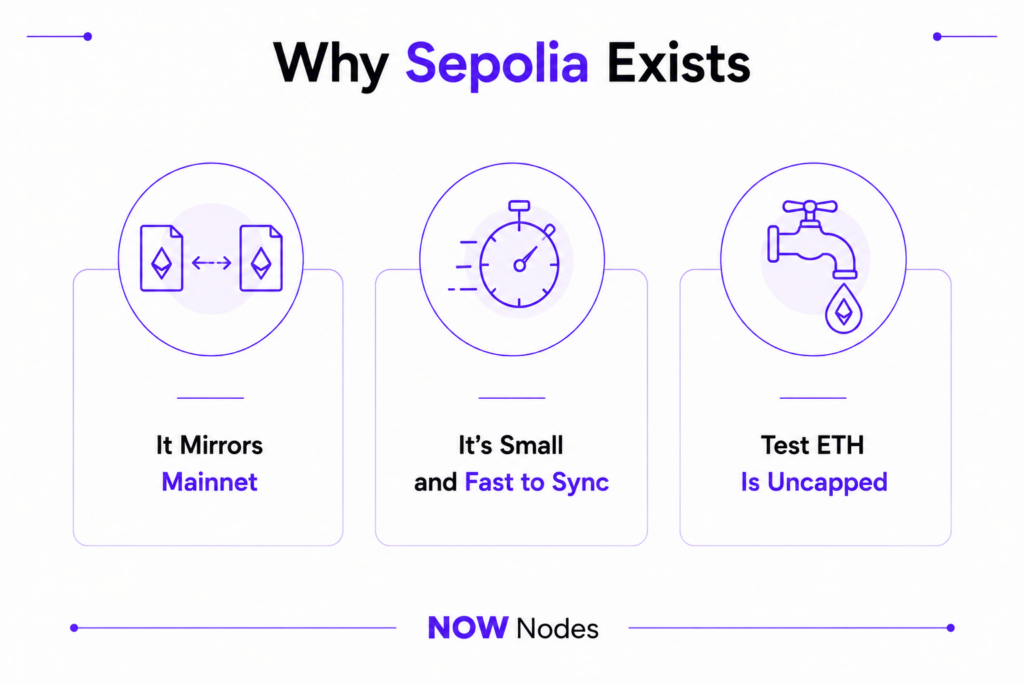
It Mirrors Mainnet
Sepolia runs the same execution and consensus layers as Ethereum mainnet. That “mainnet parity” is the whole point: your gas estimates, contract behavior, and transaction flows on Sepolia are a reliable preview of what production will do.
It’s Small and Fast to Sync
Because Sepolia is relatively young and its validator set is tightly controlled, its chain state stays small. That means faster syncing and lighter resource use for anyone who needs to stand up their own testnet infrastructure — a real advantage over older, bloated networks.
Test ETH Is Uncapped
Unlike Goerli, which suffered chronic token shortages, Sepolia’s supply of test ETH is uncapped. Faucets can keep handing it out, so developers don’t hit a wall where they simply can’t get funds to test with.
How Sepolia Works Under the Hood
Sepolia switched to proof of stake in 2022, in step with Ethereum’s own Merge, so it now secures blocks through staked validators rather than mining. Blocks arrive roughly every 12 seconds, and the network runs under Chain ID 11155111 — the number you’ll enter when adding it to a wallet.
The one detail that sets Sepolia apart from mainnet is its permissioned validator set. Anyone can use the network, but only a small group of known, approved operators actually run the validators.
Why the Validator Set Is Closed
This is a deliberate design choice, and it’s the reason Sepolia is so stable. A small, vetted validator set is easier to coordinate and far less likely to fall into the kind of failure that later took down its sibling testnet, Holesky.
Parithosh Jayanthi, the Ethereum Foundation DevOps engineer who has coordinated the testnets for years, laid out the reasoning in a GitHub discussion on the network’s setup. Keeping the set closed to proven mainnet stakers, he explained, is about reliability for the people building on top of it:
“We want to keep it closed since we’d like to provide a great, stable testnet env for developers.” — Parithosh Jayanthi, Ethereum Foundation
That trade-off — a little less decentralization for a lot more stability — is precisely what application developers want from a testnet.
From Proof of Authority to Proof of Stake
A quick bit of history, because it explains why Sepolia looks the way it does. It launched in October 2021 as a proof-of-authority network to replace the aging Ropsten testnet. When Ethereum completed The Merge in 2022, Sepolia merged too — joining its own beacon chain and adopting proof of stake, the same shift mainnet made months later. You can check the current network parameters any time in the official Sepolia configuration.
Who Uses Sepolia, and For What
Sepolia serves one broad audience: people building things on top of Ethereum. If you’re writing application code rather than testing validator hardware, this is your network.
Smart Contracts and dApps
This is the core use case. Developers deploy ERC-20 tokens, ERC-721 NFTs, DeFi protocols, and full decentralized apps to Sepolia to confirm everything works — contract logic, gas costs, wallet interactions — before going live. It plugs straight into the standard toolkits like Hardhat, Foundry, and Remix.
Layer-2 and Rollup Testing
Here’s where Sepolia quietly became critical infrastructure. Most major rollups run their own Sepolia-anchored testnets — Base Sepolia (Chain ID 84532), Arbitrum Sepolia (421614), and OP Sepolia among them — that settle back to Ethereum Sepolia as their base layer. That makes Sepolia the anchor for a whole web of cross-chain testing.
Staging Network Upgrades
Before an Ethereum hard fork reaches mainnet, it’s rehearsed on Sepolia. The Pectra upgrade ran here before its May 2025 mainnet launch, and the Fusaka upgrade was tested on Sepolia in October 2025 ahead of its own rollout later that year. If you want an early read on how a fork will behave in production, Sepolia is where it happens first.
Sepolia vs. Hoodi: Which Testnet Do You Need?
If you’ve read older guides, you’ll see Holesky mentioned as Sepolia’s counterpart. That’s out of date. Holesky was deprecated in September 2025 after it hit serious problems during Pectra testing, and a new testnet, Hoodi, replaced it — a change the Ethereum Foundation detailed in its Hoodi and Holesky announcement.
Here’s the split between the two networks that matter now:
| Sepolia | Hoodi | |
|---|---|---|
| Best for | Apps, smart contracts, dApps | Validators, staking, protocol testing |
| Validator set | Permissioned (closed) | Open (anyone can join) |
| Launched | October 2021 | March 2025 |
| Planned end-of-life | ~September 2026 | ~September 2028 |
The rule of thumb is easy: building an application? Use Sepolia. Testing a validator or staking setup? Use Hoodi. Most developers reading this want Sepolia.
The Sepolia Sunset: What’s Changing in 2026
This is critical if you’re planning anything long-term. Sepolia is not permanent. Under Ethereum’s newer policy of giving every testnet a fixed lifespan, Sepolia has an estimated end-of-life around September 30, 2026.
The good news is there’s no cliff edge. A successor testnet is due to launch in 2026 and run alongside Sepolia during a grace period, so teams can migrate their tools and workflows without anything breaking overnight.
So what should you do? For now, keep building on Sepolia — it remains the recommended network through 2026. Just fold the migration into your roadmap, and watch Ethereum’s official network documentation for the successor’s name and launch date rather than assuming Sepolia runs forever.
How to Start Using Sepolia
Enough theory. Here’s the practical path from zero to a funded testnet wallet.
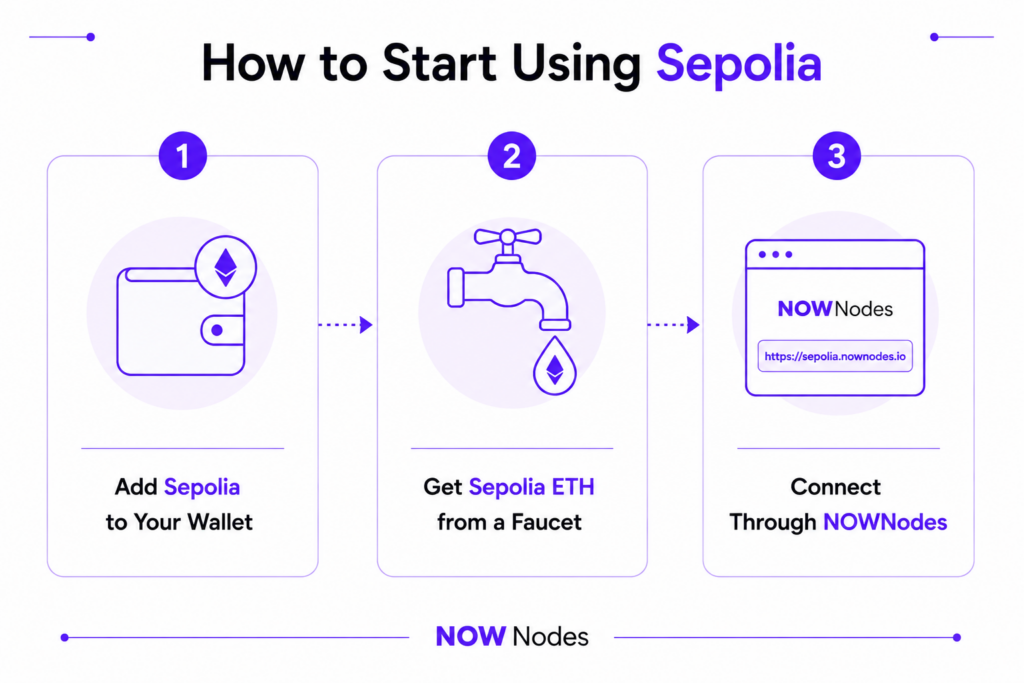
Step 1: Add Sepolia to Your Wallet
Most wallets, MetaMask included, already list Sepolia once you enable test networks in the settings. If you’d rather add it by hand, these are the official parameters:
| Field | Value |
|---|---|
| Network name | Sepolia |
| Chain ID | 11155111 |
| Currency symbol | ETH |
| Block explorer | https://sepolia.etherscan.io |
One habit worth keeping: before you approve, check that the Chain ID reads 11155111 in the wallet popup. A mismatched ID is the usual sign something’s off.
Step 2: Get Sepolia ETH from a Faucet
A faucet is a free service that drips small amounts of test ETH to your wallet so you have gas to work with. A few reliable ones in 2026:
| Faucet | Amount |
|---|---|
| Alchemy Sepolia Faucet | up to 0.1 ETH / 24h |
| QuickNode Multi-Chain Faucet | 0.05 ETH / 12h |
| Google Cloud Web3 Faucet | varies |
| PoW Faucet | no login; solve a browser challenge |
Most faucets ask for a small mainnet ETH balance or some account history to block spam. If one’s dry or rejects your wallet, try another — and always confirm it’s sending to Ethereum Sepolia, not a Layer-2 Sepolia, since those are separate.
Step 3: Connect Through NOWNodes
Public endpoints are fine for clicking around a wallet. But the moment you’re running an automated test suite, an indexer, or anything firing a high volume of requests, you’ll want a stable, keyed endpoint instead of a shared public one.
That’s where NOWNodes comes in. You sign up, generate an API key, and connect to Sepolia through a hosted endpoint — with no backend to maintain on your end. Because Sepolia is fully EVM-compatible, standard methods like eth_getBalance and eth_sendRawTransaction work exactly as they do on mainnet; you just point them at the Sepolia endpoint.
Conclusion
Sepolia is the closest thing Ethereum has to a free, no-risk copy of mainnet — a proof-of-stake testnet where you can deploy, break, and refine contracts before they ever handle real money. For application and smart contract work in 2026, it’s still the default, and nothing about its day-to-day usefulness has changed.
What has changed is the roadmap around it. Holesky is gone, Hoodi now covers validator testing, and Sepolia itself has a retirement date on the calendar with a successor on the way. Build on it with confidence — just keep an eye on the lifecycle.
When you’re ready to connect something more demanding than a wallet, NOWNodes gives you stable Sepolia access without running the backend yourself, so you can focus on what you’re building.
FAQ
What is Sepolia?
Sepolia is Ethereum’s main proof-of-stake testnet for application and smart contract development. It mirrors mainnet closely but uses valueless test ETH, so developers can deploy and test freely before going live on the real network.
Is Sepolia ETH worth any real money?
No. Like all testnet tokens, Sepolia ETH is purely for testing and has zero market value. Its only job is covering gas for transactions on Sepolia.
What’s the difference between Sepolia and Hoodi?
Sepolia is for app and smart contract testing and uses a closed, permissioned validator set for stability. Hoodi, which replaced Holesky in 2025, is for validator and staking testing and has an open validator set. If you’re building an app, use Sepolia.
Is Sepolia being deprecated?
Eventually, yes. Sepolia has a planned end-of-life around September 2026, with a successor testnet launching in 2026 and running alongside it during a grace period. For now, it remains the recommended testnet for application work.
What is Sepolia’s Chain ID?
Sepolia’s Chain ID is 11155111. You’ll enter this when adding the network to a wallet, and it’s worth verifying in the confirmation popup before you approve.