
To stake Cardano, you delegate ADA to a stake pool through a wallet like Yoroi, Eternl, or Lace — your coins never leave your wallet, there’s no minimum amount, and you can redelegate or withdraw at any time. Network-wide rewards currently sit around 2.14% APY, according to Staking Rewards’ live tracker, with 56.3% of ADA’s circulating supply already staked across roughly 3,000 registered pools.
That’s the short version. The rest of this guide covers what ADA staking actually is, why Cardano needs it, who’s doing it, and what changes once you look past the headline APY into pool selection, saturation, and the trade-offs against exchange staking.
What Does It Mean to Stake ADA?
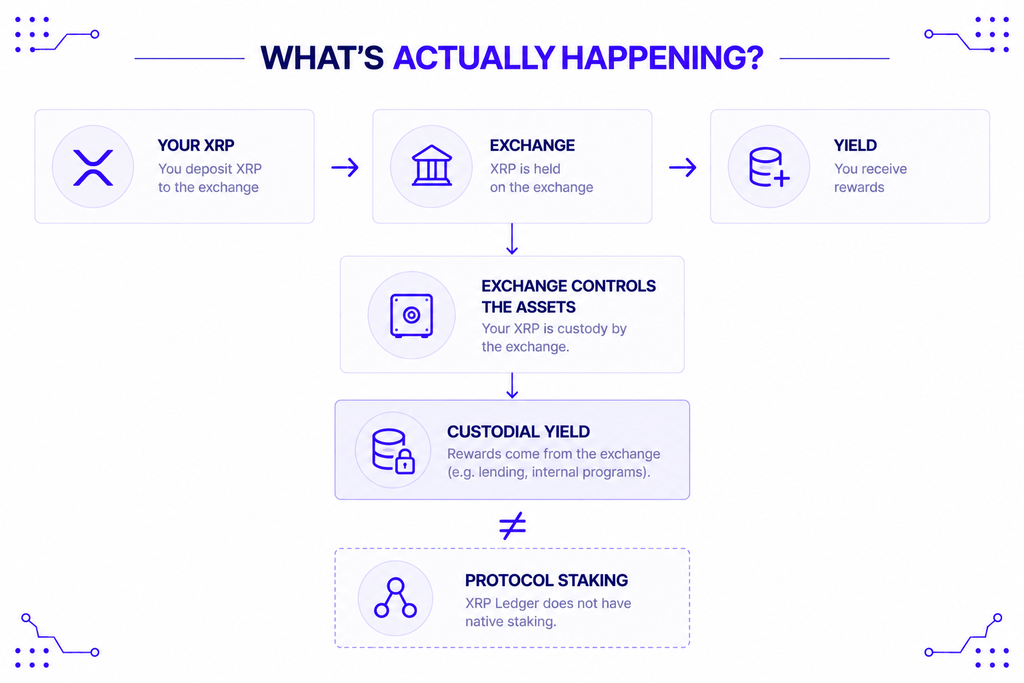
Cardano staking, more precisely called delegation, is the process of assigning your ADA’s voting power to a stake pool so it counts toward that pool’s chance of producing blocks. You’re not locking your coins into a contract or handing them to anyone — you’re issuing an on-chain certificate that says “count my balance toward this pool,” while your ADA stays fully spendable in your own wallet.
Staking Cardano works meaningfully differently than staking on Ethereum or Polkadot, where your tokens get bonded and become illiquid until you unstake. On Cardano, delegating and spending aren’t mutually exclusive: you can move, swap, or send your ADA the same day you delegate it, and your delegation simply carries forward with whatever balance remains.
Ada holders can also run a stake pool themselves rather than delegating to one, which requires technical infrastructure and a pledge of their own ADA. Most people delegate instead, since it takes a few clicks and no hardware.
Why Does Cardano Need Staking?
Cardano runs on Ouroboros, a proof-of-stake protocol that assigns block-production rights based on stake rather than computational work. Without staking, there’d be no mechanism deciding who gets to add the next block — and no economic reason for anyone to do it honestly.
Ouroboros was the first proof-of-stake protocol to be formally peer-reviewed and proven secure under academic scrutiny, according to Cardano’s own documentation, which also states the protocol is up to four million times more energy-efficient than Bitcoin’s proof-of-work. That security proof doesn’t require every participant to behave — Aggelos Kiayias, the protocol’s lead designer, has explained that Ouroboros tolerates significant misbehavior by design:
“Of those participants who are active, barely more than half need to follow the protocol — the rest can arbitrarily deviate.” — Aggelos Kiayias, Ouroboros lead researcher, via CryptoSlate
Delegation is what spreads that stake across the network instead of concentrating it. With 21.34 billion ADA currently staked — 56.3% of circulating supply, per Staking Rewards — Cardano’s security model depends directly on how widely that stake is distributed across its stake pools, not just how much is staked in total.
Who Actually Stakes ADA?
Cardano staking attracts a broader mix of people than the mechanics alone suggest, largely because the no-lock-up model removes the biggest objection to staking on other chains.
- Retail holders who want yield without giving up the ability to spend or move their ADA on short notice — the main reason delegation, not exchange staking, is the default route for most individual holders.
- Long-term believers treating staking rewards as a way to offset ADA’s own inflation rate rather than actively trading around price movements.
- Stake pool operators who run the actual infrastructure professionally and compete for delegators through lower fees or better uptime.
- Wallet and dashboard developers who need reliable, always-on access to Cardano’s chain state to display accurate balances, delegation status, and pool performance.
That last group runs into an infrastructure question quickly: showing a user’s live delegation and rewards means querying Cardano’s chain continuously, which is a different problem than just holding ADA.
How Does ADA Delegation Actually Work?
Cardano organizes time into epochs, each lasting five days, and delegation moves through a fixed sequence of them rather than taking effect instantly. Here’s the actual timeline, according to Cardano’s developer documentation:
- Epoch N — you delegate to a pool.
- Epoch N+1 — a snapshot of stake is taken at the epoch boundary.
- Epoch N+2 — the pool starts producing blocks using your stake.
- Epoch N+3 — rewards for that production are calculated.
- Epoch N+4 — rewards are distributed to your wallet.
That works out to roughly 15–20 days before your first reward lands, even though delegation itself is instant. After that initial wait, rewards arrive automatically every epoch — about every five days — and compound back into your delegated balance without any manual restaking.
Here’s a table of the current parameters governing that process:
| Parameter | Current value |
|---|---|
| Epoch length | 5 days |
| Time to first reward | ~15–20 days (epoch N+4) |
| Minimum ADA to delegate | None |
| Stake key registration deposit | 2 ADA (refundable on deregistration) |
| Pool saturation threshold | ~76 million ADA per pool (k = 500) |
| Minimum pool fixed cost | 170 ADA per epoch |
| Slashing | None — delegated ADA is never at risk |
That last row is the detail most new stakers don’t expect: Cardano has no slashing mechanism at all. If the pool you delegate to underperforms or goes offline, you simply miss rewards for that period — you never lose principal, according to the Cardano community’s own staking FAQ.
Can You Stake ADA Without Locking It Up?
Yes — and this is what separates Cardano from most other proof-of-stake networks. There’s no bonding period, no unstaking queue, and no fixed commitment length. You can redelegate to a different pool or spend your ADA outright at any moment, and the only consequence is that your reward-earning stake updates at the next epoch boundary.
Compare that to Polkadot’s fixed 28-day unbonding period or Ethereum’s multi-day exit queue, and ADA’s model looks less like staking-as-lockup and more like staking-as-a-setting you toggle on a wallet you never stop using. The trade-off is that ADA staking doesn’t produce a tradable receipt token the way liquid staking does on other chains — there’s no equivalent to stETH for staking on Cardano, because the underlying design doesn’t need one to solve a liquidity problem that doesn’t exist here in the first place.
How to Stake ADA Step by Step
Delegating through a non-custodial wallet is the standard route and keeps your keys under your own control the entire time.
- Install a Cardano wallet — Yoroi, Eternl, Lace, or Daedalus (a full node wallet) are the most widely used options, or connect a Ledger hardware device for extra key security.
- Fund the wallet with ADA. There’s no minimum amount required to delegate.
- Open the staking or delegation section inside the wallet.
- Research pools by fee structure, pledge, saturation level, and uptime history rather than headline APY alone.
- Confirm the delegation certificate. This costs a small transaction fee plus the 2 ADA stake key deposit if you haven’t registered one before.
- Wait for the first reward, which arrives roughly 15–20 days later, then let subsequent rewards compound automatically.
Through an exchange: deposit ADA on a platform like Coinbase, Kraken, or Binance and opt into its staking product. The exchange handles pool selection and reward distribution, minus its own commission — simpler, but it hands custody of your ADA to the platform in the meantime.
Where to Stake ADA: Comparing Your Options
Deciding where to stake usually comes down to how much control you want versus how much setup you’re willing to do.
| Option | Custody | Minimum | Notable trait |
|---|---|---|---|
| Yoroi / Eternl / Lace (wallet delegation) | You | None | Direct, non-custodial, widest pool choice |
| Daedalus | You | None | Full node wallet; syncs the entire chain locally |
| Ledger + a Cardano wallet | You | None | Keys never leave the hardware device |
| Coinbase / Kraken / Binance | Exchange | Often no practical minimum | Simplest onboarding, exchange keeps a commission |
There’s no single best place to stake ADA for everyone. A non-custodial wallet keeps your keys — and your choice of pool — entirely in your hands; an exchange is faster to start but adds that platform’s solvency risk on top of Cardano’s own protocol risk, the same custodial trade-off behind staking on any proof-of-stake network.
How Much Can You Earn Staking ADA?
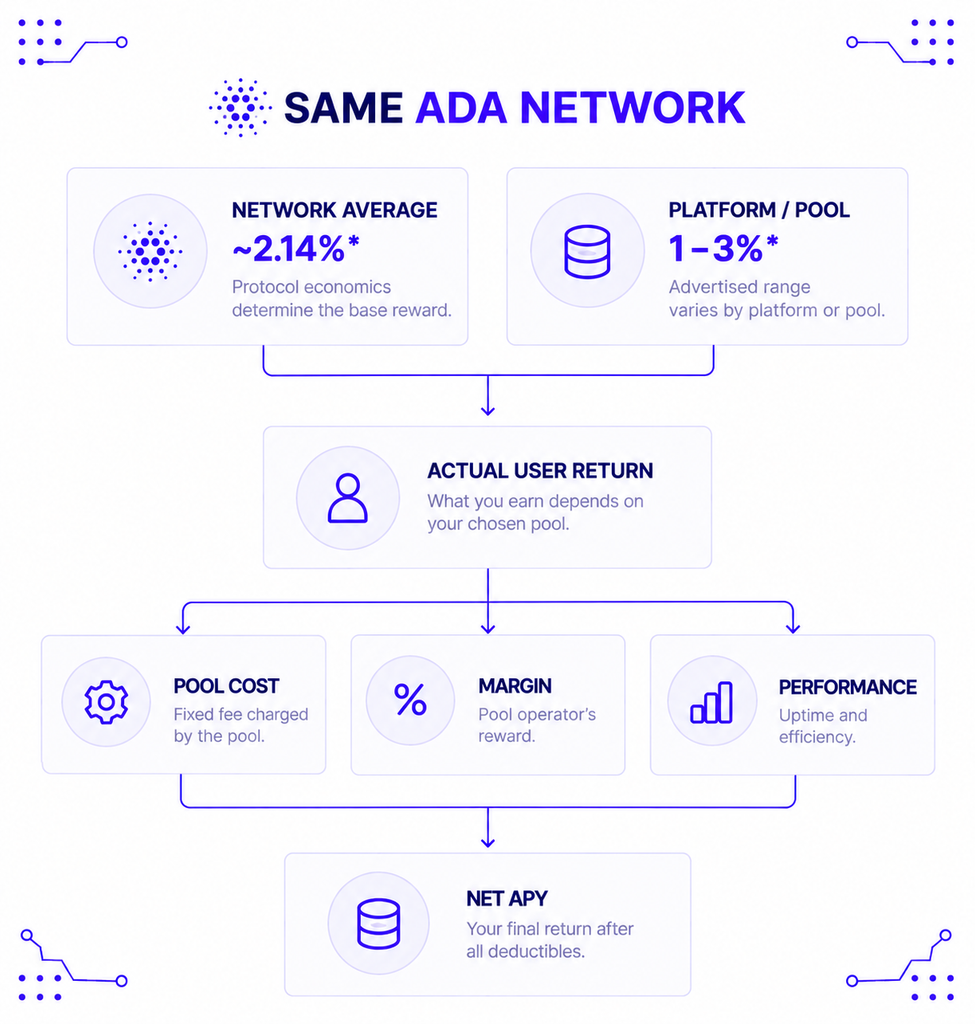
Cardano’s staking reward isn’t fixed — it moves with how much ADA is staked network-wide and how much is still being issued through the protocol’s reserve. As of September 2026, that currently works out to roughly 2.14% APY network-wide, per Staking Rewards’ live data.
Individual platforms quote different numbers. Ledger currently advertises “1–3% APY” for ADA staking, crediting rewards roughly every five days and noting the exact rate “varies with network participation levels.” That gap between platform-advertised ranges and the network average is normal — it comes down to which pool your ADA ends up delegated to and that pool’s fixed cost and margin, not a different underlying reward pool.
This is critical: any APY you see quoted, including here, moves as staked supply and issuance shift. Check the current rate on your chosen wallet or pool before assuming it’ll hold steady over a multi-year position.
What Are the Risks of Staking ADA?
Pool Fees Can Eat Small Delegations
Every pool charges a fixed cost — a minimum of 170 ADA per epoch — plus a percentage margin, both deducted before rewards reach delegators. A very small delegation to a pool with a high fixed cost can net close to nothing, which is why checking a pool’s fee structure matters more than chasing the highest headline APY.
Saturated Pools Pay Less Per ADA
Once a pool exceeds its saturation threshold — currently around 76 million ADA, based on Cardano’s k = 500 target — additional delegated stake earns a diminishing reward instead of a proportional one. This is deliberate: it’s Cardano’s way of nudging a delegator’s Cardano stake toward smaller pools to keep the network decentralized, but it means the biggest, most recognizable pools aren’t automatically the best pick.
Custodial Risk on Exchanges
Staking ADA through an exchange means trusting that platform’s solvency on top of Cardano’s own protocol risk. If the exchange fails, your staked ADA is only as safe as its own financial standing — a risk that simply doesn’t exist when delegating from a wallet you control.
Infrastructure Dependency for Anyone Building on Top
Wallets, staking dashboards, and pool-explorer tools all need reliable, continuous access to Cardano’s chain state to show accurate balances, delegation status, and epoch-boundary changes. Building that in-house means running and maintaining cardano-node yourself; a provider such as NOWNodes offers API access to Cardano nodes instead, which is why several staking-adjacent tools connect through a provider rather than maintaining node infrastructure for every chain they support.
Conclusion
Staking ADA comes down to one real advantage over most other proof-of-stake networks: there’s no lock-up, no minimum, and no slashing risk to weigh against the reward. Delegating through a non-custodial wallet like Yoroi, Eternl, or Lace keeps your keys in your own hands and your ADA fully spendable the entire time.
The number that should drive your pool choice isn’t the advertised APY — it’s the pool’s fixed cost, its saturation level, and its uptime history, since those determine what you actually net after roughly three weeks of waiting for the first reward. Check the current network-wide rate before delegating, and treat a pool’s fee structure as more decisive than its size.
FAQ
Can you stake ADA?
Yes. Any amount of ADA can be delegated to a stake pool through a non-custodial wallet or an exchange, with no minimum balance required to start earning rewards.
How long does it take to start earning ADA staking rewards?
Roughly 15–20 days after you delegate, since rewards move through a fixed four-epoch cycle before the first payout lands. After that, rewards arrive automatically about every five days.
Is there a lock-up period for staking ADA?
No. Unlike Ethereum or Polkadot, Cardano has no bonding or unbonding period — you can redelegate to a different pool or spend your ADA at any time, and the change simply takes effect at the next epoch boundary.
Can you lose ADA by staking it?
No, not through slashing — Cardano has no slashing mechanism, so your principal is never at risk from a pool’s poor performance. The real risks are custodial (staking through an exchange that fails) or opportunity cost (delegating to an oversaturated or high-fee pool).
What’s the difference between a stake pool and a validator?
A stake pool operator runs the node infrastructure and carries the technical responsibility of staying online to produce blocks. A delegator contributes stake to that pool without running any infrastructure themselves, sharing in the rewards the pool earns.
Do you pay taxes on ADA staking rewards?
In most jurisdictions, yes — staking rewards are generally treated as taxable income when received, with capital gains rules applying again if you later sell. Confirm the current rule in your own country rather than assuming one standard applies everywhere.