
To stake Cosmos, you delegate ATOM to a validator securing the Cosmos Hub, either through a wallet such as Keplr or Leap, a centralized exchange, or by running a validator node yourself. The minimum delegation is just 1 ATOM, and current network-wide rewards sit around 19.6% APY, according to Staking Rewards’ live tracker. Unstaking, on the other hand, takes a fixed 21-day unbonding period no matter which route you pick.
That’s the short answer. The rest of this guide covers what staking ATOM actually does, why the Cosmos Hub depends on it, who delegates and why, and how delegating compares to running your own validator once you look past that headline yield.
What Does It Mean to Stake ATOM?
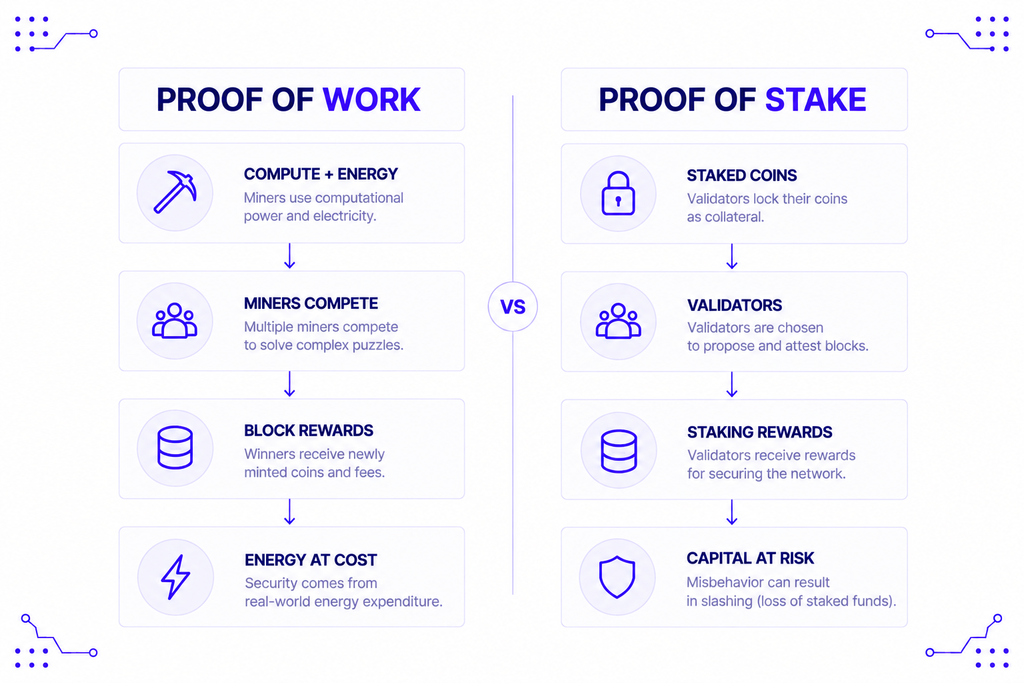
Cosmos staking means delegating ATOM — the Cosmos Hub’s native token — to a validator that produces and confirms blocks on your behalf. You don’t run any hardware yourself; you’re backing a validator with your tokens and earning a cut of their reward in return.
The Cosmos Hub runs on CometBFT (formerly Tendermint), a Byzantine Fault Tolerant consensus engine that finalizes blocks instantly rather than waiting for probabilistic confirmations the way Bitcoin does. Validators take turns proposing blocks, and a two-thirds majority of staked voting power has to sign off before a block is final, according to Cosmos SDK’s own documentation.
You’ll see this called “ATOM staking,” “delegating ATOM,” or “staking Cosmos” interchangeably across wallets and exchanges. All of it describes the same mechanism: your ATOM adds voting power to a validator, and you share in what that validator earns.
Why Does the Cosmos Hub Need Staking?
A blockchain with no cost to participate in consensus is one anyone can attack cheaply. Staking gives validators something real to lose — misbehave, and a slice of the stake behind you gets destroyed through slashing; go offline too long, and rewards for that stretch simply don’t arrive.
Staking is also how new ATOM enters circulation. The Cosmos Hub currently runs an annual inflation rate around 12.67%, and nearly all of that newly minted ATOM goes to validators and their delegators as staking rewards, per Staking Rewards’ current data. That inflation rate isn’t fixed forever — Cosmos Hub governance has repeatedly debated proposals to lower it, so today’s number is a snapshot, not a permanent setting.
Scale matters here too. As of September 2026, roughly 64.8% of ATOM’s circulating supply — about 343.7 million tokens — is staked across 180 active validators, the maximum size of the Hub’s consensus set under current governance parameters.
Who Actually Stakes ATOM?
Cosmos stake attracts a wider mix of people than the mechanics alone suggest, and each group is solving a slightly different problem.
- Retail holders who want yield on ATOM they’d otherwise leave idle, usually delegating through Keplr, Leap, or an exchange rather than running a node.
- Validators and node operators who run the actual consensus infrastructure professionally, collecting a commission from every delegator who backs them.
- Interchain projects and DAOs holding ATOM as a treasury asset, staking a portion to offset dilution from the Hub’s own inflation rather than leaving it fully idle.
- Wallet and dashboard developers, who need reliable access to the Hub’s chain state to show accurate delegated balances and validator performance.
How Does Delegating to a Validator Actually Work?
When you stake ATOM, you’re choosing a validator to back, not setting your own fixed yield. The validator takes a commission off the top — currently around 9.91% on average across the network — and passes the rest to you proportional to your delegated stake, according to Staking Rewards’ benchmark data.
Here’s a table of the current on-chain parameters that determine what delegating actually exposes you to, sourced from the Cosmos Hub’s own validator documentation:
| Parameter | Current value |
|---|---|
| Minimum delegation | 1 ATOM |
| Active validator set size | 180 |
| Unbonding period | 21 days |
| Double-sign slashing penalty | 5% of stake |
| Downtime slashing penalty | 0.01% of stake |
| Downtime threshold | Missing 95% of the last 10,000 blocks (~19 hours) |
That downtime penalty is small next to the 5% double-sign slash, but it’s still a real cost passed proportionally to every delegator behind that validator, not just the operator. Picking a validator by uptime history, not just the lowest commission, is what actually protects you from both failure modes.
How to Stake Cosmos, Step by Step
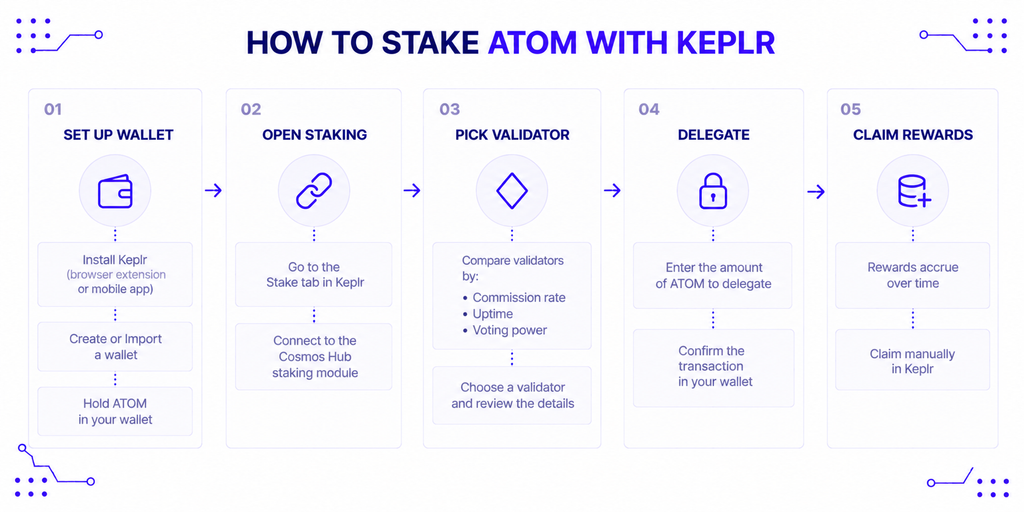
Delegating through Keplr, the most widely used Cosmos-ecosystem wallet, is the realistic route for most ATOM holders:
- Install the Keplr browser extension or mobile app and create or import a wallet holding at least 1 ATOM.
- Open the “Stake” tab inside Keplr, which connects directly to the Cosmos Hub’s staking module.
- Compare validators by commission rate, uptime, and how much voting power they already control — delegating to a smaller validator helps keep the network’s consensus set decentralized.
- Enter the amount to delegate and confirm the transaction in your wallet.
- Claim rewards periodically. Keplr shows accrued rewards in real time, but claiming is a manual transaction unless you’re using an auto-compounding tool.
Staking through an exchange works differently: deposit or hold ATOM on a supporting platform such as Coinbase, Binance, or Kraken, open its staking section, and the exchange delegates on your behalf. That’s the simplest entry point, but it hands custody of your ATOM to the exchange for as long as it stays staked there.
Running your own validator is the advanced route — it requires a competitive stake to enter the 180-seat active set, a CometBFT node with strong uptime, and infrastructure maintained around the clock. Most retail holders are better served delegating than trying to break into that set directly.
Where to Stake ATOM: Comparing Your Options
“Where to stake Cosmos” usually comes down to how much control over your keys you’re willing to trade for convenience. A few of the main routes illustrate that range.
| Option | Custody | Typical minimum | Notable trait |
|---|---|---|---|
| Keplr / Leap wallet | You | 1 ATOM | Non-custodial, connects directly to the Hub’s staking module |
| Ledger + Keplr | You | 1 ATOM | Keys stay on the hardware device during delegation |
| Centralized exchanges (Coinbase, Binance, Kraken) | Exchange | Often no practical minimum | Simplest onboarding, exchange keeps a commission |
| Liquid staking protocols (e.g., Stride) | Protocol (non-custodial) | Varies, often under 1 ATOM | Issues a tradable receipt token instead of locking ATOM outright |
There’s no single best place to stake ATOM for everyone. A non-custodial wallet keeps your keys under your own control the entire time; an exchange is faster to start but means trusting that platform’s solvency on top of the Hub’s own protocol risk — the same custodial trade-off behind staking on any proof-of-stake network. Liquid staking splits the difference by keeping you non-custodial while removing the 21-day lockup, a mechanic our guide to liquid staking covers in more depth.
How Much Can You Earn Staking ATOM?
Cosmos Hub rewards aren’t a fixed number — they move with the network’s inflation rate and how much ATOM is currently staked overall. Right now that formula works out to roughly 19.6% APY network-wide, according to Staking Rewards’ live data, a notably higher headline rate than most major proof-of-stake networks offer.
Here’s why that number runs so high: ATOM’s ~12.67% annual inflation is split only among the roughly 65% of supply that’s actually staked, which concentrates the reward pool. If more holders start staking, that same reward pool gets divided further and the effective APY compresses — it isn’t a rate the protocol guarantees to hold steady.
This is critical: any APY you see quoted, including here, is a snapshot, not a locked-in number. Validator commission, network-wide staking participation, and governance changes to inflation all shift the real return, so check the current rate directly on whichever wallet or exchange you’re using before committing.
Interchain Security and Liquid Staking: Cosmos’s Deeper Layer
Staked ATOM on the Cosmos Hub doesn’t only secure the Hub itself anymore. Through a feature called Interchain Security, the Hub’s validator set can also validate blocks for “consumer chains” that rent the Hub’s security instead of bootstrapping their own validator set from scratch — Stride became one of the first liquid staking networks to adopt it.
That design was a deliberate bet on stacking new value on top of existing staked ATOM rather than only relying on inflation. Cosmos co-founder Ethan Buchman described the thinking behind it directly:
“In the new Cosmos Hub whitepaper, we propose a new layer for secure economic scaling of the Cosmos Hub. It has 2 foundational components: interchain security and liquid staking.” — Ethan Buchman, Cosmos co-founder, via Benzinga
Liquid staking protocols built on Cosmos take this further: they let you stake ATOM while holding a receipt token you can still trade, lend, or use elsewhere in DeFi, instead of watching it sit frozen through a 21-day unbonding period. The trade-off is an added layer of smart contract risk on top of the Hub’s own validator risk — a genuine cost for the added flexibility, not a free upgrade.
What Are the Risks of Staking ATOM?
Your ATOM is locked for a fixed 21 days
Unlike Ethereum’s exit-queue model or Cardano’s instant unstaking, Cosmos Hub’s unbonding period doesn’t flex with network conditions — it’s a flat 21 days regardless of why you’re exiting. There’s no early withdrawal unless you’re staking through a liquid staking protocol instead.
Slashing reaches delegators, not just validators
If the validator you delegated to double-signs a block, everyone backing that validator loses 5% of their staked amount proportionally, even though they never touched any infrastructure. Choosing validators by uptime record and reputation, not commission alone, is what actually manages this exposure.
High APY partly reflects high inflation, not free money
ATOM’s roughly 19.6% APY looks generous next to Ethereum’s low single digits, but a meaningful share of that comes from ~12.67% annual token issuance diluting anyone who isn’t staking. Staking largely offsets that dilution for you; it doesn’t create value out of nothing.
Fake staking dashboards and phishing sites are common
Scammers regularly clone Keplr’s interface or advertise fake “high-yield” ATOM staking sites to trick people into approving a malicious transaction. Only delegate through Keplr’s official extension, Leap’s verified app, or a supporting exchange’s own domain — never a link from an ad or an unsolicited message.
How Does the Infrastructure Behind Cosmos Staking Work?
Every staking route on the Cosmos Hub — delegating through a wallet, running a validator, or staking via an exchange — depends on something separate from consensus itself: reliable, always-on access to the chain’s state. Wallets need it to show accurate delegated balances, staking dashboards need it to track validator uptime, and exchanges need it to confirm deposits before they delegate on a user’s behalf.
Building that access in-house means running and maintaining infrastructure for the Cosmos Hub specifically, on top of whatever other chains a product already supports. That’s a separate operational cost from staking itself, and it’s why a number of wallets and staking dashboards connect through a provider such as NOWNodes instead. NOWNodes gives API access to Cosmos Hub infrastructure alongside 120-plus other blockchain networks, covering the balance checks and chain queries that staking products need without a team building that infrastructure from scratch for every network they support.
Conclusion
Staking Cosmos comes down to one real choice: delegate through a wallet or exchange with almost no barrier to entry, or take on the infrastructure and stake threshold required to run your own validator. Both routes lock ATOM behind the same 21-day unbonding period and expose you to the same slashing mechanics, just distributed differently depending on who’s holding the keys.
The number that should drive your decision isn’t the headline 19.6% APY — it’s the validator’s uptime record, the current commission rate, and whether you’re comfortable with a fixed three-week exit if you need that ATOM liquid sooner. Check the current rate directly on your wallet or exchange before delegating, and verify any staking interface against Keplr’s or your exchange’s official domain rather than a link you didn’t confirm yourself.
FAQ
Can you stake Cosmos on Ledger?
Yes — connect a Ledger device to Keplr and delegate through Keplr’s staking interface as usual. Your private keys stay on the hardware device the entire time; Keplr only requests a signature for each delegation transaction.
What’s the difference between delegating and running a validator?
Delegating means backing an existing validator with your ATOM and sharing their reward minus commission, with no hardware or uptime responsibility on your end. Running a validator means operating the consensus node yourself, competing for one of 180 active seats, and taking on full slashing exposure for your own downtime or misbehavior.
Do liquid staking tokens like stATOM earn the same reward as regular staking?
Broadly yes, minus the liquid staking protocol’s own fee on top of the validator’s commission. The trade-off is smart contract risk in the liquid staking protocol itself, layered on top of the Hub’s standard validator and slashing risk.
How is ATOM staking taxed?
In most jurisdictions, staking rewards count as taxable income when you receive them, with capital gains rules applying again if you later sell. Confirm the current rule in your own country, since treatment varies and changes over time.
Can I redelegate ATOM from one validator to another without waiting 21 days?
Yes — redelegating moves your stake directly from one validator to another without triggering the unbonding period, though you can only redelegate the same tokens once every 21 days. Fully unstaking to your liquid balance is what triggers the 21-day wait.