

To stake crypto, you lock a proof-of-stake coin into a network, a pool, or an exchange so it can help validate transactions, and you earn a share of new coins or fees in return. You don’t need to run any hardware to do this — most people stake crypto through an exchange or a wallet in a few clicks, while a smaller group runs their own validator for full control over the reward. Roughly 45% of crypto holders now stake at least part of their portfolio, up from 42% a year earlier, according to CoinLaw’s 2026 staking data.
That’s the short answer. The rest of this guide covers what crypto staking actually is, why networks depend on it, who does it and why, which coins you can stake, and how the main methods compare once you look past the advertised yield.
Why Do Blockchains Need Staking?
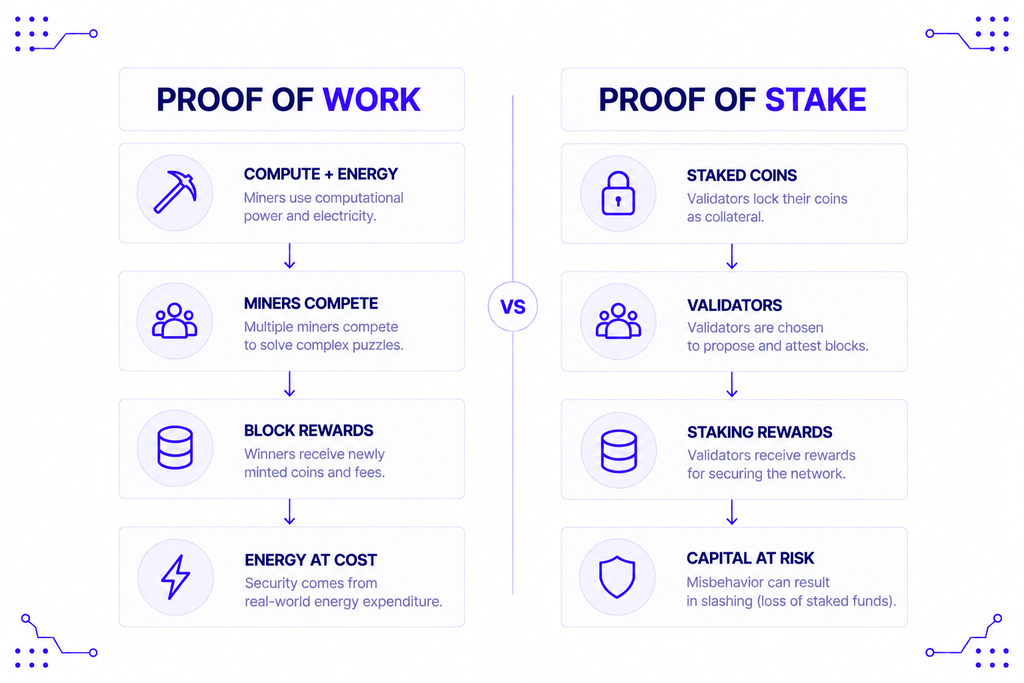
A network with no cost to participate in consensus is one anyone can attack for free. Staking gives validators something to lose: misbehave, and part of the staked amount gets destroyed through a penalty called slashing; go offline too often, and rewards quietly leak away instead.
Proof of stake replaced proof of work’s energy-heavy mining on networks like Ethereum specifically to fix this at a lower cost. Ethereum’s own move to proof of stake in September 2022 cut the network’s energy use by more than 99%, according to ethereum.org’s account of the Merge. Staking is also how these networks issue new coins — instead of miners collecting a block reward, that reward now goes to validators.
The size of the validator set matters as much as the mechanism itself. A network secured by a handful of large validators is easier to pressure or censor than one spread across hundreds of thousands of independent operators, which is exactly why decentralization keeps coming up in staking discussions well beyond the headline yield.
Who Puts Their Crypto to Work This Way?
Staking crypto attracts a wider range of participants than the mechanics alone suggest, and each group wants something slightly different from it.
- Retail holders who want yield on coins they’d otherwise leave idle, usually staking through an exchange or a wallet’s built-in delegation feature.
- DeFi users who deposit a liquid staking token like stETH into a lending market for a second layer of yield stacked on top of the base staking reward.
- Node operators and infrastructure teams who run validators professionally, either for their own holdings or on behalf of pool depositors.
- Institutional treasuries, a fast-growing category — BlackRock’s staking trust reportedly pulled in over $254 million in assets within its first week live in 2026, per CoinLaw’s tracking of institutional adoption.
That range is exactly why regulators started paying closer attention to what staking actually exposes people to. SEC Commissioner Caroline Crenshaw made the point directly when the agency issued its 2025 staking guidance:
“Staked assets are subject to the risk of loss through protocol operation (i.e. ‘slashing’), protocol failure or errors, and hacking or other theft.” — Commissioner Caroline A. Crenshaw, SEC statement, May 29, 2025
Her warning applies whether you’re running a validator yourself or letting an exchange do it for you — the underlying protocol risk doesn’t disappear just because someone else operates the hardware.
Which Cryptocurrencies Can You Stake?
Only coins built on proof-of-stake or a related consensus model can be staked; Bitcoin’s proof-of-work design has no staking mechanism at all. Beyond that split, staking terms vary a lot by network, which is worth knowing before you assume one chain’s rules apply to another.
| Coin | Approx. % of supply staked | Typical APY | Unbonding period |
|---|---|---|---|
| Ethereum (ETH) | Over one-third | ~2.5% base, more with MEV | Exit queue: minutes–days |
| Solana (SOL) | ~65–70% | ~6–7% | 2–3 days (epoch-based) |
| Cardano (ADA) | ~70% | ~3–4% | None — instant |
| Polkadot (DOT) | ~50% | ~11–13% | ~28 days (bonded) |
| Avalanche (AVAX) | ~50–55% | ~7–8% | Fixed lock at delegation |
Cardano stands out for having no lock-up at all, so you can redelegate or withdraw whenever you want. Polkadot sits at the other extreme, trading a much higher headline APY for a bonded position you can’t touch for roughly a month after you decide to exit. Always check a network’s current unbonding rules before committing, since they change with protocol upgrades.
Three Ways to Put Your Crypto to Work
Every method of staking crypto falls into one of three categories, and the category matters more than the specific brand you pick within it.
| Factor | Solo / self-run | Pooled / liquid staking | Exchange (custodial) |
|---|---|---|---|
| Who holds the keys | You | The protocol (non-custodial) | The exchange |
| Typical minimum | Often high (32 ETH for solo Ethereum) | As little as 0.01 coin on some pools | Usually none |
| Hardware needed | Yes, always-on | No | No |
| Typical fee | None | 10–15% of rewards | 25%+ |
| Liquidity while staked | None until you exit | Instant via the liquid token | Varies by platform |
Solo staking gives you the full reward and no counterparty, but the technical bar and, on networks like Ethereum, the capital minimum put it out of reach for most people. Liquid staking closes that gap while keeping you close to non-custodial through a smart contract — our guide to liquid staking covers how that token mechanic actually works. Exchange staking is the easiest entry point, but it hands custody of your coins to a third party in exchange for that simplicity.
How to Stake Crypto, Step by Step
The exact steps depend on which method you pick, but the logic is the same across all of them: choose a network and a route, hand over the coins, and start earning.
Staking through an exchange:
- Deposit or hold the coin on the exchange’s platform.
- Open its staking or “earn” section and select the asset.
- Confirm the amount — most exchanges have no practical minimum.
- Rewards accrue automatically on a recurring schedule, minus the platform’s fee.
Staking through a wallet or liquid staking protocol:
- Connect a wallet such as MetaMask or Phantom to the staking or delegation interface.
- Pick a validator, or a pool if you’re using a liquid staking protocol, and check its current fee.
- Deposit any amount — most pools don’t enforce a coin-specific minimum.
- Receive a liquid staking token or delegation receipt representing your position, which you can hold, trade, or use elsewhere in DeFi.
Running your own validator (advanced):
- Meet the network’s minimum stake and hardware requirements — Ethereum’s is 32 ETH plus a node that stays online.
- Install the required client software, ideally a minority client to avoid correlated risk if a majority client has a bug.
- Generate validator keys through the network’s official tooling — for Ethereum, that’s the staking launchpad, never a third-party tool.
- Deposit the required stake to the verified contract address, confirmed independently against the network’s official site.
- Keep the node online; downtime causes small penalties, and serious violations can trigger slashing.
Our step-by-step Ethereum staking guide walks through that last option in more detail, including current hardware specs and validator setup.
How Much Can You Earn Staking Crypto?
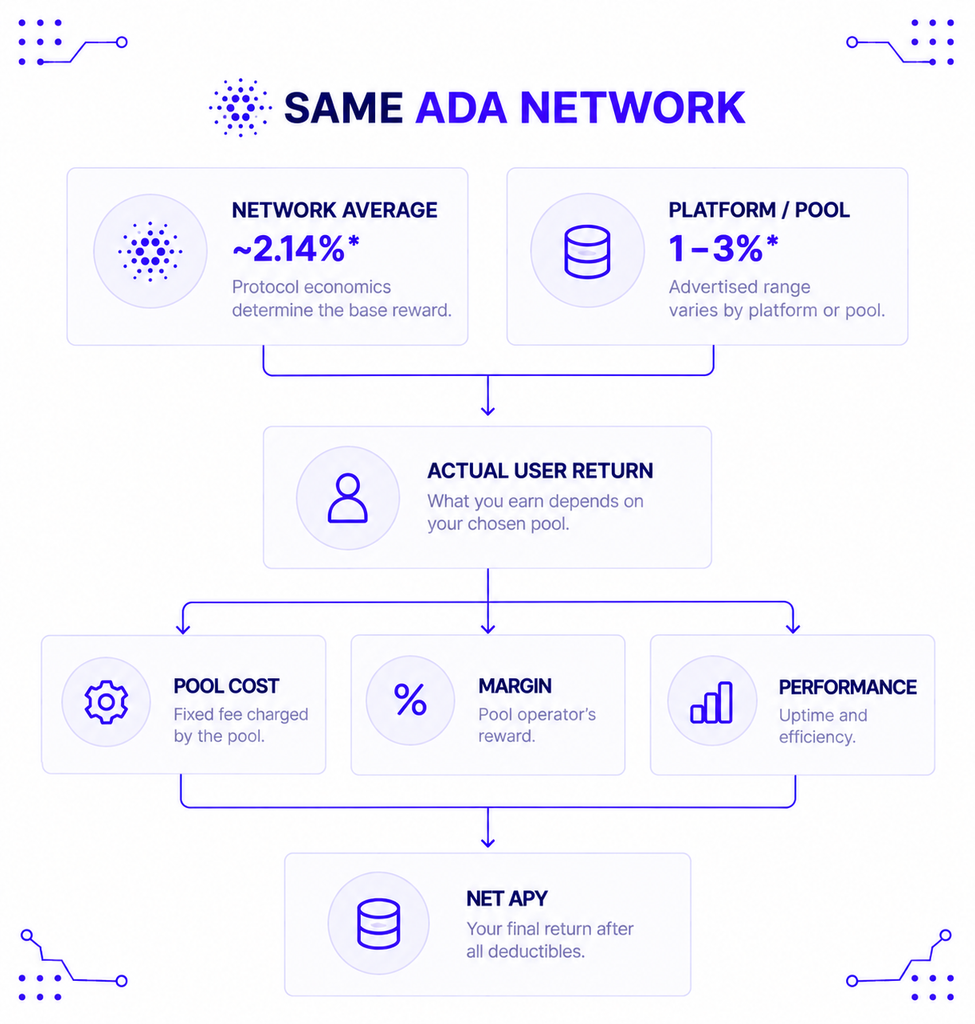
Rewards depend on the network’s own issuance rate first and the platform’s fee second — the platform you stake through doesn’t set the base yield, it only decides how much of it reaches you. That’s why a 25% exchange commission on Ethereum’s roughly 2.5% base rate nets a meaningfully different result than the same commission on Cosmos, where base APY has run as high as 21%, according to CoinLaw’s 2026 breakdown.
This is critical: an advertised APY is a starting point, not a locked-in number. Validator performance, network-wide participation, and MEV (extra value some validators capture from transaction ordering) all shift the real return, so check the current rate directly on whichever platform you’re using rather than trusting a number you saw months ago.
What Are the Risks of Staking Crypto?
Your coins aren’t instantly liquid
Direct staking usually means waiting through an unbonding or exit period before you get coins back — anywhere from minutes on Ethereum to about a month on Polkadot. A liquid staking token can be sold instantly on the open market instead, but at whatever price it happens to be trading relative to the underlying coin.
Slashing and downtime penalties are real
Slashing punishes provable misbehavior, like a validator signing two conflicting blocks, not honest mistakes. Downtime is treated more gently — you leak small rewards while offline rather than losing your stake outright — but a validator with poor uptime will consistently underperform one that stays online.
Pooled and exchange staking still pass risk to you
If the validator behind your pool or exchange deposit gets slashed, that loss is typically shared across everyone staked in it, including you, even though you never touched any hardware. Custodial exchange staking adds a second layer on top: you’re trusting that exchange’s solvency along with the protocol’s own risk.
Fake staking contracts and phishing sites are common
Scammers regularly clone staking dashboards or advertise a fake contract address to trick people into sending coins somewhere unrecoverable. Verify any staking contract or platform link against the network’s or exchange’s official domain, never a link from an ad or an unsolicited message.
How Does the Infrastructure Behind Staking Actually Work?
Every staking route — solo, pooled, or exchange — depends on something that has nothing to do with validators directly: reliable, always-on access to the blockchain itself. Wallets need it to show accurate balances, staking dashboards need it to track validator status, and exchanges need it to confirm deposits and process withdrawals correctly.
Building that access in-house means running and maintaining full nodes for every supported network, which is a real operational cost separate from staking itself. That’s an infrastructure problem rather than a staking one, and it’s why a number of wallets and staking platforms connect through a provider such as NOWNodes instead. NOWNodes gives API access to shared and dedicated nodes across 120-plus blockchain networks, covering the balance checks, transaction broadcasts, and chain data that staking products need without a team maintaining node infrastructure for every chain they support.
Conclusion
Staking crypto comes down to one real trade-off: how much control and reward you want to keep versus how much convenience you’re willing to pay for through fees and reduced liquidity. Solo staking keeps the full reward but demands capital and technical upkeep; pooled and exchange staking give up some of both in exchange for a far lower barrier to entry.
Whichever route you pick, the number that should drive your decision isn’t the headline APY — it’s the current fee, the unbonding period, and who actually holds your keys while your coins are staked. Check those three details directly on the platform before committing, and confirm any contract address independently rather than trusting a link you didn’t verify yourself.
FAQ
Can you stake any crypto?
No — only coins on proof-of-stake or related consensus models support staking. Bitcoin runs on proof of work and has no native staking mechanism, though wrapped or custodial BTC products on some platforms offer yield through different means.
How much crypto do you need to start staking?
It depends entirely on the method. Solo Ethereum staking requires 32 ETH, but pooled staking and most exchange staking programs accept far smaller amounts, sometimes as little as a fraction of a coin.
Is staking crypto safe?
It carries real risk, including slashing, platform custodial risk, and smart contract exploits in liquid staking protocols, but it isn’t inherently a scam. The safest approach is sticking to a network’s official tools or a well-established exchange or protocol, and verifying every contract address independently.
Can you lose money staking crypto?
Yes. Slashing, a hacked or insolvent platform, or a liquid staking token trading below its peg during a market stress event can all leave you with less than you deposited. The advertised yield is real, but it isn’t risk-free.
Do you pay taxes on staking rewards?
In most jurisdictions, staking rewards count as taxable income when you receive them, with capital gains rules applying again if you later sell. Confirm the current rule in your own country, since treatment varies and changes over time.
What’s the difference between staking and just holding crypto?
Holding means keeping coins without putting them to work; staking actively locks them into a network’s consensus process in exchange for rewards. The trade-off is that staked coins are usually less liquid than coins simply sitting in a wallet.