
To stake Ethereum, you lock ether into Ethereum’s proof-of-stake system, either by running your own validator with 32 ETH, joining a pool like Lido or Rocket Pool with any amount, or staking through an exchange such as Coinbase or Kraken. Rewards currently run around 2.5% APR, paid in ETH, with no fixed lock-up period — withdrawals go through a network exit queue instead. As of September 2026, more than 43 million ETH — over a third of the entire supply — sits staked this way, according to ethereum.org.
That’s the short version. The rest of this guide covers what ethereum staking actually means, why the network needs it, who’s doing it, and how solo staking, pooled staking, and exchange staking compare once you look past the headline APR.
What Is Ethereum Staking?
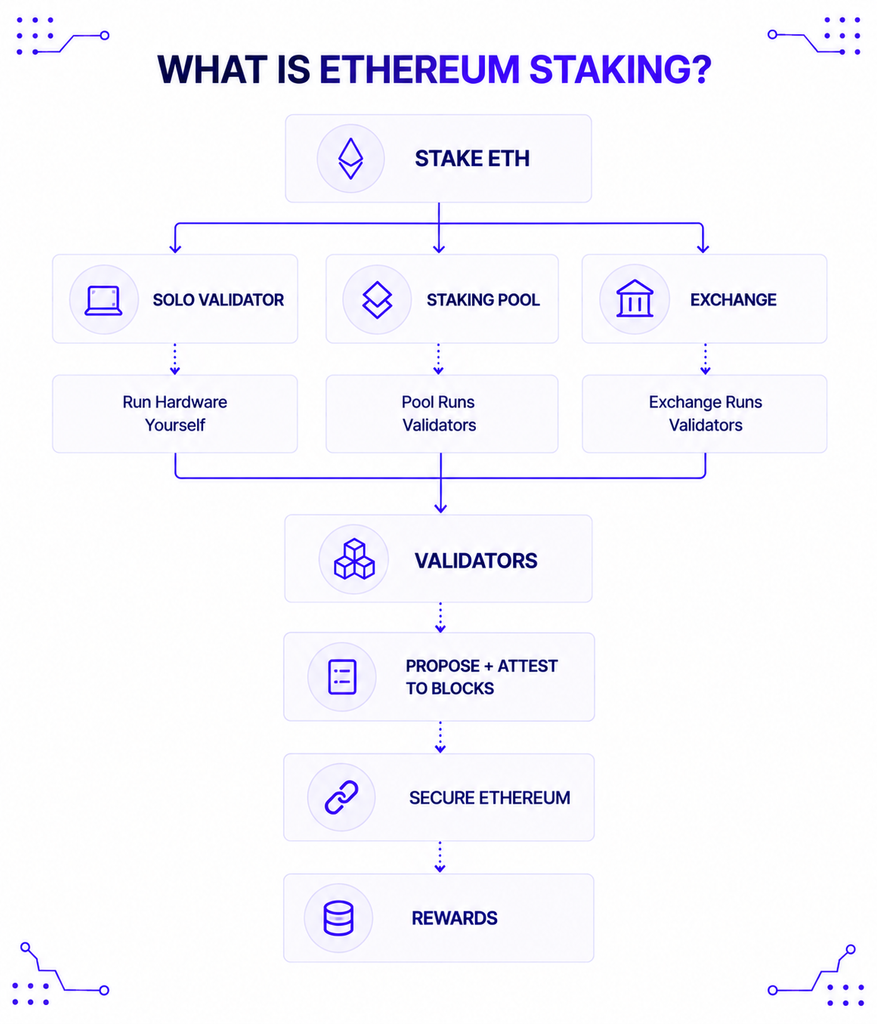
Ethereum staking is the process of locking ETH to activate a validator — a participant in Ethereum’s proof-of-stake consensus that proposes and confirms blocks. In return for doing that job honestly, a validator earns newly issued ETH plus a share of transaction fees.
You don’t need to run hardware to take part. Staking ethereum can mean running your own validator, delegating funds to a pool that runs validators on your behalf, or letting an exchange handle the process while it keeps a cut of the reward. All three routes ultimately feed the same mechanism: ETH locked as collateral, securing the chain that holds it.
You’ll also see this called “Eth2 staking” or “staking eth2” in older guides. That branding was retired once Ethereum’s proof-of-work and proof-of-stake systems merged into one chain on September 15, 2022 — there’s no separate “Eth2” anymore, just Ethereum.
Why Does Ethereum Need Staking?
A blockchain with no cost to participate is one anyone can attack for free. Staking gives validators something to lose: misbehave, and part of your staked ETH gets destroyed; go offline too often, and the rewards you’d otherwise earn quietly leak away instead.
Before the Merge, that job belonged to miners burning electricity under proof of work. Ethereum swapped that model for proof of stake in a single coordinated upgrade, cutting the network’s energy use by more than 99%, per ethereum.org’s own account of the Merge. Staking is also how new ETH enters circulation — issuance now runs at roughly 2,800 ETH a day, a small fraction of what miners collectively earned before 2022.
The scale of participation matters as much as the mechanism. Ethereum currently runs on more than 800,000 active validators, according to Staking Rewards’ live tracker — a validator set that size is what makes the chain expensive to attack and hard to censor.
Who Actually Stakes ETH?
Staking crypto on Ethereum attracts a wider mix of participants than the technical process might suggest, and each group wants something slightly different from it.
- Retail holders who want yield on ETH they’d otherwise leave idle, usually staking through an exchange or a liquid staking pool rather than running hardware.
- DeFi users who deposit a liquid staking token like stETH into a lending market for a second layer of yield on top of the base staking reward.
- Node operators and infrastructure teams who run validators professionally, either for themselves or on behalf of pool depositors.
- Institutional treasuries, including the Ethereum Foundation itself, which began staking 70,000 ETH from its treasury in February 2026 to fund research and ecosystem grants, according to CoinDesk’s coverage of the move.
That range is exactly why institutions have started paying closer attention to how decentralized Ethereum’s validator set actually is. Danny Ryan, an Etherealize co-founder and one of the engineers who led Ethereum’s shift to proof of stake, put it plainly when asked why Wall Street cares about decentralization at all:
“That’s not the right word. They care about counterparty risk… They care about — in a transaction or a particular market — who can screw me over? And if the infrastructure is decentralized, nobody can turn it off.” — Danny Ryan, Etherealize co-founder, via Etherealize on X
A validator set spread across hundreds of thousands of independent operators is what makes that answer possible — which is also why who stakes, and how concentrated their stake is, matters beyond the yield itself.
How Does Ethereum Staking Actually Work?
When you stake ETH, you’re depositing it into Ethereum’s staking contract to activate a validator, which then takes on two jobs: proposing new blocks when selected, and attesting to the validity of blocks proposed by others. Get both right consistently and you earn a steady reward; get them wrong through malicious behavior and the protocol slashes part of your stake.
Activation isn’t instant. A deposit is recognized by the network in about 13 minutes, but the validator then joins an activation queue that can take anywhere from hours to weeks depending on how many other deposits are waiting, per ethereum.org’s staking documentation. Exiting works the same way in reverse — there’s no fixed staking term, but leaving still means waiting in a queue.
Since the Pectra upgrade in May 2025, validators have had a choice of two withdrawal-credential types that change how they handle balance above 32 ETH. This distinction matters more for solo stakers than pool depositors, but it’s worth understanding either way.
| Credential type | Effective balance | What happens to rewards |
|---|---|---|
| Regular (0x01) | Capped at 32 ETH | Anything earned above 32 ETH sweeps to your wallet automatically every few days |
| Compounding (0x02) | Up to 2,048 ETH | Rewards compound inside the validator instead of sweeping out |
Compounding credentials are mainly useful for larger operators consolidating many validators into fewer, higher-balance ones — a solo staker running one 32 ETH validator won’t notice much difference either way. For a deeper look at what a validator does mechanically, see our guide to what a validator node is.
Ethereum Staking: Solo vs. Pooled vs. Exchange
Before picking a method, it helps to see the three main routes side by side. The numbers below reflect current network and platform figures as of September 2026.
| Factor | Solo staking | Pooled / liquid staking | Exchange staking |
|---|---|---|---|
| Minimum ETH | 32 ETH | As little as 0.01 ETH on some pools | Often no practical minimum |
| Who holds the keys | You | The protocol (non-custodial) | The exchange |
| Hardware required | Yes — a node that stays online | No | No |
| Typical fee | None — you keep the full reward | 10–14% of rewards (Lido, Rocket Pool) | 25%+ (Coinbase) |
| Liquidity while staked | None until exit queue clears | Instant via the LST on secondary markets | Varies by platform |
| Best fit | Technical users with 32+ ETH | Most holders who want flexibility | Simplicity over yield |
With 32 ETH worth roughly $80,000 at current prices, solo staking is out of reach for most individual holders — which is exactly the gap pooled and exchange staking exist to close. Pooled staking keeps you closer to a non-custodial setup through a smart contract; exchange staking is the simplest to start but hands custody of your ETH to a third party.
How to Stake ETH Step by Step
The steps differ depending on which route you pick. Pooled and exchange staking are the realistic path for almost everyone; solo staking is listed here too, since it’s the version every other method is built on top of.
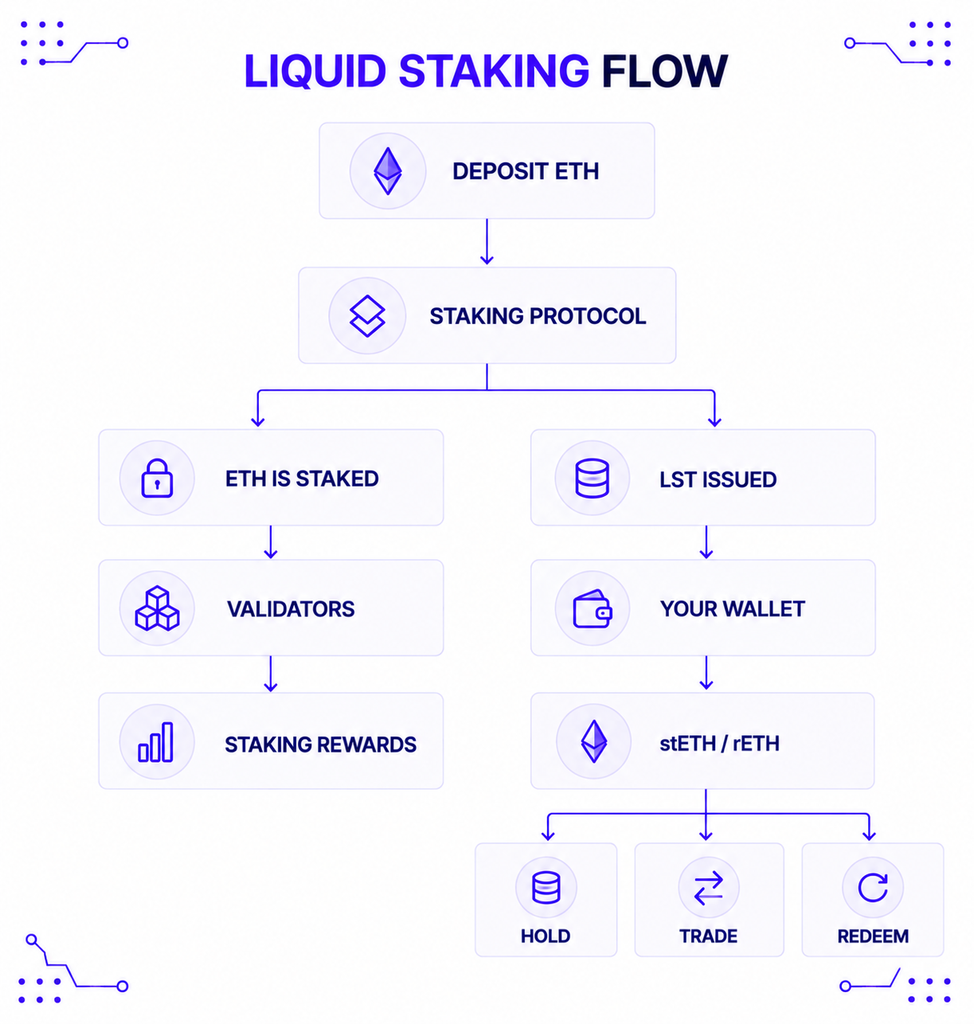
Pooled staking (Lido, Rocket Pool, and similar):
- Choose a pool and check its current fee and the format of the liquid staking token it issues.
- Connect a wallet such as MetaMask to the pool’s staking interface.
- Deposit ETH — most pools accept any amount, with no 32 ETH requirement.
- Receive your LST (stETH, rETH, or the pool’s equivalent) representing your staked position.
- Hold, trade, or redeem the token later through the protocol for the underlying ETH plus rewards.
Exchange staking (Coinbase, Kraken, and similar):
- Deposit or hold ETH on the exchange.
- Open the staking or earn section and select ETH.
- Confirm the amount — most exchanges have no practical minimum.
- Rewards accrue automatically, usually distributed on a recurring schedule minus the platform’s commission.
Solo staking (for 32+ ETH and technical users):
- Provision hardware — current community guidance recommends a 4 TB NVMe SSD, 64 GB RAM, and a stable connection of roughly 50 Mbps down / 25 Mbps up.
- Install and sync an execution client and a consensus client, ideally minority clients to reduce correlated slashing risk if a majority client has a bug.
- Generate validator keys using the official Ethereum staking launchpad rather than a third-party tool.
- Deposit exactly 32 ETH to the verified staking contract address. Always confirm the address against ethereum.org directly — fake deposit contracts are a common scam vector.
- Keep the node online. Downtime causes small inactivity penalties, not slashing, but consistent uptime is what earns the full reward.
Where to Stake ETH: Comparing Your Options
“Where to stake ETH” usually comes down to how much control you want to keep versus how much convenience you’re willing to trade for it. A few of the largest options illustrate the range.
| Platform | Type | Typical fee | Notable trait |
|---|---|---|---|
| Lido | Liquid staking pool | 10% of rewards | Largest liquid staking protocol by deposited ETH |
| Rocket Pool | Liquid staking pool | 14% of rewards | Lower node-operator bond since its Saturn 1 upgrade |
| Coinbase | Custodial exchange | 25% standard | Simplest onboarding, largest custodial commission |
| Kraken | Custodial exchange | Tiered, roughly 10–30% | Often nets a better rate than Coinbase |
| Solo (launchpad.ethereum.org) | Direct protocol staking | None | Full reward, full technical responsibility |
There’s no single best crypto staking platform for every situation — a full breakdown of how these categories compare across chains, not just Ethereum.
How Much Can You Earn Staking ETH?
Ethereum’s validator reward isn’t a fixed rate. It moves with how much ETH is staked network-wide: more ETH staked spreads the same reward pool thinner, while less staked concentrates it. As of September 2026, that formula puts the base consensus-layer reward at roughly 2.5% APR, per both Staking Rewards and ethereum.org’s own live figures.
That’s before fees. A pool or exchange takes its cut from that base rate before it reaches you, so a 10% Lido fee on a 2.5% yield nets a meaningfully different result than a 25% Coinbase fee on the same base rate. MEV — value validators can legitimately capture from transaction ordering — adds some variance on top, which is why real-world net yields across providers typically land in a 1.9%–2.8% range rather than one flat number.
This is critical: the advertised APR on any platform is a starting point, not a guarantee. Check the current rate directly before committing ETH, since both the network-wide reward and each platform’s fee structure shift over time.
What Is Ethereum Restaking?
Restaking takes ETH that’s already staked, or its liquid staking token equivalent, and pledges it a second time to help secure additional protocols in exchange for a second layer of rewards. It’s a genuinely more advanced move than plain staking, not a free upgrade to it.
The trade-off is straightforward: restaking multiplies both reward and risk on the same underlying capital. A slashing event on the restaked protocol layers on top of whatever risk the original ETH staking position already carried. Our guide to liquid staking covers restaking and liquid restaking tokens in more depth, including which protocols currently lead that market.
What Are the Risks of Staking ETH?
Your ETH isn’t instantly liquid
Unlike a savings account, staked ETH doesn’t come out the moment you ask for it. Direct protocol unstaking goes through an exit queue that can run from minutes to days depending on network conditions; an LST can be sold instantly on the open market instead, but at whatever price it’s trading relative to ETH in that moment.
Slashing and downtime penalties are real
Slashing on Ethereum is reserved for provably malicious behavior, like signing two conflicting blocks, not for honest mistakes. Downtime is treated more gently — you leak small rewards while offline rather than losing your stake outright — but a validator that’s rarely online will underperform one that stays up.
Pooled and exchange staking pass risk through to you
If the validator behind your pool or exchange deposit gets slashed, that loss is typically socialized across everyone staked in it, including you, even though you never touched the hardware. Custodial exchange staking adds a second layer: you’re trusting that platform’s solvency on top of the protocol’s own risk.
Fake staking contracts are a common scam
Scammers regularly clone staking interfaces or advertise a fake deposit contract address to trick solo stakers into sending 32 ETH somewhere it can never be recovered from. Verify any Ethereum contract address tied to staking directly against ethereum.org before sending funds, never from a link in an ad or a message.
Infrastructure dependency for anyone building on top
Wallets, staking dashboards, and validator-monitoring tools all need reliable, always-on access to Ethereum to show accurate balances and validator status. Building that in-house means running full Ethereum nodes; a provider such as NOWNodes offers API access to Ethereum nodes instead, which is why several staking-adjacent products connect through a provider rather than maintaining node infrastructure for every chain they support.
Conclusion
Staking ETH comes down to one real decision: how much control you want over your keys versus how much convenience you’re willing to pay for through fees. Solo staking gives you the full reward and no counterparty, but 32 ETH and always-on hardware put it out of reach for most people; pooled and exchange staking trade some of that reward for a far lower barrier to entry.
The number that should drive your choice isn’t the headline APR — it’s the fee structure and exit terms of whichever platform you pick, since both shift the real return more than the small gap between advertised rates. Check the current staking APR, the platform’s fee, and its exit queue behavior before committing ETH, and confirm any contract address directly against ethereum.org rather than a link you didn’t verify yourself.
FAQ
How much ETH do I need to start staking?
You need 32 ETH to run a solo validator. Pooled staking removes that requirement almost entirely — some pools accept deposits as small as 0.01 ETH — and most exchanges have no practical minimum at all.
Can I unstake ETH at any time?
There’s no fixed lock-up period, but unstaking isn’t instant either. Direct protocol withdrawals go through an exit queue that can take minutes to days depending on how many other validators are exiting; selling a liquid staking token on an exchange is faster but depends on market conditions at that moment.
Is staking ETH the same as staking Eth2?
Yes — “Eth2 staking” and “staking eth2” refer to the same thing under an old name. Ethereum retired the “Eth2” branding after its execution and consensus layers merged into one chain in September 2022.
What’s the difference between staking and restaking ETH?
Staking locks ETH to secure Ethereum itself and earns the base validator reward. Restaking pledges already-staked ETH a second time to help secure additional protocols for extra yield, carrying more risk on the same capital in exchange.
Is staking ETH through an exchange safer than a pool?
Not automatically. Exchange staking removes smart contract risk but adds custodial risk, since the exchange holds your keys. Pooled staking removes that custodial risk but adds exposure to the pool’s smart contract and, with a liquid staking token, price-peg risk during market stress.
Do I pay taxes on ETH staking rewards?
In most jurisdictions, staking rewards are treated as taxable income when you receive them, with capital gains rules applying again if you later sell. Confirm the current rule in your own country rather than assuming one standard applies everywhere.