
You can’t stake USDT the way you stake ETH or SOL — Tether isn’t a proof-of-stake network, so there’s no validator to fund and no protocol paying you directly for holding it. What people call “USDT staking” is really depositing your Tether into a centralized exchange’s earn product or a DeFi lending pool, both of which pay yield sourced from borrowers or the platform’s own treasury. Rates currently run from about 1.4% to 6% APY on the safer, higher-liquidity options, and up to roughly 11% on tiered or fixed-term products, according to DeFiLlama and platform-published rates.
That distinction matters more than it sounds. The rest of this guide covers what “staking USDT” actually means, why Tether itself can’t pay you interest, who uses these products, and how to compare the real options — CeFi and DeFi — once you look past the advertised number.
What Does “Staking USDT” Actually Mean?
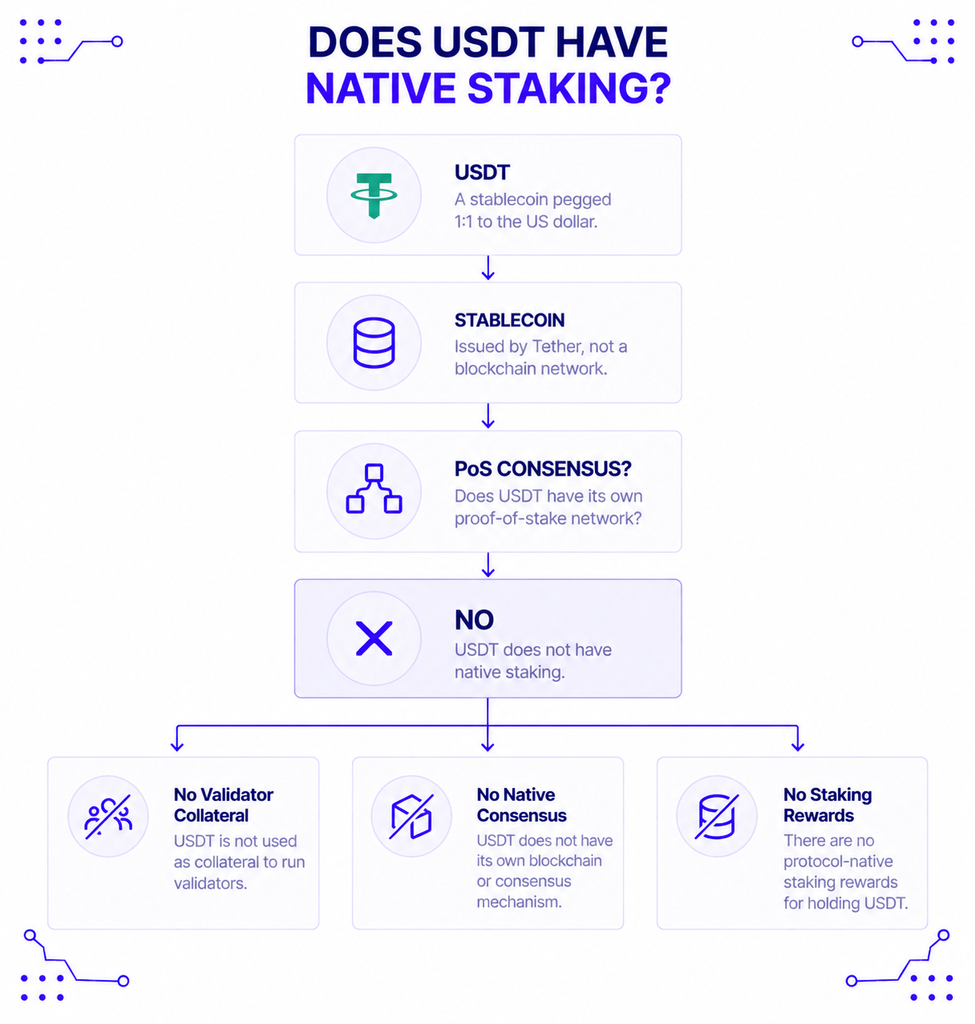
Staking, in the strict sense, is locking a coin into a proof-of-stake blockchain so a validator can use it as collateral while confirming blocks. USDT has no such mechanism — it’s a stablecoin issued by Tether and pegged 1:1 to the US dollar, not a network with its own consensus layer to secure.
So when a platform advertises “USDT staking,” it’s using the word loosely to describe one of two things: depositing USDT into a lending pool where borrowers pay interest, or handing it to an exchange that redeploys it (often into the same lending markets) and pays you a cut. Both can be worthwhile. Neither is staking in the technical sense that applies to Ethereum or Polkadot.
USDT itself isn’t tied to one chain, either — Tether currently issues it across more than a dozen networks, including Ethereum, Tron, Solana, and Polygon, per CoinMarketCap’s asset page. Which network your USDT sits on ends up mattering a lot once you start moving it between wallets and platforms, which this guide comes back to below.
Can You Stake USDT? Why Tether Doesn’t Pay Interest Directly
You can earn yield on USDT, but Tether the company won’t pay it to you directly — and that’s not an oversight. Under Section 4(a)(11) of the US GENIUS Act, signed into law in 2025, a payment stablecoin issuer is barred from paying holders “any form of interest or yield… solely in connection with the holding, use, or retention” of the token, per the statutory text summarized by Columbia’s CLS Blue Sky Blog.
Tether’s own CEO has been direct about sitting this fight out. Asked about the ongoing US debate over whether stablecoin issuers should be allowed to share yield, Paolo Ardoino said:
“We don’t take a position on the matter. Tether doesn’t share yield. So we don’t have much beef in this fight.” — Paolo Ardoino, Tether CEO, via The Block
That’s why every USDT yield product you’ll find is run by a third party — an exchange, a lending protocol, or a credit platform — not Tether itself. Those platforms aren’t restricted the same way, which is exactly the gap CeFi and DeFi earn products fill.
Who Actually Stakes USDT?
The appeal of a dollar-pegged asset that also earns something draws a fairly specific mix of users, each optimizing for a different trade-off.
- Traders parking idle capital between positions, who want yield on cash sitting in an exchange wallet rather than earning nothing while they wait for the next trade.
- DeFi users supplying USDT to lending markets like Aave or Spark to earn interest paid by borrowers, often as one leg of a larger yield strategy.
- International users in regions with limited access to dollar-denominated savings accounts, for whom USDT yield products function as an approximation of a dollar deposit account.
- Builders and platforms — wallets, payment apps, and treasury tools — that need to read USDT balances and broadcast transfers reliably across whichever chain their users hold it on.
That last group runs into an infrastructure question that has nothing to do with yield: reading accurate, real-time USDT balances across Ethereum, Tron, and other networks means running full nodes for each one, or connecting through a provider such as NOWNodes, which offers API access to shared and dedicated nodes across 120-plus blockchain networks.
How to Earn Yield on USDT: CeFi vs. DeFi
Every USDT “staking” option falls into one of two categories, and the category matters more than the specific platform you pick within it.
| Factor | Centralized exchange (CeFi) | DeFi lending protocol |
|---|---|---|
| Who holds the funds | The exchange | A smart contract (non-custodial) |
| Typical APY | ~1–6% flexible; up to ~11% fixed-term or tiered | ~1.4–4.6% variable, set by utilization |
| Main risk | Platform solvency and custody | Smart contract bugs, protocol insolvency |
| Liquidity | Instant on flexible products | Instant, minus gas or network fees |
| Example platforms | Binance, Nexo, Kraken | Aave, Spark, Maple |
CeFi is simpler: deposit USDT, opt into an earn or savings product, and the rate is fixed by the platform rather than market demand. DeFi is non-custodial — your USDT stays in a smart contract you can verify, and the rate moves with how much of the pool is currently borrowed. Our guide to the best staking platforms breaks down the same custodial-vs-non-custodial trade-off for proof-of-stake coins, if you’re comparing USDT yield against actual staking elsewhere in your portfolio.
How to Stake USDT on an Exchange, Step by Step
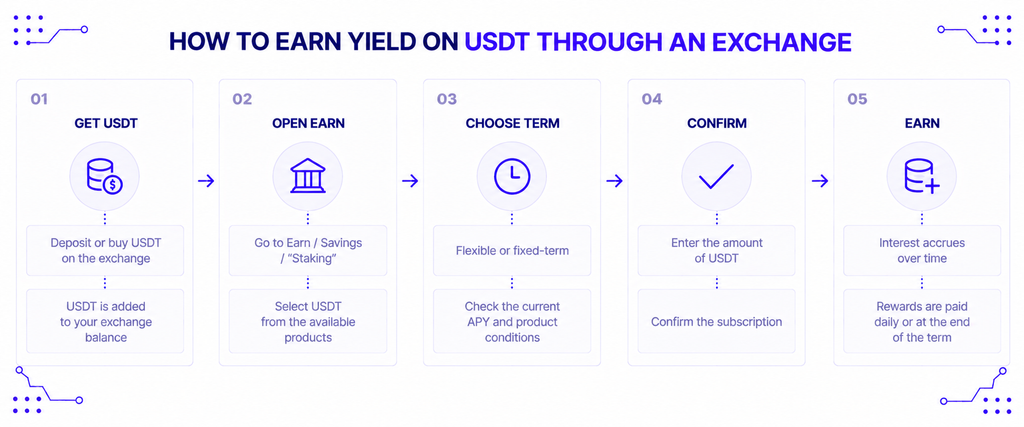
- Deposit USDT into your exchange account, or buy it directly on the platform.
- Open the earn, savings, or “staking” section and search for USDT.
- Choose flexible or fixed-term. Flexible keeps your USDT withdrawable at any time; fixed-term locks it for a set period in exchange for a higher rate.
- Confirm the amount. Most exchanges have no meaningful minimum for USDT earn products.
- Let interest accrue. Rewards are typically paid daily or at the term’s end, minus whatever cut the platform takes.
Binance currently advertises up to 6% APR on USDT flexible products, while Nexo lists rates up to roughly 11.5% depending on loyalty tier and whether you choose flexible or fixed-term savings, per each platform’s own published terms. Always check the live rate on the platform directly — these numbers move with market conditions and account tier.
How to Earn USDT Yield in DeFi, Step by Step
- Connect a self-custodial wallet, such as MetaMask, to the protocol’s app.
- Select the USDT market on your chosen network — Aave and Spark run primarily on Ethereum; JustLend operates on Tron.
- Supply USDT to the lending pool. You’ll receive an interest-bearing receipt token representing your deposit.
- Monitor the rate, since DeFi APYs float with utilization and can change hour to hour.
- Withdraw at any time, subject to available liquidity in the pool and the network’s transaction fee.
Spark’s USDT pool currently holds roughly $1.24 billion in deposits at about 2.5% APY, Maple Finance pays close to 4.33% through underwritten institutional credit, Aave’s Ethereum USDT market runs near 2.7–3.4%, and JustLend on Tron trails near 1.35%, per Staking Rewards’ tracked lending rates. Maple’s higher rate reflects real credit risk — you’re trusting the platform’s underwriting, not just a pooled smart contract.
Which Network Should You Use: TRC-20, ERC-20, or Another Chain?
USDT on Tron (TRC-20) and USDT on Ethereum (ERC-20) are the two most common versions, and the choice affects your transaction costs more than your yield. A TRC-20 transfer typically costs a small fraction of a dollar in network fees, while an ERC-20 transfer’s gas cost fluctuates with Ethereum congestion and can run several dollars or more during busy periods.
That’s why high-volume traders and exchanges often default to Tron for moving USDT, reserving Ethereum for DeFi positions that need access to Aave, Spark, or other Ethereum-native protocols. Sending USDT to the wrong network version — TRC-20 funds to an ERC-20 deposit address, for instance — is one of the most common and often unrecoverable mistakes in crypto. Always match the network selected in your wallet to the network your destination platform expects.
Wallets, exchanges, and yield trackers that show your USDT balance across several of these chains at once face the same underlying problem: each network needs its own reliable node connection to report accurate balances and confirm transfers. That’s the kind of multi-chain access NOWNodes’ Tron endpoints and Ethereum endpoints provide through a single API, rather than a team running separate node infrastructure for every network USDT happens to exist on.
How Much Can You Earn Staking USDT?
The honest answer is: less than the highest number you’ll see advertised, once you account for tier requirements and platform cuts. Flexible, no-strings products on major exchanges and blue-chip DeFi pools currently sit in the 1.4–4.6% APY range, while headline rates above 10% usually require holding a platform’s native token, locking funds for a fixed term, or accepting a smaller, less established protocol.
This is critical: a higher advertised APY on USDT almost always means more counterparty risk, more liquidity risk, or both. A dollar-pegged asset with no protocol issuance behind it has a real yield ceiling, so before sizing your USDT stake around a headline number, check exactly where that extra yield is coming from.
What Are the Risks of Staking USDT?
Counterparty and platform risk
CeFi earn products depend entirely on the exchange staying solvent and honoring withdrawals. Celsius Network’s 2022 collapse froze billions in user deposits, including stablecoin balances, and remains the clearest example of what happens when a custodial yield platform runs into trouble, as CNBC’s coverage of the bankruptcy documented at the time.
Smart contract risk in DeFi
Non-custodial doesn’t mean risk-free. A bug in a lending protocol’s code, or an exploit of its price oracle, can drain a pool regardless of how the interest rate looked on paper. Stick to audited, long-running protocols with significant total value locked rather than a newer pool advertising an unusually high rate.
USDT’s own reserve and peg risk
Your yield is only as good as the dollar it’s denominated in. Tether reported $191.77 billion in total assets against $183.54 billion in liabilities for Q1 2026 — an $8.23 billion excess reserve buffer, an all-time high, backed heavily by roughly $141 billion in US Treasuries, according to Tether’s own Q1 2026 attestation. That buffer is reassuring, but Tether’s reserves are attested quarterly rather than continuously audited, so it’s worth checking the current report rather than trusting a figure from months ago.
Regulatory uncertainty around “yield” itself
The GENIUS Act’s ban on issuers paying interest hasn’t stopped third-party yield — it’s just pushed it into rewards programs and lending arrangements whose legal footing is still being tested, per CLS Blue Sky Blog’s analysis. A platform’s current yield structure could look different in a year if regulators close that gap.
Conclusion
There’s no such thing as native USDT staking, and understanding that upfront saves you from comparing the wrong things. What you’re actually choosing between is a CeFi earn product that trades convenience for custodial risk, or a DeFi lending pool that trades some convenience for smart contract exposure — both paying real yield sourced from borrowers or a platform’s own book, not from Tether.
The number that should drive your decision isn’t the headline APY. It’s the platform’s track record, whether the rate requires a lock-up or a native token you don’t otherwise want, and which network your USDT sits on before you move it anywhere. Check the current rate directly on whichever platform you’re considering, and never assume last quarter’s number still applies.
FAQ
Is staking USDT the same as staking Ethereum or Solana?
No. Ethereum and Solana staking secures a proof-of-stake network and pays a protocol-level reward. USDT yield comes from a third-party lending pool or exchange product, not from any consensus mechanism, since Tether doesn’t run a blockchain of its own.
Does Tether pay staking rewards directly?
No. The GENIUS Act specifically bars US payment stablecoin issuers from paying holders interest or yield for simply holding the token, which is why every USDT yield product comes from an exchange or a lending protocol instead.
Is USDT yield guaranteed?
No. CeFi rates are set by the platform and can change at any time, while DeFi rates float with pool utilization. Neither is a fixed, contractually guaranteed return, and both carry the platform or protocol risk described above.
Can I lose my USDT by depositing it for yield?
Yes. A CeFi platform going insolvent, a DeFi protocol getting exploited, or — in a severe scenario — a problem with Tether’s own reserves could all result in losses. The advertised APY doesn’t include this risk in its headline number.
Which is safer: TRC-20 or ERC-20 USDT for earning yield?
Neither network is inherently safer for yield purposes — the platform you deposit into matters far more than the chain. TRC-20 is generally cheaper to move, while ERC-20 gives direct access to a wider range of established Ethereum DeFi protocols.